
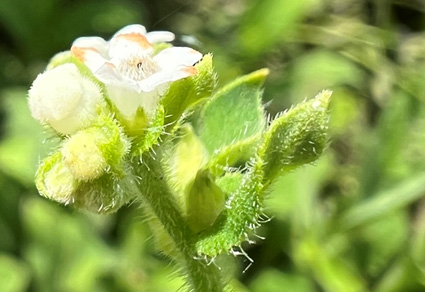

Abstract
Thaumatocaryon is a small genus of South American Boraginaceae with only three accepted names. This genus, along with Moritzia, comprises a monophyletic lineage called Moritziinae. During a review of herbarium specimens, we found morphological divergences that led us to conclude that Thaumatocaryon is more complex than previously known. According to the morphologic analysis, we recognize nine species, resulting from the revalidation of T. hilarii and the description of five new species. The species are differentiated by characteristics such as phyllotaxy, indumentum, as well as the length and color of the corolla, the morphology of stems and basal leaves, and the arrangement of flowering stems. We present a detailed description of each species, updating the four previously described species, field photographs (when available), exsiccate plates, distribution maps, and a key for all species of the genus.
References
- Al-Shehbaz, I.A. (1991) The genera of Boraginaceae in the southeastern United States. Journal of the Arnold Arboretum 1: 1–169. https://doi.org/10.5962/p.315943
- ALESC – Assembleia Legislativa do Estado de Santa Catarina. (2009) Lei n° 14.675, de 13 de abril de 2009. Institui o Código Estadual do Meio Ambiente. Available from: https://leis.alesc.sc.gov.br/html/2009/14675_2009_Lei.html (accessed 28 July 2026)
- Andrade, B.O., Boldrini, I.I., Trevisan, R., Zanin, A., Ferreira, P.M.A., Setubal, R.B. & Overbeck, G.E. (2016) Campos Sulinos: conservation status of the Brazilian subtropical grasslands. Oecologia Australis 20 (4): 289–302.
- APG, The Angiosperm Phylogeny Group, Chase, M.W., Christenhusz, M.J.M., Fay, M.F., Byng, J.W., Judd, W.S., Soltis, D.E., Mabberley, D.J., Sennikov, A.N., Soltis, P.S. & Stevens, P.F. (2016) An update of the Angiosperm Phylogeny Group classification for the orders and families of flowering plants: APG IV. Botanical Journal of the Linnean Society 181 (1): 1–20. https://doi.org/10.1111/boj.12385
- Ariza-Espinar, L. (2006) 252. Boraginaceae. In: Ariza-Espinar, L., Calviño, A., Di Fulvio, E.T. & Dottori, N. (Eds.) Flora Fanerogámica Argentina. CONICET, Buenos Aires, pp. 3–55.
- Assis, M.A. & Mattos, E.A. (2017) Campos de Altitude: vulnerability to climate change and conservation challenges. Oecologia Australis 21 (1): 1–14.
- Avise, J.C. (2000) Phylogeography: The History and Formation of Species. Harvard University Press, Cambridge, 447 pp.
- Bachman, S., Moat, J., Hill, A.W., de la Torre, J. & Scott, B. (2011) Supporting Red List threat assessments with GeoCAT: Geospatial conservation assessment tool. ZooKeys 150: 117–126. https://doi.org/10.3897/zookeys.150.2109
- Baillon, H.E. (1890) Bulletin Mensuel de la Société Linnéenne de Paris 405: 833–840.
- Bauermann, S.G. & Behling, H. (2009) Dinâmica paleovegetacional da Floresta com Araucária a partir do final do Pleistoceno: o que mostra a palinologia. In: Ramos-Costa, A.M.M., Fonseca, C. & Souza, A. (Eds.) Floresta com Araucária - Ecologia, Conservação e Desenvolvimento Sustentável. Holos Editora, Ribeirão Preto, pp. 35–38.
- Bebber, D.P., Carine, M.A., Wood, J.R.I., Wortley, A.H., Harris, D.J., Prance, G.T., Davidse, G., Paige, J., Pennington, T.D., Robson, N.K.B. & Scotland, R.W. (2010) Herbaria are a major frontier for species discovery. Proceedings of the National Academy of Sciences of the United States of America 107: 22169–22171. https://doi.org/10.1073/pnas.1011841108
- Bentham, G. & Hooker, J.D. (1876) Genera plantarum, vol. 2 (2). Reeve.
- Bickford, D., Lohman, D.J., Sodhi, N.S., Ng, P.K.L., Meier, R., Winker, K., Ingram, K.K. & Das, I. (2007) Cryptic species as a window on diversity and conservation. Trends in Ecology & Evolution 22: 148–155. https://doi.org/10.1016/j.tree.2006.11.004
- Brako, L. & Zarucchi, J.L. (1993) Catalogue of the flowering plants and gymnosperms of Peru. Monographs in Systematic Botany from the Missouri Botanical Garden 45. Missouri Botanical Garden Press.
- Brand, A. (1929) Verweisung des Gattungsnamens Antiphytum in die Synonymie. Feddes Repertorium Specierum Novarum 27: 145–149. https://doi.org/10.1002/fedr.4870270905
- Candolle, A. de (1845) Prodromus systematis naturalis regni vegetabilis, vol. 9. Fortin, Paris. http://dx.doi.org/10.5962/bhl.title.286
- De Candolle, A.P. (1846) Borragineae. In: Prodromus systematis universalis regni vegetabilis 10: 1–178.
- Cechinel, J.P. (2023) O papel do manejo tradicional com fogo e pastagem na conservação da biodiversidade nos Campos de Altitude do Planalto Catarinense. Dissertação de Mestrado, Universidade Federal de Santa Catarina (UFSC).
- Chacón, J., Luebert, F., Hilger, H.H., Ovchinnikova, S., Selvi, F., Cecchi, L., Guilliams, C.M., Hasenstab-Lehman, K., Sutorý, K., Simpson, M.G. & Weigend, M. (2016) The borage family (Boraginaceae s.str.): A revised infrafamilial classification based on new phylogenetic evidence, with emphasis on the placement of some enigmatic genera. Taxon 65 (3): 523–546. https://doi.org/10.12705/653.6
- Chacón, J., Luebert, F. & Weigend, M. (2017) Biogeographic events are not correlated with diaspore dispersal modes in Boraginaceae. Frontiers in Ecology and Evolution 5: 26. https://doi.org/10.3389/fevo.2017.00026
- Chadefaud, M. & Emberger, L. (1960) Traité de botanique systématique. Masson, Paris.
- Chamisso, L.K.A. von (1833) Spicilegium plantarum e familiis jam prius recensitis, praesertim Brasiliensium serius a Sellowio. Asperifoliae. Linnaea 8: 113–130.
- Chamisso, L.K.A. (1829) Boragineae. Linnaea 4: 435–496.
- Cohen, J.I. (2025) Phylogenomics Of Boraginaceae and Boraginales Using Lineage-Specific and Angiosperms353 Loci. Systematic Botany 49 (4): 749–767. https://doi.org/10.1600/036364424X17323182682762
- Cordeiro, N.J. & Howe, H.F. (2003) Forest fragmentation severs mutualism between seed dispersers and an endemic African tree. Proceedings of the National Academy of Sciences of the United States of America 100 (24): 14052–14056. https://doi.org/10.1073/pnas.2331023100
- Cronquist, A. (1981) An integrated system of classification of flowering plants. Columbia University Press, New York.
- Cronquist, A. (1988) The evolution and classification of flowering plants. New York Botanical Garden.
- de Queiroz, K. (2007) Species concepts and species delimitation. Systematic Biology 56: 879–886. https://doi.org/10.1080/10635150701701083
- Engler, A. (1898) Syllabus der Pflanzenfamilien, 2nd ed. Gebrüder Borntraeger, Berlin. [https://archive.org/details/syllabusderpfla00englgoog]
- Fernandes-Soares, Z. (1973) Nota sobre as Boraginaceas da regiao de Porto Alegre e arredores. Iheringia, Botanica 17: 28–33.
- Ferreira, T.deS., Tetto, A.F., Kovalsyki, B., Santos, J.F.L.dos, Marcon, A.K. & Batista, A.C. (2025) Diversidade, estrutura e ecologia de uma comunidade arbóreo-arbustiva estabelecida em um ecótono campo-floresta excluído do fogo no sul do Brasil. Ciência Florestal 35: e68951. https://doi.org/10.5902/1980509868951
- Ferrer-Paris, J.R., Zager, I., Keith, D.A., Oliveira-Miranda, M.A., Rodríguez, J.P., Josse, C., González-Gil, M., Miller, R.M., Zambrana-Torrelio, C. & Barrow, E. (2019) An ecosystem risk assessment of temperate and tropical forests of the Americas with an outlook on future conservation strategies. Conservation Letters 12 (2): e12623. https://doi.org/10.1111/conl.12623
- Fontúrbel, F.E., Candia, A.B., Malebrán, J., Salazar, D.A., González-Browne, C. & Medel, R. (2015) Meta-analysis of anthropogenic habitat disturbance effects on animal-mediated seed dispersal. Global Change Biology 21 (11): 3951–3960. https://doi.org/10.1111/gcb.13025
- Fresenius, G. (1857) Boraginaceae. In: Martius, C.F.P. von (Ed.) Flora brasiliensis, vol. 8 (1). Frid. Fleischer, Leipzig & München, pp. 1–84.
- Fundação SOS Mata Atlântica & INPE. (2023) Atlas dos remanescentes florestais da Mata Atlântica: Período 2021–2022. SOS Mata Atlântica, São Paulo. Available from: https://www.sosma.org.br (accessed 7 July 2025)
- Gentry, J.L. (1972) Moritzia DC. (Boraginaceae): a genus new to North America. Fieldiana, Botany 36: 13–16. https://doi.org/10.5962/bhl.title.955
- Gottschling, M., Hilger, H.H., Wolf, M. & Diane, N. (2001) Secondary structure of the ITS1 transcript and its application in a reconstruction of the phylogeny of Boraginales. Plant Biology (Stuttgart) 3: 629–636. https://doi.org/10.1055/s-2001-19371
- Grasel, D., Fearnside, P.M. & Vitule, J.R.S. (2019) Brazilian wetlands on the brink. Biodiversity and Conservation 28 (9): 2343–2348. https://doi.org/10.1007/s10531-018-1666-z
- Grise, M.M., Biondi, D. & Araki, H. (2016) Urban Forest Landscape of Curitiba-PR. REVSBAU 11 (3): 37–55.
- Gürke, M. (1893) Borraginaceae (Asperifoliaceae). In: Engler, A. (Ed.) Die natürlichen Pflanzenfamilien, vol. IV(3a). Engelmann.
- Hammouda, S.A., Weigend, M., Mebrouk, F., Chacón, J., Bensalah, M., Ensikat, H.J. & Adaci, M. (2015) Fossil nutlets of Boraginaceae from the continental Eocene of Hamada of Méridja (southwestern Algeria): The first fossil of the Borage family in Africa. American Journal of Botany 102 (12): 2108–2115. https://doi.org/10.3732/ajb.1500350
- Hilger, H.H., Cole, T.C.H. & Selvi, F. (2020) Boraginacea phylogeny poster. Available from: https://boraginales.myspecies.info/sites/boraginales.myspecies.info/files/BoraginaceaePP-2020-E-V2.pdf
- Humphreys, A.M., Govaerts, R., Ficinski, S.Z., Lughadha, E.N. & Vorontsova, M.S. (2019) Global dataset shows geography and life form predict extinction risk in plants. Nature Ecology & Evolution 3: 1043–1047. https://doi.org/10.1038/s41559-019-0906-2
- IBGE. (2012) Manual Técnico da Vegetação Brasileira. Instituto Brasileiro de Geografia e Estatística (IBGE), Rio de Janeiro.
- Iganci, J.R.V., Heiden, G., Miotto, S.T.S. & Ferreira, P.P.A. (2011) Campeiros e campos naturais: floristic and phytogeographic patterns in southern Brazilian grasslands. Botanical Journal of the Linnean Society 167 (3): 378–406. https://doi.org/10.1111/j.1095-8339.2011.01182.x
- IUCN [International Union for Conservation of Nature]. (2012) IUCN Red List Categories and Criteria. Version 3.1, 2nd ed. IUCN, 32 pp.
- IUCN [International Union for Conservation of Nature]. (2019) Guidelines for Using the IUCN Red List Categories and Criteria. Version 14. IUCN, 113 pp.
- IUCN [International Union for Conservation of Nature]. (2020) Red List of Ecosystems. Available from: https://assessments.iucnrle.org/ (accessed 7 July 2025)
- Johnston, I.M. (1927) Studies in the Boraginaceae.—VI. A revision of the South American Boraginoideae. Contributions from the Gray Herbarium of Harvard University 78: 3–118. https://doi.org/10.5962/p.336094
- Johnston, I.M. (1924) Studies in the Boraginaceae,—II. Contributions from the Gray Herbarium of Harvard University 70: 3–61. https://doi.org/10.5962/p.336074
- Jørgensen, P.M. & León-Yánez, S. (eds.) (1999) Catalogue of the vascular plants of Ecuador. Monographs in Systematic Botany from the Missouri Botanical Garden 75. Missouri Botanical Garden Press.
- Keller, H.A. (2007) Sobre la presencia en la Argentina de Lobelia reniformis (Campanulaceae) y Thaumatocaryon dasyanthum (Boraginaceae). Bonplandia 16: 265–269. https://doi.org/10.30972/bon.163-4162
- Kersten, R.A., Borgo, M. & Galvão, F. (2015) Floresta Ombrófila Mista: aspectos fitogeográficos, ecológicos e métodos de estudo. In: Eisenlohr, P.V. et al. (Eds.) Fitossociologia no Brasil: Métodos e Estudos de Casos - Volume II. Editora UFV, Viçosa, pp. 156–182.
- Kulkamp, J. (2015) Diversidade de plantas endêmicas nos Campos de Altitude de Santa Catarina. Trabalho de Conclusão de Curso, Universidade Federal de Santa Catarina (UFSC).
- León, C.A., Gabriel, M., Rodríguez, C., Iturraspe, R.J., Savoretti, M.A., Pancotto, V.A., Benítez Mora, A., Valdés, A., Díaz, M.F., Oberpaur, C., Domínguez, E., Fernández, L.D., Mackenzie, R., Roland, T., Mauquoy, D. & Silva, C. (2021) Peatlands of Southern South America: A review. Mires and Peat 27 (3): 1–29. https://doi.org/10.19189/MaP.2020.SNPG.StA.2021
- Linnæus, C. (1753) Species Plantarum. L. Salvius, Stockholm, 560 pp.
- Luebert, F., Cecchi, L., Frohlich, M.W., Gottschling, M., Guilliams, C.M., Hilger, H.H., Hasenstab-Lehman, K.E., Miller, J.S., Mittelbach, M., Nazaire, M., Nepi, M., Nocentini, D., Ober, D., Olmstead, R.G., Selvi, F., Simpson, M.G., Sutorý, K., Valdés, B., Walden, G.K. & Weigend, M. [= Boraginales Working Group]. (2016) Familial classification of the Boraginales. Taxon 65: 502–522. https://doi.org/10.12705/653.5
- MapBiomas / Projeto MapBiomas. (2023) Mapeamento anual de cobertura e uso da terra no Brasil entre 1985 a 2022 – Coleção 8. Available from: https://mapbiomas.org/download-dos-atbds (accessed 7 July 2025)
- Markl, J.S., Schleuning, M., Forget, P.M., Jordano, P., Lambert, J.E., Traveset, A., Wright, S.J. & Böhning-Gaese, K. (2012) Meta-Analysis of the Effects of Human Disturbance on Seed Dispersal by Animals. Conservation Biology 26: 1072–1081. https://doi.org/10.1111/j.1523-1739.2012.01927.x
- Mayr, E. (1942) Systematics and the Origin of Species. Columbia University Press, New York, 334 pp.
- Medikus, F.K. (1789) Pflanzen-Gattungen nach ihren natürlichen Verwandtschaften. C. F. Schwan, Mannheim, viii + 94 pp.
- Meisner, C.F. (1840) Plantarum vascularum genera secundum ordines naturales digesta eorumque differentiae et affinitates tabulis diagnosticis expositae. Libraria Weidmannia, Leipzig, 300 pp.
- Melcher, I.M., Bouman, F. & Cleef, A.M. (2000) Seed dispersal in páramo plants: epizoochorous and hydrochorous taxa. Plant Biology 2: 40–52. https://doi.org/10.1055/s-2000-9146
- Melchior, H. (1964) Boraginaceae. In: Melchior, H. (Ed.) A. Engler’s Syllabus der Pflanzenfamilien, vol. 2. Gebrüder Borntraeger, Berlin.
- Melo, J.I.M., Stapf, M.N.S., Silva, T.S., Cavalheiro, L., Costa, F.C.P., Cardoso, P.H., Picanço, W.L. & Cabral, A. (2020) Boraginaceae in Flora do Brasil 2020. Jardim Botânico do Rio de Janeiro. Available from: http://floradobrasil.jbrj.gov.br/reflora/floradobrasil/FB64 (accessed 21 October 2025)
- Myers, N., Mittermeier, R.A., Mittermeier, C.G., da Fonseca, G.A.B. & Kent, J. (2000) Biodiversity hotspots for conservation priorities. Nature 403: 853–858. https://doi.org/10.1038/35002501
- Nic Lughadha, E., Bachman, S.P., Govaerts, R., Scott, B., Rivers, M.C. & Nic Lughadha, E.M. (2020) Extinction risk and threats to plants and fungi. Plants, People, Planet 2: 389–408. https://doi.org/10.1002/ppp3.10146
- Pilger, R. & Krause, K. (1915) Die natürlichen Pflanzenfamilien, Ergänzungsh. 3. Engelmann.
- Pinheiro, F., Dantas-Queiroz, M.V. & Palma-Silva, C. (2018) Plant species complexes as models to understand speciation and evolution: a review of South American studies. Critical Reviews in Plant Sciences 37 (1): 54–80. https://doi.org/10.1080/07352689.2018.1471565
- Quantum GIS Development Team. (2021) Quantum GIS Geographic Information System. Open Source Geospatial Foundation Project. Program and manual available from: http://qgis.osgeo.org/ (accessed 17 March 2023)
- Ribeiro, S.P.N. (2022) Transformações de uso, cobertura e fragmentação da Floresta Ombrófila Mista. PhD thesis, Universidade Federal de Santa Catarina. [https://repositorio.ufsc.br/handle/123456789/242585]
- Ribeiro, M.C., Metzger, J.P., Martensen, A.C., Ponzoni, F.J. & Hirota, M.M. (2009) The Brazilian Atlantic Forest: How much is left, and how is the remaining forest distributed? Biological Conservation 142 (6): 1141–1153. https://doi.org/10.1016/j.biocon.2009.02.021
- Riedl, H. (1993) Three small genera of Boraginaceae-Boraginoideae revisited. Linzer Biologische Beiträge 25 (1): 81–88.
- Riedl, H. (1997) Boraginaceae. In: Kalkman, C., Kirkup, D.W., Nooteboom, H.P., Stevens, P.F. & de Wilde, W.J.J.O. (Eds.) Flora Malesiana, Series I – Seed Plants. Rijksherbarium/Hortus Botanicus, Leiden, pp. 43–144.
- Rieseberg, L.H. & Willis, J.H. (2007) Plant speciation. Science 317: 910–914. https://doi.org/10.1126/science.1137729
- Scarano, F.R., Sampaio, A.B. & Lacerda, L.D. (2016) Campos de Altitude: biodiversity, threats and perspectives. Oecologia Australis 20 (4): 223–225.
- Schaadt, S.S. & Vibrans, A.C. (2015) O uso da terra no entorno de fragmentos florestais influencia a sua composição e estrutura. Floresta e Ambiente 22 (4): 437–445. [Disponível em: https://www.scielo.br/j/floram/a/zhgZJN6mXnLgRqmMTfNQ9Mf/] https://doi.org/10.1590/2179-8087.062813
- Schlaepfer, D.R., Braschler, B., Husterholz, H.-P. & Baur, B. (2018) Genetic effects of anthropogenic habitat fragmentation on wildlife. Ecological Applications 28 (4): 1057–1070. https://doi.org/10.1002/ecs2.2488
- Schluter, D. (2000) The Ecology of Adaptive Radiation. Oxford University Press, Oxford, 288 pp.
- Selvi, F. & Bigazzi, M. (2001) Leaf surface and anatomy in Boraginaceae tribe Boragineae with respect to ecology and taxonomy. Flora 196 (4): 269–285. https://doi.org/10.1016/S0367-2530(17)30056-7
- Smith, L.B. (1970) Boragináceas. In: Reitz, R. (Ed.) Flora Ilustrada Catarinense. Herbário Barbosa Rodrigues, Itajaí, pp. 85.
- Souza, F.M., Fernandes, F.A., Teixeira, A.M.G., Ribeiro, J.F. & Overbeck, G.E. (2022) Past and future of subtropical grasslands: historical loss, remaining areas and potential restoration opportunities in the Brazilian Pampa. Anais da Academia Brasileira de Ciências 94 (1): e20201139.
- Steven, C. (1851) Observationes in Asperifolias Taurico-Caucasicas. Bulletin de la Société Impériale des Naturalistes de Moscou 24 (1): 557–589.
- Sühs, R.B., Campestrini, F.M., Vibrans, A.C., Peroni, N. & Pillar, V.D. (2020) Traditional management promotes biodiversity conservation in Brazilian subtropical highland grasslands. Scientific Reports 10: 16691. https://doi.org/10.1038/s41598-020-73628-9
- Takhtajan, A.L. (1980) Outline of the classification of flowering plants (Magnoliophyta). Botanical Review 46: 225–359. https://doi.org/10.1007/bf02861558
- Takhtajan, A.L. (1997) Diversity and classification of flowering plants. Columbia University Press, New York.
- Tausch, I.F. (1829) Flora oder Botanische Zeitung. Verlag der Flora, Regensburg, 12: 641–656.
- Thiers, B. (2023+) Index Herbariorum: a global directory of public herbaria and associated staff. New York Botanical Garden’s Virtual Herbarium. Available from: http://sweetgum.nybg.org/science/ih (accessed 17 March 2023)
- Thomasson, J.R. (1979) Late Cenozoic grasses and other angiosperms from Kansas, Nebraska, and Colorado: Biostratigraphy and relationships to living taxa. Kansas Geological Survey Bulletin 128: 1–68. https://doi.org/10.31274/rtd-180816-486
- Thorne, R.F. (1992) Classification and geography of the flowering plants. Botanical Review 58: 225–327. http://dx.doi.org/10.1007/BF02858611
- Yu, W., Wu, B., Wang, X., Yao, Z., Li, Y. & Liu, Y. (2020) Scale-dependent effects of habitat fragmentation on the genetic diversity of Actinidia chinensis populations in China. Horticulture Research 7: 172. https://doi.org/10.1038/s41438-020-00401-1
- Weigend, M.A., Luebert, F., Gottschling, M., Couvreur, T.L.P. & Hilger, H.H. (2014) From capsules to nutlets—phylogenetic relationships in the Boraginales. Cladistics 30: 508–518. https://doi.org/10.1111/cla.12061
- Weigend, M., Luebert, F., Selvi, F., Brokamp, G. & Hilger, H.H. (2013) Multiple origins for Hound’s tongues (Cynoglossum L.) and Navel seeds (Omphalodes Mill.) –The phylogeny of the borage family (Boraginaceae s. str.). Molecular Phylogenetics and Evolution 68: 604–618. https://doi.org/10.1016/j.ympev.2013.04.004
- Weigend, M., Gottschling, M., Selvi, F. & Hilger, H.H. (2010) Fossil and extant Western Hemisphere Boragineae, and the polyphyly of “Trigonotideae” Riedl (Boraginaceae: Boraginoideae). Systematic Botany 35: 409–419. https://doi.org/10.1600/036364410791638423
- Wiens, J.J. (2007) Species delimitation: New approaches for discovering diversity. Systematic Biology 56: 875–878. https://doi.org/10.1080/10635150701748506