

Abstract
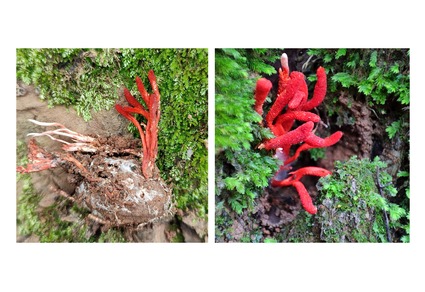
The genus Cordyceps comprises a diverse group of entomopathogenic fungi with significant ecological and biotechnological importance. However, there are several taxa which have been poorly documented across a large area of the Indian subcontinent. In the present study, we provide an integrative taxonomic account of a Cordyceps sp. from central India, by combining the macromorphology, micromorphology, culture characteristics, and multi-locus phylogenetic analysis. Fresh specimens were characterized by erect, slender, orange to scarlet-red stromata that were emerging from a buried insect host, and had immersed to semi-immersed perithecia. Micromorphological observations revealed that it has an ovoid to ellipsoid perithecia, elongated asci containing filiform, multiseptate ascospores that disarticulate into part-spores. An isaria-like asexual morph was observed in culture with phialidic conidiogenesis. Phylogenetic analyses based on combined ITS, LSU, TEF1-α, and RPB1 sequence data placed this Indian material within the Cordyceps pruinosa species complex, showing closest affinity to C. neopruinosa. The absence of stable diagnostic morphological differences separating it from closely related taxa and its phylogenetic placement support the treatment of the Indian material as Cordyceps cf. neopruinosa. This study represents the first comprehensive integrative documentation of a member of the C. pruinosa species complex from central India and provides a valuable reference for future taxonomic, ecological, and applied studies on cordycipitaceous fungi in the region.
References
- Ao, T., Deb, C.R. & Rao, S.R. (2020) Molecular strategies for identification and characterization of some wild edible mushrooms of Nagaland, India. Molecular Biology Reports 47: 621–630. https://doi.org/10.1007/s11033-019-05170-2
- Appiah, T., Agyare, C. & Luo, Y. (2017) Molecular identification of some Ghanaian mushrooms using internal transcribed spacer regions. Molecular Biology 6: 1–5. https://doi.org/10.4172/2168-9547.1000191
- Atri, N.S., Sharma, Y.P., Kumar, S. & Mridu (2019) Wild edible mushrooms of North West Himalaya: their nutritional, nutraceutical, and sociobiological aspects. In: Microbial diversity in ecosystem sustainability and biotechnological applications. Springer, pp. 533–563. https://doi.org/10.1007/978-981-13-8487-5_20
- Dong, Q.Y., Wang, Y., Wang, Z.Q., Tang, D.X., Zhao, Z.Y., Wu, H.J. & Yu, H. (2022) Morphology and phylogeny reveal five novel species in the genus Cordyceps (Cordycipitaceae, Hypocreales) from Yunnan, China. Frontiers in Microbiology 13: 846909. https://doi.org/10.3389/fmicb.2022.846909
- Kepler, R.M., Luangsa-ard, J.J., Hywel-Jones, N.L., Quandt, C.A., Sung, G.H., Rehner, S.A. & Shrestha, B. (2017) A phylogenetically based nomenclature for Cordycipitaceae (Hypocreales). IMA Fungus 8: 335–353. https://doi.org/10.5598/imafungus.2017.08.02.08
- Lakhanpal, T.N. (2014) Mushroom biodiversity in India: prospects and potential. In: Proceedings of the 8th International Conference on Mushroom Biology and Mushroom Products (ICMBMP8). pp. 7–16.
- Mongkolsamrit, S., Noisripoom, W., Tasanathai, K., Khonsanit, A., Thanakitpipattana, D., Himaman, W. & Luangsa-ard, J.J. (2020) Molecular phylogeny and morphology reveal cryptic species in Blackwellomyces and Cordyceps (Cordycipitaceae) from Thailand. Mycological Progress 19: 957–983. https://doi.org/10.1007/s11557-020-01615-2
- Pegler, D.N. (1997) The agarics of São Paulo: an account of the agaricoid fungi (Holobasidiomycetes) of São Paulo State, Brazil. Royal Botanic Gardens, Kew.
- Sai, I., Basavaraju, R., Thakur, M. & Lakhanpal, T.N. (2023) Health benefits of mushrooms: an appraisal. In: Fungal resources for sustainable economy: current status and future perspectives. Springer, pp. 179–226. https://doi.org/10.1007/978-981-19-9103-5_7
- Shrestha, B. (2011) Diversity of Cordyceps fungi in Nepal. Nepal Journal of Science and Technology 12: 103–110.
- Shrestha, B. & Sung, J.M. (2005) Notes on Cordyceps species collected from the central region of Nepal. Mycobiology 33: 235–239. https://doi.org/10.4489/myco.2005.33.4.235
- Singer, R. (1962) The Agaricales in modern taxonomy. Ronald Press, New York.
- Sung, G.H., Hywel-Jones, N.L., Sung, J.M., Luangsa-ard, J.J., Shrestha, B. & Spatafora, J.W. (2007) Phylogenetic classification of Cordyceps and the clavicipitaceous fungi. Studies in Mycology 57: 5–59. https://doi.org/10.3114/sim.2007.57.01
- Tasanathai, K., Thanakitpipattana, D., Noisripoom, W., Khonsanit, A., Kumsao, J. & Luangsa-ard, J.J. (2016) Two new Cordyceps species from a community forest in Thailand. Mycological Progress 15: 28. https://doi.org/10.1007/s11557-016-1170-3
- Tirkey, S., Verma, S. & Shukla, K.K. (2024) Bioactive secondary metabolites and pharmaceutical prospects of Cordyceps. In: Advances in Cordyceps Research. CRC Press, pp. 162–191. https://doi.org/10.1201/9781003466420-11
- Verma, S., Tirkey, S. & Shukla, K. (2024) A review on therapeutic potential of wild mushrooms with their relative status in Chhattisgarh, Central India. Advances in Traditional Medicine 24: 685–702. https://doi.org/10.1007/s13596-023-00713-2
- Wang, S.R., Zhang, J.P., He, Y.R., Chang, M.C. & Meng, J.L. (2021) Characterization of the complete mitochondrial genome of Coprinellus micaceus, a wild saprobic mushroom in China. Mitochondrial DNA Part B 6: 1979–1981. https://doi.org/10.1080/23802359.2021.1938717
- Zha, L.S., Wen, T.C., Huang, S.K., Boonmee, S. & Eungwanichayapant, P.D. (2019) Taxonomy and biology of Cordyceps qingchengensis sp. nov. and its allies. Phytotaxa 416: 14–24. https://doi.org/10.11646/phytotaxa.416.1.2