
Abstract
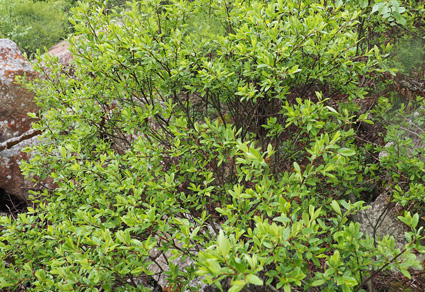
The morphological similarity between Salix hypoleuca and S. biondiana, coupled with their extensively overlapping distribution ranges, has long caused difficulties in identification and taxonomic confusion. Through detailed examination of type specimens, general herbarium materials, and field investigations, this study identifies key diagnostic characters that distinguish the two species. For the first time, we reveal the heterogeneity of the type material of S. biondiana, and treat S. hypoleuca var. kansuensis and S. pseudotangii as synonyms of S. biondiana, with lectotypes designated for S. biondiana and S. hypoleuca var. kansuensis. In addition, S. hypoleuca var. platyphylla, S. tangii, and S. rhoophila are reduced to synonyms of S. hypoleuca. Furthermore, detailed morphological descriptions and high-resolution plates are provided for both species to facilitate accurate identification.
References
- Argus, G.W. (1997) Infrageneric classification of Salix (Salicaceae) in the New World. Systematic Botany Monographs 52: 1–121. https://doi.org/10.2307/25096638
- Belyaeva, I.V. & King, C. (2025) 1138. Salix magnifica Hemsl.: Salicaceae. Botanical Magazine 42 (1): 77–94. https://doi.org/10.1111/curt.12631
- Chao, N. (1994) Taxonomic Study on Salicaceae in Sichuan and its Adjacent Regions (III). Sichuan Forestry Science and Technology 15 (2): 1–11.
- Ding, T.Y. (1995) Origin, divergence and geographical distribution of Salicaceae. Acta Botanica Yunnanica 17 (3): 277–290.
- Fang, Z.F. & Skvortsov, A.K. (1998) Validation of Hao's new Chinese taxa in Salix (Salicaceae). Novon 8 (4): 467–470. https://doi.org/10.2307/3391877
- Fang, Z.F., Zhao, S.D. & Skvortsov, A.K. (1999) Salicaceae, Salix. In: Wu, Z.Y. & Raven, P.H. (Eds.) Flora of China, vol. 4. Science Press, Beijing & Missouri Botanical Garden, St. Louis, pp. 162–274.
- Grabovskaya-Borodina, A.E., Tatanov, I.V. & Belyaeva, I.V. (2022) Nomenclatural and taxonomic notes on some Salix L. (Salicaceae) from China. Skvortsovia: International Journal of Salicology and Plant Biology 8 (2): 58–81. https://doi.org/10.51776/2309-6500_2022_8_2_58
- Goerz, R. (1932) Enumeration of the Ligneous Plants Collected by J.F. Rock on the Arnold Arboretum Expedition to Northwestern China and Northeastern Tibet, Salix L. Journal of the Arnold Arboretum 13 (4): 387–404. https://doi.org/10.5962/p.185266
- Hao, K.S. (1936) Synopsis of Chinese Salix. Dahlem bei Berlin, Berlin, pp. 1–123.
- He, L., Liao, S. & Zhang, Z.X. (2015) Nomenclature and taxonomy of Salix floccosa, S. opsimantha and S. austrotibetica. Phytotaxa 201 (2): 158–164. https://doi.org/10.11646/phytotaxa.201.2.6
- He, L., Liao, S., Chen, S.P. & Zhang, Z.X. (2016) Nomenclatural notes of Salix wangiana and S. zangica var. tibetica (Salicaceae). Phytotaxa 245 (1): 71–74. https://doi.org/10.11646/phytotaxa.245.1.8
- He, L. (2018) Taxonomy and nomenclature of Salix baileyi, S. rehderiana, and S. disperma. Phytotaxa 349 (1): 54–60. https://doi.org/10.11646/phytotaxa.349.1.6
- He, L. & Applequist, W.L. (2020) Lectotypifications and nomenclatural notes for Hao’s new Chinese taxa in Salix (Salicaceae). Novon 28 (3): 180–185. https://doi.org/10.3417/2020602
- He, L., Wagner, N.D. & Hörandl, E. (2021) Restriction‐site associated DNA sequencing data reveal a radiation of willow species (Salix L., Salicaceae) in the Hengduan Mountains and adjacent areas. Journal of Systematics and Evolution 59 (1): 44–57. https://doi.org/10.1111/jse.12593
- LI, G.Y., Chen, X.Z., Xie, W.Y., Lei, Z.P. & Chen, Z.H. (2021) New Notes on Seed Plant in East China. Journal of Zhejiang Forestry Science and Technology 41 (4): 82–85. https://doi.org/10.3969/j.issn.1001-3776.2021.04.013
- Linnaeus, C. (1753) Species Plantarum. Impensis Laurentii Salvii, Holmiae, 1200 pp.
- Liu, L.J., He, L. & Applequist, W.L. (2020) Untangling two Chinese Salix species (Salicaceae) published by C.K. Schneider, with lectotypification of four names. Willdenowia 50 (2): 159–163. https://doi.org/10.3372/wi.50.50201
- Ohashi, H. (2000) A systematic enumeration of Japanese Salix (Salicaceae). Journal of Japanese Botany 75 (1): 1–41.
- Rehder, A. (1923) Enumeration of the Ligneous Plants of Northern China. Journal of the Arnold Arboretum 4 (3): 117–192. https://doi.org/10.5962/p.317977
- Schneider, C.K. (1916) Salicaceae, Salix. In: Sargent, C.S. (Ed.) Plantae Wilsonianae, vol. 3. University Press, Cambridge, pp. 40–179.
- Seemen, O.V. (1905) Salicaceae. Botanische Jahrbücher für Systematik, Pflanzengeschichte und Pflanzengeographie 36 (5): 28–33.
- Skvortsov, A.K. (1968) Willows of the USSR. A taxonomic and geographic revision. Nauka, Moscow.
- Skvortsov, A.K. (1989) Die Weiden (Salix) der Sektion Chamaetia und das Problem der Entstehung der arktischen Flora. Flora 182: 57–67. https://doi.org/10.1016/S0367-2530(17)30394-8
- Skvortsov, A.K. (1999) Willows of Russia and adjacent countries. Taxonomical and geographical revision. Faculty of Mathematics and Natural Sciences Report Series, No. 39. University of Joensuu Press, Joensuu, pp. 1–307.
- Thiers, B. (2026) Index Herbariorum: A global directory of public herbaria and associated staff. New York Botanical Garden’s Virtual Herbarium.
- Turland, N.J., Wiersema, J.H., Barrie, F.R., Gandhi, K.N., Gravendyck, J., Greuter, W., Hawksworth, D.L., Herendeen, P.S., Klopper, R.R., Knapp, S., Kusber, W.-H., Li, D.-Z., May, T.W., Monro, A.M., Prado, J., Price, M.J., Smith, G.F. & Zamora Sefioret, J.C. (2025) International Code of Nomenclature for algae, fungi, and plants (Madrid Code). Regnum Vegetabile 162. University of Chicago Press, Chicago.
- Wang, Z., Fang, C.F., Zhao, S.D., Chou, Y.L., Dong, S.L., Yu, C.Y., Yang, C.Y. & Chao, N. (1984) Salix. In: Wang, C. & Fang, C.F. (Eds.) Flora Reipublicae Popularis Sinicae, vol. 20 (2). Science Press, Beijing, pp. 81–381.
- Yu, Z.Y. (1974) Salicaceae, Salix. In: Instituto Botanico Boreali-Occidentali Academiae Sinicae Edita (Eds.) Flora Tsinlingensis, vol. 1 (2). Science Press, Beijing, pp. 25–46, 597–601.