
Abstract
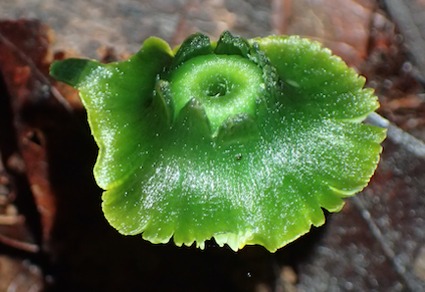
Hygrocybe subgen. Hygrocybe sect. Pseudofirmae, includes tropical species with dimorphic basidiospores and basidia, and an often perforated pileus. Field expeditions in the Cristalino basin in the Southern Brazilian Amazon revealed four new species of Hygrocybe sect. Pseudofirmae: Hygrocybe cristalinoensis, forming entirely deep green basidiomes, with a convex-umbilicate, perforated pileus and whitish fringed margin; H. viridilacerata, characterized by basidiomes with green, umbonate pileus that is perforated at the centre, whitish lamellae and predominantly 2-spored microbasidia; H. pegleri, characterized by a squamulose pileus and a long stipe (> 100 mm); and H. vinaceosquamulosa, characterized by a squamulose, purple to pink pileus, pale yellow to pinkish lamellae and oblong to cylindrical macrospores with a middle constriction. These new species are proposed based on combined morphological and ITS sequence data. Phylogenetic analyses revealed the placement and uniqueness of the new species in the sect. Pseudofirmae clade, and their relationship with close species of the section. Descriptions, illustrations, and phylogenetic analyses results for the new species are provided. In addition, the new species are compared with closely related taxa.
References
- Berkeley, M.J. (1856) Decades of fungi. Decades LXI-LXII. Rio Negro fungi. Hooker’s Journal of Botany and Kew Garden Miscellany 8: 272–280.
- Cantrell, S.A. & Lodge, D.J. (2001) Hygrophoraceae (Agaricales) of the Greater Antilles: Hygrocybe subgenus Pseudohygrocybe section Firmae. Mycological Research 105 (2): 215–224. https://doi.org/10.1017/S0953756200003397
- Capelari, M. & Maziero, R. (1988) Two new species of Agaricales from Brazil. Mycotaxon 33: 191–196. https://doi.org/10.5962/p.416662
- Cardoso, J.S., Moncalvo, J.-M., Lodge, D.J., Margaritescu, S., Neves, M.A. & Oliveira, J.J.S. (2023) Studies in Hygrocybe s.l. (Hygrocyboideae, Hygrophoraceae) in Brazil: New species of Humidicutis and Neohygrocybe. Phytotaxa 607 (1): 057–071. https://doi.org/10.11646/phytotaxa.607.1.5
- Courtecuisse, R. (1989) Élements pour un inventaire mycologique des environs du Saut Pararé (Arataye) et de l’inselberg de Norages (Guyane Française). I. Introduction. II. Hygrophoraceae. Crypto-Mycologie 10: 181–216. https://doi.org/10.5962/p.354297
- Crous, P.W., Wingfield, M.J., Burgess, T.I., Hardy, G.E.ST.J., Barber, P.A., Alvarado, P., Barnes, C.W., Buchanan, P.K., Heykoop, M., Moreno, G., Thangavel, R., Van der spuy, S., Barili, A., Barrett, S., Cacciola, S.O., Cano-Lira, J.F., Crane, C., Decock, C., Gibertoni, T.B., Guarro, J., Guevara-Suarez, M., Hubka, V., Kolarík, M., Lira, C.R.S., Ordoñez, M.E., Padamsee, M., Ryvarden, L., Soares, A.M., Stchigel, A.M., Sutton, D.A., Vizzini, A., Weir, B.S., Acharya, K., Aloi, F., Baseia, I.G., Blanchette, R.A., Bordallo, J.J., Bratek, Z., Butler, T., Cano-Canals, J., Carlavilla, J.R., Chander, J., Cheewangkoon, R., Cruz, R.H.S.F., Da Silva, M., Dutta, A.K., Ercole, E., Escobio, V., Esteve-Raventós, F., Flores, J.A., Gené, J., Góis, J.S., Haines, L., Held, B.W., Horta jung, M., Hosaka, K., Jung, T., Jurjević, Ž., Kautman, V., Kautmanova, I., Kiyashko, A.A., Kozanek, M., Kubátová, A., Lafourcade, M., La spada, F., Latha, K.P.D., Madrid, H., Malysheva, E.F., Manimohan, P., Manjón, J.L., Martín, M.P., Mata, M., Merényi, Z., Morte, A., Nagy, I., Normand, A.-C., Paloi, S., Pattison, N., Pawłowska, J., Pereira, O.L., Petterson, M.E., Picillo, B., Raj, K.N.A., Roberts, A., Rodríguez, A., Rodríguez-Campo, F.J., Romański, M., Ruszkiewicz-Michalska, M., Scanu, B., Schena, L., Semelbauer, M., Sharma, R., Shouche, Y.S., Silva, V., Staniaszek-Kik, M., Stielow, J.B., Tapia, C., Taylor, P.W.J., Toome-Heller, M., Vabeikhokhei, J.M.C., van Diepeningen, A.D., Van-Hoa, N., Van-Tri, M., Wiederhold, N.P., Wrzosek, M., Zothanzama, J. & Groenewald, J.Z. (2017) Fungal Planet description sheets: 558–624. Persoonia 38: 240–384. https://doi.org/10.3767/003158517X698941
- Darriba, D., Posada, D., Kozlov, A.M., Stamatakis, A., Morel, B. & Flouri, T. (2020) ModelTest-NG: a new and scalable tool for the selection of DNA and protein evolutionary models. Molecular Biology and Evolution 37 (1): 291–294. https://doi.org/10.1093/molbev/msz189
- Dentinger, B.T.M., Margaritescu, S. & Moncalvo, J.M. (2010) Rapid and reliable high-throughput methods of DNA extraction for use in barcoding and molecular systematics of mushrooms. Molecular Ecology Resources 10 (4): 628–633. https://doi.org/10.1111/j.1755-0998.2009.02825.x
- Edgar, R.C. (2004) MUSCLE: a multiple sequence alignment method with reduced time and space complexity. BMC Bioinformatics 5: 113. https://doi.org/10.1186/1471-2105-5-113
- Fundação Ecológica Cristalino—FEC (2025) Reservas Naturais Cristalino. Available from: http://www.fundacaocristalino.org.br/ (accessed 15 October 2025)
- Gardes, M. & Bruns, T.D. (1993) ITS primers with enhanced specificity for basidiomycetes—application to the identification of mycorrhizae and rusts. Molecular Ecology 2: 113–118. https://doi.org/10.1111/j.1365-294X.1993.tb00005.x
- Heim, R. (1967) Hygrophores tropicaux recueillés par Roger Heim 1: Espéces de Guyan française et de Nouvelle-Guinée australienne. Revue de Mycologie 32: 16–27.
- Heinemann, P. (1963) Champignons récoltés au Congo par Madame M. Goossens-Fontana, V. Hygrophoraceae. Bulletin du Jardin Botanique de l'État, Bruxelles 33: 421–458, figs. 1–41. https://doi.org/10.2307/3667377
- Heinemann, P. (1966) Flore Iconographique des Champignons du Congo, Fasc. 15: Hygrophoraceae, Laccaria et Boletineae II (Compl.). Bulletin du Jardin Botanique de l'État, Bruxelles. [279–308, pl. 47–49]
- Hu, Y., Karunarathna, S.C., Li, H., Galappaththi, M.C., Zhao, C.L., Kakumyan, P. & Mortimer, P.E. (2022) The impact of drying temperature on basidiospore size. Diversity 14 (4): 239. https://doi.org/10.3390/d14040239
- Instituto Nacional de Pesquisas Espaciais—INPE (2020) A taxa consolidada de desmatamento por corte raso para os nove estados da Amazônia Legal (AC, AM, AP, MA, MT, PA, RO, RR e TO) em 2019 é de 10.129 km2, Brazilian Federal Government. Available from: http://www.obt.inpe.br/OBT/noticias-obt-inpe/a-taxa-consolidada-de-desmatamento-por-corte-raso-para-os-nove-estados-da-amazonia-legal-ac-am-ap-ma-mt-pa-ro-rr-e-to-em-2019-e-de-10-129-km2 (accessed 15 October 2025) https://doi.org/10.18472/SustDeb.v9n1.2018.7143
- Komura, D.L., De Olivera, J.J.S., Moncalvo, J.M., Margaritescu, S. & Zartman, C.E. (2016) Marasmius calvocystidiatus sp. nov. and M. horridulus (Marasmiaceae): characterization of two unusual species from central Amazonia. Phytotaxa 280: 222–240. https://doi.org/10.11646/phytotaxa.280.3.2
- Komura, D.L., Oliveira, J.J.S., Moncalvo, J.M., Margaritescu, S. & Zartman, C.E. (2020) Six new species of Tetrapyrgos (Basidiomycota, Agaricales, Marasmiaceae) from the Brazilian Amazon. Phytotaxa 440: 193–214. https://doi.org/10.11646/phytotaxa.440.3.2
- Kramer, L.A. (2004) The Online Auction Color Chart. Stanford, Online Auction Color Chart Company, USA, 6 pp.
- Kummer, P. (1871) Der Führer in die Pilzkunde. C. Luppe, Zerbst, Germany, 146 pp.
- Largent, D.L. (1986) How to Identify Mushrooms to Genus I: Macroscopic features. 3ed, Mad River Press Inc., Eureka, CA, USA, 166 pp.
- Largent, D.L., Johnson, D. & Watling, R. (1977) How to Identify Mushrooms to Genus III: Microscopic features. 3ed, Mad River Press Inc., Eureka, CA, USA, 148 pp.
- Lodge, D.J. & Pegler, D.N. (1990) Hygrophoraceae of the Luquillo Mountains of Puerto Rico. Mycological Research 94 (4): 443–456. https://doi.org/10.1016/S0953-7562(10)80002-4
- Lodge, D.J., Padamsee, M., Matheny, P.B., Aime, M.C., Cantrell, S.A., Boertmann, D., Kovalenko, A., Vizzini, A., Dentinger, B.T.M., Kirk, P.M., Ainsworth, A.M., Moncalvo, J.-M., Vilgalys, R., Larsson, E., Lucking, R., Griffith, G.W., Smith, M.E., Norvell, L.L., Desjardin, D.E., Redhead, S.A., Ovrebo, C.L., Lickey, E.B., Ercole, E., Hughes, K.W., Courtecuisse, R., Young, A., Binder, M., Minnis, A.M., Lindner, D.L., Ortiz-Santana, B., Haight, J., Laessoe, T., Baroni, T.J., Geml, J. & Hattori, T. (2013) Molecular phylogeny, morphology, pigment chemistry and ecology in Hygrophoraceae (Agaricales). Fungal Diversity 64: 1–99. https://doi.org/10.1007/s13225-013-0259-0
- Neves, M.A., Sourell, S., Lodge, D.J., Cardoso, J.S., Silva, D.F., Cardoso, S.M.C., Ribeiro, R.S. & Araújo-Silva, L.E. (2018) Amazonian fungi: knowledge as a key to conservation—the Cristalino Fungi Project. [Conference paper, State of the World’s Fungi Symposium. London, England]
- Oliveira, J.J.S., Vargas-Isla, R., Cabral, T.S., Cardoso, J.S., Andriolli, F.S., Rodrigues, D.P., Ikeda, T., Clement, C.R. & Ishikawa, N.K. (2021) The Amazonian luminescent Mycena cristinae sp. nov. from Brazil. Mycoscience 62 (6): 395–405. https://doi.org/10.47371/mycosci.2021.05.004
- Pegler, D.N. (1983) Agaric flora of the Lesser Antilles. Kew Bulletin Adititional Series 9, HMSO, London, 668 pp.
- Pegler, D.N. (1997) The Agarics of São Paulo: An account of the agaricoid fungi (Holobasidiomycetes) of São Paulo State, Brasil. Royal Botanic Gardens, Kew, UK, 68 pp.
- Pegler, D.N. & Fiard, J.P. (1978) Hygrocybe sect. Firmae (Agaricales) in Tropical America. Kew Bulletin 32 (2): 297–312. https://doi.org/10.2307/4117101
- Petch, T. (1917) Revision of Ceylon fungi (Part V). Annals of the Royal Botanic Gardens Peradeniya 6: 307–355.
- Pires, J.M. & Prance, G.T. (1985) The Vegetation Types of the Brazilian Amazon. In: Prance, G.T. & Lovejoy, T.E. (Eds.) Key environments: Amazonia. Pergamon Press, Oxford.
- Rambaut, A. (2007) FigTree v1.4.3. Institute of Evolutionary Biology, University of Edinburgh, Edinburgh. Available from: http://tree.bio.ed.ac.uk/software/figtree/ (accessed 17 November 2025)
- Rathnayaka, A.R., Tennakoon, D.S., Jones, G.E., Wanasinghe, D.N., Bhat, D.J., Priyashantha, A.H., Stephenson, S.L., Tibpromma, S. & Karunarathna, S.C. (2025) Significance of precise documentation of hosts and geospatial data of fungal collections, with an emphasis on plant-associated fungi. New Zealand Journal of Botany 63 (2–3): 462–489. https://doi.org/10.1080/0028825X.2024.2381734
- Ronquist, F., Teslenko, M., van der Mark, P., Ayres, D., Darling, A., Höhna, S., Larget, B., Liu, L., Suchard, M.A. & Huelsenbeck, J.P. (2012) MrBayes 3.2: efficient Bayesian phylogenetic inference and model choice across a large model space. Systematic Biology 61: 539–542. https://doi.org/10.1093/sysbio/sys029
- Silva-Filho, A.G.S., Sa, M.C.A., Komura, D.L., Moncalvo, J.M., Margaritescu, S., Roy, M. & Wartchow, F. (2020) Two novel species of Lactifluus subg. Pseudogymnocarpi (Russulaceae) from Brazil. Phytotaxa 436: 222–236. https://doi.org/10.11646/phytotaxa.436.3.2
- Silva-Filho, A.G.S., Sa, M.C.A., Komura, D.L., Baseia, I.G., Marinho, P., Moncalvo, J.M., Roy, M. & Wartchow, F. (2021) Novelties in Lactifluus subg. Gymnocarpi (Russulales, Basidiomycota) from Brazilian tropical forests. Mycological Progress 20: 549–565. https://doi.org/10.1007/s11557-021-01693-w
- Silva-Filho, A.G.S., Sa, M.C.A., Komura, D.L., Braga-Neto, R., Baseia, I.G., Marinho, P., Moncalvo, J.M., Roy, M. & Wartchow, F. (2023) Lactifluus subg. Lactariopsis (Russulales/Basidiomycota) from Brazilian tropical forests. Botany 101: 570–581. https://doi.org/10.1139/cjb-2023-0077
- Singer, R. (1958) Fungi Mexicani, series Prima, Agaricales. Sydowia 11: 354–374.
- Singer, R. (1965) Interesting and new Agaricales from Brazil. Atas do Instituto de Micologia 2: 15–59.
- Soares, C.C., Cabral, T.S., Vargas-Isla, R., Cardoso, J.S., Rodrigues, D.P., Ishikawa, N.K. & Oliveira, J.J. (2024) Mycena lamprocephala, a new luminescent species from the Brazilian Amazon. Phytotaxa 634 (3): 187–203. https://doi.org/10.11646/phytotaxa.634.3.1
- Stamatakis, S. (2006) RAxML-VI-HPC: Maximum likelihood-based phylogenetic analyses with thousands of taxa and mixed models. Bioinformatics 22: 2688–2690. https://doi.org/10.1093/bioinformatics/btl446
- Stropp, J., Umbelino, B., Correia, R.A., Campos-Silva, J.V., Ladle, R.J. & Malhado, A.C.M. (2020) The ghosts of forests past and future: deforestation and botanical sampling in the Brazilian Amazon. Ecography 43: 979–989. https://doi.org/10.1111/ecog.05026
- White, T.J., Bruns, T., Lee, S. & Taylor, J.W. (1990) Amplification and direct sequencing of fungal ribosomal RNA genes for phylogenetics. In: Innis, M.A., Gelfand, D.H., Sninsky, J.J. & White, T.J. (Eds.) PCR protocols: a guide to methods and applications. Academic Press, New York, pp. 315–322. https://doi.org/10.1016/B978-0-12-372180-8.50042-1
- Wildlife Conservation Society—WCS (2025) Aliança Águas Amazônicas. Bacias Principais: Tapajós. Available from: https://pt.aguasamazonicas.org/bacia/bacias-principais/tapajos/ (accessed 15 October 2025)
- Licensed under Creative Commons Attribution-N.C. 4.0 International https://creativecommons.org/licenses/by-nc/4.0/
- Licensed under Creative Commons Attribution-N.C. 4.0 International https://creativecommons.org/licenses/by-nc/4.0/