

Abstract
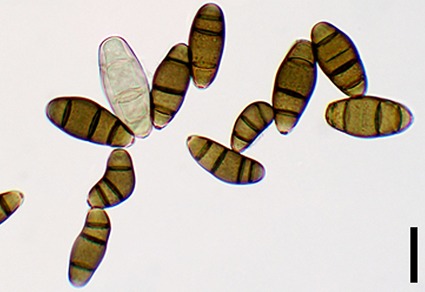
Six unidentified Curvularia strains, selected from the Collection of Fungal Cultures in Department of Plant Protection (Shahid Chamran University of Ahvaz, Iran), were identified. These strains were previously isolated from three pasture‑medicinal plants, including Cardaria draba, Ficaria kochii, and Phlomis olivieri in west of Iran. These fungi were characterised based on DNA sequence data from the internal transcribed spacer regions 1 and 2 including the intervening 5.8S nuclear ribosomal DNA (ITS), partial glyceraldehyde-3-phosphate dehydrogenase (gpd1) and translation elongation factor 1-α (tef1). A multi-locus phylogeny, in combination with morphology, allowed for the identification of Curvularia nicotiae, C. subpapendorfii, and a novel species, C. ilamica, which is morphologically and genetically distinctive from previously described species. In addition, new host records for Curvularia nicotiae and C. subpapendorfii are reported.
References
- Adamska, I. (2001) Microscopic fungus-like organisms and fungi of the Słowiński National Park. II. (NW PoIand). Acta Mycologica 36 (1): 31. https://doi.org/10.5586/am.2001.005
- Alcalde, M.B. (1952) In Memoriam. Algunos micromicetos recolectados por el Prof. Caballero Segares en Valencia. Anales del Jardín Botánico de Madrid 10 (2): 229–255.
- Alcorn, J.B. (1990) Indigenous agroforestry systems in the Latin American tropics.
- Alcorn, J.L. (1983) Generic concepts in Drechslera, Bipolaris and Exserohilum. https://doi.org/10.5962/p.417485
- Bakalova, G.G. & Borisova, T.I. (2010) Cercosporoid Hyphomycetous Fungi. Fungi of Bulgaria 7: 1–259.
- Bakhshi, M., Arzanlou, M., Babai-Ahari, A., Groenewald, J.Z., Braun, U. & Crous, P.W. (2015) Application of the consolidated species concept to Cercospora spp. from Iran. Persoonia-Molecular Phylogeny and Evolution of Fungi 34 (1): 65–86. https://doi.org/10.3767/003158515X685698
- Beenken, L., Lutz, M. & Scholler, M. (2017) DNA barcoding and phylogenetic analyses of the genus Coleosporium (Pucciniales) reveal that the North American goldenrod rust C. solidaginis is a neomycete on introduced and native Solidago species in Europe. Mycological Progress 16 (11): 1073–1085. https://doi.org/10.1007/s11557-017-1357-2
- Beneke, E.S. & Rogers, A.L. (1996) Medical mycology and human mycoses. Star Publishing Company, Belmont, 239 pp.
- Berbee, M., Pirseyedi, M. & Hubbard, S. (1999) Cochliobolus phylogenetics and the origin of known, highly virulent pathogens, inferred from ITS and glyceraldehyde-3-phosphate dehydrogenase gene sequences. Mycologia 91: 964–977. https://doi.org/10.1080/00275514.1999.12061106
- Boedijn, K.B. (1933) Über einige phragmosporen Dematiazen. Bulletin du Jardin Botanique de Buitenzorg 13: 120–134.
- Boerema, G.H. (Ed.) (2004) Phoma identification manual: differentiation of specific and infra-specific taxa in culture. CABI. https://doi.org/10.1079/9780851997438.0000
- Braun, U. (1995) A monograph of Cercosporella, Ramularia, and allied genera (phytopathogenic hyphomycetes) Ihw-Verlag, Eching, 333 pp.
- Carter, E. & Boudreaux, C. (2004) Fatal cerebral phaeohyphomycosis due to Curvularia lunata in an immunocompetent patient. Journal of Clinical Microbiology 42 (11): 5419–5423. https://doi.org/10.1128/JCM.42.11.5419-5423.2004
- Chupp, C. (1954) Monograph of the fungus genus Cercospora. Published by the Author. Plant Pathology Department, Cornell University, Ithaca, New York.
- Conners, I.L. (1967) An annotated index of plant diseases in Canada and fungi recorded on plants in Alaska, Canada and Greenland.
- Cook, P.R. & Dubé, A.J. (1989) Host-pathogen index of plant diseases in South Australia. Field Crops Pathology Group South Australian Dept. of Agriculture, Adelaide, pp.
- Crous, P.W. & Braun, U. (2003) Mycosphaerella and its anamorphs: 1. Names published in Cercospora and Passalora. pp. 571–pp.
- Da Cunha, K.C., Keith, C., Sutton, D.A., Fothergill, A.W., Deanna, A. & Crous, J.G. (2013) In vitro antifungal susceptibility and molecular identity of 99 clinical isolates of the opportunistic fungal genus Curvularia. Diagnostic Microbiology and Infectious Disease 76 (2): 168–174. https://doi.org/10.1016/j.diagmicrobio.2013.02.034
- Darriba, D., Taboada, G.L., Doallo, R. & Posada, D. (2012) jModelTest 2: more models, new heuristics and parallel computing. Nat Methods 9: 772. https://doi.org/10.1038/nmeth.2109
- De Hoog, G.S., Guarro, J., Gené, J. & Figueras, M.J. (2011) Atlas of clinical fungi2nd edn. Centraalbureau voor Schimmekulture, The Netherlands.
- Dehdari, F., Mehrabi-Koushki, M. & Hayati, J. (2018) Curvularia shahidchamranensis sp. nov., a crude oil-tolerant fungus. Current Research in Environmental & Applied Mycology 8 (6): 572–584. https://doi.org/10.5943/cream/8/6/2
- Drechsler, C. (1934) Phytopathological and taxonomic aspects of Ophiobolus, Pyrenophora, Helminthosporium, and a new genus Cochliobolus
- Dudka, I.O., Heluta, V.P., Tykhonenko, Y.Y., Andrianova, T.V., Hayova, V.P. & Isikov, V.P. (2004) Fungi of the Crimean Peninsula (Translated from Russian). MG Kholodny Institute of Botany, National Academy of Sciences of Ukraine, 452 pp.
- Dugan, F.M., Schubert, K. & Braun, U. (2004) Check-list of Cladosporium names. Schlechtendalia 11: 1–103.
- Edler, D., Klein, J., Antonelli, A. & Silvestro, D. (2021) raxmlGUI 2.0: a graphical interface and toolkit for phylogenetic analyses using RAxML. Methods in Ecology and Evolution 12 (2): 373–377. https://doi.org/10.1111/2041-210X.13512
- Ellis, M.B. (1971) Dematiaceaus Hyphomycetes. Commonwealth Mycological Institute, Kew, England. https://doi.org/10.1079/9780851986180.0000
- Gaponenko, N.I. (1965) Survey of the fungi of Bukhara. Akad Sa Uzbekh.
- Gautam, A.K., Kant, M. & Thakur, Y. (2013) Isolation of endophytic fungi from Cannabis sativa and study their antifungal potential. Arch Phytopathol Plant Protect 46: 627–635. https://doi.org/10.1080/03235408.2012.749696
- Groenewald, J.Z., Nakashima, C., Nishikawa, J., Shin, H.D., Park, J.H. & Crous, P.W. (2013) Species concepts in Cercospora: spotting the weeds among the roses. Studies in Mycology 75 (1): 115–170. https://doi.org/10.3114/sim0012
- Hall, T.A. (1999) BioEdit: a user-friendly biological sequence alignment editor and analysis program for windows 95/98/NT. Nuc Acids Symp Ser 41: 95–98.
- Heidari, K., Mehrabi-Koushki, M. & Farokhinejad, R. (2018) Curvularia mosaddeghii sp. nov., a novel species from the family Pleosporaceae. Mycosphere 9: 635–646. https://doi.org/10.5943/mycosphere/9/4/2
- Ito, S. (1930) On some new ascigerous stages of the species of Helminthosporium parasitic on cereals. Proceedings of the Imperial Academy 6 (8): 352–355.
- Jatwa, T.K., Sharma, S.S., Meena, N.K. & Khan, I. (2021) Evaluation of Yield Loss Assessment Caused due to Curvularia Leaf Spot (Curvularia lunata) in Maize. Int. J. Curr. Microbiol. App. Sci. 10 (09): 538–544. https://doi.org/10.20546/ijcmas.2021.1009.062
- Jena, S.K. & Tayung, K. (2013) Endophytic fungal communities associated with two ethno-medicinal plants of Similipal Biosphere Reserve, India and their antimicrobial prospective. J Appl Pharmaceutical Sci 3: 7–12. https://doi.org/10.7324/JAPS.2013.34.S2
- Leonard, K.J. & Suggs, E.G. (1974) Setosphaeria prolata, the ascigerous state of Exserohilum prolatum. Mycologia 66 (2): 281–297. https://doi.org/10.1080/00275514.1974.12019603
- Liang, Y., Ran, S.F., Bhat, J., Hyde, K.D., Wang, Y. & Zhao, D.G. (2018) Curvularia microspora sp. nov. associated with leaf diseases of Hippeastrum striatum in China. MycoKeys (29): 49. https://doi.org/10.3897/mycokeys.29.21122
- Liu, Q., Li, G., Li, J. & Chen, S. (2016) Botrytis eucalypti, a novel species isolated from diseased Eucalyptus seedlings in South China. Mycological Progress 15 (10): 1057–1079. https://doi.org/10.1007/s11557-016-1229-1
- Lobik, A.I. (1928) Materialen zur Mykoflora des Terskikreises. Morbi Plant. Leningr 17: 157–199.
- Louw, J.P.J., Victor, D., Crous, P.W., Holz, G. & Janse, B.J.H. (1995) Characterization of Pyrenophora isolates associated with spot and net type lesions on barley in South Africa. Journal of Phytopathology 143 (3): 129–134. https://doi.org/10.1111/j.1439-0434.1995.tb00245.x
- Madrid, H., Da Cunha, K.C., Gené, J., Dijksterhuis, J., Cano, J. & Crous, P.W. (2014) Novel Curvularia species from clinical specimens. Persoonia-Molecular Phylogeny and Evolution of Fungi 33 (1): 48–60. [https://www.ingentaconnect.com/content/wfbi/pimj] https://doi.org/10.3767/003158514X683538
- Manamgoda, D.S., Cai, L., Bahkali, A.H., Chukeatirote, E. & Hyde, K.D. (2011) Cochliobolus: an overview and current status of species. Fungal Divers 51: 3–42. https://doi.org/10.1007/s13225-011-0139-4
- Manamgoda, D.S., Cai, L., McKenzie, E.H., Crous, P.W., Madrid, H. & Hyde, K.D. (2012a) A phylogenetic and taxonomic re-evaluation of the Bipolaris-Cochliobolus-Curvularia complex. Fungal Diversity 56 (1): 131–144. https://doi.org/10.1007/s13225-012-0189-2
- Manamgoda, D.S., Cai, L., McKenzie, E.H.C., Chukeatirote, E. & Hyde, K.D. (2012b) Two new Curvularia species from northern Thailand. Sydowia 64: 255–266.
- Manamgoda, D.S., Rossman, A.Y., Castlebury, L.A., Crous, P.W., Madrid, H., Chukeatirote, E. & Hyde, K.D. (2014) The genus Bipolaris. Stud Mycol 79: 221–288. https://doi.org/10.1016/j.simyco.2014.10.002
- Manamgoda, D.S., Rossman, A.Y., Castlebury, L.A., Chukeatirote, E. & Hyde, K.D. (2015) Taxonomic and phylogenetic re-appraisal of the genus Curvularia (Pleosporaceae): human and plant pathogens. Phytotaxa 212: 175–198. https://doi.org/10.11646/phytotaxa.212.3.1
- Marin-Felix, Y., Groenewald, J.Z., Cai, L.M.C.G., Chen, Q., Marincowitz, S. & Crous, P.W. (2017) Genera of phytopathogenic fungi: GOPHY 1. Studies in Mycology 86: 99–216. https://doi.org/10.1016/j.simyco.2017.04.002
- Marin-Felix, Y., Senwanna, C., Cheewangkoon, R. & Crous, P.W. (2017b) New species and records of Bipolaris and Curvularia from Thailand. Mycosphere 8: 1556–1574. https://doi.org/10.5943/mycosphere/8/9/11
- Marin-Felix, Y., Hernandez-Restrepo, M. & Crous, P.W. (2020) Multi-locus phylogeny of the genus Curvularia and description of ten new species. Mycol Prog 19 (6): 559–588. https://doi.org/10.1007/s11557-020-01576-6
- Mason-Gamer, R. & Kellogg, E. (1996) Testing for phylogenetic conflict among molecular datasets in the tribe Tiriceae (Graminae). Syst Biol 45: 524–545. https://doi.org/10.1093/sysbio/45.4.524
- McKenzie, E.H.C. & Dingley, J.M. (1996) New plant disease records in New Zealand: miscellaneous fungal pathogens III. New Zealand Journal of Botany 34 (2): 263–272. https://doi.org/10.1080/0028825X.1996.10410690
- Mehrabi-Koushki, M., Pooladi, P., Eisvand, P. & Babaahmadi, G. (2018) Curvularia ahvazensis and C. rouhanii spp. nov. from Iran. Mycosphere 9: 1173–1186. https://doi.org/10.5943/mycosphere/9/6/7
- Mel’nik, V.A., Shabunin, D.A. & Popov, E.S. (2008) Contributions to the studies of mycobiota in Novgorod And Pskov Regions. II Coelomycetes Mikol Fitopatol 42: 43–52.
- Mouchacca, J. (1999) A list of novel fungi described from the Middle East, mostly from non-soil substrata. https://doi.org/10.1127/nova.hedwigia/68/1999/149
- Mułenko, W., Majewski, T. & Ruszkiewicz-Michalska, M. (2008) A preliminary checklist of micromycetes in Poland. pp. 752–pp.
- Nag Raj, T.R. (1993) Coelomycetous anamorphs with appendage-bearing conidia. (No Title).
- Nelson, R.R. (1964) Aggregate production functions and medium-range growth projections. The American Economic Review 54 (5): 575–606.
- O’Donnell, K. (1993) Fusarium and its near relatives. In: Reynolds, D.R. & Taylor, J.W. (Eds.) The fungal holomorph: mitotic, meiotic and pleomorphic speciation in fungal systematics. CAB International, Wallingford, pp. 225–233.
- Peres, C.B., Fabian, A.C., Edge, A.C., Allen, S.W., Johnstone, R.M. & White, D.A. (1998) A ROSAT study of the cores of clusters of galaxies—I. Cooling flows in an X-ray flux-limited sample. Monthly Notices of the Royal Astronomical Society 298 (2): 416–432. https://doi.org/10.1046/j.1365-8711.1998.01624.x
- Pollack, F.G. (1987) An annotated compilation of Cercospora names. pp. 212–pp.
- Priyadharsini, P. & Muthukumar, T. (2017) The root endophytic fungus Curvularia geniculata from Parthenium hysterophorus roots improves plant growth through phosphate solubilization and phytohormone production. Fungal Ecol 27: 69–77. https://doi.org/10.1016/j.funeco.2017.02.007
- Radulescu, E., Negru, A. & Docea, E. (1973) Septoriozele din Romania. Ed. Academiei RSR.
- Rehner, S.A. & Buckley, E. (2005) A Beauveria phylogeny inferred from nuclear ITS and EF1-alpha sequences: evidence for cryptic diversification and links to Cordyceps teleomorphs. Mycologia 97: 84–98. https://doi.org/10.3852/mycologia.97.1.84
- Revankar, S.G. & Sutton, D.A. (2010) Melanized fungi in human disease. Clinical Microbiology Reviews 23 (4): 884–928. https://doi.org/10.1128/CMR.00019-10
- Ronquist, F., Teslenko, M., Van Der Mark, P., Ayres, D.L., Darling, A. & Huelsenbeck, J.P. (2012) MrBayes 3.2: efficient Bayesian phylogenetic inference and model choice across a large model space. Systematic Biology 61 (3): 539–542. https://doi.org/10.1093/sysbio/sys029
- Safi, A., Mehrabi-Koushki, M. & Farokhinejad, R. (2020) Amesia khuzestanica and Curvularia iranica spp. nov. from Iran. Mycological Progress 19 (9): 935–945. https://doi.org/10.1007/s11557-020-01612-5
- Scott, E.M. & Carter, R.T. (2014) Canine keratomycosis in 11 dogs: A case series (2000–2011). J Am Anim Hosp Assoc 50: 112–118. https://doi.org/10.5326/JAAHA-MS-6012
- Shoemaker, R.A. (1959) Nomenclature of Drechslera and Bipolaris, grass parasites segregated from ‘Helminthosporium’. Canadian Journal of Botany 37 (5): 879–887. https://doi.org/10.1139/b59-073
- Sivanesan, A. (1987) Graminicolous species of Bipolaris, Curvularia, Drechslera, Exserohilum and their teleomorphs. pp. vi+–261 pp.
- Tadych, M., Bergen, M.S., Johnson-Cicalese, J., Polashock, J.J., Vorsa, N. & White, J.F. (2012) Endophytic and pathogenic fungi of developing cranberry ovaries from flower to mature fruit: diversity and succession. Fungal Diversity 54 (1): 101–116. https://doi.org/10.1007/s13225-012-0160-2
- Tamura, K., Stecher, G., Peterson, D., Filipski, A. & Kumar, S. (2013) MEGA6: molecular evolutionary genetics analysis version 6.0. Molecular Biology and Evolution 30 (12): 2725–2729. https://doi.org/10.1093/molbev/mst197
- Tan, Y.P., Crous, P.W. & Shivas, R.G. (2018) Cryptic species of Curvularia in the culture collection of the Queensland Plant Pathology Herbarium. MycoKeys 35: 1–25. https://doi.org/10.3897/mycokeys.35.25665
- Tan, Y.P., Madrid, H., Crous, P.W. & Shivas, R.G. (2014) Johnalcornia gen. et. comb. nov., and nine new combinations in Curvularia based on molecular phylogenetic analysis. Australasian Plant Pathology 43 (6): 589–603. https://doi.org/10.1007/s13313-014-0315-6
- Taylor, J.W., Jacobson, D.J., Kroken, S., Kasuga, T., Geiser. & Fisher, M.C. (2000) Phylogenetic species recognition and species concepts in fungi. Fungal Genetics and Biology 31 (1): 21–32. https://doi.org/10.1006/fgbi.2000.1228
- Tomaso-Peterson, M., Jo, Y.K., Vines, P.L. & Hoffmann, F.G. (2016) Curvularia malina sp. nov. incites a new disease of warm-season turfgrasses in the southeastern United States. Mycologia 108 (5): 915–924. https://doi.org/10.3852/15-238
- Verma, P., Singh, S. & Singh, R. (2013) Seven species of Curvularia isolated from three lakes of Bhopal. Advances in Life Science and Technology 8: 13–15.
- Wang, S., Lu, Z., Lang, B., Wang, X., Li, Y. & Chen, J. (2022) Curvularia lunata and Curvularia Leaf Spot of Maize in China. ACS Omega 7 (51): 47462–47470. https://doi.org/10.1021/acsomega.2c03013
- Weising, K., Atkinson, R.G. & Gardner, R.C. (1995) Genomic fingerprinting by microsatellite-primed PCR: a critical evaluation. Genome Research 4 (5): 249–255. https://doi.org/10.1101/gr.4.5.249
- White, T.J., Bruns, T., Lee, S. & Taylor, J. (1990) Amplification and direct sequencing of fungal ribosomal RNA genes for phylogenetics. In: Innis, M.A., Gelfand, D.H., Sninsky, J.J. & White, T.J. (Eds.) PCR protocols: a guide to methods and applications. Academic Press, New York, pp. 315–322. https://doi.org/10.1016/B978-0-12-372180-8.50042-1