
Abstract
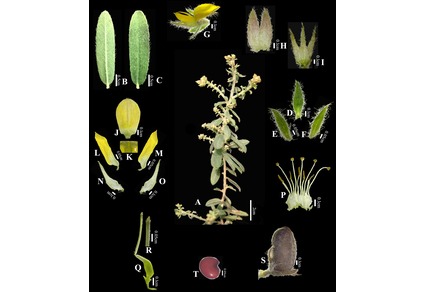
A new species, Crotalaria bilaspurensis (Fabaceae), is described and illustrated from Bilaspur, Chhattisgarh (Central India). Morphologically allied to C. hirta, the new taxon shares several traits, including a pubescent stem, ciliate leaf margins, terminal raceme inflorescence, yellow corolla, bilabiate calyces. However, it differs in a suite of diagnostic features related to floral and vegetative morphology such as plant height, leaf size, inflorescence length, peduncle length, standard apex, keel vestiture, ovary and pod morphology confirmed through detailed micro and macro-morphological observations. The Principal Component Analysis distinctly separates C. bilaspurensis from its closest relative, revealing character combinations and intergroup distances that highlights its taxonomic uniqueness. Molecular phylogenetic analysis based on nuclear ITS sequences further supports its separation, showing consistent nucleotide differences from related taxa. The species is placed in Crotalaria sect. Calycinae and a revised identification key for the genus in the region is provided.
References
- Addinsoft (2006) XLSTAT: Leading Data Analysis and Statistical Solution for Microsoft Excel. Addinsoft, Paris.
- Akaike, H. (1974) A new look at the statistical model identification. IEEE Transactions on Automatic Control 19: 716–723. https://doi.org/10.1109/TAC.1974.1100705
- Ali, S.I. & Qaiser, M. (2017) Flora of Pakistan. Missouri Botanical Garden, St. Louis & Department of Botany, University of Karachi, Karachi. Available from: http://www.efloras.org/florataxon.aspx?flora_id=5&taxon_id=10166
- Almeida, M.R. (1998) Flora of Maharashtra, Fabaceae-Apiaceae, Vol. II. Orient Press, Mumbai, pp. 31–48.
- Ansari, A.A. & Chauhan, V. (2020) A supplement. In: Crotalaria L. in India. Bishen Singh Mahendra Pal Singh, Dehradun, pp. 40–100.
- Ansari, A.A. (2008) Crotalaria in India. Bishen Singh Mahendra Pal Singh, Dehradun, 376 pp.
- Bagheri, A., Maassoumi, A.A., Rahiminejad, M.R. & Blattner, F.R. (2016) Molecular phylogeny and morphological analysis support a new species and new synonymy in Iranian Astragalus (Leguminosae). PLoS ONE 11 (3): e0149726. https://doi.org/10.1371/journal.pone.0149726
- Baker, J.G. (1876) Crotalaria. In: Hooker, J.D. (Ed.) Flora of British India, 2. Reeve & Co., London, pp. 65–85.
- Boatwright, J.S., Le Roux, M.M., Wink, M. & Van Wyk, B.E. (2008) Phylogenetic relationships of tribe Crotalarieae (Fabaceae) inferred from DNA sequences and morphology. Systematic Botany 33: 752–761. https://doi.org/10.1600/036364408786500271
- Boatwright, J.S., Tilney, P.M. & Van Wyk, B.E. (2009) The generic concept of Lebeckia (Crotalarieae, Fabaceae): reinstatement of Calobota and the new genus Wiborgiella. South African Journal of Botany 75: 546–556. https://doi.org/10.1016/j.sajb.2009.06.001
- Boatwright, J.S., Wink, M. & Van Wyk, B.E. (2011) The generic concept of Lotononis (Crotalarieae, Fabaceae): reinstatement of Euchlora, Leobordea and Listia and the new genus Ezoloba. Taxon 60: 161–177. https://doi.org/10.1002/tax.601014
- Cooke, T. (1902) The Flora of the Presidency of Bombay, Vol. 1. Government of India Press, Calcutta, pp. 310–324. https://doi.org/10.5962/bhl.title.10884
- Dalzell, N.A. & Gibson, A. (1861) Bombay Flora, 2 parts. Education Society’s Press, Bombay.
- Danda, S., Subramaniam, S., Rather, S.A. & Pandey, A.K. (2016) A new species of Crotalaria (Fabaceae, Crotalarieae) from Meghalaya, India. Systematic Botany 41 (2): 307–315. https://doi.org/10.1600/036364416x691894
- De Candolle, A.P. (1825) Prodromus Systematis Naturalis Regni Vegetabilis. Crapelet, Paris, pp. 340–437.
- Endress, P.K. (2010) Disentangling confusions in inflorescence morphology. Journal of Systematics and Evolution 48 (4): 225–239. https://doi.org/10.1111/j.1759-6831.2010.00087.x
- ESRI (2002) Data and Maps for ArcGIS. Available from: https://www.lib.ncsu.edu/gis/esri2006.html
- Flores, A.S., Corrêa, A.M., Forni-Martins, E.R. & Azevedo-Tozzi, A.M.G. (2006) Chromosome numbers in Brazilian species of Crotalaria. Botanical Journal of the Linnean Society 151: 271–277. https://doi.org/10.1111/j.1095-8339.2006.00479.x
- Fyson, P.F. (1915) The Flora of the Nilgiri and Pulney Hill-tops, Vol. 1. Government Press.
- Gamble, J.S. (1918) Flora of the Presidency of Madras, Vol. 1. Adlard & Son Ltd., London.
- Gholave, A.R., Madhav, N.A., Gosavi, K.V. & Kambale, S.S. (2021) Crotalaria gajureliana (Fabaceae), a new species from Maharashtra. Nordic Journal of Botany 2022 (1). https://doi.org/10.1111/njb.03359
- Gholave, A.R., Mane, R.N., Gore, R.D., Kambale, S.S. & Gaikwad, S.P. (2019) Crotalaria kanchiana (Fabaceae), a new species from Balaghat Ranges of Maharashtra, India. Phytotaxa 409 (4): 233–238. https://doi.org/10.11646/phytotaxa.409.4.6
- Guindon, S. & Gascuel, O. (2003) A simple, fast and accurate algorithm to estimate large phylogenies by maximum likelihood. Systematic Biology 52: 696–704. https://doi.org/10.1093/sysbio/syq010
- Harris, J.G. & Harris, M.W. (2001) Plant Identification Terminology: An Illustrated Glossary, 2nd ed. Spring Lake Publishing, Utah.
- Heracle BioSoft (2016) DNA Sequence Assembler 4.3. Available from: http://www.dnabaser.com
- Herbarium JCB (2022) J.C. Bose Herbarium. Centre for Ecological Sciences, Indian Institute of Science, Bengaluru. Available from: https://flora-peninsulaindica.ces.iisc.ac.in/ (accessed 7 August 2022)
- Hewson, H.J. (1990) Plant Indumentum: A Handbook of Terminology. Australian Government Publishing Service, Canberra.
- Hickey, M. & King, C. (2007) The Cambridge Illustrated Glossary of Botanical Terms. Cambridge University Press, Cambridge.
- Hijmans, R.J., Cameron, S.E., Parra, J.L., Jones, P.G. & Jarvis, A. (2005) Very high-resolution interpolated climate surfaces for global land areas. International Journal of Climatology 25: 1965–1978. https://doi.org/10.1002/joc.1276
- IMD (2024) India Meteorological Department Raipur. Available from: https://mausam.imd.gov.in/ (accessed 6 August 2026)
- JSTOR Global Plants (2023) JSTOR Global Plants. ITHAKA, New York. Available from: https://plants.jstor.org/ (accessed 21 April 2023)
- Katoh, K. & Standley, D.M. (2013) MAFFT multiple sequence alignment software version 7: improvements in performance and usability. Molecular Biology and Evolution 30: 772–780. https://doi.org/10.1093/molbev/mst010
- Katoh, K. & Standley, D.M. (2016) A simple method to control over-alignment in the MAFFT multiple sequence alignment program. Bioinformatics 32: 1933–1942. https://doi.org/10.1093/bioinformatics/btw108
- Khanna, K.K., Kumar, A. & Jha, A.K. (2005) Floristic diversity of Chhattisgarh: Angiosperms. Bishen Singh Mahendra Pal Singh, Dehradun.
- Krishnaraj, M.V., Tandeyekkal, D. & Mohanan, N. (2013) Crotalaria trichotoma (Fabaceae: Crotalarieae)—a new record to peninsular India. Indian Journal of Forestry 36 (3): 409–410. https://doi.org/10.54207/bsmps1000-2013-872B3H
- Kucharczyk, H. & Kucharczyk, M. (2012) Application of PCA in taxonomy research: Thrips as a model group. In: San-guansat, P. (Ed.) Principal Component Analysis. InTech. https://doi.org/10.5772/37602
- Kumar, S. & Sane, P.V. (2003) Legumes of South Asia: A Checklist. Royal Botanic Gardens, Kew, pp. 140–164.
- Lamarck, J.B.A.P.M. de. (1786) Encyclopédie Méthodique. Botanique, Vol. 2. Panckoucke, Paris, 774 pp.
- Le Roux, M.M., Boatwright, J.S. & Van Wyk, B.E. (2013) A global infrageneric classification system for the genus Crotalaria (Leguminosae). Taxon 62: 957–971. https://doi.org/10.12705/625.1
- Lewis, G., Schrire, B., Mackinder, B. & Lock, M. (2005) Legumes of the World. Royal Botanic Gardens, Kew.
- Linnaeus, C. (1753) Species Plantarum. Laurentius Salvius, Stockholm, 1200 pp.
- Maddison, W.P. & Maddison, D.R. (2009) Mesquite version 3.2: A modular system for evolutionary analysis. Available from: http://mesquiteproject.org
- McAleece, N., Gage, J.D.G., Lambshead, P.J.D. & Paterson, G.L.J. (1997) BioDiversity Professional Statistics Analysis Software. Scottish Association for Marine Science & Natural History Museum, London.
- Naik, M.C. & Singh, L.J. (2021) Dentella cylindrica sp. nov. (Rubiaceae) from Andaman and Nicobar Islands, India. Indian Journal of Forestry 43 (4): 308–314. https://doi.org/10.54207/bsmps1000-2021-67UB28
- Nayar, T.S., Sibi, M. & Rasiya Beegam, A. (2014) Flowering Plants of the Western Ghats, India, Vols. 1–2. JNTBGRI, Thiruvananthapuram.
- Pandey, A., Singh, R., Sharma, K.S. & Bhandari, D.C. (2010) Diversity assessment of useful Crotalaria species in India. Genetic Resources and Crop Evolution 57: 461–470. https://doi.org/10.1007/s10722-009-9517-0
- Panigrahi, G. & Murti, S.K. (1989) Flora of Bilaspur District, Madhya Pradesh. Botanical Survey of India, Kolkata, Vol. 1: 4671.
- Polhill, R.M. (1982) Crotalaria in Africa and Madagascar. A.A. Balkema, Rotterdam.
- Posada, D. (2008) jModelTest: Phylogenetic model averaging. Molecular Biology and Evolution 25: 1253–1256. https://doi.org/10.1093/molbev/msn083
- POWO (2024) Plants of the World Online. Royal Botanic Gardens, Kew, Richmond, U.K. Available from: https://powo.science.kew.org/ (accessed 6 August 2026)
- Rather, S.A., Subramaniam, S., Danda, S. & Pandey, A.K. (2018) Discovery of two new species of Crotalaria from Western Ghats, India. PLoS ONE 13 (2): e0192226. https://doi.org/10.1371/journal.pone.0192226
- Rockinger, A., Flores, A.S. & Renner, S.S. (2017) Clock-dated phylogeny for 48% of the 700 species of Crotalaria. BMC Evolutionary Biology 17: 1–13. https://doi.org/10.1186/s12862-017-0903-5
- Rokade, K., Dalavi, J.V., Gaikwad, N. & Yadav, S. (2019) A new variety of Crotalaria prostrata Roxb. from northern Western Ghats. Phytotaxa 414 (1): 35–40. https://doi.org/10.11646/phytotaxa.414.1.4
- Rokade, K., Dalavi, J.V., Gaikwad, S. & Gaikwad, N. (2020) Crotalaria shrirangiana (Fabaceae), a new rattlepod from Western Ghats, India. Phytotaxa 449 (2): 188–194. https://doi.org/10.11646/phytotaxa.449.2.7
- Ronquist, F. & Huelsenbeck, J.P. (2003) MrBayes 3: Bayesian phylogenetic inference under mixed models. Bioinformatics 19: 1572–1574. https://doi.org/10.1093/bioinformatics/btg180
- Roxburgh, W. (1832) Flora Indica. W. Thacker, Serampore, 745 pp.
- Saleem, F., Singh, L.J. & Pandey, A.K. (2024) Crotalaria andamanica (Fabaceae), a new species from Andaman and Nicobar Islands. Taiwania 69 (1): 67. https://doi.org/10.22541/au.170663769.95438499/v1
- Saleem, F., Singh, L.J., Subramaniam, S. & Pandey, A.K. (2023) Crotalaria nicobarica (Fabaceae), a new species from Andaman and Nicobar Islands. Nordic Journal of Botany e04077. https://doi.org/10.1111/njb.04077
- Sanjappa, M. (1992) Legumes of India. Bishen Singh Mahendra Pal Singh, Dehradun, 132 pp.
- Sanjappa, M. (2020) Flowering Plants of India: A Checklist of Dicotyledones, Vol. 2. Botanical Survey of India, Kolkata.
- Shigwan, B.K., Kulkarni, A., Smrithy, V. & Datar, M.N. (2024) An overview of tree ecology and forest studies in the Northern Western Ghats of India. iForest-Biogeosciences and Forestry 17 (4): 213. https://doi.org/10.3832/ifor4471-017
- Singh, N.P. & Karthikeyan, S. (2000) Flora of Maharashtra State – Dicotyledons, Vol. 1. Botanical Survey of India, Calcutta.
- Sivaramakrishna, P., Yugandhar, P. & Singh, L.J. (2021) Crotalaria lamelliformis from Eastern Ghats, India. Phytotaxa 490 (1): 71–81. https://doi.org/10.11646/phytotaxa.490.1.6
- Stamatakis, A. (2006) RAxML-VI-HPC: Maximum likelihood-based phylogenetic analyses. Bioinformatics 22: 2688–2690. https://doi.org/10.1093/bioinformatics/btl446
- Subramaniam, S. & Pandey, A.K. (2014) Taxonomy and phylogeny of the genus Crotalaria: an overview. Acta Biologica Indica 2 (1): 253–264.
- Subramaniam, S., Pandey, A.K. & Geeta, R. (2013) Molecular systematics of Indian Crotalaria. Plant Systematics and Evolution 299: 1089–1106. https://doi.org/10.1007/s00606-013-0781-2
- Subramaniam, S., Pandey, A.K. & Rather, S.A. (2015) Revised circumscription of the Bracteatae complex in Crotalaria. Plant Systematics and Evolution 301: 2261–2290. https://doi.org/10.1007/s00606-015-1228-8
- Subramaniam, S., Rather, S.A., Danda, S. & Pandey, A.K. (2022) Systematic significance of pod morphology in Indian Crotalaria. Flora 290: 152059. https://doi.org/10.1016/j.flora.2022.152059
- Thiers, B. (2016) Index Herbariorum: A Global Directory of Public Herbaria and Associated Staff. New York Botanical Garden. Available from: http://sweetgum.nybg.org/ih/
- Thompson, J.D., Gibson, T.J., Plewniak, F., Jeanmougin, F. & Higgins, D.G. (1997) The Clustal X windows interface. Nucleic Acids Research 25: 4876–4882. https://doi.org/10.1093/nar/25.24.4876
- Van Wyk, B.E. (2005) Tribe Crotalarieae. In: Lewis, G., Schrire, B., Mackinder, B. & Lock, M. (Eds.) Legumes of the World. Royal Botanic Gardens, Kew, pp. 21–28.
- White, T.J., Bruns, T., Lee, S. & Taylor, J. (1990) Amplification and direct sequencing of fungal ribosomal RNA genes for phylogenetics. In: Innis, M.A., Gelfand, D.H., Sninsky, J.J. & White, T.J. (Eds.) PCR Protocols. Academic Press, New York, pp. 315–322. https://doi.org/10.1016/b978-0-12-372180-8.50042-1
- Wight, R. & Arnott, G.A.W. (1834) Prodromus Florae Peninsulae Indiae Orientalis. Parbury, Allen & Co., London. https://doi.org/10.5962/bhl.title.252