

Abstract
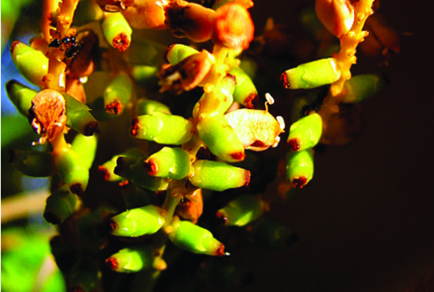
Bactris comprises 79 species with a Neotropical distribution, exhibiting its greatest diversity in humid forests. Bactris glassmanii was described as part of the Flora Neotropica, characterized by staminate flowers with pedicels ca. 1 mm long. Based on field expeditions in the Brazilian Atlantic Forest and analyses of herbarium material, we propose a taxonomic re-delimitation of B. glassmanii into two distinct taxa, including a new species here described, named B. atlantica. They are distinguished mainly by the leaflets’ apex form, number of rachilla, and the size of the staminate flower pedicel. Both are endemic to the Brazilian Atlantic Forest. B. glassmanii occurs in Bahia and Pernambuco states, and B. atlantica occurs from Sergipe to Espírito Santo states, especially in humid forests. The new species is provisionally considered as Endangered (EN) based on IUCN criteria.
References
- Bachman, S., Moat, J., Hill, A.W., de la Torre, J. & Scott, B. (2011) Supporting Red List threat assessments with GeoCAT: geospatial conservation assessment tool. ZooKeys 150: 117–126. https://doi.org/10.3897/zookeys.150.2109
- Beentje, H. (2016) The Kew plant glossary: an illustrated dictionary of plant terms. 2nd edition. Royal Botanic Gardens, Kew, Richmond, Surrey, 185 pp.
- Bernal, R., Galeano, G., Copete, J. & Cámara-Leret, R. (2014) Two new, overlooked species of Bactris endemic to the Colombian Chocó. Palms 58 (1): 35–44.
- CNCFlora (2026) Centro Nacional de Conservação da Flora. Available from: https://cncflora.jbrj.gov.br/portal (accessed 22 May 2026)
- Couvreur, T.L.P., Hahn, W.J., de Granville, J.-J., Pham, J.-L., Ludeña, B. & Pintaud, J.-C. (2007) Phylogenetic relationships of the cultivated neotropical palm Bactris gasipaes (Arecaceae) with its wild relatives inferred from chloroplast and nuclear DNA polymorphisms. Systematic Botany 32 (3): 519–530. https://doi.org/10.1600/036364407782250526
- CRIA (2026) SpeciesLink. Centro de Referência em Informação Ambiental. Available from: https://specieslink.net (accessed 10 March 2026)
- Dias, T.C., Silveira, L.F. & Francisco, M.R. (2023) Spatiotemporal dynamics reveals forest rejuvenation, fragmentation, and edge effects in an Atlantic Forest hotspot, the Pernambuco Endemism Center, northeastern Brazil. PLoS ONE 18 (9): e0291234. https://doi.org/10.1371/journal.pone.0291234
- Dransfield, J. (1986) A guide to collecting palms. Annals of the Missouri Botanical Garden 73: 166–176. https://doi.org/10.2307/2399148
- Dransfield, J., Uhl, N.W., Asmussen, C.B., Baker, W.J., Harley, M.M. & Lewis, C.E. (2008) Genera Palmarum: the evolution and classification of palms. Royal Botanic Gardens, Kew, 732 pp.
- Eiserhardt, W.L., Pintaud, J.-C., Asmussen-Lange, C.B., Hahn, W.J., Bernal, R., Balslev, H. & Borchsenius, F. (2011) Phylogeny and divergence times of Bactridinae (Arecaceae, Palmae) based on plastid and nuclear DNA sequences. Taxon 60 (2): 485–498. https://doi.org/10.1002/tax.602016
- Ferreira, E.J.R. (2001) Anatomical and phylogenetic studies of Bactris and Bactridinae (Palmae: Cocoseae). PhD thesis, The City University of New York, New York.
- Flora e Funga do Brasil (2026) Jardim Botânico do Rio de Janeiro. Available from: http://floradobrasil.jbrj.gov.br (accessed 12 April 2026)
- Henderson, A. (2000) Bactris (Palmae). Flora Neotropica Monograph 79: 1–181.
- IPNI (2026) International Plant Names Index. Available from: https://www.ipni.org (accessed 12 April 2026)
- IUCN (2012) IUCN Red List categories and criteria: version 3.1. 2nd edition. IUCN, Gland & Cambridge.
- Kunth, K.S. (1816) Palmae. In: Humboldt, F.W.H.A. von, Bonpland, A.J.A. & Kunth, K.S. (Eds.) Nova genera et species plantarum, Vol. 1. Ex officina Christophori Plantini, Paris, pp. 298–304.
- Lorenzi, H. (2026) Bactris in Flora e Funga do Brasil. Jardim Botânico do Rio de Janeiro. Available from: https://floradobrasil.jbrj.gov.br/FB15687 (accessed 12 March 2026)
- Mendes, L.J., Milagre, J.C., Morais Júnior, V.T.M. & Coswosk, G.G. (2022) Forest cover analysis of a highly fragmented basin in northern Espírito Santo State, Brazil. Scientia Forestalis 50: e3928. https://doi.org/10.18671/scifor.v50.32
- Mittermeier, R.A., Turner, W.R., Larsen, F.W., Brooks, T.M. & Gascon, C. (2011) Global biodiversity conservation: the critical role of hotspots. In: Zachos, F.E. & Habel, J.C. (Eds.) Biodiversity Hotspots. Springer, London, pp. 3–22. https://doi.org/10.1007/978-3-642-20992-5_1
- QGIS Development Team (2026) QGIS Geographic Information System. Open Source Geospatial Foundation. Available from: https://qgis.org (accessed 28 April 2026)
- Ramos, E.A., Nuvoloni, F.M. & Lopes, E.R.N. (2022) Landscape transformations and loss of Atlantic forests: challenges for conservation. Journal for Nature Conservation 66: 126152. https://doi.org/10.1016/j.jnc.2022.126152
- Ribeiro, M.C., Metzger, J.P., Martensen, A.C., Ponzoni, F.J. & Hirota, M.M. (2009) The Brazilian Atlantic Forest: how much is left, and how is the remaining forest distributed? Implications for conservation. Biological Conservation 142 (6): 1141–1153. https://doi.org/10.1016/j.biocon.2009.02.021
- Scopoli, J.A. (1777) Introductio ad historiam naturalem sistens genera lapidum, plantarum, et animalium: hactenus detecta, caracteribus essentialibus donata, in tribus divisa, subinde ad leges naturae. Prague. https://doi.org/10.5962/bhl.title.10827
- Smith, N. (2015) Palms and people in the Amazon. Springer, New York, 282 pp. https://doi.org/10.1007/978-3-319-05509-1
- Thiers, B. (2026) Index Herbariorum: a global directory of public herbaria and associated staff. The New York Botanical Garden. Available from: http://sweetgum.nybg.org/science/ih/ (accessed 10 March 2026)
- Turland, N.J., Wiersema, J.H., Barrie, F.R., Gandhi, K.N., Gravendyck, J., Greuter, W., Hawksworth, D.L., Herendeen, P.S., Klopper, R.R., Knapp, S., Kusber, W.-H., Li, D.-Z., May, T.W., Monro, A.M., Prado, J., Price, M.J., Smith, G.F. & Zamora Señoret, J.C. (2025) International Code of Nomenclature for algae, fungi, and plants (Madrid Code). Regnum Vegetabile 162. University of Chicago Press, Chicago. https://doi.org/10.7208/chicago/9780226839479.001.0001