

Abstract
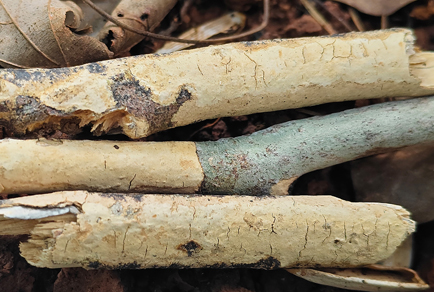
A new species, Vararia subtropica, from Yunnan Province, SW China, is described and illustrated based on morphological characters and phylogenetic analyses. Vararia subtropica is characterized by the cream to buff hymenial surface, a dimitic hyphal system with generative hyphae with clamp connections, and cylindrical, slightly curved to allantoid basidiospores (7.1–11.3 × 2.7–5.2 µm). Sequences of ITS and nLSU were generated from the studied specimens, and phylogenetic analysis was performed with Maximum Likelihood and Bayesian Inference methods. The phylogenetic analysis indicated that the new species belongs to the genus Vararia and is the sister species of V. daweishanensis. A description, illustrations, and phylogenetic analysis results are provided. This discovery expands the known diversity of Vararia in subtropical Asia and improves our understanding of phylogenetic relationships within the genus.
References
- Bernicchia, A. & Gorjón, S.P. (2010) Fungi Europaei 12: Corticiaceae s.l. Edizioni Candusso, Alassio, Italy, 1008 pp.
- Boidin, J. & Lanquetin, P. (1975) Vararia subgenus Vararia (Basidiomycètes Lachnocladiaceae): étude spéciale des espèces d’Afrique intertropicale. Bulletin de la Société Mycologique de France 91 (4): 457–513.
- Boidin, J., Lanquetin, P. & Gilles, G. (1980) Application du concept biologique del'espèce aux Basidiomycètes. Le genre Vararia section Vararia au Gabon. Cryptogamie, Mycologie 1 (4): 265–384. https://doi.org/10.5962/p.354072
- Bougher, N.L. & Barrett, M.D. (2020) Fungi and slime moulds recorded in surveys at Kings Park and Bold Parkurban bushlands Perth, Western Australia. West Australian Naturalist 31 (4): 191–251.
- Case, N.T., Gurr, S.J., Fisher, M.C., Blehert, D.S., Boone, C., Casadevall, A., Chowdhary, A., Cuomo, C.A., Currie, C.R., Denning, D.W., Ene, I.V., Fritz-aylin, K., Gerstein, A.C., Gow, N.A.R., Gusa, A., Iliev, I.D., James, T.Y., Jin, H., Kahmann, R., Klein, B.S., Kronstad, J.W., Ost, K.S., Peay, K.G., Shapiro, R.S., Sheppard, D.C., Shlezinger, N., Stajich, J.E., Stukenbrock, E.H., Taylor, J.W., Wright, G.D., Cowen, E., Heitman, J. & Segre, J.A. (2025) Fungal impacts on Earth’s ecosystems. Nature 638 (8049): 49–57. https://doi.org/10.1038/s41586-024-08419-4
- Chen, J.J., Cui, B.K., Zhou, L.W., Korhonen, K. & Dai, Y.C. (2015) Phylogeny, divergence time estimation, and biogeography of the genus Heterobasidion (Basidiomycota, Russulales). Fungal Diversity 71: 185–200. https://doi.org/10.1007/s13225-014-0317-2
- Cui, B.K., Li, H.J., Ji, X., Zhou, J.L., Song, J., Si, J., Yang, Z.L. & Dai, Y.C. (2019) Species diversity, taxonomy and phylogeny of Polyporaceae (Basidiomycota) in China. Fungal Diversity 97 (1): 137–392. https://doi.org/10.1007/s13225-019-00427-4
- Dai, Y.C., Yang, Z.L., Cui, B.K., Wu, G., Yuan, H.S., Zhou, L.W., He, S.H., Ge, Z.W., Wu, F., Wei, Y.L., Yuan, Y. & Si, J. (2021) Diversity and systematics of the important macrofungi in Chinese forests. Mycosystema 40: 770–805. https://doi.org/10.13346/j.mycosystema.210036
- Deng, Y.L. & Zhao, C.L. (2023) The molecular phylogeny and morphology revealed a new wood-rotting fungus Vararia yunnanensis (Peniophoraceae, Russulales) in Yunnan Province, China. Phytotaxa 583 (1): 39–49. https://doi.org/10.11646/phytotaxa.583.1.4
- Deng, Y.L., Chen, M., Zhang, S.C., Wang, K.S., Liu, W.T., Qiu, Y.H., Dou, Y.T., Liu, X.F., Wijesinghe, S.N., Zhou, H.M., Jabeen, S. & Zhao, C.L. (2026a) Notes, taxonomy and phylogeny of wood-inhabiting fungi in Russulales. Mycosphere 17: e003. https://doi.org/10.48130/mycosphere-0026-0003
- Deng, Y.L., Li, J.F., Zhao, C.L. & Zhao, J. (2024) Four new fungal species in forest ecological system from southwestern China. Journal of Fungi 10: 194. https://doi.org/10.3390/jof10030194
- Deng, Y.L., Wang, K.S., Chen, M., Qiu, Y.H., Liu, W.T., Jabeen, S., Liu, X.F. & Zhao, C.L. (2026b) Addition of four new wood-inhabiting fungi of Russulales (Agaricomycetes, Basidiomycota) from southwestern China. MycoKeys 133: 1–40. https://doi.org/10.3897/mycokeys.133.193737
- Dong, J.H., Li, Q., Yuan, Q., Luo, Y.X., Zhang, X.C., Dai, Y.F., Zhou, Q., Liu, X.F., Deng, Y.L., Zhou, H.M., Muhammad, A. & Zhao, C.L. (2024) Species diversity, taxonomy, molecular systematics and divergence time of wood-inhabiting fungi in Yunnan-Guizhou Plateau, Asia. Mycosphere 15 (1): 1110–1293. https://doi.org/10.5943/mycosphere/15/1/10
- Gilbertson, R.L. (1965) Some species of Vararia from temperate North America. Papers of the Michigan Academy of Science. Arts and Letters 50: 161–184.
- Hibbett, D., Nagy, L.G. & Nilsson, R.H. (2025) Fungal diversity, evolution, and classification. Current Biology 35 (11): R463–R469. https://doi.org/10.1016/j.cub.2025.01.053
- Hu, Y., Karunarathna, S.C., Li, H., Galappaththi, M.C., Zhao, C.L., Kakumyan, P. & Mortimer, P.E. (2022) The impact of drying temperature on basidiospore size. Diversity 14 (4): 239. https://doi.org/10.3390/d14040239
- Kalyaanamoorthy, S., Minh, B.Q., Wong, T.K.F., Haeseler, A.V. & Jermiin, L.S. (2017) ModelFinder: Fast model selection for accurate phylogenetic estimates. Nature Methods 14: 587–589. https://doi.org/10.1038/nmeth.4285
- Katoh, K., Rozewicki, J. & Yamada, K.D. (2019) MAFFT online service: Multiple sequence alignment, interactive sequence choice and visualization. Briefings in Bioinformatics 20 (4): 1160–1166. https://doi.org/10.1093/bib/bbx108
- Kirk, P.M., Cannon, P.F., Minter, D.W. & Stalpers, J.A. (2008) Dictionary of the fungi. 10th ed. CAB International, Wallingford, 771 pp.
- Larsson, A. (2014) AliView: A fast and lightweight alignment viewer and editor for large data sets. Bioinformatics 30 (22): 3276–3278. https://doi.org/10.1093/bioinformatics/btu531
- Larsson, E. & Larsson, K.H. (2003) Phylogenetic relationships of russuloid basidiomycetes with emphasis on aphyllophoralean taxa. Mycologia 95 (6): 1037–1065. https://doi.org/10.1080/15572536.2004.11833020
- Larsson, K.H. (2007) Re-thinking the classification of corticioid fungi. Mycological Research 111 (9): 1040–1063. https://doi.org/10.1016/j.mycres.2007.08.001
- Larsson, K.H., Larsson, E. & Kõljalg, U. (2004) High phylogenetic diversity among corticioid homobasidiomycetes. Mycological Research 108 (9): 983–1002. https://doi.org/10.1017/s0953756204000851
- Leal-Dutra, C.A., Neves, M.A., Griffith, G.W., Reck, M.A., Clasen, L.A. & Dentinger, B.T.M. (2018) Reclassification of Parapterulicium Corner (Pterulaceae, Agaricales), contributions to Lachnocladiaceae and Peniophoraceae (Russulales) and introduction of Baltazaria gen. nov. MycoKeys 37: 39–56. https://doi.org/10.3897/mycokeys.37.26303
- Li, Y., Xu, W.Q., Liu, S.L., Yang, N. & He, S.H. (2023) Species diversity and taxonomy of Scytinostroma sensu stricto (Russulales, Basidiomycota) with descriptions of four new species from China. MycoKeys 98: 133–152. https://doi.org/10.3897/mycokeys.98.105632
- Liu, L.L., Ren, Y.L., Habib, K., Lu, C.T., Wu, Y.P., Long, S.H., Lin, Y., Zhang, X., Kang, Y.Q., Wijayawardene, N.N., Wang, F., Elgorban, A.M., Al-Rejaie, S., Samarakoon, M.C., Shen, X.C. & Li, Q.R. (2025) New taxa of Xylariales from Karst Ecosystems in Southwestern China. Mycosphere 16 (1): 1–78. https://doi.org/10.5943/mycosphere/16/1/1
- Liu, S., Nakasone, K. & He, S. (2019) Michenera incrustata sp. nov. (Peniophoraceae, Russulales) from southern China. Nova Hedwigia 108: 197–206. https://doi.org/10.1127/nova_hedwigia/2018/0500
- Liu, S.L. & He, S.H. (2016) The genus Vararia (Russulales, Basidiomycota) in China. Two new species and two new Chinese records. Nordic Journal of Botany 1756–1051. https://doi.org/10.1111/njb.01170
- Liu, S.L. & He, S.H. (2018) Taxonomy and phylogeny of Dichostereum (Russulales), with descriptions of three new species from southern China. MycoKeys 40: 111–126. https://doi.org/10.3897/mycokeys.40.28700
- Miller, M.A., Pfeiffer, W. & Schwartz, T. (2012) The CIPRES science gateway. Proceedings of the 1st Conference of the Extreme Science and Engineering Discovery Environment: Bridging from the Extreme to the Campus and Beyond: 1–39. https://doi.org/10.1145/2335755.2335836
- Miller, S.L., Larsson, E., Larsson, K.H., Verbeken, A. & Nuytinck, J. (2006) Perspectives in the new Russulales. Mycologia 98 (6): 960–970. https://doi.org/10.1080/15572536.2006.11832625
- Nakasone, K.K. (2015) Taxonomic studies in Chrysoderma, Corneromyces, Dendrophysellum, Hyphoradulum, and Mycobonia. Mycotaxon 130: 369–397. https://doi.org/10.5248/130.369
- Petersen, J.H. (1996) Farvekort. In: The Danish Mycological Society’s Colour-Chart. Foreningen til Svampekundskabens Fremme, Greve,Germany, pp. 1–6.
- Rathnayaka, A.R., Tennakoon, D.S., Jones, G.E., Wanasinghe, D.N., Bhat, D.J., Priyashantha, A.H., Stephenson, S.L., Tibpromma, S. & Karunarathna, S.C. (2025) Significance of precise documentation of hosts and geospatial data of fungal collections, with an emphasis on plant-associated fungi. New Zealand Journal of Botany 63 (2–3): 462–489. https://doi.org/10.1080/0028825X.2024.2381734
- Ronquist, F., Teslenko, M., van der Mark, P., Ayres, D.L., Darling, A., Hӧhna, S., Larget, B., Liu, L., Suchard, M.A. & Huelsenbeck, J.P. (2012) Mrbayes 3.2: efficient Bayesian phylogenetic inference and model choice across a large model space. Systematic Biology 61: 539–542. https://doi.org/10.1093/sysbio/sys029
- Rosenthal, L.M., Larsson, K.H., Branco, S., Chung, J.A., Glassman, S.I., Liao, H.L., Peay, K.G., Smith, D.P., Talbot, J.M., Taylor, J.W., Vellinga, E.C., Vilgalys, R. & Bruns, T.D. (2017) Survey of corticioid fungi in North American pinaceous forests reveals hyperdiversity, underpopulated sequence databases, and species that are potentially ectomycorrhizal. Mycologia 109 (1): 115–127. https://doi.org/10.1080/00275514.2017.1281677
- Si, J., Li, W., Cui, B.K. & Dai, Y.C. (2011) Advances of research on characteristic, molecular biology and applications of laccase from fungi. Biotechnology Bulletin 223: 48–55. https://doi.org/10.13560/j.cnki.biotech.bull.1985.2011.02.018
- Suhara, H., Maekawa, N., Ushijima, S., Kinjo, K. & Hoshi, Y. (2010) Asterostroma species (Basidiomycota) from mangrove forests in Japan. Mycoscience 51 (1): 75–80. https://doi.org/10.1007/S10267-009-0006-2
- Tedersoo, L., Bahram, M., Põlme, S., Kõljalg, U., Yorou, N.S., Wijesundera, R., Villarreal Ruiz, L., Vasco-Palacios, A.M., Thu, P.Q., Suija, A., Smith, M.E., Sharp, C., Saluveer, E., Saitta, A., Rosas, M., Riit, T., Ratkowsky, D., Pritsch, K., Põldmaa, K., Piepenbring, M., Phosri, C., Peterson, M., Parts, K., Pärtel, K., Otsing, E., Nouhra, E., Njouonkou, A.L., Nilsson, R.H., Morgado, L.N., Mayor, J., May, T.W., Majuakim, L., Lodge, D.J., Lee, S.S., Larsson, K.H., Kohout, P., Hosaka, K., Hiiesalu, I., Henkel, T.W., Harend, H., Guo, L.D., Greslebin, A., Grelet, G., Geml, J., Gates, G., Dunstan, W., Dunk, C., Drenkhan, R., Dearnaley, J., De Kesel, A., Dang, T., Chen, X., Buegger, F., Brearley, F.Q., Bonito, G., Anslan, S., Abell, S. & Abarenkov, K. (2014) Fungal biogeography. Global diversity and geography of soil fungi. Science 346 (6213): 1256688. https://doi.org/10.1126/science.1256688
- Vilgalys, R. & Hester, M. (1990) Rapid genetic identification and mapping of enzymatically amplified ribosomal DNA from several Cryptococcus species. Journal of Bacteriology 172: 4238–4246. https://doi.org/10.1128/jb.172.8.4238-4246.1990
- Vu, D., Groenewald, M., Vries, M., Gehrmann, T., Stielow, B. & Eberhardt, U. (2019) Large-scale generation and analysis of filamentous fungal DNA barcodes boosts coverage for kingdom fungi and reveals thresholds for fungal species and higher taxon delimitation. Studies in Mycology 92 (1): 135–154. https://doi.org/10.1016/j.simyco.2018.05.001
- Wang, C.G., Dai, Y.C., Kout, J., Gates, G.M., Liu, H.G., Yuan, Y. & Vlasák, J. (2024) Multi-gene phylogeny and taxonomy of Physisporinus (Polyporales, Basidiomycota). Mycosphere 15: 1455–1521. https://doi.org/10.1080/21501203.2024.2379476
- Wang, C.G., Wu, Y.D., Zhang, X., Dai, Y.C., Li, Z.H. & Yuan, Y. (2025) Studies in phylogeny and divergence times of Irpicaceae and Meripilaceae (Polyporales, Basidiomycota), with an emphasis on Ceriporia and Meripilus including ten new species. IMA Fungus 16: e161336. https://doi.org/10.3897/imafungus.16.161336
- Wang, H., He, X. & Zhao, C.L. (2020) Scytinostroma yunnanense sp. nov. (Russulales, Basidiomycota) evidenced by morphological characteristics and phylogenetic analyses in China. Phytotaxa 451 (2): 145–153. https://doi.org/10.11646/phytotaxa.451.2.4
- Wang, K.S., Deng, Y.L., Zhu, Y.G., Chen, M. & Zhao, C.L. (2026) Molecular phylogeny and morphology reveal a new wood-inhabiting fungal species, Vararia tuberculata (Peniophoraceae, Russulales) from China. Phytotaxa 740 (3): 248–262. https://doi.org/10.11646/phytotaxa.740.3.3
- White, T.J., Bruns, T., Lee, S. & Taylor, J. (1990) Amplification and direct sequencing of fungal ribosomal RNA genes for phylogenetics. In: Innis, M.A., Gelfand, D.H., Sninsky, J.J. & White, T.J. (Eds.) PCR protocols: A guide to methods and applications. Academic Press, San Diego, pp. 315–322. https://doi.org/10.1016/B978-0-12-372180-8.50042-1
- Wijesinghe, S.N., Deng, Y.L., Yuan, Q., Zhou, H.M., Wang, L., Dai, Y.F., Xu, Y., Jiang, N., Al-Otibi, F., Al-Sadi, A.M., Cao, B., Chen, Q., de Silva, N.I., Dong, J.H., Dong, W., Du, T.Y., Gu, Z.R., He, S.Y., Jiang, Q.Q., Li, F., Li, Q., Li, W., Liu, P., Liu, W.X., Liu, X.Y., Liu, Z.B., Lu, W.H., Maharachchikumbura, S.S.N., Su, J.Q., Tang, S.M., Tennakoon, D.S., Wang, X.C., Xiao, W.Y., Xie, M.L., Yang, X., Yang, Y., Yang, Y., Yang, Y.H., Yang, Y.T., Zhang, J.L., Zhang, S.C., Zhang, X.C., Zhang, X.J., Zhou, Q., Al-Kharousi, M., Al-Maqbali, D., Al-Owaisi, A., Al-Yahya'ei, M.N., Han, X.X., Hongsanan, S., Hussain, S., Jin, J.L., Karunarathna, S.C., Li, C.T., Li, S.L., Li, Y., Luo, Z.L., Manawasinghe, I.S., Peng, L.Y., Thongklang, N., Tian, W.H., Tibpromma, S., Velazhahan, R., Xiao, Y.P., Zhang, Z.J., Zhao, H.J., Zhao, R.L., Rathnayaka, A.R., Wanasinghe, D.N., Hyde, K.D. & Zhao, C.L. (2025) Mycosphere Notes 572-624: Exploring the hidden diversity of fungi and fungi-like taxa in different terrestrial microhabitats. Mycosphere 16 (1): 2975–3129. https://doi.org/10.5943/mycosphere/16/1/21
- Wu, F., Zhou, L.W., Vlasák, J. & Dai, Y.C. (2022) Global diversity and systematics of Hymenochaetaceae with poroid hymenophore. Fungal Diversity 113: 1–192. https://doi.org/10.1007/s13225-021-00496-4
- Xu, Y.L., Tian, Y. & He, S.H. (2023) Taxonomy and phylogeny of Peniophora sensu lato (Russulales, Basidiomycota). Journal of Fungi 9 (1): 93. https://doi.org/10.3390/jof9010093
- Yuan, Y., Bian, L.S., Wu, Y.D., Chen, J.J., Wu, F., Liu, H.G., Zeng, G.Y. & Dai, Y.C. (2023) Species diversity of pathogenic wood-rotting fungi (Agaricomycetes, Basidiomycota) in China. Mycology 14 (3): 204–226. https://doi.org/10.1080/21501203.2023.2238779
- Yurchenko, E., Riebesehl, J. & Langer, E. (2020) Fasciodontia gen. nov. (Hymenochaetales, Basidiomycota) and the taxonomic status of Deviodontia. Mycological Progress 19: 171–184. https://doi.org/10.1007/s11557-019-01554-7
- Zhao, C.L., Qu, M.H., Huang, R.X. & Karunarathna, S.C. (2023) Multi-gene phylogeny and taxonomy of the wood-rotting fungal genus Phlebia sensu lato (Polyporales, Basidiomycota). Journal of Fungi 9: 320. https://doi.org/10.3390/jof9030320
- Zhao, H., Cui, Y.J., Guan, Q.X., Wang, K., Zhuang, L., Zeng, G.Y., Wei, Y.L., Wu, F. & Yuan, H.S. (2025) Global species diversity and distribution patterns within the order Hymenochaetales (Agaricomycetes, Basidiomycota). Mycosphere 16 (1): 3257–3280. https://doi.org/10.5943/mycosphere/16/1/24
- Zhao, H., Yuan, H.S., Cui, Y.J., Wang, K., Wu, F., Dai, Y.C. & Yuan, Y. (2026) Global polypores funga and distribution patterns. Fungal Diversity 136: 136002. https://doi.org/10.65390/fdiv.2026.136002
- Zhou, M., Dai, Y.C., Vlasák, J., Liu, H.G. & Yuan, Y. (2023) Updated systematics of Trichaptum s.l. (Hymenochaetales, Basidiomycota). Mycosphere 14 (1): 815–917. https://doi.org/10.5943/mycosphere/14/1/11
- Zou, L., Zhang, X.L., Deng, Y.L. & Zhao, C.L. (2022) Four new wood-inhabiting fungal species of Peniophoraceae (Russulales, Basidiomycota) from the Yunnan-Guizhou Plateau, China. Journal of Fungi 8 (11): 1227. https://doi.org/10.3390/jof8111227