
Abstract
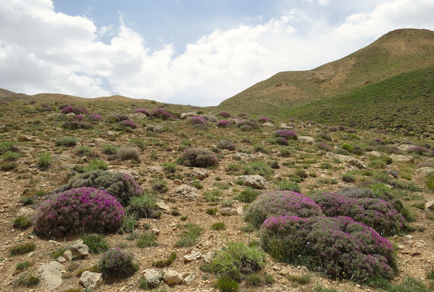
This study investigates the floristic diversity of Fabaceae in Eastern Alborz (Semnan Province, Iran). A comprehensive floristic survey was conducted based on field collections and the identification of specimens housed in the herbarium of Damghan University (DU). A total of 143 species, representing 24 genera, were identified. Among these, six species, Astragalus glycyphylloides, A. pseudocyclophyllus, Medicago rigidula, Ononis spinosa, Oxytropis kopetdaghensis, and Vicia villosa, were newly recorded for the study area. Astragalus, comprising 87 species, was the most species-rich genus, followed by Oxytropis (8 species), Vicia and Onobrychis (6 species each), and Trifolium and Medicago (5 species each). Phytogeographical analysis revealed that approximately 76% of the species are Irano-Turanian elements. Regarding the life-form spectrum, hemicryptophytes were dominant with 89 species (62.24%), followed by chamaephytes (32 species, 22.38%), while other life forms were less represented. Furthermore, 61 species were identified as endemic to Iran, of which 49 belong to the genus Astragalus, highlighting the major contribution of this genus in the regional flora. These results improve our knowledge of the diversity and distribution of Fabaceae in Eastern Alborz.
References
- Abubakar, I., Bello, B.M., Tukur, K., Maiakwai, N.S. & Sani, M.M. (2023) Checklist, diversity and abundance of the flora in some selected local government of Zamfara State, northwestern Nigeria. UMYU Scientifica 2 (3): 153–164. https://doi.org/10.56919/usci.2323.021
- Akhani, H., Mahdavi, P., Noroozi, J. & Zarrinpour, V. (2013) Vegetation patterns of the Irano-Turanian steppe along a 3,000 m altitudinal gradient in the Alborz Mountains of Northern Iran. Folia Geobotanica 48 (2): 229–255. https://doi.org/10.1007/s12224-012-9147-8
- Amirabadizadeh, H., Assadi, M., Nemati Peykani, M., Janighorban, M., Jalilian, N., Maassoumi, A.A., Small, E., Zaeifi, M., Abbassi, M., Naanaie, S.Y., Jafari, A., Pooyan, P., Ghahremaninejad, F., Chaghamirzaei, E., Amirkosravi, A. & Mehregan, I. (2023) Fabaceae p.p. In: Assadi, M. & Maassoumi, A.A. (Eds.) Flora of Iran, vol. 177. Research Institute of Forests and Rangelands, Tehran, 934 pp. [in Persian]
- Angelo, R. & Boufford, D.E. (2013) Atlas of the flora of New England: Fabaceae. Phytoneuron 2 (115): 1–121.
- Assadi, M., Maassoumi, A.A. & Mozaffarian, V. (Eds.) (1988–2023) Flora of Iran, vols. 1–183. Research Institute of Forests and Rangelands Publications, Tehran. [in Persian]
- Attar, F., Maroofi, H., Mirtadzadini, M. & Sotoodeh, A. (2022) Two new species of genus Cousinia (Asteraceae, Cardueae) from W and NE Iran. Nova Biologica Reperta 9 (2): 144–152. https://doi.org/10.52547/nbr.9.2.144
- Bardsiri, A., Naderi, R. & Amirahmadi, A. (2017a) Plant diversity of Sarband hunting prohibited area (Dibaj, Semnan Province). Taxonomy and Biosystematics 9 (31): 1–28. https://doi.org/10.22108/TBJ.2018.105253.1029
- Bardsiri, A., Naderi, R., Amirahmadi, A., Faghir, M.B. & Mirtadzadini, M. (2017b) Drymocallis damghanensis (Rosaceae), a new species from Iran. Annales Botanici Fennici 54: 33–37. https://doi.org/10.5735/085.054.0306
- Bridson, D. & Forman, L. (1992) The herbarium handbook. Royal Botanic Gardens, Kew, 303 pp.
- Bruneau, A., Mercure, M., Lewis, G.P. & Herendeen, P.S. (2013) Legume phylogeny and classification in the 21st century: Progress, prospects and lessons for other species–rich clades. Taxon 62 (2): 217–248. https://doi.org/10.12705/622.8
- Chrtková-Žertová, A., Van Der Maesen, L.J.G. & Rechinger, K.H. (1979) Papilionaceae I., Vicieae. In: Rechinger, K.H. (Ed.) Flora Iranica, vol. 140. Akademische Druck- u. Verlagsanstalt, Graz, 89 pp.
- Dash, D. & Deole, S. (2019) Review on the role of biological nitrogen fixation in the environmental terms. International Journal of Current Microbiology and Applied Sciences 8 (8): 2670–2679. https://doi.org/10.20546/ijcmas.2019.808.308
- Fayaz, M. (2016) Ecological regions of Iran, vegetation types of Semnan province. Research Institute of Forest and Rangelands, Tehran, 154 pp.
- Frey, W. & Probst, W. (1986) Contributions to the vegetation of Southwest Asia. In: Kürschner, H. (Ed.) Dr. Ludwig Reichert, Wiesbaden, pp. 9–43.
- GBIF (2025) GBIF Home Page. Available from: https://www.gbif.org/ (accessed during plants identification, 2009-2025)
- Ghazanfar, S.A. & McDaniel, T. (2016) Floras of the Middle East: A quantitative analysis and biogeography of the flora of Iraq. Edinburgh Journal of Botany 73 (1): 1–24. https://doi.org/10.1017/S0960428615000244
- Gholipour, A. (2021) Silene aminiradii (Caryophyllaceae), an interesting alpine plant in Iran. Novon: A Journal for Botanical Nomenclature 29 (1): 195–199. https://doi.org/10.3417/2021693
- Ghorbani, M. (2021a) Geological setting and crustal structure of Iran. In: The geology of Iran: Tectonic, magmatism and metamorphism (Earth and Environmental Sciences Library). Springer, Cham, pp. 1–22. https://doi.org/10.1007/978-3-030-71109-2_1
- Ghorbani, M. (2021b) Structural units of Iran. In: The geology of Iran: Tectonic, magmatism and metamorphism (Earth and Environmental Sciences Library). Springer, Cham, pp. 23–80. https://doi.org/10.1007/978-3-030-71109-2_2
- Gore, R. & Gaikwad, S. (2015) Checklist of Fabaceae Lindley in Balaghat Ranges of Maharashtra, India. Biodiversity Data Journal 3: e4541. https://doi.org/10.3897/BDJ.3.e4541
- Hansen, A.P. (2017) Legume–rhizobium symbioses: Significance for sustainable plant production. In: Varma, A. & Sharma, A.K. (Eds.) Modern tools and techniques to understand microbes. Springer International Publishing, Cham, pp. 159–182. https://doi.org/10.1007/978-3-319-49197-4_8
- Harris, S. (2004) Woody legumes (excluding Acacias). In: Burley, J. (Ed.) Encyclopedia of forest sciences. Elsevier, pp. 1793–1797. https://doi.org/10.1016/B0-12-145160-7/00198-8
- IPNI (2025) International Plant Names Index. The Royal Botanic Gardens, Kew, Harvard University Herbaria & Libraries and Australian National Herbarium.
- Jafari, F., Mirtadzadini, M., Gholipour, A., Rabeler, R., Oxelman, B. & Zarre, S. (2019) Notes on the genus Silene (Caryophyllaceae, Sileneae) in Iran. Phytotaxa 425 (1): 35–48. https://doi.org/10.11646/phytotaxa.425.1.3
- Kebede, E. (2021) Contribution, utilization, and improvement of legumes-driven biological nitrogen fixation in agricultural systems. Frontiers in Sustainable Food Systems 5: 767998. https://doi.org/10.3389/fsufs.2021.767998
- LPWG (2017) A new subfamily classification of the Leguminosae based on a taxonomically comprehensive phylogeny. Taxon 66: 44–77. https://doi.org/10.12705/661.3
- Maassoumi, A.A. (1990) Illustrated guide of the genus Astragalus in Iran, vol. 1. Research Institute of Forests and Rangelands, Tehran, 200 pp.
- Maassoumi, A.A. (1993) Illustrated guide of the genus Astragalus in Iran, vol. 2. Research Institute of Forests and Rangelands, Tehran, 200 pp.
- Maassoumi, A.A. (2003a) Illustrated guide of the genus Astragalus in Iran, vol. 3. Research Institute of Forests and Rangelands, Tehran, 200 pp.
- Maassoumi, A.A. (2003b) Papilionaceae: Astragalus L. I. In: Assadi, M. & Maassoumi, A.A. (Eds.) Flora of Iran, vol. 43. Research Institute of Forests and Rangelands, Tehran, 386 pp. [in Persian]
- Maassoumi, A.A. (2005) The genus Astragalus in Iran, vol. 5. Research Institute of Forests and Rangelands, Tehran, 786 pp. [in Persian]
- Maassoumi, A.A. (2016) Fabaceae: Astragalus L. II. In: Assadi, M. & Maassoumi, A.A. (Eds.) Flora of Iran, vol. 85. Research Institute of Forests and Rangelands, Tehran, 504 pp. [in Persian]
- Maassoumi, A.A. (2018) Fabaceae: Astragalus L. III. In: Assadi, M. & Maassoumi, A.A. (Eds.) Flora of Iran, Vol. 145. Research Institute of Forests and Rangelands, Tehran, 766 pp. [in Persian]
- Mehregan, I. & Assadi, M. (2016) A synopsis of Cousinia sect. Pseudactinia (Cardueae, Asteraceae) including a new species from NE Iran. Phytotaxa 257 (3): 271–279. https://doi.org/10.11646/phytotaxa.257.3.5
- Memariani, F., Zarrinpour, V. & Akhani, H. (2016) A review of plant diversity, vegetation, and phytogeography of the Khorassan-Kopet Dagh floristic province in the Irano-Turanian region (northeastern Iran-southern Turkmenistan). Phytotaxa 249 (1): 8–30. https://doi.org/10.11646/phytotaxa.249.1.4
- Morais, V.A., Silva, L.B., de Araujo, E.J., Curto, R.D. & dos Santos Ataíde, D.H. (2024) Unveiling the botanical treasures of the amazon: the magnificent legacy of the Fabaceae family. Concilium 24 (5): 217–236. https://doi.org/10.53660/clm-3063-24e26
- Naderi, R., Maassoumi, A.A., Amirahmadi, A. & Rahnama, F. (2025) Astragalus tangeh-zendanensis (sect. Incani DC.), a new species from Eastern Alborz, Iran, based on morphological and molecular evidence. Nordic Journal of Botany 2025 (5): e04650. https://doi.org/10.1111/njb.04650
- Naderi, R., Zakeri, A. & Afsharian, M.H. (2021) Identification of medicinal plants of Semnan province: description, distribution and therapeutic properties. Damghan University, Damghan, 364 pp. [in Persian]
- Najafi, M.S. & Alizadeh, O. (2023) Climate zones in Iran. Meteorological Applications 30 (5): e2147. https://doi.org/10.1002/met.2147
- Noroozi, J., Khalvati, S., Nafisi, H., Kaveh, A., Nazari, B., Zare, G., Minaei, M., Vitek, E. & Schneeweiss, G.M. (2021) Endemics determine bioregionalization in the alpine zone of the Irano-Anatolian biodiversity hotspot (South-West Asia). Alpine Botany 131: 177–186. https://doi.org/10.1007/s00035-021-00266-7
- Noroozi, J., Minaei, M., Khalvati, S., Kaveh, A., Nafisi, H., Nazari, B., Zare, G., Vitek, E., Hülber, K. & Schneeweiss, G.M. (2023) Hotspots of (sub)alpine plants in the Irano-Anatolian global biodiversity hotspot are insufficiently protected. Diversity & Distributions 29: 244–253. https://doi.org/10.1111/ddi.13656
- Noroozi, J., Talebi, A. & Doostmohammadi, M. (2020) The Alborz Mountain Range. In: Noroozi, J. (Ed.) Plant Biogeography and Vegetation of High Mountains of Central and South-West Asia. Springer International Publishing, Cham, pp. 117–149. https://doi.org/10.1007/978-3-030-45212-4_4
- Noroozi, J., Talebi, A., Doostmohammadi, M., Manafzadeh, S., Asgarpour, Z. & Schneeweiss, G.M. (2019) Endemic diversity and distribution of the Iranian vascular flora across phytogeographical regions, biodiversity hotspots and areas of endemism. Scientific Reports 9 (1): 12991. https://doi.org/10.1038/s41598-019-49417-1
- Noroozi, J., Talebi, A., Doostmohammadi, M., Rumpf, S.B., Linder, H.P. & Schneeweiss, G.M. (2018) Hotspots within a global biodiversity hotspot-areas of endemism are associated with high mountain ranges. Scientific Reports 8: 1–10. https://doi.org/10.1016/j.biocon.2019.07.005
- Perrino, E.V. & Calabrese, G. (2018) Endangered segetal species in southern Italy: distribution, conservation status, trends, actions and ethnobotanical notes. Genetic Resource and Crop Evolution 65 (8): 2107–2134. https://doi.org/10.1007/s10722-018-0678-6
- Podlech, D. (1999) Astragalus L. In: Rechinger, K.H. (Ed.) Flora Iranica, vol. 174. Akademische Druck- u. Verlagsanstalt, Graz, 350 pp.
- Podlech, D., Maassoumi, A.A. & Zarre, Sh. (2012) Astragalus L. V. In: Rechinger, K.H. & Rechinger, W. (Eds.) Flora Iranica, vol. 179. Verlag des Naturhistorischen Museums, Wien, 312 pp.
- Podlech, D., Zarre, Sh. & Maassoumi, A.A. (2001) Astragalus L. II. In: Rechinger, K.H. & Rechinger, W. (Eds.) Flora Iranica, vol. 175. Akademische Druck- u. Verlagsanstalt, Salzburg, 197 pp.
- Podlech, D., Zarre, Sh., Maassoumi, A.A., Ekici, M. & Sytin, A. (2010) Astragalus L. IV. In: Rechinger, K.H. & Rechinger, W. (Eds.) Flora Iranica, vol. 178. Verlag des Naturhistorischen Museums, Wien, 430 pp.
- Pourebrahim, S., Kazempour-Osaloo, S. & Maassoumi, A.A. (2024) Contributions to Astragalus sect. Dissitiflori in the light of morphological and molecular evidence: a new species and a new resurrect. Phytotaxa 668 (3): 258–272. https://doi.org/10.11646/phytotaxa.668.3.3
- Rahnama, F., Naderi, R. & Amirahmadi, A. (2024a) Floristic composition, life forms and phytogeography of the mountains between Damghan and Shahrud, Eastern Alborz (Iran). Phytotaxa 640 (3): 258–278. https://doi.org/10.11646/phytotaxa.640.3.1
- Rahnama, F., Naderi, R., Amirahmadi, A., Noroozi, J., Mahmoodi, M. & Mirtadzadini, M. (2024b) A botanical expedition in Eastern Alborz (Iran): rare plant species and assessing their conservation status. Phytotaxa 642 (1): 1–28. https://doi.org/10.11646/phytotaxa.642.1.1
- Ramzi, S., Noroozi, J., Gholizadeh, H., Hamzeh’ee, B., Asri, Y., Talebi, A., Moradi, H., Mahdavi, P., Tamjidi Eramsadati, S.S., Zarezadeh, S., Kamrani, A., Esmailzadeh, O., Ghorbanalizadeh, A., Bashirzadeh, M., Jalili, A., Sharifi, J., Moradi, A., Bidarlord, M., Siadati, S., Lotfi, S., Attar, F., Mohammadpour Darzi, M., Kazemi Gorji, Z., Ghasemi, S., Dehghani, M., Rahmanian, S., Esmailpoor, A., Sanaei, A., Ghafari, S., Ashouri, P., Ali, A., Dehghani, A., Hosseini, S., Hamedani, H., Tirgan, S., Maghsoudi, M., Daneshi, A., Eshaghi Rad, J., Eslami, M., Ramezani, M., Mehrabi, Z., Naqipour, Z., Naseri, N., Bahari, H., Ashouri, M., Vasefi, N., Seyedakhlaghi, S.A., Ejtehadi, H., Farzam, M., Mokhtari, S., Djamali, M., Ramezani, E., Zare, H., Masudian, N., Alinejad, R., Kasiri, M., Hosseini, M.S., Raeisi, M., Ravanbakhsh, H., Essl, F., Jalilvand, H., Abedi, M., Bahalkeh, K.& Naqinezhad, A. (2024) IranVeg–the Vegetation Database of Iran: Current status and the way forward. Vegetation Classification and Survey 5: 237–256. https://doi.org/10.3897/VCS.114081
- Raunkiaer, C. (1934) The life forms of plants and statistical plant geography. Clarendon Press, Oxford, 632 pp.
- Rechinger, K.H. (1963–2015) Flora Iranica, vols. 1–181. Akademische Druck-u. Verlagsanstalt, Graz.
- Rechinger, K.H., Ali, S.I., Browicz, K., Chrtková-Žertová, A., Heller, D., Heyn, C.C., Thulin, M. & Vassilczenko, I.T. (1984) Papilionaceae II. In: Rechinger, K.H. (Ed.) Flora Iranica, vol. 157. Akademische Druck- u. Verlagsanstalt, Graz, 499 pp.
- Rosa, E. (2017) Enhancing legume growing through sustainable cropping for protein supply. Journal of the Science of Food and Agriculture 98 (4): 1267–1275. https://doi.org/10.1002/jsfa.8569
- Smýkal, P., Coyne, C.J., Ambrose, M.J., Maxted, N., Schaefer, H., Blair, M.W., Berger, J., Greene, S.L., Nelson, M.N., Besharat, N., Vymyslický, T., Toker, C., Saxena, R.K., Roorkiwal, M., Pandey, M.K., Hu, J., Li, Y.H., Wang, L.X., Guo, Y., Qiu, L.J., Redden, R.J. & Varshney, R.K. (2015) Legume crops phylogeny and genetic diversity for science and breeding. Critical Reviews in Plant Sciences 34 (1–3): 43–104. https://doi.org/10.1080/07352689.2014.897904
- Stinca, A., Chianese, G., D’Auria, G., Fascetti, S., Ravo, M., Romano, V.A., Salerno, G., Astuti, G., Bartolucci, F., Bernardo, L., Bonari, G., Bouvet, D., Cancellieri, L., Carli, E., Caruso, G., Catalano, I., Cennamo, G.D., Ciaschetti, G., Conti, F., Di Pietro, R., Fortini, P., Gangale, C., Lapenna, M.R., Lattanzi, E., Marcucci, R., Peccenini, S., Pennesi, R., Perrino, E.V., Peruzzi, L., Roma-Marzio, F., Scoppola, A., Tilia, A., Villani, M. & Rosati, L. (2019) Contribution to the floristic knowledge of eastern Irpinia and Vulture-Melfese area. Italian Botanist 8: 1–16. https://doi.org/10.3897/italianbotanist.8.37818
- Takhtajan, A. (1986) Floristic Regions of the World. University of California Press, Berkeley, 544 pp.
- Victor, J.E., Koekemoer, M., Fish, L., Smithies, Sh. & Mӧessmer, M. (2004) Herbarium essentials: the southern African herbarium user manual. Southern African Botanical Diversity Network Report No. 25, Pretoria, 93 pp.
- Wagensommer, R.P., Marrese, M., Perrino, E.V., Bartolucci, F., Cancellieri, L., Carruggio, F., Conti, F., Di Pietro, R., Fortini, P., Galasso, G., Lattanzi, E., Lavezzo, P., Longo, D., Peccenini, S., Rosati, L., Russo, G., Salerno, G., Scoppola, A., Soldano, A., Stinca, A., Tilia, A., Turco, A., Medagli, P. & Forte, L. (2014) Contributo alla conoscenza floristica della Puglia: resoconto dell’escursione del Gruppo di Floristica (S.B.I.) nel 2011 nel settore meridionale dei Monti della Daunia. Informatore Botanico Italiano 46 (2): 175–208.
- Wojciechowski, M.F. (2005) Astragalus (Fabaceae): a molecular phylogenetic perspective. Brittonia 57 (4): 382–396. https://doi.org/10.1663/0007-196X(2005)057[0382:AFAMPP]2.0.CO;2
- Yahara, T., Javadi, F., Onoda, Y., Paganucci de Queiroz, L., Faith, D.P., Prado, D.E., Akasaka, M., Kadoya, T., Ishihama, F., Davies, S., Slik, J.W.F., Yi, T., Ma, K., Bin, C., Darnaedi, D., Pennington, R.T., Tuda, M., Shimada, M., Ito, M., Egan, A.N., Buerki, S., Raes, N., Kajita, T., Vatanparast, M., Mimura, M., Tachida, H., Iwasa, Y., Smith, G.F., Victor, J.E. & Nkonki, T. (2013) Global legume diversity assessment: concepts, key indicators, and strategies. Taxon 62 (2): 249–266. https://doi.org/10.12705/622.12
- Zaheri, A., Naderi, R. & Amirahmadi, A. (2024) Possible extinction of Eversmannia subspinosa in Eastern Alborz by 2060 due to climate change: a MaxEnt study. Theoretical and Applied Climatology 155 (7): 6917–6929. https://doi.org/10.1007/s00704-024-05047-w
- Zarre, Sh., Maassoumi, A.A. & Podlech, D. (2008) Astragalus L. III. In: Rechinger, K.H. & Rechinger, W. (Eds.) Flora Iranica, vol. 177. Verlag des Naturhistorischen Museums, Wien, 124 pp.
- Zohary, M. (1973) Geobotanical foundations of the Middle East. Gustav Fischer Verlag, Stuttgart, 765 pp.