
Abstract
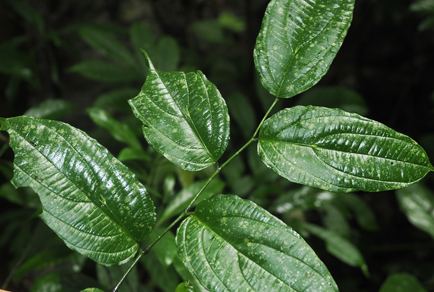
Stichoneuron Hooker (1883: 747) is a genus of small perennial herbs in Stemonaceae (Pandanales), distinguished from the other genera of the family, Croomia, Stemona and Pentastemona, by erect or procumbent, branched and perennial stems, four free tepals and stamens and presence of pseudo-funicles (Duyfjes 1993, Inthachub et al. 2009). Currently, five species are known in Stichoneuron: one species, S. membranacea Hooker (1892: 299) is distributed in India and northern Myanmar, and four species, S. bognerianum Duyfjes in Inthachub et al. (2009: 219), S. calcicola Inthachub in Inthachub et al. (2009), S. caudatum Ridley (1911: 107) and S. halabalensis Inthachub in Inthachub et al. (2009), are known from Malay Peninsula of Thailand and Malaysia (Gagnepain 1934, Tanaka et al. 2007, Inthachub et al. 2009, Duyfjes & Inthachub 2011, Majumdar & Datta 2013, POWO 2026). Here, we describe an additional species of Stichoneuron from Laos, which was discovered during a field survey in the forests on limestone hills in Kasi District, Vang Vieng Province, central Laos.
References
- Duyfjes, B.E.E. (1993) Stemonaceae. In: van Steenis, C.G.G.J. (Ed.) Flora Malesiana, ser. I, Spermatophyta 11. Noordhoff-Kolff, Jakarta, pp. 399–409.
- Duyfjes, B.E.E. & Inthachub, P. (2011) Stemonaceae. In: Santisuk, T. & Larsen, K. (Eds.) Flora of Thailand, vol. 11. The Forest Herbarium, National Park, Wildlife and Plant Conservation Department, Bangkok, pp. 74–99.
- Gagnepain, F. (1934) Stemonaceés. In: Lecomte, M.H. & Gagnepain, F. (Eds.) Flore générale de l'Indo-Chine, vol. 6. Masson, Paris, pp. 745–7533.
- Hooker, J.D. (1883) Roxburghiaceae. In: Bentham, G. & Hooker, J.D. (Eds.) Genera plantarum, vol. 2. Reeve, London, pp. 746–747.
- Inthachub, P., Vajrodaya, S. & Duyfjes, B.E.E. (2009) Review of the genus Stichoneuron (Stemonaceae). Edinburgh Journal of Botany 66: 213–288. https://doi.org/10.1017/S0960428609005368
- IUCN (2024) Guidelines for using the IUCN Red List categories and criteria, version 16. Prepared by the IUCN Standards and Petitions Committee. Available from: https://www.iucnredlist.org/documents/RedListGuidelines.pdf (accessed 8 April 2025)
- Majumdar, K. & Datta, B.K. (2013) Fruit and seed discoveries in Stichoneuron membranaceum Hook.f. (Stemonaceae): an endemic to Indo-Myanmar. Modern Phytomorphology 3: 39–44.
- Newman, M.F., Pullan, M., Souladeth, P., Ketphanh, S., Svengsuksa, B., Thomas, P., Sengdala, K., Lamxay, V. & Armstrong, K. (2017–present) A checklist of the vascular plants of Lao PDR. Online database available at: https://padme.rbge.org.uk/laos/ (accessed 2 April 2025)
- POWO (2026) Plants of the World online. Facilitated by the Royal Botanic Gardens, Kew. Published on the Internet; https://powo.science.kew.org/ (accessed 15 February 2026)
- Ridley, J. (1911) A scientific expedition to Temengoh, Upper Perak. Journal of Straits Branch of the Royal Asiatic Society 57: 5–122.
- Tanaka, N., Tanaka, N., Ohi-Toma, T. & Murata, J. (2007) New or noteworthy plant collections from Myanmar (2) Aponogeton lakhonensis, Cryptocoryne cruddasiana, C. cripatula var. balansae and Stichoneuron membranaceum. Journal of Japanese Botany 82: 266–273. https://doi.org/10.51033/jjapbot.82_5_9992