
Abstract
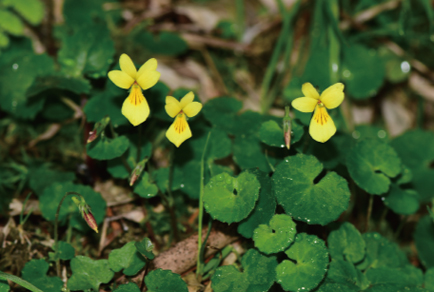
Viola shennongjiaensis (Violaceae), a new species endemic to the Shennongjia Forestry District, Hubei Province, China, is described and illustrated. Morphologically, it is assigned to V. sect. Chamaemelanium and is most similar to V. biflora and V. wallichiana, but differs from both species by the combination of slender, elongate rhizomes and densely puberulous leaf blades, and most notably by its markedly longer cylindrical spur. Phylogenetic analyses based on nuclear single-copy genes resolve V. shennongjiaensis as a distinct lineage that is strongly supported as sister to V. delavayi. Under a combined morphological and phylogenetic species concept, the observed differences justify recognition as a distinct species.
References
- Anisimova, M., Gil, M., Dufayard, J.F., Dessimoz, C. & Gascuel, O. (2011) Survey of branch support methods demonstrates accuracy, power, and robustness of fast likelihood-based approximation schemes. Systematic Biology 60 (5): 685–699. https://doi.org/10.1093/sysbio/syr041
- Ballard, H.E., Kartesz, J.T. & Nishino, M. (2023) A taxonomic treatment of the violets (Violaceae) of the northeastern United States and adjacent Canada. The Journal of the Torrey Botanical Society 150 (1): 3–266. https://doi.org/10.3159/TORREY-D-22-00029.1
- Boissieu, H. de (1901) Viola cameleo. Bulletin de l’Herbier Boissier sér. 2, 1 (11): 1074.
- Candolle, A.P. de (1824) Prodromus systematis naturalis regni vegetabilis, vol. 1. Treuttel et Würtz, Paris, 748 pp. https://doi.org/10.5962/bhl.title.286
- Capella-Gutiérrez, S., Silla-Martínez, J.M. & Gabaldón, T. (2009) trimAl: a tool for automated alignment trimming in large-scale phylogenetic analyses. Bioinformatics 25 (15): 1972–1973. https://doi.org/10.1093/bioinformatics/btp348
- Chen, Y.S., Yang, Q.E., Ohba, H. & Nikitin, V.V. (2007) Violaceae. In: Wu, Z.-Y., Raven, P.H. & Hong, D.-Y. (Eds.) Flora of China, vol. 13. Science Press, Beijing & Missouri Botanical Garden Press, St. Louis, pp. 72–111.
- Flicker, B.J. & Ballard, H.E. (2015) Afrohybanthus (Violaceae), a new genus for a group of species long assigned to Hybanthus. Phytotaxa 230 (1): 39–53. https://doi.org/10.11646/phytotaxa.230.1.3
- Franchet, A.R. (1886) Viola delavayi. Bulletin de la Société Botanique de France 33: 413. https://doi.org/10.1080/00378941.1886.10828441
- Gingins de la Sarraz, F.C.J. de (1823) Mémoire sur la famille des Violacées. Mémoires de la Société de Physique et d’Histoire Naturelle de Genève 2 (1): 1–28.
- Guindon, S., Dufayard, J.F., Lefort, V., Anisimova, M., Hordijk, W. & Gascuel, O. (2010) New algorithms and methods to estimate maximum-likelihood phylogenies: assessing the performance of PhyML 3.0. Systematic Biology 59 (3): 307–321. https://doi.org/10.1093/sysbio/syq010
- Hall, T.A. (1999) BioEdit: a user-friendly biological sequence alignment editor and analysis program for Windows 95/98/NT. Nucleic Acids Symposium Series 41: 95–98.
- Huang, Y.S., Ding, J.H., Ye, Q.L., Dai, J.M., Zhong, Z.M. & Fan, Q. (2023) Four new species of Viola (Violaceae) from southern China. Nordic Journal of Botany 2023: e03941. https://doi.org/10.1111/njb.03941
- Johnson, M.G., Gardner, E.M., Liu, Y., Medina, R., Goffinet, B., Shaw, A.J., Zerega, N.J.C. & Wickett, N.J. (2016) HybPiper: extracting coding sequence and introns for phylogenetics from high–throughput sequencing reads using target enrichment. Applications in Plant Sciences 4 (7): 1600016. https://doi.org/10.3732/apps.1600016
- Johnson, M.G., Pokorny, L., Dodsworth, S., Botigué, L.R., Cowan, R.S., Devault, A., Eiserhardt, W.L., Epitawalage, N., Forest, F., Kim, J.T., Leebens-Mack, J.H., Leitch, I.J., Maurin, O., Soltis, D.E., Soltis, P.S., Wong, G.K-S., Baker, W.J. & Wickett, N.J. (2019) A universal probe set for targeted sequencing of 353 nuclear genes from any flowering plant designed using k-medoids clustering. Systematic Biology 68 (4): 594–606. https://doi.org/10.1093/sysbio/syy086
- Kalyaanamoorthy, S., Minh, B.Q., Wong, T.K.F., von Haeseler, A. & Jermiin, L.S. (2017) ModelFinder: fast model selection for accurate phylogenetic estimates. Nature Methods 14 (6): 587–589. https://doi.org/10.1038/nmeth.4285
- Katoh, K. & Standley, D.M. (2013) MAFFT multiple sequence alignment software version 7: improvements in performance and usability. Molecular Biology and Evolution 30 (4): 772–780. https://doi.org/10.1093/molbev/mst010
- Kuntze, O. (1891) Revisio Generum Plantarum, Part 1. A. Felix, Leipzig, 374 pp.
- Liao, S.Y., Liao, J.J., He, D.M., Wu, J.Y. & Chen, Y.S. (2023) Viola austroyunanensis (Violaceae), a new species from Yunnan Province of China. Phytotaxa 613 (2): 153–161. https://doi.org/10.11646/phytotaxa.613.2.4
- Linnaeus, C. (1753) Species Plantarum, vol. 2. Laurentius Salvius, Stockholm, pp. 561–1200.
- Marcussen, T., Heier, L., Brysting, A.K., Oxelman, B. & Jakobsen, K.S. (2015) From gene trees to a dated allopolyploid network: insights from the angiosperm genus Viola (Violaceae). Systematic Biology 64 (1): 84–101. https://doi.org/10.1093/sysbio/syu071
- Marcussen, T., Ballard, H.E., Danihelka, J., Flores, A.R., Nicola, M.V. & Watson, J.M. (2022) A revised phylogenetic classification for Viola (Violaceae). Plants 11 (17): 2224. https://doi.org/10.3390/plants11172224
- Minh, B.Q., Nguyen, M.A.T. & Von Haeseler, A. (2013) Ultrafast approximation for phylogenetic bootstrap. Molecular Biology and Evolution 30 (5): 1188–1195. https://doi.org/10.1093/molbev/mst024
- Nguyen, L.T., Schmidt, H.A., Von Haeseler, A. & Minh, B.Q. (2015) IQ-TREE: a fast and effective stochastic algorithm for estimating maximum-likelihood phylogenies. Molecular Biology and Evolution 32 (1): 268–274. https://doi.org/10.1093/molbev/msu300
- Raven, P.H., Hong, D.Y. & Wu, Z.Y. (2013) History of the Flora of China. Flora of China 1: 1–21.
- Sher, H., Ur Rahman, I., Jan, H.A., Abbasi, A.M., Bussmann, R.W. & Paniagua-Zambrana, N.Y. (2021) Viola biflora L., V. canescens Wall., V. odorata L., V. pilosa Blume, V. rupestris F.W. Schmidt & V. suavis M. Bieb. (Violaceae). In: Kunwar, R. & Bussmann, R.W. (Eds.) Ethnobotany of the Himalayas. Ethnobotany of Mountain Regions. Springer, Cham, pp. 2123–2137. https://doi.org/10.1007/978-3-030-57408-6_258
- Wallich, N. (1824) Alsodeia bengalensis. In: Roxburgh, W. & Wallich, N. (Eds.) Flora indica; or descriptions of Indian plants, vol. 2. Mission Press, Serampore, p. 444.
- Wang, C.R. (1991) Viola L. In: Wang, C.R. (Ed.) Flora Reipublicae Popularis Sinicae, vol. 51. Science Press, Beijing, pp. 8–129.
- Weitemier, K., Straub, S.C.K., Cronn, R.C., Fishbein, M., Schmickl, R., McDonnell, A. & Liston, A. (2014) Hyb-Seq: combining target enrichment and genome skimming for plant phylogenomics. Applications in Plant Sciences 2 (9): 1400042. https://doi.org/10.3732/apps.1400042
- Wei, G.Y., Xu, C.G., Li, Y.J., Feng, B., Hu, Q.M., Yang, C., Qu, X.C. & Nong, Y. (2025) Viola xinchengensis (Violaceae), a new species from central Guangxi, China. PhytoKeys 253: 143. https://doi.org/10.3897/phytokeys.253.128972