

Abstract
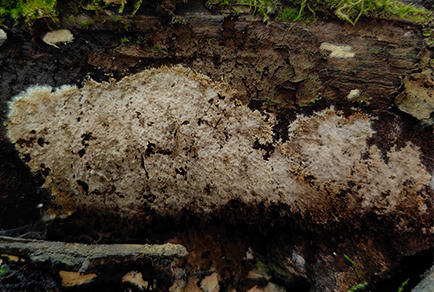
A new wood-inhabiting corticioid species, Coniophora heilongjiangensis (Coniophoraceae, Boletales), is described and illustrated from a mixed coniferous and broad-leaved forest in Heilongjiang Province, Northeast China, based on morphological characters combined with phylogenetic analyses of the internal transcribed spacer (ITS) and the nuclear large subunit rRNA (nLSU) regions. The new species is characterized by a combination of the following features: resupinate, membranaceous basidiomata with a smooth, pale gray to brownish gray hymenophore darkening in KOH; a monomitic hyphal system with simple-septate generative hyphae; the absence of cystidia; and ovoid, dextrinoid, cyanophilous basidiospores measuring 8.8–10.4 × 6.0–7.4 μm (L = 9.6 μm, W = 6.7 μm, Q = 1.43). Phylogenetic analyses of the combined ITS + nLSU dataset, inferred using Maximum Parsimony (MP), Maximum Likelihood (ML), and Bayesian inference (BI), recovered C. heilongjiangensis as sister to C. fusispora; however, the two species are readily distinguished by basidiospore shape and dimensions, basidial size, and hymenophore coloration. Morphological, phylogenetic, and ecological comparisons with the closely related species C. arida and C. hainanensis are also provided.
References
- Binder, M. & Hibbett, D.S. (2006) Molecular systematics and biological diversification of Boletales. Mycologia 98 (6): 971–981. https://doi.org/10.1080/15572536.2006.11832626
- Binder, M., Larsson, K.H., Matheny, P.B. & Hibbett, D.S. (2010) Amylocorticiales ord. nov. and Jaapiales ord. nov.: early diverging clades of Agaricomycetidae dominated by corticioid forms. Mycologia 102 (4): 865–880. https://doi.org/10.3852/09-288
- Blanco-Dios, J.B., Moreno, G., Checa, J., Platas, G. & Peláez, F. (2009) Taxonomic and phylogenetic revision of Coniophora arachnoidea, C. opuntiae, and C. prasinoides. Mycotaxon 108: 467–477. https://doi.org/10.5248/108.467
- Dai, Y.C. (2000) A checklist of polypores from Northeast China. Karstenia 40 (1–2): 23–29. https://doi.org/10.29203/ka.2000.347
- Dai, Y.C. & Penttilä, R. (2006) Polypore diversity of Fenglin Nature Reserve, northeastern China. Annales Botanici Fennici 43 (2): 81–96.
- Dai, Y.C., Wei, Y.L. & Zhang, X.Q. (2004) An annotated checklist of non-poroid Aphyllophorales in China. Annales Botanici Fennici 41 (4): 233–247.
- Dai, Y.C. (2011) A revised checklist of corticioid and hydnoid fungi in China for 2010. Mycoscience 52 (1): 69–79. https://doi.org/10.1007/s10267-010-0068-1
- De Candolle, A.P. (1815) Flore française, ou descriptions succinctes de toutes les plantes qui croissent naturellement en France, disposées selon une nouvelle méthode d'analyse, et précédées par un exposé des principes élémentaires de la botanique, 3rd edn., Tome V. Desray, Paris, 662 pp.
- Dueñas, M., Martín, M.P. & Telleria, M.T. (2023) First records from Cape Verde and range extension of Coniophora eremophila Lindsey & Gilb. (Basidiomycota, Boletales): a morphological and molecular identification. Check List 19 (3): 399–408. https://doi.org/10.15560/19.3.399
- Edler, D., Klein, J., Antonelli, A. & Silvestro, D. (2021) raxmlGUI 2.0: a graphical interface and toolkit for phylogenetic analyses using RAxML. Methods in Ecology and Evolution 12 (2): 373–377. https://doi.org/10.1111/2041-210X.13512
- Ginns, J. (1978) Leucogyrophana (Aphyllophorales): identification of species. Canadian Journal of Botany 56 (16): 1953–1973. https://doi.org/10.1139/b78-235
- Ginns, J. (1982) A monograph of the genus Coniophora (Aphyllophorales, Basidiomycetes). Opera Botanica 61: 1–61.
- Hall, T.A. (1999) BioEdit: a user-friendly biological sequence alignment editor and analysis program for Windows 95/98/NT. Nucleic Acids Symposium Series 41: 95–98.
- Katoh, K. & Standley, D.M. (2013) MAFFT multiple sequence alignment software version 7: improvements in performance and usability. Molecular Biology and Evolution 30 (4): 772–780. https://doi.org/10.1093/molbev/mst010
- Kauserud, H., Svegården, I.B., Decock, C. & Hallenberg, N. (2007) Hybridization among cryptic species of the cellar fungus Coniophora puteana (Basidiomycota). Molecular Ecology 16 (2): 389–399. https://doi.org/10.1111/j.1365-294X.2006.03129.x
- Kornerup, A. & Wanscher, J.H. (1978) Methuen handbook of colour, 3rd edn. Methuen, London, 252 pp.
- Kumar, S., Stecher, G., Suleski, M., Sanderford, M., Sharma, S. & Tamura, K. (2024) MEGA12: Molecular Evolutionary Genetic Analysis version 12 for adaptive and green computing. Molecular Biology and Evolution 41 (12): msae263. https://doi.org/10.1093/molbev/msae263
- Larsson, K.H., Spirin, V., Ryvarden, L. & Larsson, E. (2025) Reclassification of eleven corticioid basidiomycetes with nine typifications. Fungal Systematics and Evolution 16 (1): 1–28. https://doi.org/10.3114/fuse.2025.16.1
- Li, Y. & He, S.H. (2023) Taxonomy and phylogeny of brown-rot corticioid fungi in China: Coniophora beijingensis and Veluticeps subfasciculata spp. nov. Frontiers in Microbiology 14: 1133236. https://doi.org/10.3389/fmicb.2023.1133236
- Li, Y., Zhu, Q.Z., He, S.H. & Zhu, A.H. (2025) Two new species of Coniophora (Boletales, Coniophoraceae) from the Hainan Tropical Rainforest National Park, China. Mycosystema 44 (7): 250081. (in Chinese with English abstract) https://doi.org/10.13346/j.mycosystema.250081
- Martín, M.P. & Raidl, S. (2002) The taxonomic position of Rhizopogon melanogastroides (Boletales). Mycotaxon 84: 221–228. https://doi.org/10.5962/p.418306
- Moreth, U. & Schmidt, O. (2005) Investigations on ribosomal DNA of indoor wood decay fungi for their characterization and identification. Holzforschung 59 (1): 90–93. https://doi.org/10.1515/HF.2005.014
- Pusz, W., Baturo-Cieśniewska, A., Kaczmarek, A. & Zwijacz-Kozica, T. (2020) The health status of silver fir (Abies alba Mill.) in selected locations of the Tatra National Park and the Karkonosze National Park. Acta Scientiarum Polonorum, Silvarum Colendarum Ratio et Industria Lignaria 19 (3): 145–152. [in Polish with English abstract] https://doi.org/10.17306/J.AFW.2020.3.15
- Rambaut, A. (2014) FigTree v. 1.4.2. [http://tree.bio.ed.ac.uk/software/figtree]
- Ronquist, F., Teslenko, M., van der Mark, P., Ayres, D.L., Darling, A., Höhna, S., Larget, B., Liu, L., Suchard, M.A. & Huelsenbeck, J.P. (2012) MrBayes 3.2: efficient Bayesian phylogenetic inference and model choice across a large model space. Systematic Biology 61 (3): 539–542. https://doi.org/10.1093/sysbio/sys029
- Skrede, I., Engh, I.B., Binder, M., Carlsen, T., Kauserud, H. & Bendiksby, M. (2011) Evolutionary history of Serpulaceae (Basidiomycota): molecular phylogeny, historical biogeography and evidence for a single transition of nutritional mode. BMC Evolutionary Biology 11 (1): 230. https://doi.org/10.1186/1471-2148-11-230
- Stamatakis, A. (2014) RAxML version 8: a tool for phylogenetic analysis and post-analysis of large phylogenies. Bioinformatics 30 (9): 1312–1313. https://doi.org/10.1093/bioinformatics/btu033
- Swofford, D.L. (2003) PAUP*: phylogenetic analysis using parsimony (*and other methods), version 4. Sinauer Associates, Sunderland, Massachusetts.
- Vu, D., Groenewald, M., de Vries, M., Gehrmann, T., Stielow, B., Eberhardt, U., Al-Hatmi, A., Groenewald, J.Z., Cardinali, G., Houbraken, J., Boekhout, T., Crous, P.W., Robert, V. & Verkley, G.J.M. (2019) Large-scale generation and analysis of filamentous fungal DNA barcodes boosts coverage for kingdom fungi and reveals thresholds for fungal species and higher taxon delimitation. Studies in Mycology 92: 135–154. https://doi.org/10.1016/j.simyco.2018.05.001
- Yuan, Y., Chen, J.J., Korhonen, K., Martin, F. & Dai, Y.C. (2021) An updated global species diversity and phylogeny in the forest pathogenic genus Heterobasidion (Basidiomycota, Russulales). Frontiers in Microbiology 11: 596393. https://doi.org/10.3389/fmicb.2020.596393
- Yang, Y., Li, R., Liu, C. & Zhao, C. (2023) Morphological and molecular identification for two new species of wood-inhabiting macrofungi (Basidiomycota) from Yunnan-Guizhou Plateau, China. Phytotaxa 591 (1): 1–18. https://doi.org/10.11646/phytotaxa.591.1.1
- Yuan, H.S., Zhou, L.J., Zhu, Y.Q., Wei, Y.L., Zhang, X.J., Zhao, C.L. & Zhao, H. (2026) Species diversity of corticioid and hydnoid fungi in China and their medicinal, environmental, agricultural, and industrial values. Mycosphere 17: e005. https://doi.org/10.48130/mycosphere-0026-0004
- Zhao, Y.N., Liu, S.L., Nakasone, K.K. & He, S.H. (2018) Coniophoropsis bambusicola sp. nov. (Coniophoraceae, Basidiomycota) from southern Vietnam. Phytotaxa 360 (2): 153–160. https://doi.org/10.11646/phytotaxa.360.2.7
- Zhou, M., Dai, Y.C., Vlasák, J., Liu, H.G. & Yuan, Y. (2023) Updated systematics of Trichaptum s.l. (Hymenochaetales, Basidiomycota). Mycosphere 14 (1): 815–917. https://doi.org/10.5943/mycosphere/14/1/11
- Zhu, Y.Q., Zhou, L.J., Liu, J.X., Yuan, Y.W., Wei, Y.L. & Yuan, H.S. (2026) Thirty new species in Thelephorales and Hymenochaetales from the Eastern Himalayas and Southern China. Mycosphere 17: e001. https://doi.org/10.48130/mycosphere-0026-0001