
Abstract
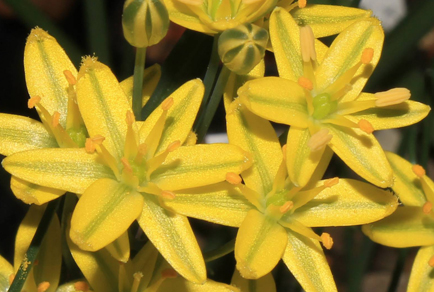
Field explorations in the Northern Cape province of South Africa revealed an undescribed species of Coilonox, sharing diagnostic characters of the genus. These include ovate-oblong tepals of a fleshy texture with a darker longitudinal midrib band visible on both sides and associated with 3–5 aggregated nerves, sub-homomorphic stamens with narrowly subulate filaments, and most notably, a gynoecium with an ovate-oblong, smooth and subcylindrical ovary and elongated and thin style, commonly deflexed and ending into a subcapitate stigma covered by elongated, abundant glands. However, the new species clearly differs from the currently known species in the genus by distinct morphological characters, such as the small overall plant size; filiform, small, apically twisted leaves; sessile to shortly pedicellate flowers; and comparatively small flowers, fruits and seeds. Coilonox spiciflorum, a new species occurring in quartzite fields and on quarzitic outcrops in Namaqualand, South Africa, is here described. A complete morphological description of the new species, as well as data on ecology, distribution, and differences with related species, are provided. In addition, a new combination, C. gildenhuysii, is established for another South African congener from the Northern Cape.
References
- Aiton, W. (1789) Hortus Kewensis; or, a Catalogue of the Plants Cultivated in the Royal Botanic Garden at Kew. George Nicol, London, 496 pp. https://doi.org/10.5962/bhl.title.4504
- Angiosperm Phylogeny Group. (2003) An update of the Angiosperm Phylogeny Group classification for the orders and families of flowering plants: APG II. Botanical Journal of the Linnean Society 141 (4): 399–436. https://doi.org/10.1046/j.1095-8339.2003.t01-1-00158.x
- Angiosperm Phylogeny Group. (2009) An update of the Angiosperm Phylogeny Group Classification for the orders and families of flowering plants: APG III. Botanical Journal of the Linnean Society 161 (2): 105–121. https://doi.org/10.1111/j.1095-8339.2009.00996.x
- Angiosperm Phylogeny Group. (2016) An update of the Angiosperm Phylogeny Group Classification for the orders and families of flowering plants: APG IV. Botanical Journal of the Linnean Society 181 (1): 1–20. https://doi.org/10.1111/boj.12385
- Baker, J.G. (1873) Revision of the genera and species of Scilleae and Chlorogaleae. Journal of the Linnean Society, Botany 13 (68): 209–292. [https://www.biodiversitylibrary.org/item/8364#page/213/mode/1up] https://doi.org/10.1111/j.1095-8339.1873.tb00095.x
- Chase, M.W., Reveal, J.L. & Fay, M.F. (2009) A subfamilial classification for the expanded asparagalean families, Amaryllidaceae, Asparagaceae and Xanthorrhoeaceae. Botanical Journal of the Linnean Society 161 (2): 132–136. https://doi.org/10.1111/j.1095-8339.2009.00999.x
- IPNI. (2026+) The International Plant Names Index. Available from: http://www.ipni.org (continuously updated; accessed January 2026)
- Johnson, S.D., Jürgens, A. & Kuhlmann, M. (2012) Pollination function transferred: modified tepals of Albuca serve as secondary stigmas. Annals of Botany 110 (3): 565–572. https://doi.org/10.1093/aob/mcs114
- Leistner, O.A. & Morris, J.W. (1976) Southern African place names. Annals of the Cape Provincial Museum 12: 1–565. [https://www.biodiversitylibrary.org/item/211761#page/9/mode/1up]
- Linnaeus, C. (1753) Species plantarum. Salvius, Stockholm, 1200 pp. https://doi.org/10.5962/bhl.title.37656
- Linnaeus, C. (1762) Species plantarum ed. 2. Salvius, Stockholm, 784 pp. https://doi.org/10.5962/bhl.title.11179
- Manning, J.C. & Goldblatt, P. (2013) Nomenclatural corrections in sub-Saharan Africa, predominantly subfam. Urgineoideae. Bothalia 43 (1): 75–80. https://doi.org/10.4102/abc.v43i1.110
- Manning, J.C., Goldblatt, P. & Fay, M.F. (2004) A revised generic synopsis of Hyacinthaceae in Sub-Saharan Africa, based on molecular evidence, including new combinations and the new tribe Pseudoprospereae. Edinburgh Journal of Botany 60 (3): 533–568. https://doi.org/10.1017/S0960428603000404
- Manning, J.C., Forest, F., Dion, S.D., Fay, M.F. & Goldblatt, P. (2009) A molecular phylogeny and a revised classification of Ornithogaloideae (Hyacinthaceae) based on an analysis of four plastid DNA regions. Taxon 58 (1): 77–107. https://doi.org/10.1002/tax.581011
- Martínez-Azorín, M., Crespo, M.B. & Juan, A. (2007) Taxonomic revision of Ornithogalum subg. Cathissa (Salisb.) Baker (Hyacinthaceae). Anales del Jardín Botánico de Madrid 64 (1): 7–25. https://doi.org/10.3989/ajbm.2007.v64.i1.47
- Martínez-Azorín, M., Crespo, M.B. & Juan, A. (2009) Taxonomic revision of Ornithogalum subg. Beryllis (Hyacinthaceae) in the Iberian Peninsula and the Balearic Islands. Belgian Journal of Botany 142 (2): 140–162. [https://www.jstor.org/stable/41427183]
- Martínez-Azorín, M., Crespo, M.B., Juan, A. & Fay, M.F. (2011) Molecular phylogenetics of subfamily Ornithogaloideae (Hyacinthaceae) based on nuclear and plastid DNA regions, including a new taxonomic arrangement. Annals of Botany 107 (1): 1–37. https://doi.org/10.1093/aob/mcq207
- Martínez-Azorín, M., Crespo, M.B., Alonso, M.Á., Pinter, M., Crouch, N.R., Dold, A.P., Mucina, L., Pfosser, M. & Wetschnig, W. (2023a) Molecular phylogenetics of subfamily Urgineoideae (Urgineoideae): Towards a coherent generic circumscription informed by molecular, morphological and distributional data. Journal of Systematics and Evolution 63 (1): 42–63. https://doi.org/10.1111/jse.12905
- Martínez-Azorín, M., Crespo, M.B., Alonso, M.Á., Pinter, M., Crouch, N.R., Dold, A.P., Mucina, L., Pfosser, M. & Wetschnig, W. (2023b) A generic monograph of the Hyacinthaceae subfam. Urgineoideae. Phytotaxa 610 (1): 1–143. https://doi.org/10.11646/phytotaxa.610.1.1
- Mucina, L., Jürgens, N., Le Roux, A., Rutherford, M.C., Schmiedel, U., Esler, K.J., Powrie, L.W., Desmet, P.G. & Milton, S.J. (2006) Succulent-Karoo Biome. In: Mucina, L. & Rutherford, M.C. (Eds.) The Vegetation of South Africa, Lesotho and Swaziland. South African National Biodiversity Institute, Pretoria, South Africa, pp. 221–299.
- Müller-Doblies, U. (2006) Enumeratio Albucarum (Hyacinthaceae) Austro-Africanarum adhuc cognitarum. 3. Additions and additional notes to Albuca subgenus. Falconera and A. subgenus. Albuca. Feddes Repertorium 117 (1–2): 96–138. https://doi.org/10.1002/fedr.200611089
- Müller-Doblies, U. & Müller-Doblies, D. (1996) Revisionula incompleta Ornithogalorum Austro-Africanorum (Hyacinthaceae). Feddes Repertorium 107 (5–6): 361–548. https://doi.org/10.1002/fedr.19961070511
- Obermeyer, A.A. (1978) Ornithogalum: a revision of the southern African species. Bothalia 12: 323–376. https://doi.org/10.4102/abc.v12i3.1793
- Phillips, E.P. (1922) Ornithogalum roodeae. Flowering Plants of South Africa 2: Pl. 75. [https://www.biodiversitylibrary.org/item/334409?t=169557#page/146/mode/1up]
- Salisbury, R.A. (1866) The genera of plants: A fragment containing part of Liriogamae. John van Voorst, London, 143 pp. [https://archive.org/details/mobot31753000358504]
- Speta, F. (1998a) Hyacinthaceae. In: Kubitzki, K. (Ed.) The families and genera of vascular plants, vol. 3. Springer, Berlin, pp. 261–285. https://doi.org/10.1007/978-3-662-03533-7_35
- Speta, F. (1998b) Systematische Analyse der Gattung Scilla L. s.l. (Hyacinthaceae). Phyton (Horn, Austria) 38 (1): 1–141.
- Speta, F. (2001) Die Echte und die Falsche Meerzwiebel: Charybdis Speta und Stellarioides Medicus (Hyacinthaceae), mit Neubeschreibungen und Neukombinationen im Anhang. Stapfia 75: 139–176. [https://www.zobodat.at/pdf/STAPFIA_0075_0139-0176.pdf]
- Rafinesque, C.S. (1837) Flora Telluriana vol. 2. H. Probasco, Philadelphia, 112 pp. https://doi.org/10.5962/bhl.title.7751
- Thiers, B. (2026+) Index Herbariorum: A global directory of public herbaria and associated staff. New York Botanical Garden’s Virtual Herbarium. Available from: http://sweetgum.nybg.org/ih/ (continuously updated; accessed January 2026)
- Van Jaarsveld, E.J. (2012) Ornithogalum gildenhuysii (Hyacinthaceae), a new cliff-dwelling bulbous succulent from the Northern Cape (South Africa). Herbertia 65: 51–59. [https://www.biodiversitylibrary.org/page/63954255#page/52/mode/1up]