

Abstract
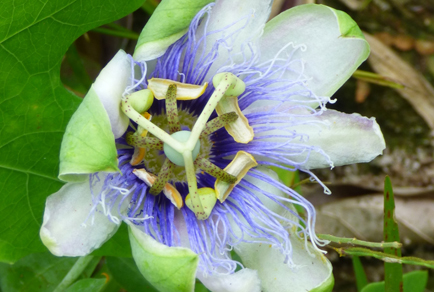
The genus Passiflora (Passifloraceae) exhibits remarkable diversification across Peru’s heterogeneous landscapes, where ecological variation promotes high species endemism. During targeted fieldwork and herbarium studies in 2025, comparative analyses of populations historically attributed to Passiflora spectabilis revealed consistent morphological, ecological, and phenological differences between lowland Amazonian and premontane Andean populations. The latter, characterized by smaller reniform stipules, shorter floral diameter, corniculate sepals with elongated fleshy awns, and a distinct lavender‑magenta corona, is herein described as Passiflora ruparupa sp. nov. The new species inhabits Andean cloud forests above 900 m, entirely allopatric from P. spectabilis which occurs only below 250 m in Amazonian floodplain habitats. Integrating field, herbarium, and photographic data, this study highlights the significance of ecological context in disentangling cryptic diversity within Passiflora and enriches understanding of Peru’s rapidly diversifying flora.
References
- Bachmann, S., Moat, J., Hill, A.W., De La Torre, J. & Scott, B. (2011) Supporting Red List threat assessments with GeoCAT: Geospatial conservation assessment tool. ZooKeys 150: 117–126. https://doi.org/10.3897/zookeys.150.2109
- Bernex de Falen, N. (1985) Environmental diversity, socioeconomic disparity and regional development in contemporary Peru. GeoJournal 11 (1): 15–28. https://doi.org/10.1007/bf00572936
- Feuillet, C. & MacDougal, J.M. (2003) A new infrageneric classification of Passiflora L. (Passifloraceae). Passiflora: The Journal &Newsletter of Passiflora Society International 13: 34–38. https://doi.org/10.2307/3393379
- GBIF (2025) GBIF occurrence data, Dataset. Global Biodiversity Information Facility. [continuously updated]
- Guayasamin, J.M., Cisneros-Heredia, D.F., McDiarmid, R.W., Peña, P. & Hutter, C.R. (2020) Glassfrogs of Ecuador: diversity, evolution, and conservation. Diversity 12 (6): 222. https://doi.org/10.3390/d12060222
- iNaturalist (n.d.) iNaturalist research-grade observations. Occurrence dataset. [continuously updated]
- IUCN (2025) Guidelines for Using the IUCN Red List Categories and Criteria. Version 14. Standards and Petitions Subcommittee. [http://cmsdocs.s3.amazonaws.com/RedListGuidelines.pdf]
- Pulgar Vidal, J. (1941) Las ocho regiones naturales del Perú. In: Actas y trabajos de la tercera asamblea general del Instituto Panamericano de Geografía e Historia 1: 3–14. https://doi.org/10.4000/terrabrasilis.1027
- Jørgensen, P.M. & MacDougal, J.M. (1997) Three new species of Passiflora (Passifloraceae) from Ecuador and notes on Passiflora viridescens. Novon 7: 379–386. https://doi.org/10.2307/3391769
- JSTOR (n.d.) JSTOR Global Plants. Dataset. [https://plants.jstor.org; continuously updated]
- Killip, E.P. (1930) Passiflora spectabilis. Journal of the Washington Academy of Sciences 20: 379. [https://www.biodiversitylibrary.org/page/39921785]
- Killip, E.P. (1938) The American species of Passifloraceae. Field Museum of Natural History, Botanical Series 19: 1–613. https://doi.org/10.5962/bhl.title.2269
- Kuethe, J.R. (2020) Passiflora—List of recognized species—2020. ResearchGate. https://doi.org/10.13140/RG.2.2.25502.48965
- Kuethe, J.R., Montesinos, K., Garzón-Suárez, H.X. & Jost, L. (2023) A large new species of Passiflora, supersect. Laurifolia, ser. Quadrangulares (Passifloraceae) from the sub-Amazonian forests of Ecuador, with notes on its taxonomic alliance and distribution. Phytotaxa 619 (4): 277–284. https://doi.org/10.11646/phytotaxa.619.4.2
- Linnaeus, C. (1753) Species Plantarum. Impensis Laurentii Salvii, Stockholm, 1200 pp.
- Sandweiss, D.H. & Richardson, J.B.III (2008) Central Andean Environments. In: Silverman, H. & Isbell, W.H. (Eds.) The handbook of South American archaeology. Springer, New York, pp. 93–104. https://doi.org/10.1007/978-0-387-74907-5_6
- SpeciesLink (n.d.) speciesLink. Dataset. [http://splink2.jbrj.gov.br; continuously updated]
- Thiers, B. (2025) Index Herbariorum: A global directory of public herbaria and associated staff. New York Botanical Garden’s Virtual Herbarium. [continuously updated; http://sweetgum.nybg.org/science/ih]
- Tropicos.org (2026) Missouri Botanical Garden. Available from: http://www.tropicos.org (accessed 5 Aug. 2026) [continuously updated]
- Tito, R., Salinas, N., Cosio, E.G., Espinoza, T.E.B., Muñiz, J.G., Aragón, S. & Roman-Cuesta, R.M. (2022) Secondary forests in Peru: differential provision of ecosystem services compared to other post-deforestation forest transitions. Ecology and Society 27 (3): 31. https://doi.org/10.5751/ES-13446-270312
- Ulmer, T. & MacDougal, J.M. (2004) Passiflora: Passionflowers of the world. Timber Press, Portland, Oregon, 432 pp.