
Abstract
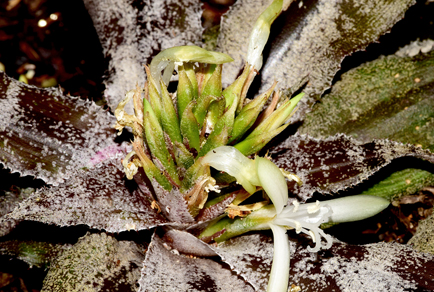
The authors describe and illustrate two new species of Cryptanthus, C. prolectus and C. proliferus, both endemic to the Atlantic Forest and associated with tree-like Restinga vegetation along the coastal zone of the state of Bahia, Brazil. Despite not being morphologically related to each other, C. prolectus and C. proliferus have in common the simple or subsimple inflorescences, which makes them different from their closer relatives, C. cruzalmensis and C. cajuitensis, respectively. Additional morphological differences are presented, and their geographical occurrence and conservation status are discussed. Illustrations of both species are also provided.
References
- Bachman, S., Moat, J., Hill, A.W., Torre, J. & Scott, B. (2011) Supporting Red List threat assessments with GeoCAT: geospatial conservation assessment tool. In: Smith, V. & Penev, L. (Eds.) e-Infrastructures for data publishing in biodiversity science. ZooKeys 150: 117–126. https://doi.org/10.3897/zookeys.150.2109
- Convention on Biological Diversity (1992) Article 9. Available from: The Secretariat of the Convention on Biological Diversity website. Available from: https://www.cbd.int/convention (accessed 14 January 2026)
- Ferreira, D.M.C. & Louzada, R.B. (2022) Two new species of Cryptanthus (Bromelioideae, Bromeliaceae) from the Atlantic Forest of northeastern Brazil. Phytotaxa 571 (1): 65–75. https://doi.org/10.11646/phytotaxa.571.1.5
- Fidalgo, O. & Bononi, V.L.R. (1984) Técnicas de coleta, preservação e herborização de material botânico, Manual n° 4. Instituto de Botânica, São Paulo, 62 pp.
- Fonseca, G.A.B., Rylands, A., Paglia, A. & Mittermeier, R.A. (2004) Atlantic Forest. In: Mittermeier, R.A., Gil, P.R., Hoffman, M., Pilgrim, J., Brooks, T., Mittermeier, C.G., Lamoreux, J. & Fonseca, G.A.B. Hotspots revisited: earth’s biologically richest and most endangered terrestrial ecoregions. CEMEX, pp. 84–92.
- Gouda, E.J., Butcher, D. & Dijkgraaf, L. (2026 [cont. updated]) Encyclopaedia of Bromeliads, version 5. Utrecht University Botanic Gardens. Available from: http://bromeliad.nl/encyclopedia/ (accessed 14 January 2026)
- Hawksworth, D.L. (2010) Terms used in bionomenclature, the name of organisms (and plant communities). Global Biodiversity Information Facility, Copenhagen, 215 pp.
- IUCN (2012) IUCN Red List Categories and Criteria: Version 3.1. Second edition. IUCN, Gland and Cambridge, iv + 32 pp. Available from: https://www.iucnredlist.org/resources/categories-and-criteria (accessed 14 January 2026)
- IUCN (2024) Standards and Petitions Committee. Guidelines for Using the IUCN Red List Categories and Criteria. Version 16. Prepared by the Standards and Petitions Committee. Available from: https://www.iucnredlist.org/documents/RedListGuidelines.pdf (accessed 14 January 2026)
- Jussieu, A.L. (1789) Genera plantarum: secundum ordines naturales disposita, juxta methodum in Horto regio parisiensi exaratam, anno M.DCC.LXXIV. Herissant, Paris, 498 pp. https://doi.org/10.5962/bhl.title.284
- Leme, E.M.C. (2014) A new species of Cryptanthus from Espírito Santo, Brazil. Journal of the Bromeliad Society 64: 150–155.
- Leme, E.M.C., Amorim, A.M., Silva, B.R., Ferreira, G.C. & Fernandez, E.P. (2025a) A new Wittmackia species (Bromeliaceae: Bromelioideae) from a hotpoint within a hotspot in Brazil. Phytotaxa 730 (2): 189–198. https://doi.org/10.11646/phytotaxa.730.2.6
- Leme, E.M.C., Heller, S., Zizka, G. & Halbritter, H. (2017) New circumscriptions of Cryptanthus and new Cryptanthoid genera and subgenera (Bromeliaceae: Bromelioideae) based on neglected morphological traits and molecular phylogeny. Phytotaxa 318 (1): 1–88. https://doi.org/10.11646/phytotaxa.318.1.1
- Leme, E.M.C., Ribeiro, O.B.C., Souza, F.V.D., Souza, E.H., Kollmann, L.J.C. & Fontana, A.P. (2020) Miscellaneous new species in the “Cryptanthoid complex” (Bromeliaceae: Bromelioideae) from Eastern Brazil. Phytotaxa 430 (3): 157–202. https://doi.org/10.11646/phytotaxa.430.3.2
- Leme, E.M.C., Souza, E.H., Aona, L.Y.S. & Souza, F.V.D. (2023) Two new Wittmackia species (Bromeliaceae: Bromelioideae) from Bahia, Brazil. Phytotaxa 583 (3): 241–250. https://doi.org/10.11646/phytotaxa.583.3.2
- Leme, E.M.C., Souza, E.H., Till, W., Barfuss, M.H.J., Siqueira-Filho, J.A., Kollmann, L.J.C., Couto, D.R., Fraga, C.N., Fontana, A.P., Farias-Castro, A.S. & Silva, J.B.F. (2025b) Twenty miscellaneous new species and one new nothogenus and nothospecies in Brazilian Bromeliaceae. Phytotaxa 692 (1): 1–60. https://doi.org/10.11646/phytotaxa.692.1.1
- Martini, A.M.Z., Fiaschi, P., Amorim, A.M. & Paixão, J.L.da (2007) A hot-point within a hot-spot: a high diversity site in Brazil’s Atlantic Forest. Biodiversity Conservation 16: 3111–3128. https://doi.org/10.1007/s10531-007-9166-6
- Ostroski, P., Saiter, F.Z., Amorim, A.M. & Fiaschi, P. (2020) Angiosperm emdemism in a Brazilian biodiversity hot-point. Brazilian Journal of Botany 43: 397–404. https://doi.org/10.1007/s40415-020-00603-w
- Otto, F. & Dietrich, A. (1836) Eine neue Gattung aus der Familie der Bromeliaceae. Berliner Allgemeine Gartenzeitung 4: 297–300.
- Scharf, U. & Gouda, E.J. (2008) Bringing Bromeliaceae back to homeland botany. Journal of the Bromeliad Society 58: 123–129.
- SEI—Superintendência de Estudos Econômicos e Sociais da Bahia (2014) Físico-ambientais – mapas estaduais. Available from: https://www.sei.ba.gov.br/index.php?option=com_content&view=article&id=2669&Itemid=710 (accessed 14 January 2026)
- Smith, L.B. & Downs, R.J. (1979) Bromeliaceae (Bromelioideae). Flora Neotropica Monograph 14 (3): 1493–2142.
- Thiers, B.M. (cont. updated) Index Herbariorum. New York Botanical Garden. Available from: http://sweetgum.nybg.org/science/ih/ (accessed 14 January 2026)
- Turland, N.J., Wiersema, J.H., Barrie, F.R., Gandhi, K.N., Gravendyck, J., Greuter, W., Hawksworth, D.L., Herendeen, P.S., Klopper, R.R., Knapp, S., Kusber, W.-H., Li, D.-Z., May, T.W., Monro, A.M., Prado, J., Price, M.J., Smith, G.F. & Zamora Señoret, J.C. (2025) International Code of Nomenclature for algae, fungi, and plants (Madrid Code). Regnum Vegetabile, vol. 162. University of Chicago Press, Chicago, 345 pp.