

Abstract
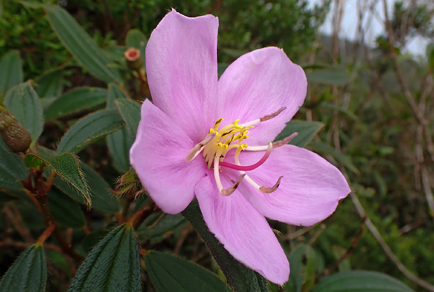
Melastoma dinagatense (Melastomataceae) from Dinagat Island, Caraga Region, Philippines, is here described and illustrated. The species is most similar to the widespread M. malabathricum but differs in its longer pedicels, larger hypanthium and calyx lobes, longer hypanthium scales, and a distinctive leaf indumentum composed of elongated crystalliferous cells with a branched base and emergent hairs, as well as leaf margins with spreading pilose-ciliate hairs. The new species is known only from the ultramafic elfin forest on Mount Redondo and is assessed as Critically Endangered. A dichotomous key to the Philippine species of Melastoma is provided.
References
- Agcaoili, J.M., Barcelona, J.F. & Pelser, P.B. (2020) Melastoma malabituin (Melastomataceae): A new species from northern Luzon, Philippines. Phytotaxa 435 (1): 25–32. https://doi.org/10.11646/phytotaxa.435.1.3
- Amoroso, V.B., Acola, M.S., Guiang, M.M.M., Acma, F.M., Fritsch, P.W. & Coritico, F.P. (2023) A new species of grass fern, Schizaea erecta (Schizaeaceae), from Dinagat Island, Mindanao, Philippines. Phytotaxa 618 (3): 265–273. https://doi.org/10.11646/phytotaxa.618.3.4
- Bachman, S., Moat, J., Hill, A.W., de la Torre, J. & Scott, B. (2011) Supporting Red List threat assessments with GeoCAT: Geospatial conservation assessment tool. ZooKeys 150: 117–126. https://doi.org/10.3897/zookeys.150.2109
- Fernando, E.S., Quakenbush, J.P., Lillo, E.P. & Ong, P.S. (2018) Medinilla theresae (Melastomataceae), a new species from ultramafic soils in the Philippines. PhytoKeys 113: 145–155. https://doi.org/10.3897/phytokeys.113.30027
- Fernando, E.S. & Wilson, P.G. (2021) Tristaniopsis flexuosa (Myrtaceae), a new species from ultramafic soils in the Philippines. Telopea 24: 345–349. https://doi.org/10.7751/telopea15588
- Galey, M.L., Van der Ent, A., Iqbal, M.C. & Rajakaruna, N. (2017) Ultramafic geoecology of South and Southeast Asia. Botanical Studies 58 (1). https://doi.org/10.1186/s40529-017-0167-9
- Haribon (2004) Technical report: Mts. Kambinliw & Redondo, Loreto, Dinagat Island, Surigao del Norte. Haribon Foundation for the Conservation of Natural Resources, Inc., 140 Kalayaan Avenue, Quezon City, Philippines 1101, 69 pp.
- Harris, J.G. & Harris, M.W. (2004) Plant identification terminology: an illustrated glossary. 2nd ed. Spring Lake Publishing, Spring Lake, Utah, pp. 1–198.
- Hickey, L.J. (1973) Classification of the architecture of dicotyledonous leaves. American Journal of Botany 60 (1): 17–33. https://doi.org/10.1002/j.1537-2197.1973.tb10192.x
- IUCN Standards and Petitions Committee (2022) Guidelines for Using the IUCN Red List Categories and Criteria. Version 15. Available from: https://www.iucnredlist.org/resources/redlistguidelines (accessed 18 January 2026)
- Meyer, K. (2001) Revision of the Southeast Asian genus Melastoma (Melastomataceae). Blumea: Biodiversity, Evolution and Biogeography of Plants 46 (2): 351–398.
- Neo, L., Wong, K.M. & Tan, H.T.W. (2017) Studies in Southeast Asian Melastoma (Melastomataceae), 3. A new species of Melastoma from Peninsular Malaysia. Phytotaxa 317 (4): 286–292. https://doi.org/10.11646/phytotaxa.317.4.3
- Pelser, P.B., Barcelona, J.F. & Nickrent, D.L. (Eds.) (2011 onwards) Co’s Digital Flora of the Philippines. [http://www.philippineplants.org]
- QGIS Development Team (2026) QGIS Geographic Information System. Version 3.34 Prizren. Open Source Geospatial Foundation Project. Available from: https://qgis.org/ (accessed 13 July 2026)
- Robinson, A.S., Zamudio, S.G. & Caballero, R.B. (2019) Nepenthes erucoides (Nepenthaceae), an ultramaficolous micro-endemic from Dinagat Islands Province, northern Mindanao, Philippines. Phytotaxa 423 (1): 21–32. https://doi.org/10.11646/phytotaxa.423.1.3
- Siti-Maisarah, Z., Amri, C.A., Rozilawati, S. & Noor-Syaheera, M. (2020) Systematic significance of foliar trichomes in selected Melastoma L. species from Fraser’s Hill, Pahang. Matrix Science Pharma 4 (1): 9–14. https://doi.org/10.4103/mtsp.mtsp_2_20
- Souvannakhoummane, K., Tanaka, N., Souladeth, P., Tagane, S., Dang, V.-S., Yamamoto, T., Yamazaki, K., Pham, Q.T., Phonepaseuth, P., Vongthavone, T., Phengmala, K., Kongxaisavath, D. & Sengthong, A. (2026) Two new species of Melastoma L. (Melastomataceae) from Limestone Karst, Khammouane Province, central Laos. European Journal of Taxonomy 1034 (1): 1–13. https://doi.org/10.5852/ejt.2026.1034.3141
- Tahil, A.A. (2022) Studies on Philippine Melastoma (Melastomataceae)—the rarely collected M. laevifolium group. Harvard Papers in Botany 27 (1): 117–124. https://doi.org/10.3100/hpib.v27iss1.2022.n16
- Tamayo, M.N., Fernando, E.S. & Fritsch, P.W. (2023) Vaccinium coarctatum (Ericaceae), an ultramafic-obligate new species from the dwarf forest of Mount Redondo, Dinagat Island, Philippines. Edinburgh Journal of Botany 80: 1–12. https://doi.org/10.24823/ejb.2023.1960
- Veranso-Libalah, M.C., Stone, R.D., Fongod, A.G.N., Couvreur, T.L.P. & Kadereit, G. (2017) Phylogeny and systematics of African Melastomateae (Melastomataceae). Taxon 66 (3): 584–614. https://doi.org/10.12705/663.5
- Veranso-Libalah, M.C., Stone, R.D., Kadereit, G. & Guimarães, P.J.F. (2022) Systematics and taxonomy of the tribe Melastomateae. In: Goldenberg, R., Michelangeli, F.A. & Almeda, F. (Eds.) Systematics, Evolution, and Ecology of Melastomataceae. Springer, Cham, pp. 429–463. https://doi.org/10.1007/978-3-030-99742-7_21
- Wong, K.M. (2015) Studies in Southeast Asian Melastoma (Melastomataceae), 1. Morphological variation in Melastoma malabathricum and notes on rheophytic taxa and interspecific hybridisation in the genus. Gardens’ Bulletin Singapore 67 (2): 387–410. https://doi.org/10.3850/S2382581215000319
- Wong, K.M. (2016) The genus Melastoma in Borneo including 31 new species. Natural History Publications (Borneo), Kota Kinabalu, in association with National Parks Board, Singapore, 514 pp.
- Wong, K.M. & Low, Y.W. (2015) Novitates Bruneienses, 3. Eight new woody plants in the Brunei flora, including five new species. Garden’s Bulletin Singapore 67 (1): 69–84. https://doi.org/10.3850/S2382581215000083