

Abstract
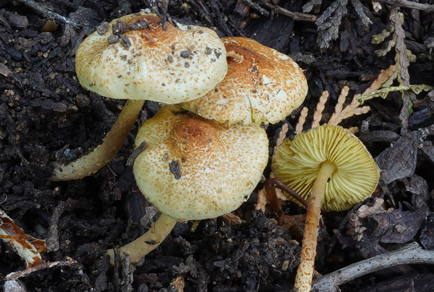
A new species Lepiota aurantiolutea is described and illustrated from Puzhao Temple of Mount Tai Scenic Area (Tai’an City, Shandong Province, China), based on morphological and molecular evidence. Our phylogenetic analyses based on DNA sequences of the internal transcribed spacers 1 and 2 with the 5.8S rDNA (ITS), the large subunit of nuclear ribosomal DNA (LSU) and the second largest subunit of RNA polymerase II (RPB2) support the inclusion of this new species in the genus Lepiota as it forms an independent clade in the phylogenetic tree. Morphologically, Lepiota aurantiolutea differs from any known species by the combination of a reddish orange pileus covering forming squamules on a pale yellow background, a yellow stipe bearing fine white pubescence and orange to red squamules at the middle and base.
References
- Acharya, K., Tarafder, E., Dutta, A.K., Nandi, S., Pradhan, P., Sarkar, J., Paloi, S., Sikder, R. & Roy, A. (2017a) Contribution to the Macromycetes of West Bengal, India: 8–12. Research Journal of Pharmacy and Technology 10 (3): 823. https://doi.org/10.5958/0974-360x.2017.00155.x
- Acharya, K., Tarafder, E., Pradhan, P., Dutta, A.K., Paloi, S., Datta, M. & Roy, A. (2017b) Contribution to the Macromycetes of West Bengal, India: 18–22. Research Journal of Pharmacy and Technology 10 (9): 3061. https://doi.org/10.5958/0974-360x.2017.00543.1
- Azeem, M., Kiran, M. & Jabeen, S. (2024) Molecular phylogeny and morphological characterization revealed Lepiota brunneoaurantia, a new species in L. sect. Stenosporae from Margalla Hills, Pakistan. Phytotaxa 636 (1): 61–73. https://doi.org/10.11646/phytotaxa.636.1.5
- Bashir, H., Usman, M. & Khalid, A.N. (2020) Lepiota cholistanensis a new species of Lepiota (Agaricaceae: Basidiomycota) from Cholistan desert, Pakistan. Phytotaxa 455 (4): 267–276. https://doi.org/10.11646/phytotaxa.455.4.4
- Bon, M. (1981) Clé monographique des “lépiotes” d’Europe. Documents Mycologiques 11 (43): 1–77.
- Bon, M. (1993) Novitates 4. Famille Lepiotaceae Roze ex Overeem. Documents Mycologiques 22 (88): 27–32.
- Bresadola, G. (1929) Iconographia Mycologica 12: tab. 598.
- Candusso, M. & Lanzoni, G. (1990) Lepiota s.l. Fungi Europaei 4. Giovanna Biella, Saronno, 322 pp.
- Chakraborty, N., Tarafder, E., Paul, A., Paloi, S. & Acharya, K. (2022) Trichoglossum benghalense (Geoglossales, Ascomycota) from India: new to science. Phytotaxa 536 (1): 72–82. https://doi.org/10.11646/phytotaxa.536.1.4
- Dutta, A.K., Bera, S., Paloi, S., Rakshit, S., Tarafder, E., Sherpa, A.R. & Acharya, K. (2020) Lepiotaceous fungi of West Bengal, India: the genus Chlorophyllum. Phytotaxa 451 (2): 113–131. https://doi.org/10.11646/phytotaxa.451.2.2
- Doyle, J.J. & Doyle, J. (1987) A rapid DNA isolation procedure for small quantities of fresh leaf material. Phytochemical Bulletin 19: 11–15.
- Dutta, A.K., Nandi, S., Tarafder, E., Sikder, R., Roy, A. & Acharya, K. (2017) Trogia benghalensis (Marasmiaceae, Basidiomycota), a new species from India. Phytotaxa 331 (2): 273–280. https://doi.org/10.11646/phytotaxa.331.2.11
- Gardes, M. & Bruns, T.D. (1993) ITS primers with enhanced specificity for basidiomycetes-application to the identification of mycorrhizae and rusts. Molecular Ecology 2: 113–118. https://doi.org/10.1111/j.1365-294X.1993.tb00005.x
- Gray, S.F. (1821) A Natural Arrangement of British Plants: According to Their Relations to Each Other as Pointed Out by Jussieu, De Candolle, Brown, &c... (Vol. 2). Baldwin, Cradock, and Joy, 610 pp. https://doi.org/10.5962/bhl.title.43804
- Hall, T.A. (1999) BioEdit: a user-friendly biological sequence alignment editor and analysis program for windows 95/98/NT. Nucleic Acids Symposium Series 41: 95–98.
- Hou, Y.J. & Ge, Z.W. (2020) New species of Echinoderma and Lepiota (Agaricaceae) from China. Phytotaxa 447 (4): 221–236. https://doi.org/10.11646/phytotaxa.447.4.1
- Jülich, W. (1982) Higher taxa of Basidiomycetes. Bibliotheca Mycologica 85: 393.
- Kalichman, J., Kirk, P.M. & Matheny, P.B. (2020) A compendium of generic names of agarics and Agaricales. Taxon 69 (3): 425–447. https://doi.org/10.1002/tax.12240
- Kirk, P.M., Cannon, P.F., Minter, D.W. & Stalpers, J.A. (2008) Ainsworth & Bisby’s dictionary of the fungi, 10th edn. CABI, Wallingford, 771 pp. https://doi.org/10.1079/9780851998268.0000
- Kornerup, A. & Wanscher, J.H. (1978) Methuen handbook of Colours [3 Ed.]. Eyre Methuen, London, 252 pp.
- Kretzer, A.M. & Bruns, T.D. (1999) Use of atp6 in fungal phylogenetics: An example from the Boletales. molecular Phylogenetics and Evolution 13 (3): 483–492. https://doi.org/10.1006/mpev.1999.0680
- Lange, J.E. (1935) Flora Agaricina Danica. I. Recato, Copenhagen, pp. 1–40.
- Liang, J.F. (2007) Study on taxonomy of Lepiota from China and molecular phylogeny of the genus with notes on population genetics of L. cristata. PhD Thesis, Kunming Institute of Botany, the Chinese Academy of Sciences, China.
- Liang, J.F. (2016) Taxonomy and phylogeny in Lepiota sect. Stenosporae from China. Mycologia 108: 56–69. https://doi.org/10.3852/14-192
- Nylander, J.A.A. (2004) MrModelTest v2. Program distributed by the editor. https://doi.org/10.1049/cp:20040370
- Pegler, D.N. (1986) Agaric Flora of Sri Lanka. Kew Bulletin Additional Series 12: 285–313.
- Persoon, C.H. (1797) Tentamen dispositionis methodicae fungorum. Wolf, Leipzig, 76 pp. https://doi.org/10.5962/bhl.title.42674
- Qu, H., Cai, Q., Redhead, S.A., Chen, X., Ge, Z.W. & Yang, Z.L. (2025) Exploring criteria for constructing suprageneric classifications of fungi in the genomic era: A case study of suborders Agaricineae, Pluteineae, and Tricholomatineae (Agaricales). Fungal Diversity 132: 127–150. https://doi.org/10.1007/s13225-025-00557-y
- Quélet, L. (1881) Quelques espèces critiques ou nouvelles de la flore mycologique de France. Comptes Rendu de l'Association Française pour l'Avancement des Sciences 9 (Reims 1880): 661–675.
- Rehman, A., Usman, M., Afshan, N.U.S. & Khalid, A.N. (2024) Taxonomy and phylogeny reveal two novel species of genus Lepiota (Agaricaceae, Agaricales) from Punjab, Pakistan. Plant Systematics and Evolution 310: 8. https://doi.org/10.1007/s00606-024-01891-5
- Ronquist, F. & Huelsenbeck, J.P. (2003) Mrbayes 3: Bayesian phylogenetic inference under mixed models. Bioinformatics 19 (12): 1572–1574. https://doi.org/10.1093/bioinformatics/btg180
- Saccardo, P.A. (1887) Sylloge fungorum omnium hucusque cognitorum. Patavii: sumptibus auctoris 5: 57.
- Salichanh, T., Sysouphanthong, P., Thongklang, N. & Luangharn, T. (2024) Cystolepiota flavolamellata (Verrucosporaceae, Agaricales), a new species from Southeast Asia. Phytotaxa 645 (1): 18–28. https://doi.org/10.11646/phytotaxa.645.1.2
- Sarawi, S., Shi, Y.N., Lotz-Winter, H., Reschke, K., Bode, H.B. & Piepenbring, M. (2022) Occurrence and chemotaxonomical analysis of amatoxins in Lepiota spp. (Agaricales). Phytochemistry 195: 113069. https://doi.org/10.1016/j.phytochem.2021.113069
- Sarawi, S., Piepenbring, M. & Reschke, K. (2025) Phylogenetic and taxonomic reassessment of the genera Echinoderma and Lepiota. Fungal Systematics and Evolution 15: 235–263. https://doi.org/10.3114/fuse.2025.15.11
- Schoch, C.L., Robbertse, B., Robert, V., Vu, D., Cardinali, G., Irinyi, L., Meyer, W., Nilsson, R.H., Hughes, K., Miller, A.N., Kirk, P.M., Abarenkov, K., Aime, M.C., Ariyawansa, H.A., Bidartondo, M., Boekhout, T., Buyck, B., Cai, Q., Chen, J., Crespo, A., Crous, P.W., Damm, U., De Beer, Z.W., Dentinger, B.T.M., Divakar, P.K., Dueñas, M., Feau, N., Fliegerova, K., García, M.A., Ge, Z.-W., Griffith, G.W., Groenewald, J.Z., Groenewald, M., Grube, M., Gryzenhout, M., Gueidan, C., Guo, L., Hambleton, S., Hamelin, R., Hansen, K., Hofstetter, V., Hong, S.-B., Houbraken, J., Hyde, K.D., Inderbitzin, P., Johnston, P.R., Karunarathna, S.C., Kõljalg, U., Kovács, G.M., Kraichak, E., Krizsan, K., Kurtzman, C.P., Larsson, K.-H., Leavitt, S., Letcher, P.M., Liimatainen, K., Liu, J.-K., Lodge, D.J., Luangsa-ard, J.J., Lumbsch, H.T., Maharachchikumbura, S.S.N., Manamgoda, D., Martín, M.P., Minnis, A.M., Moncalvo, J.-M., Mulè, G., Nakasone, K.K., Niskanen, T., Olariaga, I., Papp, T., Petkovits, T., Pino-Bodas, R., Powell, M.J., Raja, H.A., Redecker, D., Sarmiento-Ramirez, J.M., Seifert, K.A., Shrestha, B., Stenroos, S., Stielow, B., Suh, S.-O., Tanaka, K., Tedersoo, L., Telleria, M.T., Udayanga, D., Untereiner, W.A., Diéguez Uribeondo, J., Subbarao, K.V., Vágvölgyi, C., Visagie, C., Voigt, K., Walker, D.M., Weir, B.S., Weiß, M., Wijayawardene, N.N., Wingfield, M.J., Xu, J.P., Yang, Z.L., Zhang, N., Zhuang, W.-Y. & Federhen, S. (2014) Finding needles in haystacks: linking scientific names, reference specimens and molecular data for Fungi. Database: the journal of biological databases and curation bau061. https://doi.org/10.1093/database/bau061
- Smith, S.A. & Dunn, C.W. (2008) Phyutility: a phyloinformatics tool for trees, alignments and molecular data. Bioinformatics 24: 715–716. https://doi.org/10.1093/bioinformatics/btm619
- Singer, R. (1986) the Agaricales in modern taxonomy [4th ed.]. Koeltz Scientific Books, Federal Republic of Germany, 981 pp.
- Song, X.H., Lv, X.B. & Li, C.R. (2015) Willingness and motivation of residents to pay for conservation of urban green spaces in Jinan, China. Acta Ecologica Sinica 35 (4): 89–94. https://doi.org/10.1016/j.chnaes.2015.06.003
- Stamatakis, A. (2006) RAxML-vI-HPC: maximum-likelihood-based phylogenetic analyses with thousands of taxa and mixed models. Bioinformatics 22: 2688–2690. https://doi.org/10.1093/bioinformatics/btl446
- Sysouphanthong, P., Hyde, K.D., Chukeatirote, E. & Vellinga, E.C. (2011) A review of genus Lepiota and its distribution in East Asia. Current Research in Environmental & Applied Mycology 1: 161–176. https://doi.org/10.5943/cream/1/2/3
- Sysouphanthong, P., Thongklang, N., Suwannapoom, C., Nuangmek, W. & Hyde, K. (2020) Lepiota section Stenosporae (Agaricaceae): Two new records to Lao People's Democratic Republic. Chiang Mai Journal of Science 47: 49–56.
- Tarafder, E., Dutta, A.K., Sarkar, J. & Acharya, K. (2018) A new species of Agaricus sect. Brunneopicti from Eastern India. Phytotaxa 374 (2): 139–146. https://doi.org/10.11646/phytotaxa.374.2.5
- Tarafder, E., Dutta, A.K., Karunarathna, S.C., He, M.Q., Tian, F. & Acharya, K. (2023) Agaricus sect. Xanthodermatei (Agaricales) of West Bengal, India. Phytotaxa 630 (4): 245–265. https://doi.org/10.11646/phytotaxa.630.4.1
- Tarafder, E., Karunarathna, S.C., Dutta, A.K., Elgorban, A.M., Tian, F.-H. & Acharya, K. (2025a) Morphology and phylogeny reveal two new species and a new geographical record of Agaricus sect. Rubricosi (Agaricales) from West Bengal, India. Scientific Reports 15 (1). https://doi.org/10.1038/s41598-025-08102-2
- Tarafder, E., Karunarathna, S.C., Das, D., Elgorban, A.M., Wen, T.-C. & Acharya, K. (2025b) New species of Rhodocybe (Entolomataceae, Agaricales) from India. New Zealand Journal of Botany 63 (5): 2120–2137. https://doi.org/10.1080/0028825x.2025.2477703
- Tarafder, E., Hoque, E., Sherpa, A.R., Karunarathna, S.C., Wang, M., Wijayawardene, N.N., Li, Q., Yu, F., Dai, D.-Q. & Watsuntorn, W. (2026) Taxonomy and phylogeny reveal new species of Volvariella (Volvariellaceae, Agaricales) and Volvopluteus (Pluteaceae, Agaricales) from eastern India. MycoKeys 130: 185–208. https://doi.org/10.3897/mycokeys.130.183859
- Vellinga, E.C. (2001) Lepiota (Pers. : Fr.) S.F. Gray. In: Noordeloos, M.E., Kuyper, Th.W. & Vellinga, E.C. (Eds.) Flora agaricina neerlandica 5. Swets and Zeitlinger, Lisse, pp. 109–151.
- Vellinga, E.C. (2003) Phylogeny of Lepiota (Agaricaceae)-evidence from nrITS and nrLSU sequences. Mycological Progress 2: 305–322. https://doi.org/10.1007/s11557-006-0068-x
- Vellinga, E.C. (2004) Genera in the family Agaricaceae: evidence from nrITS and nrLSU sequences. Mycological Research 108: 354–377. https://doi.org/10.1017/S0953756204009700
- Vilgalys, R. & Hester, M. (1990) Rapid genetic identification and mapping of enzymatically amplified ribosomal DNA from several Cryptococcus species. The Journal of Bacteriology 172 (8): 4238–4246. https://doi.org/10.1128/jb.172.8.4238-4246.1990
- Vizzini, A., Tatti, A., Huijser, H.A., Liang, J.F. & Ercole, E. (2019) Looking for Lepiota psalion Huijser & Vellinga (Agaricales, Agaricaceae). MycoKeys 52: 45–69. https://doi.org/10.3897/mycokeys.52.34021
- Wang, P.M., Liu, X.B., Dai, Y.C., Horak, E., Steffen, K. & Yang, Z.L. (2018) Phylogeny and species delimitation of Flammulina: taxonomic status of winter mushroom in East Asia and a new European species identified using an integrated approach. mycological Progress 17: 1013–1030. https://doi.org/10.1007/s11557-018-1409-2
- Wang, P.M. & Yang, Z.L. (2019) Two new taxa of the Auriscalpium vulgare species complex with substrate preferences. mycological Progress 18: 641–652. https://doi.org/10.1007/s11557-019-01477-3
- Wasser, S.P. (1978) New taxonomic combinations and new taxons in the family Agaricaceae Fr. Ukrainian Botanical Journal 35 (5): 516–519.
- White, T.J., Bruns, T., Lee, S. & Taylor, J. (1990) Amplification and direct sequencing of fungal ribosomal RNA genes for phylogenetics. In: Innis, M.A., Gelfand, D.H., Sninsky, J.J. & White, T.J. (Eds.) PCR Protocols: a guide to methods and applications. Academic Press, San Diego, pp. 315–322. https://doi.org/10.1016/B978-0-12-372180-8.50042-1
- Yang, Z.L., Ge, Z.W. & Liang, J.F. (2019) Fungi lepiotoidei (Agaricaceae). In: Consilio florarum cryptogamarum sinicarum academiae sinicae (Eds.) Flora fungorum sinicorum vol. 52. Science Press, Beijing, 228 pp.
- Yang, K.L., Lin, J.Y., Li, G.M., Li, T.H. & Yang, Z.L. (2024) Rediscovering Leucoagaricus sinicus, with the recognition of Leucoagaricus and Leucocoprinus as separate genera, and two new genera in Agaricaceae (Basidiomycota). Phytotaxa 676 (3): 199–255. https://doi.org/10.11646/phytotaxa.676.3.1