

Abstract
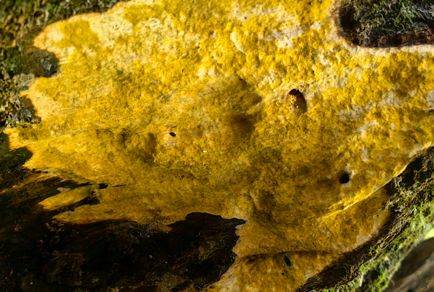
Crustodontia is characterized by resupinate, ceraceous, smooth, grandinioid to odontioid or tuberculate basidiomata, exhibiting a yellowish, brownish, or black hymenial surface that turns reddish or purplish upon application of KOH. A novel leather-like fungus, Crustodontia electrina, was discovered in Yunnan Province, southwestern China, and is described and illustrated here based on both morphological and molecular evidence. This species is distinguished by resupinate basidiomata, a smooth and light curry-yellow hymenial surface when fresh, a monomitic hyphal system with clamp connections on generative hyphae, subclavate cystidia, clavate to subuniform basidia, and thin-walled, ellipsoid to broadly ellipsoid basidiospores measuring 3.4–4.7 × 2.9–3.9 µm. Phylogenetic analysis indicates that the new species forms a distinct lineage within the Crustodontia clade, based on internal transcribed spacer (ITS) sequences. A comprehensive description, illustrations, and results of the phylogenetic analysis of the new species are presented.
References
- Binder, M., Justo, A., Riley, R., Salamov, A., Lopez-Giraldez, F., Sjökvist, E., Copeland, A., Foster, B., Sun, H., Larsson, E., Larsson, K.H., Townsend, J., Grigoriev, I.V. & Hibbett, D.S. (2013) Phylogenetic and phylogenomic overview of the Polyporales. Mycologia 105: 1350–1373. https://doi.org/10.3852/13-003
- Chen, C.C., Chen, C.Y. & Wu, S.H. (2021) Species diversity, taxonomy and multi-gene phylogeny of phlebioid clade (Phanerochaetaceae, Irpicaceae, Meruliaceae) of Polyporales. Fungal Diversity 111: 337–442. https://doi.org/10.1007/s13225-021-00490-w
- Chowdhary, A., Kathuria, S., Agarwal, K. & Meis, J.F. (2014) Recognizing filamentous basidiomycetes as agents of human disease: a review. Medical Mycology 52: 782–797. https://doi.org/10.1093/mmy/myu047
- Crozier, J., Thomas, S.E., Aime, M.C., Evans, H.C. & Holmes, K.A. (2006) Molecular characterization of fungal endophytic morphospecies isolated from stems and pods of Theobroma cacao. Plant Pathology 55: 783–791. https://doi.org/10.1111/j.1365-3059.2006.01446.x
- Dai, Y.C. (2010) Hymenochaetaceae (Basidiomycota) in China. Fungal Diversity 45: 131–343. https://doi.org/10.1007/s13225-010-0066-9
- Dai, Y.C., Cui, B.K., Yuan, H.S. & Li, B.D. (2007) Pathogenic wood-decaying fungi in China. Forest Pathology 37: 105–120. https://doi.org/10.1111/j.1439-0329.2007.00485.x
- Dai, Y.C., Yang, Z.L., Cui, B.K., Wu, G., Yuan, H.S., Zhou, L.W., He, S.H., Ge, Z.W., Wu, F., Wei, Y.L., Yuan, Y. & Si, J. (2021) Diversity and systematics of the important macrofungi in Chinese forests. Mycosystema 40: 770–805. https://doi.org/10.13346/j.mycosystema.210036
- Dai, Y.C., Yang, Z.L., Cui, B.K., Yu, C.J. & Zhou, L.W. (2009) Species diversity and utilization of medicinal mushrooms and fungi in China. International Journal of Medicinal Mushrooms 11: 287–302. https://doi.org/10.1615/IntJMedMushr.v11.i3.80
- Dong, J.H., Chen, M.L., Chen, M., Li, Q., Zhu, Y.J., Zhang, X.C., Zhou, C.Q., Li, W., Muhammad, A., Zhou, H.M., Jabeen, S. & Zhao, C.L. (2025) Notes, outline, taxonomy and phylogeny of wood-inhabiting Agaricales. Mycosphere 16 (1): 2599–2711. https://doi.org/10.5943/mycosphere/16/1/16
- Dong, J.H., Li, Q., Yuan, Q., Luo, Y.X., Zhang, X.C., Dai, Y.F., Zhou, Q., Liu, X.F., Deng, Y.L., Zhou, H.M., Muhammad, A. & Zhao, C.L. (2024) Species diversity, taxonomy, molecular systematics and divergence time of wood-inhabiting fungi in Yunnan-Guizhou Plateau, Asia. Mycosphere 15: 1110–1293. https://doi.org/10.5943/mycosphere/15/1/10
- El-Gharabawy, H.M., Leal-Dutra, C.A. & Griffith, G.W. (2021) Crystallicutis gen. nov. (Irpicaceae, Basidiomycota), including C. damiettensis sp. nov., found on Phoenix dactylifera (date palm) trunks in the Nile Delta of Egypt. Fungal Biology 125 (6): 447–458. https://doi.org/10.1016/j.funbio.2021.01.004
- Felsenstein, J. (1985) Confidence intervals on phylogenetics: An approach using bootstrap. Evolution 39: 783–791. https://doi.org/10.1111/j.1558-5646.1985.tb00420.x
- Floudas, D. & Hibbett, D.S. (2015) Revisiting the taxonomy of Phanerochaete (Polyporales, Basidiomycota) using a four gene dataset and extensive ITS sampling. Fungal Biology 119: 679–719. https://doi.org/10.1016/j.funbio.2015.04.003
- Floudas, D., Binder, M., Riley, R., Barry, K., Blanchette, R.A., Henrissat, B., Martínez, A.T., Otillar, R., Spatafora, J.W., Yadav, J.S., Aerts, A., Benoit, I., Boyd, A., Carlson, A., Copeland, A., Coutinho, P.M., de Vries, R.P., Ferreira, P., Findley, K., Foster, B., Gaskell, J., Glotzer, D., Górecki, P., Heitman, J., Hesse, C., Hori, C., Igarashi, K., Jurgen, J.A., Kallen, N., Kersten, P., Kohler, A., Kües, U., Kumar, T.K.A., Kuo, A., LaButti, K., Larrondo, L.F., Lindquist, E., Ling, A., Lombard, V., Lucas, S., Lundell, T., Martin, R., McLaughlin, D.J., Morgenstern, I., Morin, E., Murat, C., Nagy, L.G., Nolan, M., Ohm, R.A., Patyshakuliyeva, A., Rokas, A., Ruiz Dueñas, F.J., Sabat, G., Salamov, A., Samejima, M., Schmutz, J., Slot, J.C., John, F.St., Stenlid, J., Sun, H., Sun, S., Syed, K., Tsang, A., Wiebenga, A., Young, D., Pisabarro, A., Eastwood, D.C., Martin, F., Cullen, D., Grigoriev, I.V. & Hibbett, D.S. (2012) The Paleozoic origin of enzymatic lignin decomposition reconstructed from 31 fungal genomes. Science 336: 1715–1719. https://doi.org/10.1126/science.1221748
- Guo, W., Jiang, Q. & Zhou, H. (2026) Morphological characteristics and phylogenetic analyses revealed Lopharia guangdongensis sp. nov. (Polyporaceae, Basidiomycota) from Southern China. Phytotaxa 739 (3): 245–259. https://doi.org/10.11646/phytotaxa.739.3.1
- Hall, T.A. (1999) Bioedit: a user-friendly biological sequence alignment editor and analysis program for Windows 95/98/NT. Nucleic Acids Symposium Series 41: 95–98. https://doi.org/10.1021/bk-1999-0734.ch008
- He, M.Q., Zhao, R.L., Hyde, K.D., Begerow, D., Kemler, M., Yurkov, A., McKenzie, E.H.C., Raspé, O., Kakishima, M., Sánchez-Ramírez, S., Vellinga, E.C., Halling, R., Papp, V., Zmitrovich, I.V., Buyck, B., Ertz, D., Wijayawardene, N.N., Cui, B.K., Schoutteten, N., Liu, X.Z., Li, T.H., Yao, Y.J., Zhu, X.Y., Liu, A.Q., Li, G.J., Zhang, M.Z., Cao, B., Antonín, V., Boekhout, T., Silva, B.D.B.D., Crop, E.D., Decock, C., Dima, B., Dutta, A.K., Fell, J.W., Geml, J., Ghobad-Nejhad, M., Giachini, A.J., Gibertoni, T.B., Gorjón, S.P., Haelewaters, D., He, S.H., Hodkinson, B.P., Horak, E., Hoshino, T., Justo, A., Lim, Y.W., Menolli Jr, N., Mešić, A., Moncalvo, J.M., Mueller, G.M., Nagy, L.G., Nilsson, R.H., Noordeloos, M., Nuytinck, J., Orihara, T., Ratchadawan, C., Rajchenberg, M., Silva-Filho, A.G.S., Sulzbacher, M.A., Tkalčec, Z., Valenzuela, R., Verbeken, A., Vizzini, A., Wartchow, F., Wei, T.Z., Weiß, M., Zhao, C.L. & Kirk, P.M. (2019) Notes, outline and divergence times of Basidiomycota. Fungal Diversity 99: 105–367. https://doi.org/10.1007/s13225-019-00435-4
- Hibbett, D.S., Binder, M., Bischoff, J.F., Blackwell, M., Cannon, P.F., Eriksson, O.E., Huhndorf, S., James, T., Kirk, P.M., Lücking, R., Lumbsch, H.T., Lutzoni, F., Matheny, P.B., McLaughlin, D.J., Powell, M.J., Redhead, S., Schoch, C.L., Spatafora, J.W., Stalpers, J.A., Vilgalys, R., Aime, M.C., Aptroot, A., Bauer, R., Begerow, D., Benny, G.L., Castlebury, L.A., Crous, P.W., Dai, Y.C., Gams, W., Geiser, D.M., Griffith, G.W., Gueidan, C., Hawksworth, D.L., Hestmark, G., Hosaka, K., Humber, R.A., Hyde, K.D., Ironside, J.E., Kõljalg, U., Kurtzman, C.P., Larsson, K.H., Lichtwardt, R., Longcore, J., Miadlikowska, J., Miller, A., Moncalvo, J.M., Mozley-Standridge, S., Oberwinkler, F., Parmasto, E., Reeb, V., Rogers, J.D., Roux, C., Ryvarden, L., Sampaio, J.P., Schüssler, A., Sugiyama, J., Thorn, R.G., Tibell, L., Untereiner, W.A., Walker, C., Wang, Z., Weir, A., Weiss, M., White, M.M., Winka, K., Yao, Y.J. & Zhang, N. (2007) A higher-level phylogenetic classification of the Fungi. Mycological Research 111 (5): 509–547. https://doi.org/10.1016/j.mycres.2007.03.004
- Hjortstam, K. & Ryvarden, L. (2005) New taxa and new combinations in tropical corticioid fungi (Basidiomycotina, Aphyllophorales). Synopsis Fungorum 20: 33–41.
- Huang, R.X. & Zhao, C.L. (2020) Three new species of Phlebia (Polyporales, Basidiomycota) based on the evidence from morphology and DNA sequence data. Mycological Progress 19: 753–767. https://doi.org/10.1007/s11557-020-01591-7
- Huang, R.X., Luo, K.Y. & Zhao, C.L. (2020) Phlebia nigrodontea sp. nov. in Meruliaceae (Polyporales) with a black hymenial surface. Phytotaxa 458: 195–206. https://doi.org/10.11646/phytotaxa.458.3.2
- James, T.Y., Stajich, J.E., Hittinger, C.T. & Rokas, A. (2020) Toward a fully resolved fungal tree of life. Annual Review of Microbiology 74: 291–313. https://doi.org/10.1146/annurev-micro-022020-051835
- Justo, A., Miettinen, O., Floudas, D., Ortiz-Santana, B., Sjökvist, E., Lindner, D., Nakasone, K.K., Niemelä, T., Larsson, K.H. & Ryvarden, L. (2017) A revised family-level classification of the Polyporales (Basidiomycota). Fungal Biology 121 (9): 798–824. https://doi.org/10.1016/j.funbio.2017.05.010
- Kumar, A.K. & Sharma, S. (2017) Recent updates on different methods of pretreatment of lignocellulosic feedstocks: a review. Bioresources and Bioprocessing 4: 7. https://doi.org/10.1186/s40643-017-0137-9
- Kumar, P., Barrett, D.M., Delwiche, M.J. & Stroeve, P. (2009) Methods for pretreatment of lignocellulosic biomass for efficient hydrolysis and biofuel production. Industrial and Engineering Chemistry Research 48: 3713–3729. https://doi.org/10.1021/ie801542g
- Larsson, K.H., Larsson, E. & Kõljalg, U. (2004) High phylogenetic diversity among corticioid homobasidiomycetes. Mycological Research 108: 983–1002. https://doi.org/10.1017/s0953756204000851
- Lee, S.O., Kim, H.Y., Choi, G.J., Lee, H.B., Jang, K.S., Choi, Y.H. & Kim, J.C. (2009) Mycofumigation with Oxyporus latemarginatus EF069 for con trol of postharvest apple decay and Rhizoctonia root rot on moth orchid. Journal of Applied Microbiology 106: 1213–1219. https://doi.org/10.1111/j.1365-2672.2008.04087.x
- Li, T., Le-Gao, J., Huang, J.H., Gu, L., Zou, J. & Wu, X.J. (2021) Phlebiopsis xuefengensis sp. nov. from Gastrodia elata (Orchidaceae) in Hunan Province, Southern China. South African Journal of Botany 142: 299–304. https://doi.org/10.1016/j.sajb.2021.06.034
- Li, Y., Bateman, C.C., Skelton, J., Jusino, M.A., Nolen, Z.J., Simmons, D.R. & Hulcr, J. (2017) Wood decay fungus Flavodon ambrosius (Basidiomycota: Polyporales) is widely farmed by two genera of ambrosia beetles. Fungal Biology 121: 984–989. https://doi.org/10.1016/j.funbio.2017.08.004
- Li, Y., Cao, Y.F., Nakasone, K.K., Liu, S.L., Huang, M.R. & He, S.H. (2025) Species diversity, taxonomy, multi-gene phylogeny, and divergence times of Meruliaceae (Polyporales, Basidiomycota). Mycology 16 (3): 1–42. https://doi.org/10.1080/21501203.2024.2443216
- Li, Y., Simmons, D.R., Bateman, C.C., Short, D.P., Kasson, M.T., Rabaglia, R.J. & Hulcr, J. (2015) New fungus-insect symbiosis: culturing, molecular, and histological methods determine saprophytic Polyporales mutualists of Ambrosiodmus ambrosia beetles. Plos One 10: e0137689. https://doi.org/10.1371/journal.pone.0137689
- Liu, Z.B., Yuan, Y., Dai, Y.C., Liu, H.G., Vlasák, J., Zeng, G.Y., He, S.H. & Wu, F. (2025) Global diversity and systematics of Hymenochaetaceae with non-poroid hymenophore. Fungal Diversity 131: 1–97. https://doi.org/10.1007/s13225-025-00552-3
- Lücking, R., Aime, M.C., Robbertse, B., Miller, A.N., Aoki, T., Ariyawansa, H.A., Cardinali, G., Crous, P.W., Druzhinina, I.S., Geiser, D.M., Hawksworth, D.L., Hyde, K.D., Irinyi, L., Jeewon, R., Johnston, P.R., Kirk, P.M., Malosso, E., May, T.W., Meyer, W., Nilsson, H.R., Öpik, M., Robert, V., Stadler, M., Thines, M., Vu, D., Yurkov, A.M., Zhang, N. & Schoch, C.L. (2021) Fungal taxonomy and sequence-based nomenclature. Nature Microbiology 6 (5): 540–548. https://doi.org/10.1038/s41564-021-00888-x
- Mäkinen, M., Larrondo, L.F., Putnam, N., Gelpke, M.D.S., Huang, K., Chapman, J., Helfenbein, K.G., Ramaiya, P., Detter, J.C., Larimer, F., Coutinho, P.M., Henrissat, B., Berka, R., Cullen, D. & Rokhsar, D. (2019) Genome description of Phlebia radiata 79 with comparative genomics analysis on lignocellulose decomposition machinery of phlebioid fungi. BMC Genomics 20: 430. https://doi.org/10.1186/s12864-019-5817-8
- Mao, W.L., Wu, Y.D., Liu, H.G., Yuan, Y. & Dai, Y.C. (2023) A contribution to Porogramme (Polyporaceae, Agaricomycetes) and related genera. IMA Fungus 14: 5. https://doi.org/10.1186/s43008-023-00110-z
- Martin, R., Gazis, R., Skaltsas, D., Chaverri, P. & Hibbett, D.S. (2015) Unexpected diversity of basidiomycetous endophytes in sapwood and leaves of Hevea. Mycologia 107: 284–297. https://doi.org/10.3852/14-206
- Martinez, D., Larrondo, L.F., Putnam, N., Gelpke, M.D.S., Huang, K., Chapman, J., Helfenbein, K.G., Ramaiya, P., Detter, J.C., Larimer, F., Coutinho, P.M., Henrissat, B., Berka, R., Cullen, D. & Rokhsar, D. (2004) Genome sequence of the lignocellulose degrading fungus Phanerochaete chrysosporium strain RP78. Nature Biotechnology 22: 695–700. https://doi.org/10.1038/nbt967
- Ogura-Tsujita, Y., Gebauer, G., Xu, H., Fukasawa, Y., Umata, H., Tetsuka, K., Kubota, M., Schweiger, J.M.I., Yamashita, S., Maekawa, N., Maki, M., Isshiki, S. & Yukawa, T. (2018) The giant mycoheterotrophic orchid Erythrorchis altissima is associated mainly with a divergent set of wood-decaying fungi. Molecular Ecology 27: 1324–1337. https://doi.org/10.1111/mec.14524
- Pratt, J.E., Niemi, M. & Sierota, Z.H. (2000) Comparison of three products based on Phlebiopsis gigantea for the control of Heterobasidion annosum in Europe. Biocontrol Science and Technology 10: 467–477. https://doi.org/10.1080/09583150050115052
- Qin, G.F., Qin, W.M., Wang, H.C., Zhao, J., Korhonen, K., Chen, J., Dai, Y.C. & Yuan, Y. (2025) Phylogeny and species diversity of Armillaria in China based on morphological, mating test, and GCPSR criteria. Mycology 16 (2): 777–811. https://doi.org/10.1080/21501203.2024.2404121
- Rathnayaka, A.R., Tennakoon, D.S., Jones, G.E., Wanasinghe, D.N., Bhat, D.J., Priyashantha, A.H., Stephenson, S.L., Tibpromma, S. & Karunarathna, S.C. (2025) Significance of precise documentation of hosts and geospatial data of fungal collections, with an emphasis on plant-associated fungi. New Zealand Journal of Botany 63 (2–3): 462–489. https://doi.org/10.1080/0028825x.2024.2381734
- Rungjindamai, N., Pinruan, U., Choeyklin, R., Hattori, T. & Jones, E.B.G. (2008) Molecular characterization of basidiomycetous endophytes isolated from leaves, rachis and petioles of the oil palm, Elaeis guineensis, in Thailand. Fungal Diversity 33: 139–161.
- Ryvarden, L. & Melo, I. (2017) Poroid Fungi of Europe. Fungiflora, Oslo, 431 pp.
- Sánchez, C. (2009) Lignocellulosic residues: biodegradation and bioconversion by fungi. Biotechnology Advances 27: 185–194. https://doi.org/10.1016/j.biotechadv.2008.11.001
- Sayari, M., Babaeizad, V., Ghanbari, M.A.T., Rahimian, H., Borhani, B., Mohammadi, M.M. & Nasiri, J.S. (2012) First report of Hyphodermella rosae causing dry fruit rot disease on plum in Iran. Plant Disease 96: 1228–1228. https://doi.org/10.1094/PDIS-10-11-0825
- Suetsugu, K., Matsubayashi, J. & Tayasu, I. (2020) Some mycoheterotrophic orchids depend on carbon from dead wood: novel evidence from a radiocarbon approach. New Phytologist 227: 1519–1529. https://doi.org/10.1111/nph.16409
- Swofford, D. (2002) PAUP*. Phylogenetic analysis using parsimony (*and Other Methods); Version 4.0b10. Sinauer Associates, Massachusetts, USA. https://doi.org/10.1111/j.0014-3820.2002.tb00191.x
- Thomas, S.E., Crozier, J., Aime, M.C., Evans, H.C. & Holmes, K.A. (2008) Molecular characterisation of fungal endophytic morphospecies associated with the indigenous forest tree, Theobroma gileri, in Ecuador. Mycological Research 112: 852–860. https://doi.org/10.1016/j.mycres.2008.01.008
- Tomšovský, M. (2016) Sarcodontia crocea (Basidiomycota, Polyporales) is unrelated to Spongipellis. Phytotaxa 288 (2): 197–200. https://doi.org/10.11646/phytotaxa.288.2.12
- Wang, C.G., Dai, Y.C., Kout, J., Gates, G.M., Liu, H.G., Yuan, Y. & Vlasák, J. (2024) Multi-gene phylogeny and taxonomy of Physisporinus (Polyporales, Basidiomycota). Mycosphere 15: 1455–1521. https://doi.org/10.1080/21501203.2024.2379476
- Wang, C.G., Wu, Y.D., Zhang, X., Dai, Y.C., Li, Z.H. & Yuan, Y. (2025) Studies in phylogeny and divergence times of Irpicaceae and Meripilaceae (Polyporales, Basidiomycota), with an emphasis on Ceriporia and Meripilus including ten new species. IMA Fungus 16: e161336. https://doi.org/10.3897/imafungus.16.161336
- Wijayawardene, N.N., Hyde, K.D., Al-Ani, L.K., Tedersoo, L., Haelewaters, D., Rajeshkumar, K.C. & Zhao, R. (2020) Outline of Fungi and fungus-like taxa. Mycosphere 11: 1060–1456. https://doi.org/10.5943/mycosphere/11/1/8
- Wu, F., Yuan, H.S. & Zhou, L.W. (2020) Polypore diversity in South China. Mycosystema 39: 653–682. https://doi.org/10.13346/j.mycosystema.200087
- Wu, F., Zhou, L.W., Vlasák, J. & Dai, Y.C. (2022) Global diversity and systematics of Hymenochaetaceae with poroid hymenophore. Fungal Diversity 113: 1–192. https://doi.org/10.1007/s13225-021-00496-4
- Wu, F., Zhou, L.W., Yang, Z.L., Bau, T., Li, T.H. & Dai, Y.C. (2019) Resource diversity of Chinese macrofungi: edible, medicinal and poisonous species. Fungal Diversity 98: 1–76. https://doi.org/10.1007/s13225-019-00432-7
- Xiao, P. & Kondo, R. (2019) Biodegradation and bioconversion of endrin by white rot fungi, Phlebia acanthocystis and Phlebia brevispora. Mycoscience 60: 255–261. https://doi.org/10.1016/j.myc.2019.04.004
- Xu, J. (2020) Fungal species concepts in the genomics era. Genome Biology 63 (9): 459–468. https://doi.org/10.1139/gen-2020-0022
- Yang, Y., Xu, Y., Wang, L., Jiang, Q.Q., Su, J.Q., Li, R., Zhou, H.M. & Zhao, C.L. (2025) Multigene phylogeny of seven wood-inhabiting fungal orders in Basidiomycota, and proposal of a new genus and thirteen new species. Mycosphere 16 (1): 245–295. https://doi.org/10.5943/mycosphere/16/1/4
- Yuan, Y., Bian, L.S., Wu, Y.D., Chen, J.J., Wu, F., Liu, H.G., Zeng, G.Y. & Dai, Y.C. (2023) Species diversity of pathogenic wood-rotting fungi (Agaricomycetes, Basidiomycota) in China. Mycology 14 (3): 204–226. https://doi.org/10.1080/21501203.2023.2238779
- Zhao, C.L. & Wu, Z.Q. (2017) Ceriporiopsis kunmingensis sp. nov. (Polyporales, Basidiomycota) evidenced by morphological characters and phylogenetic analysis. Mycological Progress 16: 93–100. https://doi.org/10.1007/s11557-016-1259-8
- Zhao, C.L., Cui, B.K. & Dai, Y.C. (2012) New species and phylogeny of Perenniporia based on morphological and molecular characters. Fungal Diversity 58: 47–60. https://doi.org/10.1007/s13225-012-0177-6
- Zhao, C.L., Cui, B.K., Song, J. & Dai, Y.C. (2015) Fragiliporiaceae, a new family of Polyporales (Basidiomycota). Fungal Diversity 70: 115–126. https://doi.org/10.1007/s13225-014-0299-0
- Zhao, C.L., Qu, M.H., Huang, R.X. & Karunarathna, S.C. (2023) Multi-gene phylogeny and taxonomy of the wood-rotting fungal genus Phlebia s.l. (Polyporales, Basidiomycota). Journal of Fungi 9 (3): 320. https://doi.org/10.3390/jof9030320
- Zhou, H.M., Dai, Y.C., Vlasák, J., Liu, H.G. & Yuan, Y. (2023) Updated systematics of Trichaptum s.l. (Hymenochaetales, Basidiomycota). Mycosphere 14 (1): 815–917. https://doi.org/10.5943/mycosphere/14/1/11
- Licensed under Creative Commons Attribution-N.C. 4.0 International https://creativecommons.org/licenses/by-nc/4.0/
- Licensed under Creative Commons Attribution-N.C. 4.0 International https://creativecommons.org/licenses/by-nc/4.0/