
Abstract
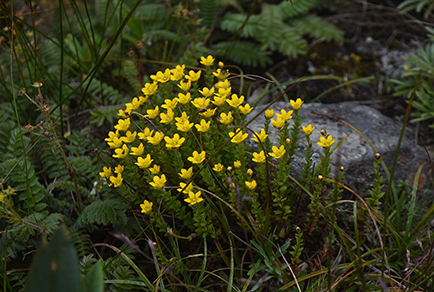
Saxifraga is the largest genus within Saxifragaceae, and China represents one of its major centers of species diversity. In this study, we describe and illustrate a new species, S. paniana, from the Cangshan-Erhai National Natural Reserve in Yunnan, southwestern China. Morphological characters and molecular phylogenetic analysis place it within S. sect. Ciliatae subsect. Hirculoideae. Morphologically, it most closely resembles S. peplidifolia, but differs in leaf, pedicel, and sepal indumentum. Phylogenetic analyses based on complete plastome data indicate that it is sister to S. subaequifoliata. However, these two species are clearly distinguishable in plant size, inflorescence structure, and indumentum.
References
- Bolger, A.M., Lohse, M. & Usadel, B. (2014) Trimmomatic: a flexible trimmer for Illumina sequence data. Bioinformatics 30: 2114–2120. https://doi.org/10.1093/bioinformatics/btu170
- Capella-Gutiérrez, S., Silla-Martínez, J.M. & Gabaldón, T. (2009) TrimAl: a tool for automated alignment trimming in large-scale phylogenetic analyses. Bioinformatics 25: 1972–1973. https://doi.org/10.1093/bioinformatics/btp348
- Chen, Y.P., Zhao, F., Paton, A.J., Sunojkumar, P., Gao, L.M. & Xiang, C.L. (2022) Plastome sequences fail to resolve shallow level relationships within the rapidly radiated genus Isodon (Lamiaceae). Frontiers in Plant Science 13: 985488. https://doi.org/10.3389/fpls.2022.985488
- Deng, J., Drew, B.T., Mavrodiev, E.V., Gitzendanner, M.A., Soltis, P.S. & Soltis, D.E. (2015) Phylogeny, divergence times, and historical biogeography of the angiosperm family Saxifragaceae. Molecular Phylogenetics and Evolution 83: 86–98. https://doi.org/10.1016/j.ympev.2014.11.011
- Don, D. (1822) A monograph of the genus Saxifraga. Transactions of the Linnean Society of London 13: 341–452. https://doi.org/10.1111/j.1095-8339.1821.tb00066.x
- Doyle, J.J. & Doyle, J.L. (1987) A rapid DNA isolation procedure for small quantities of fresh leaf tissue. Phytochemical Bulletin 19: 11–15.
- Ebersbach, J., Muellner-Riehl, A.N., Michalak, I., Tkach, N., Hoffmann, M.H., Röser, M., Sun, H. & Favre, A. (2017) In and out of the Qinghai-Tibet plateau: divergence time estimation and historical biogeography of the large arctic-alpine genus Saxifraga L. Journal of Biogeography 44: 900–910. https://doi.org/10.1111/jbi.12899
- Engler, A. & Irmscher, E. (1912a) Plantae Chinenses Forrestianae. Enumeration and description of species of Saxifraga and Bergenia. Notes from the Royal Botanic Garden, Edinburgh 5: 123–148.
- Engler, A. & Irmscher, E. (1912b) Revision von Saxifraga Sect. Hirculus und neue Arten anderer Sektionen. Botanische Jahrbücher für Systematik 48: 565–610.
- Engler, A. & Irmscher, E. (1916–1919) Saxifragaceae–Saxifraga. In: Engler, A. (Ed.) Das Pflanzenreich IV. 117. Wilhelm Engelmann, Leipzig, pp. 1–448.
- Franchet, A. (1889–1890) Plantae Delavayanae. Paul Klincksieck, Paris, 240 pp.
- Gao, Q.B., Li, Y.H., Gornall, R.J., Zhang, Z.X., Zhang, F.Q., Xing, R., Fu, P.C., Wang, J.L., Liu, H.R., Tian, Z.Z. & Chen, S.L. (2015) Phylogeny and speciation in Saxifraga sect. Ciliatae (Saxifragaceae): evidence from psbA-trnH, trnL-F and ITS sequences. Taxon 64 (4): 703–713. https://doi.org/10.12705/644.3
- Gornall, R.J. (1987) An outline of a revised classification of Saxifraga L. Botanical Journal of the Linnean Society 95: 273–292. https://doi.org/10.1111/j.1095-8339.1987.tb01860.x
- Haworth, A.H. (1803) Miscellanea naturalia: sive, Dissertationes variæ ad historiam naturalem spectantes. J. Taylor, London, 204 pp.
- Haworth, A.H. (1812) Synopsis plantarum succulentarum: cum descriptionibus, synonymis, locis, observationibus anglicanis, culturaque. Typis Richardi Taylor et Socii, Londini, 334 pp. https://doi.org/10.5962/bhl.title.9462
- Irmscher, E. (1935) Über einige ostasiatische Saxifragen. Notes from the Royal Botanic Garden, Edinburgh 18 (90): 262–273.
- Jin, J.J., Yu, W.B., Yang, J.B. & Song, Y. (2020) GetOrganelle: a fast and versatile toolkit for accurate de novo assembly of organelle genomes. Genome Biology 21: 241. https://doi.org/10.1186/s13059-020-02154-5
- Kalyaanamoorthy, S., Minh, B.Q., Wong, T.K. & Von Haeseler, A. & Jermiin, L.S. (2017) ModelFinder: fast model selection for accurate phylogenetic estimates. Nature Methods 14: 587–589. https://doi.org/10.1038/nmeth.4285
- Katoh, K. & Standley, D.M. (2013) MAFFT multiple sequence alignment software version 7: improvements in performance and usability. Molecular Biology and Evolution 30: 772–780. https://doi.org/10.1093/molbev/mst010
- Letunic, I. & Bork, P. (2024) Interactive Tree of Life (iTOL) v6: recent updates to the phylogenetic tree display and annotation tool. Nucleic Acids Research 52 (W1): W78–W82. https://doi.org/10.1093/nar/gkae268
- Linnaeus, C. (1753) Species plantarum. Laurentius Salvius, Stockholm, 1200 pp.
- Minh, B.Q., Schmidt, H.A., Chernomor, O., Schrempf, D., Woodhams, M.D., Von Haeseler, A. & Lanfear, R. (2020) IQ-TREE 2: New models and efficient methods for phylogenetic inference in the genomic era. Molecular Biology and Evolution 37: 1530–1534. https://doi.org/10.1093/molbev/msaa015
- Mosbrugger, V., Favre, A., Muellner-Riehl, A.N., Päckert, M. & Mulch, A. (2018) Cenozoic evolution of geo-biodiversity in the Tibeto-Himalayan region. In: Hoorn, C., Perrigio, A. & Antonelli, A. (Eds.) Mountains, Climate, and Biodiversity. Wiley-Blackwell, Hoboken, pp. 429–448.
- Pan, J.T. (1978) The genus Saxifraga in Qing-Zang Plateau. Acta Phytotaxonomica Sinica 16: 11–35.
- Pan, J.T. (1990) New taxa of the genus Saxifraga from China. Acta Phytotaxonomica Sinica 28: 384–396.
- Pan, J.T. (1991) A study on the genus Saxifraga from China. Acta Phytotaxonomica Sinica 29: 1–24.
- Pan, J.T. (1992) Saxifraga L. In: Pan, J.T. (Ed.) Flora Reipublicae Popularis Sinicae, vol. 34 (2). Science Press, Beijing, pp. 69–221.
- Pan, J.T., Gornall, R.J. & Ohba, H. (2001) Saxifraga L. In: Wu, Z.Y., Raven, P.H. & Hong, D.Y. (Eds.) Flora of China, vol. 8. Science Press, Beijing & Missouri Botanical Garden Press, St. Louis, pp. 280–344.
- Qu, X.J., Moore, M.J., Li, D.Z. & Yi, T.S. (2019) PGA: a software package for rapid, accurate, and flexible batch annotation of plastomes. Plant Methods 15: 50. https://doi.org/10.1186/s13007-019-0435-7
- Ronquist, F., Teslenko, M., van der Mark, P., Ayres, D.L., Darling, A., Höhna, S., Larget, B., Liu, L., Suchard, M.A. & Huelsenbeck, J.P. (2012) MrBayes 3.2: efficient Bayesian phylogenetic inference and model choice across a large model space. Systematic Biology 61: 539–542. https://doi.org/10.1093/sysbio/sys029
- de Candolle, A.P. (1830) Prodromus systematis naturalis regni vegetabilis vol. 4. Sumptibus Sociorum Treuttel et Würtz, Parisii, 683 pp.
- Soltis, D.E., Kuzoff, R.K., Conti, E., Gornall, R.J. & Ferguson, K. (1996) matK and rbcL gene sequence data indicate that Saxifraga (Saxifragaceae) is polyphyletic. American Journal of Botany 83: 371–382. https://doi.org/10.1002/j.1537-2197.1996.tb12717.x
- Soltis, D.E. (2007) Saxifragaceae. In: Kubitzki, K. (Ed.) The Families and Genera of Vascular Plants, vol. 9. Springer, Berlin, pp. 418–435. https://doi.org/10.1007/978-3-540-32219-1_47
- Smith, H. (1960) Saxifraga of the Himalaya. II. Some new species. Bulletin of the British Museum (Natural History), Botany 2 (9): 229–260.
- Thiers, B. (2026) Index Herbariorum: A Global Directory of Public Herbaria and Associated Staff. New York Botanical Garden’s Virtual Herbarium. Available from: http://sweetgum.nybg.org/science/ih/ (accessed 12 April 2026)
- Tkach, N., Röser, M., Miehe, G., Muellner-Riehl, A.N., Ebersbach, J., Favre, A. & Hoffmann, M.H. (2015) Molecular phylogenetics, morphology and a revised classification of the complex genus Saxifraga (Saxifragaceae). Taxon 64: 1159–1187. https://doi.org/10.12705/646.4
- Webb, D.A. & Gornall, R.J. (1989) Saxifrages of Europe. Christopher Helm, London, 307 pp.
- Wu, C.Y. & Pan, J.T. (1990) New taxa of the genus Saxifraga from Hengduan mountains. Acta Phytotaxonomica Sinica 28: 54–67.
- Yuan, R., Ma, X.L., Zhang, Z.X., Gornall, R.J., Wang, Y.C., Chen, S.L. & Gao, Q.B. (2023) Chloroplast phylogenomics and the taxonomy of Saxifraga section Ciliatae (Saxifragaceae). Ecology and Evolution 13: e9694. https://doi.org/10.1002/ece3.9694
- Zhang, Q., Folk, R.A., Mo, Z.Q., Ye, H., Zhang, Z.Y., Peng, H., Zhao, J.L., Yang, S.X. & Yu, X.Q. (2023) Phylotranscriptomic analyses reveal deep gene tree discordance in Camellia (Theaceae). Molecular Phylogenetics and Evolution 188: 107912. https://doi.org/10.1016/j.ympev.2023.107912
- Zhang, Z.X. & Gornall, R.J. (2011) Systematic significance of pollen nucleus number in the genus Saxifraga (Saxifragaceae). Plant Systematics and Evolution 295: 13–22. https://doi.org/10.1007/s00606-011-0456-9