
Abstract
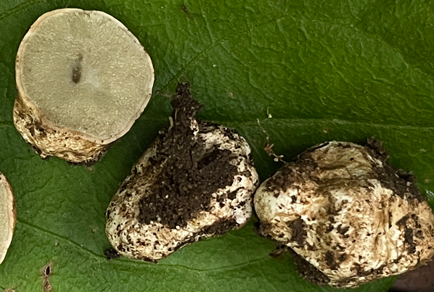
A new species of false truffle was discovered in Shibaoshan Mountain, located in northwestern Yunnan Province, China. Through morphological examination and multi-locus phylogenetic analyses utilizing ITS, nrLSU, atp6, rpb2, and tef1 sequences, this species is formally described as Hysterangium shibaoshanense sp. nov. The species is distinguished by basidiomata with a non-discoloring peridium, relatively small and light golden-yellow spores (excluding utricle, measuring 2–4 × 0.8–1.5 μm), and utricles that are asymmetrically inflated in 5% KOH or water, reaching 0.5–1.5 μm in thickness from the spore wall. A comparative analysis of the main morphological characteristics of 16 Chinese Hysterangium species is presented, along with a dichotomous key.
References
- Brock, P.M., Döring, H. & Bidartondo, M.I. (2009) How to know unknown fungi: the role of a herbarium. New Phytologist 181 (3): 719–724. https://doi.org/10.1111/j.1469-8137.2008.02703.x
- Castellano, M.A. (1988) The taxonomy of the genus Hysterangium (Basidiomycotina: Hysterangiaceae) with notes on its ecology. Oregon State University. [http://ir.library.oregonstate.edu/xmlui/bitstream/handle/1957/13508/CastellanoMichaelA1990]
- Castellano, M.A. (1999) Hysterangium. In: Ectomycorrhizal fungi key genera in profile. Springer Berlin Heidelberg, Berlin, Heidelberg, pp. 311–323. https://doi.org/10.1007/978-3-662-06827-4
- Castellano, M.A. & Beever, R.E. (1994) Truffle-like Basidiomycotina of New Zealand: Gallacea, Hysterangium, Phallobata, and Protubera. New Zealand Journal of Botany 32 (3): 305–328. https://doi.org/10.1080/0028825X.1994.10410473
- Davoodian, N., Jackson, C.J., Holmes, G.D. & Lebel, T. (2020) Continental‐scale metagenomics, BLAST searches, and herbarium specimens: The Australian Microbiome Initiative and the National Herbarium of Victoria. Applications in Plant Sciences 8 (9): e11392. https://doi.org/10.1002/aps3.11392
- Davoodian, N., Lebel, T., Castellano, M.A. & Hosaka, K. (2021) Hysterangiales revisited: expanded phylogeny reveals new genera and two new suborders. Fungal Systematics and Evolution 8 (1): 65–80. https://doi.org/10.3114/fuse.2021.08.06
- Dawson, H.R. & Dawson, H.A. (2024) Use of a Truffle Dog Provides Insight Into the Ecology and Abundant Occurrence of Genea (Pyronemataceae) in Western Oregon, USA. Ecology and Evolution 14 (11): e70590. https://doi.org/10.1002/ece3.70590
- Dunham, S.M., Larsson, K.H. & Spatafora, J.W. (2007) Species richness and community composition of mat-forming ectomycorrhizal fungi in old-and second-growth Douglas-fir forests of the HJ Andrews Experimental Forest, Oregon, USA. Mycorrhiza 17 (8): 633–645. https://doi.org/10.1007/s00572-007-0141-6
- Eckblad, F.E. & Ellingsen, H.J. (1984) Gasteromycetes from China collected by Dr. Harry Smith 1921-1923, 1924–1925 and 1934. Sydowia: Annales mycologici.
- Elliott, T.F., Georgiev, A.V., Lokasola, A.L. & Smith, M.E. (2020) Hysterangium bonobo: A newly described truffle species that is eaten by bonobos in the Democratic Republic of Congo. Mycologia 112 (6): 1203–1211. https://doi.org/10.1080/00275514.2020.1790234
- Frank, J.L., Barry, S. & Southworth, D. (2006) Mammal mycophagy and dispersal of mycorrhizal inoculum in Oregon white oak woodlands. Northwest Science 80 (4): 264.
- Gardes, M. & Bruns, T.D. (1993) ITS primers with enhanced specificity for basidiomycetes application to the identification of mycorrhizae and rusts. Mol. Ecol. 2: 113–118. https://doi.org/10.1111/j.1365-294X.1993.tb00005.x
- Giachini, A.J., Hosaka, K., Nouhra, E., Spatafora, J. & Trappe, J.M. (2010) Phylogenetic relationships of the Gomphales based on nuc-25S-rDNA, mit-12S-rDNA, and mit-atp6-DNA combined sequences. Fungal biology 114 (2–3): 224–234. https://doi.org/10.1016/j.funbio.2010.01.002
- Gladish, S., Frank, J. & Southworth, D. (2010) The serpentine syndrome below ground: ectomycorrhizas and hypogeous fungi associated with conifers. Canadian Journal of Forest Research 40 (8): 1671–1679. https://doi.org/10.1139/X10-092
- Guevara Guerrero, G., Castellano, M.A., García Jiménez, J., Cázares González, E. & Trappe, J.M. (2008) Hysterangium (Hysterangiales, Hysterangiaceae) del norte de México. Revista mexicana de micología 28 (SPE): 95–100. https://doi.org/10.33885/sf.2008.3.1036
- Guevara-Guerrero, G., Martínez, M.M., Reyes, V.G., Ge, Z.W. & Castellano, M.A. (2021) New molecular data in the Truffle-like fungus, Aroramyces Herrerae, Reveal a novel cryptic ancestral taxon, Pterosporomyces herrerae gen. nov. & comb. nov. Trappeacea, Phallales. Global Journal of Science Frontier Research 21 (C3): 1–6. [https://journalofscience.org/index.php/GJSFR/article/view/2970]
- Hall, T. (2007) BioEdit 7.0. 5.3 Department of Microbiology, North Carolina State University. Available from: http://www.mbio.ncsu.edu/BioEdit/Bioedit.Html (accessed 1 May 2024)
- He, M.Q., Cao, B., Liu, F., Boekhout, T., Denchev, T.T., Schoutteten, N., Denchev, C.M., Kemler, M., Gorjón, S.P., Begerow, D., Valenzuela, R., Davoodian, N., Niskanen, T., Vizzini, A., Redhead, S.A., Ramírez-Cruz, V., Papp, V., Dudka, V.A., Dutta, A.K., García-Sandoval, R., Liu, X.Z., Kijpornyongpan, T., Savchenko, A., Tedersoo, L., Theelen, B., Trierveiler-Pereira, L., Wu, F., Zamora, J.C., Zeng, X.Y., Zhou, L.W., Liu, S.L., Ghobad-Nejhad, M., Giachini, A.J., Li, G.J., Kakishima, M., Olariaga, I., Haelewaters, D., Sulistyo, B., Sugiyama, J., Svantesson, S., Yurkov, A., Alvarado, P., Antonín, V., da Silva, A.F., Druzhinina, I., Gibertoni, T.B., Guzmán-Dávalos, L., Justo, A., Karunarathna, S.C., Galappaththi, M.C.A., Toome-Heller, M., Hosoya, T., Liimatainen, K., Márquez, R., Mešić, A., Moncalvo, J.M., Nagy, L.G., Varga, T., Orihara, T., Raymundo, T., Salcedo, I., Silva-Filho, A.G.S., Tkalčec, Z., Wartchow, F., Zhao, C.L., Bau, T., Cabarroi-Hernández, M., Cortés-Pérez, A., Decock, C., De Lange, R., Weiss, M., Menolli Jr., N., Nilsson, R.H., Fan, Y.G., Verbeken, A., Gafforov, Y., Meiras-Ottoni, A., Mendes-Alvarenga, R.L., Zeng, N.K., Wu, Q., Hyde, K.D., Kirk, P.M. & Zhao, R.L. (2024) Phylogenomics, divergence times and notes of orders in Basidiomycota. Fungal Diversity 126 (1): 127–406. https://doi.org/10.1007/s13225-024-00535-w
- Hosaka, K., Bates, S.T., Beever, R.E., Castellano, M.A., Colgan III, W., Domínguez, L.S., Nouhra, E.R., Geml, J., Giachini, A.J., Kenney, S.R., Simpson, N.B., Spatafora, J.W. & Trappe, J.M. (2006) Molecular phylogenetics of the gomphoid-phalloid fungi with an establishment of the new subclass Phallomycetidae and two new orders. Mycologia 98 (6): 949–959. https://doi.org/10.3852/mycologia.98.6.949
- Hosaka, K., Castellano, M.A. & Spatafora, J.W. (2008) Biogeography of Hysterangiales (Phallomycetidae, Basidiomycota). Mycological Research 112 (4): 448–462. https://doi.org/10.1016/j.mycres.2007.06.004
- Humpert, A.J., Muench, E.L., Giachini, A.J., Castellano, M.A. & Spatafora, J.W. (2001) Molecular phylogenetics of Ramaria and related genera: evidence from nuclear large subunit and mitochondrial small subunit rDNA sequences. Mycologia 93 (3): 465–477. https://doi.org/10.1080/00275514.2001.12063180
- Hyde, K.D., Noorabadi, M.T., Thiyagaraja, V., He, M.Q., Johnston, P.R., Wijesinghe, S.N., Armand, A., Biketova, A.Y., Chethana, K.W.T., Erdoğdu, M., Ge, Z.W., Groenewald, J.Z., Hongsanan, S., Kušan, I., Leontyev, D.V., Li, D.W., Lin, C.G., Liu, N.G., Maharachchikumbura, S.S.N., Matočec, N., May, T.W., McKenzie, E.H.C., Mešić, A., Perera, R.H., Phukhamsakda, C., Piątek, M., Samarakoon, M.C., Selcuk, F., Senanayake, I.C., Tanney, J.B., Tian, Q., Vizzini, A., Wanasinghe, D.N., Wannasawang, N., Wijayawardene, N., Zhao, R.L., Abdel-Wahab, M.A., Abdollahzadeh, J., Abeywickrama, P.D., Abhinav, Absalan, S., Acharya, K., Afshari, N., Afshan,. NS, Afzalinia, S., Ahmadpour, S.A., Akulov, O., Alizadeh, A., Alizadeh, M., Al-Sadi, A.M., Alves, A., Alves, V.C.S., Alves-Silva, G., Antonín, V., Aouali, S., Aptroot, A., Apurillo, C.C.S., Arias, R.M., Asgari, B., Asghari, R., Assis, D.M.A., Assyov, B., Atienza, V., Aumentado, H.D.R., Avasthi, S., Azevedo, E., Bakhshi, M., Bao, D.F., Baral, H.O., Barata, M., Barbosa, K.D., Barbosa, R.N., Barbosa, F.R., Baroncelli, R., Barreto, G.G., Baschien, C., Bennett, R.M., Bera, I., Bezerra, J.D.P., Bhunjun, C.S., Bianchinotti, M.V., Błaszkowski, J., Boekhout, T., Bonito, G.M., Boonmee, S., Boonyuen, N., Bortnikov, F.M., Bregant, C., Bundhun, D., Burgaud, G., Buyck, B., Caeiro, M.F., Cabarroi-Hernández, M., Cai, M.F., Cai, L., Calabon, M.S., Calaça, F.J.S., Callalli, M., Câmara, M.P.S., Cano-Lira, J., Cao, B., Carlavilla, J.R., Carvalho, A., Carvalho, T.G., Castañeda-Ruiz, R.F., Catania, M.D.V., Cazabonne, J., Cedeño-Sanchez, M., Chaharmiri-Dokhaharani, S., Chaiwan, N., Chakraborty, N., Cheewankoon, R., Chen, C., Chen, J., Chen, Q., Chen, Y.P., Chinaglia, S., Coelho-Nascimento, C.C., Coleine, C., CostaRezende, D.H., Cortés-Pérez, A., Crouch, J.A., Crous, P.W., Cruz, R.H.S.F., Czachura, P., Damm, U., Darmostuk, V., Daroodi, Z., Das, K., Davoodian, N., Davydov, E.A., da Silva, G.A., da Silva, I.R., da Silva, R.M.F., da Silva, S.A.C., Dai, D.Q., Dai, Y.C., de Groot, M.D., De Kesel, A., De Lange, R., de Medeiros, E.V., de Souza, C.F.A., de Souza, F.A., dela Cruz, T.E.E., Decock, C., Delgado, G., Denchev, C.M., Denchev, T.T., Deng, Y.L., Dentinger, B.T.M., Devadatha, B., Dianese, J.C., Dima, B., Doilom, M., Dissanayake, A.J., Dissanayake, D.M.L.S., Dissanayake, L.S., Diniz, A.G., Dolatabadi, S., Dong, J.H., Dong, W., Dong, Z.Y., Drechsler-Santos, E.R., Druzhinina, I.S., Du, T.Y., Dubey, M.K., Dutta, A.K., Elliott, T.F., Elshahed, M.S., Egidi, E., Eisvand, P., Fan, L., Fan, X., Fan, X.L., Fedosova, A.G., Ferro, L.O., Fiuza, P.O., Flakus, A.W., Fonseca, E.O., Fryar, S.C., Gabaldón, T., Gajanayake, A.J., Gannibal, P.B., Gao, F., GarcíaSánchez, D., García-Sandoval, R., Garrido-Benavent, I., Garzoli, L., Gasca-Pineda, J., Gautam, A.K., Gené, J., Ghobad-Nejhad, M., Ghosh, A., Giachini, A.J., Gibertoni, T.B., Gentekaki, E., Gmoshinskiy, V.I., GóesNeto, A., Gomdola, D., Gorjón, S.P., Goto, B.T., Granados-Montero, M.M., Griffith, G.W., Groenewald, M., Grossart, H.-P., Gu, Z.R., Gueidan, C., Gunarathne, A., Gunaseelan, S., Guo, S.L., Gusmão, L.F.P., Gutierrez, A.C., Guzmán-Dávalos, L., Haelewaters, D., Haituk, H., Halling, R.E., He, S.C., Heredia, G., HernándezRestrepo, M., Hosoya, T., Hoog, S.D., Horak, E., Hou, C.L., Houbraken, J., Htet, Z.H., Huang, S.K., Huang, W.J., Hurdeal, V.G., Hustad, V.P., Inácio, C.A., Janik, P., Jayalal, R.G.U., Jayasiri, S.C., Jayawardena, R.S., Jeewon, R., Jerônimo, G.H., Jin, J., Jones, E.B.G., Joshi, Y., Jurjević, Ž., Justo, A., Kakishima, M., Kaliyaperumal, M., Kang, G.P., Kang, J.C., Karimi, O., Karunarathna, S.C., Karpov, S.A., Kezo, K., Khalid, A.N., Khan, M.K., Khuna, S., Khyaju, S., Kirchmair, M., Klawonn, I., Kraisitudomsook, N., Kukwa, M., Kularathnage, N.D., Kumar, S., Lachance, M.A., Lado, C., Latha, K.P.D., Lee, H.B., Leonardi, M., Lestari, A.S., Li, C., Li, H., Li, J., Li, Q., Li, Y., Li, Y.C., Li, Y.X., Liao, C.F., Lima, J.L.R., Lima, J.M.S., Lima, N.B., Lin, L., Linaldeddu, B.T., Linn, M.M., Liu, F., Liu, J.K., Liu, J.W., Liu, S., Liu, S.L., Liu, X.F., Liu, X.Y., Longcore, J.E., Luangharn, T., Luangsaard, J.J., Lu, L., Lu, Y.Z., Lumbsch, H.T., Luo, L., Luo, M., Luo, Z.L., Ma, J., Madagammana, A.D., Madhushan, A., Madrid, H., Magurno, F., Magyar, D., Mahadevakumar, S., Malosso, E., Malysh, J.M., Mamarabadi, M., Manawasinghe, I.S., Manfrino, R.G., Manimohan, P., Mao, N., Mapook, A., Marchese, P., Marasinghe, D.S., Mardones, M., Marin-Felix, Y., Masigol, H., Mehrabi, M., MehrabiKoushki, M., Meiras-Ottoni, A., de Melo, R.F.R., Mendes-Alvarenga, R.L., Mendieta, S., Meng, Q.F., Menkis, A., Menolli, J.N., Mikšík, M., Miller, S.L., Moncada, B., Moncalvo, J.M., Monteiro, J.S., Monteiro, M., Mora-Montes, H.M., Moroz, E.L., Moura, J.C., Muhammad, U., Mukhopadhyay, S., Nagy, G.L., Najamul, S.A., Najafiniya, M., Nanayakkara, C.M., Naseer, A., Nascimento, E.C.R., Nascimento, S.S., Neuhauser, S., Neves, M.A., Niazi, A.R., Nie, Yong., Nilsson, R.H., Nogueira, P.T.S., Novozhilov, Y.K., Noordeloos, M., Norphanphoun, C., Nuñez, O.N., O’Donnell, R.P., Oehl, F., Oliveira, J.A., Oliveira, J.I., Oliveira, N.V.L., Oliveira, P.H.F., Orihara, T., Oset, M., Pang, K.L., Papp, V., Pathirana, L.S., Peintner, U., Pem, D., Pereira, O.L., Pérez-Moreno, J., Pérez-Ortega, S., Péter, G., Pires-Zottarelli, C.L.A., Phonemany, M., Phongeun, S., Pošta, A., Prazeres, J.F.S.A., Quan, Y., Quandt, C.A., Queiroz, M.B., Radek, R., Rahnama, K., Raj, K.N.A., Rajeshkumar, K.C., Rajwar, S., Ralaiveloarisoa, A.B., Rämä, T., Ramírez-Cruz, V., Rambold, G., Rathnayaka, A.R., Raza, M., Ren, G.C., Rinaldi, A.C., Rivas-Ferreiro, M., Robledo, G.L., Ronikier, A., Rossi, W., Rusevska, K., Ryberg, M., Safi, A., Salimi, F., Salvador-Montoya, C.A., Samant, B., Samaradiwakara, N.P., Sánchez-Castro, I., Sandoval-Denis, M., Santiago, A.L.C.M.A., Santos, A.C.D.S., Santos, L.A., Sarma, V.V., Sarwar, S., Savchenko, A., Savchenko, K., Saxena, R.K., Schoutteten, N., Selbmann, L., Ševčíková, H., Sharma, A., Shen, H.W., Shen, Y.M., Shu, Y.X., Silva, H.F., Silva-Filho, A.G.S., Silva, V.S.H., Simmons, D.R., Singh, R., Sir, E.B., Sohrabi, M., Souza, F.A., Souza-Motta, C.M., Sriindrasutdhi, V., Sruthi, O.P., Stadler, M., Stemler, J., Stephenson, S.L., Stoyneva-Gaertner, M.P., Strassert, J.F.H., Stryjak-Bogacka, M., Su, H., Sun, Y.R., Svantesson, S., Sysouphanthong, P., Takamatsu, S., Tan, T.H., Tanaka, K., Tang, C., Tang, X., Taylor, J.E., Taylor, P.W.J, Tennakoon, D.S., Thakshila, S.A.D., Thambugala, K.M., Thamodini, G.K., Thilanga, D., Thines, M., Tiago, P.V., Tian, X.G., Tian, W.H., Tibpromma, S., Tkalčec, Z., Tokarev, Y.S., Tomšovský, M., Torruella, G., Tsurykau, A., Udayanga, D., Ulukapı, M., Untereiner, W.A., Usman, M., Uzunov, B.A., Vadthanarat, S., Valenzuela, R., Van den Wyngaert, S., Van Vooren, N., Velez, P., Verma, R.K., Vieira, L.C., Vieira, W.A.S., Vinzelj, J.M., Tang, A.M.C., Walker, A., Walker, A.K., Wang, Q.M., Wang, Y., Wang, X.Y., Wang, Z.Y., Wannathes, N., Wartchow, F., Weerakoon, G., Wei, D.P., Wei, X., White, J.F., Wijesundara, D.S.A., Wisitrassameewong, K., Worobiec, G., Wu, H.X., Wu, N., Xiong, Y.R., Xu, B., Xu, J.P., Xu, R., Xu, R.F., Xu, R.J., Yadav, S., Yakovchenko, L.S., Yang, H.D., Yang, X., Yang, Y.H., Yang, Y., Yang, Y.Y., Yoshioka, R., Youssef, N.H., Yu, F.M., Yu, Z.F., Yuan, L.L., Yuan, Q., Zabin, D.A., Zamora, J.C., Zapata, C.V., Zare, R., Zeng, M., Zeng, X.Y., Zhang, J.F., Zhang, J.Y., Zhang, S., Zhang, X.C., Zhao, C.L., Zhao, H., Zhao, Q., Zhao, H., Zhao, H.J., Zhou, H.M., Zhu, X.Y., Zmitrovich, I.V., Zucconi, L. & Zvyagina, E. (2024) The 2024 Outline of Fungi and fungus-like taxa. Mycosphere 15: 5146–6239. https://doi.org/10.5943/mycosphere/15/1/25
- Katoh, K. & Standley, D.M. (2013) MAFFT multiple sequence alignment software version 7: Improvements in performance and usability. Molecular Biology and Evolution 30: 772–780. https://doi.org/10.1093/molbev/mst010
- Kornerup, A. & Wanscher, J.H. (1978) Methuen Handbook of Colour, 3rd ed. Methuen, London.
- Kretzer, A.M. & Bruns, T.D. (1999) Use of atp6 in fungal phylogenetics: an example from the Boletales. Molecular phylogenetics and evolution 13 (3): 483–492. https://doi.org/10.1006/mpev.1999.0680
- Liu, Y.J., Whelen, S. & Hall, B.D. (1999) Phylogenetic relationships among ascomycetes: evidence from an RNA polymerase II subunit. Molecular Biology and Evolution 16 (12): 1799–1808. https://doi.org/10.1093/oxfordjournals.molbev.a026092
- Liu, B., Fan, L. & Li, J. (2005) Fungi of China, Volume 23. Beijing Science Press, Beijing.
- Malajczuk, N., Dell, B. & Bougher, N.L. (1987) Ectomycorrhiza formation in eucalyptus: iii. superficial ectomycorrhizas initiated by hysterangium and cortinarius species. New Phytologist 105 (3): 421–428. https://doi.org/10.1111/j.1469-8137.1987.tb00879.x
- Matheny, P.B. (2005) Improving phylogenetic inference of mushrooms with RPB1 and RPB2 nucleotide sequences (Inocybe, Agaricales). Molecular Phylogenetics and Evolution 35: 1–20. https://doi.org/10.1016/j.ympev.2004.11.014
- Miller, M.A., Pfeiffer, W. & Schwartz, T. (2010) Gateway for inference of large phylogenetic trees. Available from: http://www.phylo.org/sub_sections/portal (accessed 8 July 2026)
- Morehouse, E.A., James, T.Y., Ganley, A.R.D., Vilgalys, R., Berger, L., Murphy, P.J. & Longcore, J.E. (2003) Multilocus sequence typing suggests the chytrid pathogen of amphibians is a recently emerged clone. Molecular Ecology 12: 395–403. https://doi.org/10.1046/j.1365-294x.2003.01732.x
- Nuske, S.J., Anslan, S., Tedersoo, L., Bonner, M.T., Congdon, B.C. & Abell, S.E. (2018) The endangered northern bettong, Bettongia tropica, performs a unique and potentially irreplaceable dispersal function for ectomycorrhizal truffle fungi. Molecular Ecology 27 (23): 4960–4971. https://doi.org/10.1111/mec.14916
- Nylander, J.A.A. (2004) MrModeltest 2C program for selecting DNA substitution models using PAUP. Evolutionary Biology Centre, Uppsala University, Sweden.
- Osmundson, T.W., Robert, V.A., Schoch, C.L., Baker, L.J., Smith, A., Robich, G., Mizzan, L. & Garbelotto, M.M. (2013) Filling gaps in biodiversity knowledge for macrofungi: contributions and assessment of an herbarium collection DNA barcode sequencing project. PloS one 8 (4): e62419. https://doi.org/10.1371/journal.pone.0062419
- Peña-Ramírez, R., Ge, Z.W., Gaitán-Hernández, R., Martínez-González, C.R. & Guevara-Guerrero, G. (2019) A novel sequestrate species from Mexico: Aroramyces guanajuatensis sp. nov.(Hysterangiaceae, Hysterangiales). MycoKeys 61: 27–37. https://doi.org/10.3897/mycokeys.61.36444
- Phukhamsakda, C., Nilsson, R.H., Bhunjun, C.S., de Farias, A.R.G., Sun, Y.R., Wijesinghe, S.N., Raza, M., Bao, D.F., Lu, L., Tibpromma, S., Dong, W., Tennakoon, D.S., Tian, X.G., Xiong, Y.R., Karunarathna, S.C., Cai, L., Luo, Z.L., Wang, Y., Manawasinghe, I.S., Camporesi, E., Kirk, P.M., Promputtha, I., Kuo, C.H., Su, H.Y., Doilom, M., Li, Y., Fu, Y.P. & Hyde, K.D. (2022) The numbers of fungi: contributions from traditional taxonomic studies and challenges of metabarcoding. Fungal Diversity 114: 327–386. https://doi.org/10.1007/s13225-022-00502-3
- Rambaut, A., Drummond, A.J., Xie, D., Baele, G. & Suchard, M.A. (2018) Posterior summarization in Bayesian phylogenetics using Tracer 1.7. Systematic biology 67 (5): 901–904. https://doi.org/10.1093/sysbio/syy032
- Rathnayaka, A.R., Tennakoon, D.S., Jones, G.E., Wanasinghe, D.N., Bhat, D.J., Priyashantha, A.H., Stephenson, S.L., Karunarathna, S.C. (2025) Significance of precise documentation of hosts and geospatial data of fungal collections, with an emphasis on plant-associated fungi. New Zealand Journal of Botany 63 (2-3): 462–489. https://doi.org/10.1080/0028825X.2024.2381734
- Rehner, S.A. & Buckley, E. (2005) A Beauveria phylogeny inferred from nuclear ITS and EF1-α sequences: evidence for cryptic diversification and links to Cordyceps teleomorphs. Mycologia 97 (1): 84–98. https://doi.org/10.3852/mycologia.97.1.84
- Ronquist, F., Huelsenbeck, J. & Teslenko, M. (2011) Distributed with the software from. [https://brahms.biology.rochester.edu/software.html]
- Sheedy, E.M., Ryberg, M., Lebel, T., May, T.W., Bougher, N.L. & Matheny, P.B. (2016) Dating the emergence of truffle-like fungi in Australia, by using an augmented meta-analysis. Australian Systematic Botany 29 (5): 284–302. https://doi.org/10.1071/SB16007
- Smith, M.E., Douhan, G.W. & Rizzo, D.M. (2007) Ectomycorrhizal community structure in a xeric Quercus woodland based on rDNA sequence analysis of sporocarps and pooled roots. New Phytologist 174 (4). https://doi.org/10.1111/j.1469-8137.2007.02073.x
- Smith, M.E., Henkel, T.W., Uehling, J.K., Fremier, A.K., Clarke, H.D. & Vilgalys, R. (2013) The ectomycorrhizal fungal community in a neotropical forest dominated by the endemic dipterocarp Pakaraimaea dipterocarpacea. PLoS one 8 (1): e55160. https://doi.org/10.1371/journal.pone.0055160
- Stamatakis, A. (2014) RAxML version 8: a tool for phylogenetic analysis and post-analysis of large phylogenies. Bioinformatics 30 (9): 1312–1313. https://doi.org/10.1093/bioinformatics/btu033
- Sulzbacher, M.A., Grebenc, T., Nouhra, E.R., Giachini, A.J., Martín, M.P. & Baseia, I.G. (2019) Hysterangium atlanticum sp. nov., forms ectomycorrhizae with Coccoloba species (Polygonaceae) from the Atlantic rainforest of Northeastern Brazil. Symbiosis 78: 275–286. https://doi.org/10.1007/s13199-019-00613-2
- Suz, L.M., Barsoum, N., Benham, S., Dietrich, H.P., Fetzer, K.D., Fischer, R., García, P., Gehrman, J., Kristöfel, F., Manninger, M., Neagu, S., Nicolas, M., Oldenburger, J., Raspe, S., Sánchez, G., Schröck, H.W., Schubert, A., Verheyen, K., Verstraeten, A. & Bidartondo, M.I. (2014) Environmental drivers of ectomycorrhizal communities in Europe’s temperate oak forests. Molecular Ecology 23 (22): 5628–5644. https://doi.org/10.1111/mec.12947
- Tao, K., Chang, M. & Liu, B. (1996) New species and new records of hypogeous fungi from China V. Journal of Shanxi University (Natural Science Edition) 19 (1): 82–87.
- Truong, C., Mujic, A.B., Healy, R., Kuhar, F., Furci, G., Torres, D., Niskanen, T., Sandoval-Leiva, P.A., Fernández, N., Escobar, J.M., Moretto, A., Palfner, G., Pfister, D., Nouhra, E., Swenie, R., Sánchez-García, M., Matheny, P.B. & Smith, M.E. (2017) How to know the fungi: Combining field inventories and DNA-barcoding to document fungal diversity. New Phytologist 214: 913–919. https://doi.org/10.1111/nph.14509
- Twieg, B.D. (2006) Ectomycorrhizal communities of Douglas-fir and paper birch along a gradient of stand age following clearcutting and wildfire in the Interior Cedar-Hemlock Zone, southern British Columbia. University of British Columbia.
- Vaidya, G., Lohman, D.J. & Meier, R. (2011) SequenceMatrix: concatenation software for the fast assembly of multi‐gene datasets with character set and codon information. Cladistics 27 (2): 171–180. https://doi.org/10.1111/j.1096-0031.2010.00329.x
- Vilgalys, R. & Hester, M. (1990) Rapid genetic identification and mapping of enzymatically amplified DNA from several Cryptococcus species. Journal of Bacteriology 172: 4238–4246. https://doi.org/10.1128/jb.172.8.4238-4246.1990
- Vittadini, C. (1831) Monographia Tuberacearum. Typographia F. Rusconi, Milano.
- White, T.J., Bruns, T., Lee, S. & Taylor, J. (1990) Amplification and direct sequencing of fungal ribosomal RNA genes for phylogenetics. In: Innis, M.A., Gelfand, D.H., Sninsky, J.J. & White, T.J. (Eds.) PCR Protocols: A Guide to Methods and Applications, Volume 1. Academic Press, New York, pp. 315–322. https://doi.org/10.1016/B978-0-12-372180-8.50042-1
- Xu, A.S. & Liu, B. (2003) A new species in the genus Hysterangium from China. Mycosystema 22 (1): 16–18.
- Zeller, S.M. & Dodge, C.W. (1929) Hysterangium in North America. Annals of the Missouri Botanical Garden 16 (1): 83–128. https://doi.org/10.2307/2394174