
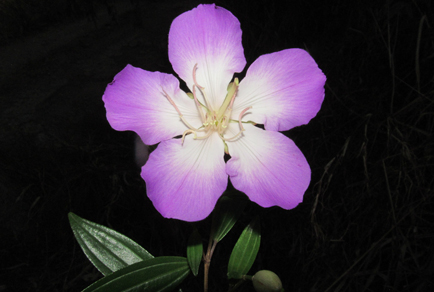

Abstract
We present a taxonomic reassessment of a morphologically complex group of “manacás” and “quaresmeiras”, characterized by strigose branches covered with appressed trichomes and flower buds subtended by six cucullate bracteoles. These species belong to a group of Pleroma (Melastomataceae) endemic to the Brazilian Atlantic Forest and widely cultivated as ornamental trees in urban landscaping. Based on morphological analyses, herbarium surveys, phenological data, and in vivo observations, we demonstrate that the current taxonomic interpretation—treating P. pulchrum as a synonym of P. raddianum—obscures a distinct taxonomic entity. By reinstating P. pulchrum and redefining P. raddianum, we clarify identification limits using consistent morphological characters. Discontinuities in leaf venation, bracteole size, and floral characters—particularly differences in the size, shape, and indumentum of floral parts—as well as fruit size delimit three species—P. pulchrum, P. raddianum, and P. sellowianum—which are often confused due to their overall morphological similarity. Most plants propagated ornamentally, frequently referred to as Tibouchina mutabilis “Nana” (an illegitimate name), correspond to P. raddianum and differ from native populations by subtle morphological differences, including leaf venation, petal colour pattern, and merosity. These differences are likely related to local genetic characteristics and the origin of these progenies, which are commonly propagated by cuttings, have resulted in clonal plants with fixed and uniform morphology. The three species, P. pulchrum, P. raddianum, and P. sellowianum, exhibit largely non-overlapping flowering peaks—summer, early autumn, and winter, respectively—and partially contiguous distributions, suggesting possible zones of secondary contact. We provide concise descriptions of P. pulchrum, P. raddianum, and P. sellowianum, along with an identification key for the species group, characterized by solitary flowers and petals that change colour during senescence. Distribution maps and comparative illustrations are also presented. This treatment improves species recognition and refines the current understanding of Pleroma diversity in the Atlantic Forest.
References
- Aublet, J.B.C.F. (1775) Histoire des Plantes de la Guiane Françoise. V. 1. Pierre François Didot, London, 621 pp.
- Augustin, A.F., Lima, D.F., Speck Vieira, F.C., Stefenon, V.M. & Caddah, M.K. (2025) Conservation genetics of two rare and endemic Myrceugenia species (Myrtaceae) from the Brazilian Atlantic Forest. Conservation Genetics 26: 787–803. https://doi.org/10.1007/s10592-025-01703-4
- Bachman, S., Moat, J., Hill, A.W., De la Torre, J. & Scott, B. (2011) Supporting Red List threat assessments with GeoCAT: geospatial conservation assessment tool. ZooKeys 150: 117–126. https://doi.org/10.3897/zookeys.150.2109
- Beentje, H. (2010) The Kew Plant Glossary, an illustrated dictionary of plant terms. Kew Publishing, Royal Botanic Gardens, London, 160 pp.
- Brade, A.C. (1938) Melastomataceae novae II. Archivos do Instituto de Biologia Vegetal 4 (1): 71–78.
- Brito, V.L.G. & Sazima, M. (2012) Tibouchina pulchra (Melastomataceae): reproductive biology of a tree species at two sites of an elevational gradient in the Atlantic rainforest in Brazil. Plant Systematics and Evolution 298: 1271–1279. https://doi.org/10.1007/s00606-012-0633-5
- Brito, V.L.G., Weynans, K., Sazima, M. & Lunau, K. (2015) Trees as huge flowers and flowers as oversized floral guides: the role of floral color change and retention of old flowers in Tibouchina pulchra. Frontiers in Plant Science 6: 362. https://doi.org/10.3389/fpls.2015.00362
- Brito, V.L.G., Mori, G.M., Vigna, B.B.Z., Azevedo-Silva, M., Souza, A.P. & Sazima, M. (2016) Genetic structure and diversity of populations of polyploid Tibouchina pulchra Cogn. (Melastomataceae) under different environmental conditions in extremes of an elevational gradient. Tree Genetics & Genomes 12: 101. https://doi.org/10.1007/s11295-016-1059-y
- Chamisso, A. (1834) De plantis in expeditione speculatoria Romanzoffiana et in herbariis Regiis Berolinensibus observatis—Melastomaceae Americanae continuatio. Linnaea 9: 428–460.
- Cogniaux, C.A. (1885) Melastomataceae. In: Martius, C.F.P., Eichler, A.G. & Urban, I. (Eds.) Flora Brasiliensis 14 (3). Lipsiae, Frid. Fleischer, Munich, 655 pp.
- Cogniaux, C.A. (1891) Mélastomaceés. In: Candolle, A. & Candolle, C. (Eds.) Monographiae Phanerogamarum 7. G. Masson, Paris, 1256 pp.
- De Candolle, A.P. (1828) Prodromus systematis naturalis regni vegetabilis 3. Tretttel et Würtz, Paris, 494 pp.
- Don, D. (1823) [“1822”] An Illustration of the natural family of plants called Melastomaceae. Memoirs of the Wernerian Natural History Society 4: 276–329.
- Flora e Funga do Brasil (2025) Jardim Botânico do Rio de Janeiro. Available from: http://floradobrasil.jbrj.gov.br/ (accessed 18 December 2025)
- Gardner, G. (1843) Contributions toward a flora of Brazil. Part II. Plants from the Organ Mountains. The London Journal of Botany 2: 329–355.
- Goldenberg, R. & Baldini, R.M. (2002) Melastomataceae Raddianae: a study of G Raddi's Melastomataceae types housed in the herbaria of Pisa (PI) and Firenze (FI). Taxon 51: 739–746. https://doi.org/10.2307/1555028
- Guimarães, P.J.F. & Oliveira, C.M.S. (2009) Tibouchina Aubl. In: Martins, S.E., Wanderley, M.G.L., Shepherd, G.J., Giulietti, A.M. & Melhem, T.S. (Eds.) Flora Fanerogâmica do Estado de São Paulo, v.6. Instituto de Botânica, São Paulo, pp. 127–149.
- Guimarães, P.J.F., Michelangeli, F.A., Sosa, K. & Gomez, J.R.S. (2019) Systematics of Tibouchina and allies (Melastomataceae: Melastomateae): a new taxonomic classification. Taxon 68: 937–1002. https://doi.org/10.1002/tax.12151
- Hickey, M. & King, C. (2000) The Cambridge Illustrated Glossary of Botanical Terms. Cambridge University Press, Cambridge, 208 pp.
- Humboldt, A. & Bonpland, A. (1823) Monographie des Melastomaceés. In: Humboldt, A. & Bonpland, A. (Eds.) Monographia Melastomacearum, Vol. 2, Rhexies. Chez Gide Fils, Paris, pp. 1–158.
- IBGE—Instituto Brasileiro de Geografia e Estatística (2012) Manual Técnico da Vegetação Brasileira, nº1, 2ª Ed. IBGE, Rio de Janeiro, 271 pp.
- IUCN—International Union for Conservation of Nature (2024) Diretrizes para o Uso das Categorias e Critérios da Lista Vermelha da UICN, versão 16. Prepared by the Standards and Petitions Committee. Available from: https://www.iucnredlist.org/resources/redlistguidelines (accessed 7 October 2025)
- Jussieu, A.L. (1789) Genera plantarum secundum ordines naturales disposita, juxta methodum in Horto Regio Parisiensi exaratam. Apud viduam Herissant et Theophilum Barrois, Paris, 498 pp. https://doi.org/10.5962/bhl.title.284
- Liao, R.L., Ma, Y.P., Gong, W.C., Chen, G., Sun, W.B., Zhou, R.C. & Marczewski, T. (2015) Natural hybridization and asymmetric introgression at the distribution margin of two Buddleja species with a large overlap. BMC Plant Biology 15: 146. https://doi.org/10.1186/s12870-015-0539-9
- López-Caamal, A. & Tovar-Sánchez, E. (2014) Genetic, morphological, and chemical patterns of plant hybridization. Revista Chilena de Historia Natural 87: 16. https://doi.org/10.1186/s40693-014-0016-0
- Lorenzi, H. (2013) Plantas para Jardim no Brasil, herbáceas, arbustivas e trepadeiras. Instituto Plantarum, Nova Odessa, 1120 pp.
- Martin, C.V. & Cremers, G. (2007) Les Melastomataceae américaines décrites par C. Naudin. Le Journal de Botanique 37: 3–111. https://doi.org/10.3406/jobot.2007.2029
- Meyer, F.S., Guimarães, P.J.F. & Goldenberg, R. (2010) Tibouchina (Melastomataceae) do estado do Paraná, Brasil. Rodriguésia 61: 615–638. https://doi.org/10.1590/2175-7860201061405
- Meyer, F.S. (2016) Estudos Sistemáticos no clado de Chaetogastra DC. e gêneros aliados (Melastomataceae: Melastomeae). Phd Thesis, Instituto de Biologia Vegetal, Universidade Estadual de Campinas, Campinas, São Paulo, 325 pp. Available from: http://www.bibliotecadigital.unicamp.br/document/?code=000968781 (accessed 11 December 2025)
- QGIS Development Team (2025) QGIS 3.44.3—Solothurn. Available from: https://www.qgis.org/pt_BR/site/forusers/download.html (accessed 6 October 2025)
- Raddi, G. (1820) Quaranta piante nuove del Brasile. Memoria di Matematica e di Fisica della Societa Italiana delle Scienze Residente in Modena. Parte Contenente le Memorie di Fisica Modena 18: 382–414.
- R Core Team (2022) R version 4.1.3.—Index of /bin/windows/base/old/4.1.3. Available from: https://cran.r-project.org/bin/windows/base/old/4.1.3/ (accessed 22 October 2022)
- Reginato, M. (2016) monographaR: An R package to facilitate the production of plant taxonomic monographs. Brittonia 68: 212–216. https://doi.org/10.1007/s12228-015-9407-z
- Reis, T.S., Ciampi-Guillardi, M., Bajay, M.M., Souza, A.P. & Santos, F.A.M. (2015) Elevation as a barrier: genetic structure for an Atlantic rain forest tree (Bathysa australis) in the Serra do Mar mountain range, SE Brazil. Ecology and Evolution 5: 1919–1931. https://doi.org/10.1002/ece3.1501
- Renner, S.S. (1993) Phylogeny and classification of the Melastomataceae and Memecylaceae. Nordic Journal of Botany 13: 519–540. https://doi.org/10.1111/j.1756-1051.1993.tb00096.x
- Saldanha da Gama, J. de & Cogniaux, C.A. (1887) Bouquet de Mélastomacées brésiliennes: dédiées a Sa Majesté Dom Pedro II empereur du Brésil. Impr. A. Remacle, Verviers, 16 pp. https://doi.org/10.5962/bhl.title.884
- Schneider, C.A., Rasband, W.S. & Eliceiri, K.W. (2012) NIH Image to ImageJ: 25 years of image analysis. Nature Methods 9: 671–675. https://doi.org/10.1038/nmeth.2089
- Souza, M.L.D.R. (1986) Estudo taxonômico do gênero Tibouchina Aubl. (Melastomataceae) no Rio Grande do Sul—Brasil. Insula 16: 3–109.
- Stearn, W.T. (1985) Botanical Latin, 3 ed. Redwood Burn, Trowbridge, 566 pp.
- Suarez-Gonzalez, A., Lexer, C. & Cronk, Q.C.B. (2018) Adaptive introgression: a plant perspective. Biology Letters 14 (3): 20170688. https://doi.org/10.1098/rsbl.2017.0688
- Thiers, B. (2026) [continuously updated]. Index Herbariorum: A global directory of public herbaria and associated staff. Available from: https://sweetgum.nybg.org/science/ih/ (accessed 22 May 2026)
- Triana, J.J. (1871) [“1872”] Les Mélastomacées. Transactions of the Linnean Society of London 28: 1–188. https://doi.org/10.1111/j.1096-3642.1871.tb00222.x
- Twyford, A. & Ennos, R. (2012) Next-generation hybridization and introgression. Heredity 108: 179–189. https://doi.org/10.1038/hdy.2011.68
- Vellozo, J.M.C. (1829 [1825]) Florae Fluminensis, seu, descriptionum plantarum praefectura fluminensi sponte nascentium liber primus ad systema sexuale concinnatus. Typographia Nationali, Rio de Janeiro, 352 pp.
- Wurdack, J.J. (1962) Melastomataceae of Santa Catarina. Sellowia 14: 109–217.