

Abstract
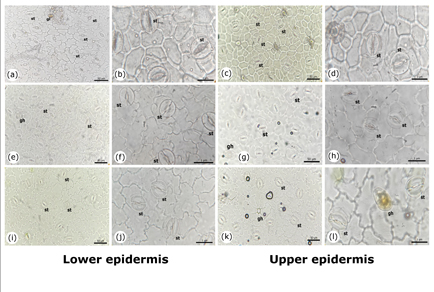
A comparative anatomical study was conducted on three Globularia taxa (G. orientalis, G. trichosantha and G. cordifolia) from Türkiye, which was based on examination of their root, stem and leaf structures using light microscopy. All taxa share diagnostic generic characters, including perennial root anatomy, equifacial (isobilateral) leaves with amphistomatic and anomocytic stomata, and the presence of both covering and glandular trichomes. Despite these similarities, several anatomically informative characters were identified. Winged stem protrusions, recorded here for the first time in G. trichosantha and G. cordifolia but absent in G. orientalis, represent a useful diagnostic feature within the genus. In addition, a distinct type of enlarged parenchyma cell resembling myrosin cells (“myrosin-like cells”) was observed in the root and stem tissues of all taxa. These cells may represent specialised elements involved in the storage or metabolism of secondary compounds found in Globularia. Comparative evaluation of published cytological data indicates pronounced ploidy variation in G. cordifolia, supporting its treatment as the “G. cordifolia species complex” and highlighting its morphological and anatomical plasticity. Overall, the results provide new diagnostic characters relevant to species delimitation and establish a structural basis for future histochemical, ultrastructural and molecular research into evolutionary relationships within Globularia.
References
- Akgül, G. & Tunçkol, B. (2018) Globularia L. (Plantaginaceae). In: Akkemik, Ü. (Ed.) Türkiye’nin Doğal-Egzotik Ağaç ve Çalıları. Orman Genel Müdürlüğü Yayınları, Ankara, pp. 450–452.
- Albach, D.C., Meudt, H.M. & Oxelman, B. (2005) Piecing together the “new” Plantaginaceae. American Journal of Botany 92: 297–315. https://doi.org/10.3732/ajb.92.2.297
- Algan, G. (1981) Bitkisel dokular için mikroteknik. Fırat Üniversitesi Fen Fakültesi Yayınları, İstanbul.
- APG IV (2016) An update of the Angiosperm Phylogeny Group classification for the orders and families of flowering plants: APG IV. Botanical Journal of the Linnean Society 181: 1–20. https://doi.org/10.1111/boj.12385
- Baytop, T. (1984) Therapy with medicinal plants in Türkiye (past and present). Istanbul University Publications No. 3255/40, İstanbul, 520 pp.
- Crantz, H.J.N. von (1766) Institutiones rei herbariae juxta nutum naturae digestae ex habitu, vol. 1. Vienna, 350 pp.
- Çalış, İ., Kırmızıbekmez, H. & Sticher, O. (2001) Iridoid glycosides from Globularia trichosantha. Journal of Natural Products 64: 60–64. https://doi.org/10.1021/np0003591
- Çalış, İ., Kırmızıbekmez, H., Taşdemir, D. & Ireland, C.M. (2002) Iridoid glycosides from Globularia davisiana. Chemical and Pharmaceutical Bulletin 50: 678–680. https://doi.org/10.1248/cpb.50.678
- Çilden, E. & Zare, G. (2019) Comparative anatomical survey on the species of Iberis L. (Brassicaceae) from Turkey. Hacettepe Journal of Biology and Chemistry 47: 389–401. https://doi.org/10.15671/hjbc.585877
- Çifci, S.K., Büyükkartal, H.N. & Akgül, G. (2024) Stem and leaf anatomies of some Globularia L. (Plantaginaceae) taxa grown in Türkiye and their systematic value. Süleyman Demirel Üniversitesi Fen Bilimleri Enstitüsü Dergisi 28: 167–176. https://doi.org/10.19113/sdufenbed.1307574
- Çölgeçen, H., Atar, H., Toker, G. & Akgül, G. (2018) Callus production and analysis of secondary metabolites in Globularia trichosantha subsp. trichosantha. Turkish Journal of Botany 42: 559–567. https://doi.org/10.3906/bot-1712-13
- Danışman, B. (2015) Türkiye’de yayılış gösteren Globularia orientalis, G. trichosantha subsp. trichosantha, G. sintenisii ve G. alypum’un polen morfolojileri üzerine bir çalışma. MSc Thesis, Nevşehir Hacı Bektaş Veli Üniversitesi, Nevşehir.
- Demir, T.D. (2014) Türkiye’de yayılış gösteren Globularia L. türlerinin tohum morfolojisi. MSc Thesis, Nevşehir Üniversitesi, Nevşehir.
- Edmondson, J.R. (1982) Globularia L. In: Davis, P.H. (Ed.) Flora of Türkiye and the East Aegean Islands, vol. 7. Edinburgh University Press, Edinburgh, pp. 27–31.
- Fay, M.F. & Christenhusz, M.J.M. (2010) Brassicales—an order of plants characterised by shared chemistry. Curtis’s Botanical Magazine 27: 165–196. https://doi.org/10.1111/j.1467-8748.2010.01695.x
- Fischer, F.E.L. von & Meyer, C.A.A.T. (1839) Index seminum, quae Hortus Botanicus Imperialis Petropolitanus pro mutua commutatione offert. St. Petersburg, 36 pp.
- Friščić, M., Maslo, S., Garić, R., Maleš, Ž. & Hazler Pilepić, K. (2018) Comparative analysis of specialized metabolites and antioxidant capacity of natural populations of Globularia spp. Acta Botanica Croatica 77: 1–9. [https://hrcak.srce.hr/198396]
- Friščić, M., Petlevski, R., Kosalec, I., Madunić, J., Matulić, M., Bučar, F., Hazler Pilepić, K. & Maleš, Ž. (2022) Globularia alypum L. and related species: LC–MS profiles and antidiabetic, antioxidant, anti-inflammatory, antibacterial and anticancer potential. Pharmaceuticals 15: 1–34. https://doi.org/10.3390/ph15050506
- Güner, A., Özhatay, N., Ekim, T. & Başer, K.H.C. (2000) Flora of Türkiye and the East Aegean Islands, vol. 11. Edinburgh University Press, Edinburgh.
- Heckel, E., Schlagdenhauffen, F. & Moursou, J. (1894) Étude monographique de la famille des Globulariaceae au point de vue botanique, chimique et thérapeutique. G. Masson, Paris, 202 pp.
- Holländer, K. & Jäger, E.J. (1994) Globularia: morphology, biology and ecogeographical differentiation: I. Progressions in the growth form, leaf structure, inflorescences, and distribution of the species. Flora 189: 223–254. https://doi.org/10.1016/S0367-2530(17)30598-4
- Innangi, M., Friščić, M., Hazler Pilepić, K., Danise, T., Conti, F., Bartolucci, F., Fioretto, A. & Peruzzi, L. (2020) Explaining intricate morphometric variability with environmental predictors: the case of the Globularia cordifolia species complex. Plants 9: 1–24. https://doi.org/10.3390/plants9030314
- Kırmızıbekmez, H. (2002) Globularia tohumları üzerinde farmakognozik çalışmalar. PhD Thesis, Hacettepe University, Ankara.
- Kırmızıbekmez, H., Çalış, İ., Akbay, P. & Sticher, O. (2003) Iridoid and bisiridoid glycosides from Globularia cordifolia. Zeitschrift für Naturforschung C 58: 337–341. https://doi.org/10.1515/znc-2003-5-608
- Kırmızıbekmez, H., Bassarello, C., Piacente, S., Akaydın, G. & Çalış, İ. (2009) Flavonoid, phenylethanoid and iridoid glycosides from Globularia aphyllanthes. Zeitschrift für Naturforschung B 64: 252–256. https://doi.org/10.1515/znb-2009-0217
- Kupffender, H. (1981) Beiträge zur Anatomie der Globulariaceen und Selaginaceen und Kenntnis des Blattcambiums. PhD Thesis, Universität Erlangen.
- Linnaeus, C. (1753) Species Plantarum, vol. 1. Impensis Laurentii Salvii, Holmiae, 560 pp.
- Metcalfe, C.R. & Chalk, L. (1950) Anatomy of the dicotyledons. Leaves, tem and wood in relation to Taxonomy, with notes on economic uses, vol. II. Oxford University Press, Oxford, pp. 725–1500.
- Özkan, G. (2015) Türkiye’de yayılış gösteren bazı Globularia türlerinin polen morfolojisi. MSc Thesis, Nevşehir Hacı Bektaş Veli Üniversitesi, Nevşehir.
- POWO (2026) Plants of the World Online. Royal Botanic Gardens, Kew. Available from: http://www.plantsoftheworldonline.org (continuously updated; accessed 10 January 2026)
- Schwarz, O.K.A. (1949) A new Anatolian Globularia. Kew Bulletin 4: 309–310. https://doi.org/10.2307/4109192
- Sezik, E., Tabata, M., Yeşilada, E., Honda, G., Goto, K. & Ikeshiro, Y. (1991) Traditional medicine in Türkiye. I. Folk medicine in Northeast Anatolia. Journal of Ethnopharmacology 35: 191–196. https://doi.org/10.1016/0378-8741(91)90072-L
- Skim, F., Kaaya, A., Jaouhari, J.T., Lazrek, H.B., Jana, M. & El Amri, H. (1999) Hypoglycaemic activity of Globularia alypum leaves in rats. Fitoterapia 70: 382–389. https://doi.org/10.1016/S0367-326X(99)00058-1
- Tundis, R., Peruzzi, L., Colica, C. & Menichini, F. (2012) Iridoid and bisiridoid glycosides from Globularia meridionalis. Biochemical Systematics and Ecology 40: 71–74. https://doi.org/10.1016/j.bse.2011.10.007
- Wagenitz, G. (2004) Globulariaceae. In: Kadereit, J.W. (Ed.) The families and genera of vascular plants, vol. 7. Springer, Berlin, pp. 159–162. https://doi.org/10.1007/978-3-642-18617-2_9