
Abstract
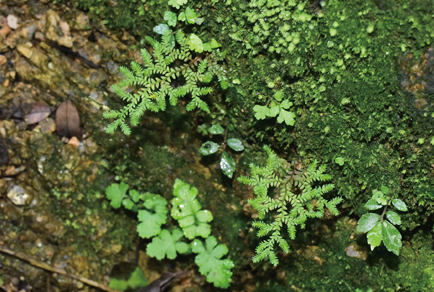
The identification of Selaginella leptophylla, a lycophyte species recorded from Guangdong and Hong Kong in southern China, is reviewed. Through literature review and specimen examination, we conclude that the record for S. leptophylla from Hong Kong is dubious due to the absence of authentic voucher specimens, whereas its record from Guangdong resulted from misidentification of S. chrysorrhizos, a species previously known only from the Eastern Himalayas and Indochina. This species has also been recently found in the wild in Yunnan and Xizang, southwestern China. Phylogenetic analyses of three plastid regions (rbcL, atpI, and psbA) demonstrate that S. chrysorrhizos is most closely related to S. densiciliata, S. vaginata, and S. xipholepis. A detailed description, along with illustrations, the diagnostic characters, and the morphological comparisons with similar species, is provided for S. chrysorrhizos.
References
- Alston, A.H.G. (1934) An enumeration of the Chinese species of Selaginella. Bulletin of the Fan Memorial Institute of Biology 5: 261–304.
- Alston, A.H.G. (1951) Selaginellaceae. Flore Generale de l’Indo-Chine 7 (2): 555–594.
- Baker, J.G. (1885) A synopsis of the genus Selaginella. Journal of Botany, British and Foreign 23: 19–25, 45–48, 116–122, 154–157, 176–180, 248–252, 292–302.
- Chang, H.-M., Chiou, W.-L. & Wang, J.-C. (2012) Flora of Taiwan: Selaginellaceae. Endemic Species Research Institute, Taiwan, 138 pp.
- Dahlen, M.A. (1988) Taxonomy of Selaginella: a study of characters, techniques, and classification in the Hong Kong species. Botanical Journal of the Linnean Society 98: 277–302. https://doi.org/10.1111/j.1095-8339.1988.tb01704.x
- Desvaux, N.A. (1814) Lycopodium. In: Lamarck, M. (Ed.) Encyclopédie méthodique (Botanique), suppl. 3. H. Agasse, Paris, pp. 539–559. [https://www.biodiversitylibrary.org/page/738717]
- Dixit, R.D. (1983) Four new species of Selaginella P.Beauv. from India. Bulletin of the Botanical Survey of India 25: 223–227. https://doi.org/10.20324/nelumbo/v25/1983/75151
- Don, D. (1825) Prodromus Florae Nepalensis. J. Gale, London, 256 pp.
- Dong, S.-Y. & Chen, Z.-C. (2017) Selaginellaceae. In: Shenzhen Fairy Lake Botanical Garden (Ed.) Flora of Shenzhen, vol. 1. China Forestry Publishing House, Beijing, pp. 34–42.
- Dunn, S.T. & Tutcher, W.J. (1912) Flora of Kwangtung and Hongkong (China). Bulletin of Miscellaneous Information additional ser. 10: 1–370. [https://www.biodiversitylibrary.org/item/105502]
- Fang, S.-L., Xu, B., Zhang, L., He, Z.-R. & Zhou, X.-M. (2023) Selaginella densiciliata (subg. Heterostachys, Selaginellaceae), a new spikemoss species from China based on morphological and molecular data. PhytoKeys 227: 135–149. https://doi.org/10.3897/phytokeys.227.101222
- Franchet, A.R. & Savatier, P.A.L. (1877–1879) Enumeratio Plantarum in Japonia Sponte Crescentium, vol. 2. Savy, Paris, 789 pp. [https://www.biodiversitylibrary.org/page/6210321]
- Fraser-Jenkins, C.R., Gandhi, K.N., Kholia, B.S. & Benniami, A. (2017) An Annotated Checklist of Indian Pteridophytes Part-1. Bishen Singh Mahendra Pal Singh, Dehra Dun, 562 pp.
- Greville, R.K. & Hooker, J. (1831) Enumeratio Filicum. Botanical Miscellany 2: 360–403. [https://www.biodiversitylibrary.org/item/10540]
- Hassler, M. (1994–2026) World Plants. Synonymic Checklist and Distribution of the World Flora. Version 26.03. Available from: www.worldplants.de (accessed 16 March 2026)
- Horner, H.T. & Arnott, H.J. (1963) Sporangial Arrangement in North American Species of Selaginella. Botanical Gazette 124: 371–383. https://doi.org/10.1086/336222
- Huang, J.-K., Guo, Z.-Y., Deng, C.-Y. & Dong, S.Y. (2026) Towards a taxonomic revision of the lycophyte genus Selaginella (Selaginellaceae) in Guizhou, China: new species, new records, and cryptic species. PhytoKeys 274: 73–98. https://doi.org/10.3897/phytokeys.274.184803
- Huang, L., Li, S.-H. & Dong, S.-Y. (2022) Two new species of the lycophyte genus Selaginella (Selaginellaceae) from China, with notes on the phylogenetic positions of related species. Systematic Botany 47: 85–96. https://doi.org/10.1600/036364422X16442668423400
- Jermy, A.C. (1990) Selaginellaceae. In: Kubitzki, K. (Ed.) The Families and Genera of Vascular Plants, vol. 1. Springer-Verlag, Berlin, pp. 39–45. https://doi.org/10.1007/978-3-662-02604-5_11
- Jin, J.-J., Yu, W.-B., Yang, J.-B., Song, Y., dePamphilis, C.W., Yi, T.-S. & Li, D.Z. (2020) GetOrganelle: a fast and versatile toolkit for accurate de novo assembly of organelle genomes. Genome Biology 21: 241. https://doi.org/10.1186/s13059-020-02154-5
- Katoh, K. & Standley, D.M. (2013) MAFFT Multiple Sequence Alignment Software Version 7: Improvements in Performance and Usability. Molecular Biology and Evolution 30: 772–780. https://doi.org/10.1093/molbev/mst010
- Kearse, M., Moir, R., Wilson, A., Stones-Havas, S., Cheung, M., Sturrock, S., Buxton, S., Cooper, A., Markowitz, S., Duran, C., Thierer, T., Ashton, B., Meintjes, P. & Drummond, A. (2012) Geneious Basic: An integrated and extendable desktop software platform for the organization and analysis of sequence data. Bioinformatics 28: 1647–1649. https://doi.org/10.1093/bioinformatics/bts199
- Lee, T.-C., Wu, S.-H. & Chau, C.C. (2003) Flora of Hong Kong: Pteridophyta. Kadoorie Farm & Botanic Garden, Hong Kong, 469 pp.
- Lefort, V., Longueville, J.E. & Gascuel, O. (2017) SMS: Smart Model Selection in PhyML. Molecular Biology and Evolution 34: 2422–2424. https://doi.org/10.1093/molbev/msx149
- Miller, M.A., Pfeiffer, W. & Schwartz, T. (2010) Creating the CIPRES Science Gateway for inference of large phylogenetic trees. In: Proceedings of the Gateway Computing Environments Workshop (GCE). Gateway Computing, New Orleans, pp. 1–8. https://doi.org/10.1109/GCE.2010.5676129
- Palisot-Beauvois, A.M.F.J. (1804) Suite de l’Aethéogamie. Magasin Encyclopédique 9: 472–483.
- PPG I (2016) A community-derived classification for extant lycophytes and ferns. Journal of Systematics and Evolution 54: 563–603. https://doi.org/10.1111/jse.12229
- Retzius, A.J. (1789) Observationes Botanicae, quintus. Siegfried Lebrecht Crusium, Lipsiae, 32 pp.
- Ronquist, F., Teslenko, M., van der Mark, P., Ayres, D.L., Darling, A., Hohna, S., Larget, B., Liu, L., Suchard, M.A. & Huelsenbeck, J.P. (2012) MrBayes 3.2: Efficient Bayesian Phylogenetic Inference and Model Choice Across a Large Model Space. Systematic Biology 61: 539–542. https://doi.org/10.1093/sysbio/sys029
- Spring, A.F. (1843) Enumeratio Lycopodinearum, quas in ejusdem plantarum ordinis monographia descripsit. Bulletin de l’Academie Royale des Sciences et Belles-lettres de Bruxelles 10: 135–146, 225–235.
- Spring, A.F. (1850) Monographie de la Famille des Lycopodiacées, Seconde partie. Mémoires de l’Académie royale des sciences, des lettres et des beaux-arts de Belgique 24: 1–358. https://doi.org/10.3406/marb.1850.3485
- Stamatakis, A. (2014) RAxML version 8: a tool for phylogenetic analysis and post-analysis of large phylogenies. Bioinformatics 30: 1312–1313. https://doi.org/10.1093/bioinformatics/btu033
- Swofford, D.L. (1991) PAUP: Phylogenetic Analysis Using Parsimony, Version 3.1 Computer program distributed by the Illinois Natural History Survey, Champaign, Illinois.
- Tagawa, M. & Iwatsuki, K. (1979) Flora of Thailand: Pteridophytes (Vol. 3, pt. 1). Forest Herbarium, Royal Forest Department, Bangkok, 128 pp.
- Thiers, B. (2020) Index Herbariorum: A Global Directory of Public Herbaria and Associated Staff. New York Botanical Garden’s Virtual Herbarium. Available from: http://sweetgum.nybg.org/science/ih/ (accessed 1 January 2020)
- Warburg, O. (1900) Monsunia: Beiträge zur Kenntniss der Vegetation des Süd- und Ostasiatischen Monsungebietes. Verlag von Wilhelm Engelmann, Leipzig, 207 pp.
- Zhang, D., Gao, F., Jakovlic, I., Zou, H., Zhang, J., Li, W.-X. & Wang, G.-T. (2020) PhyloSuite: An integrated and scalable desktop platform for streamlined molecular sequence data management and evolutionary phylogenetics studies. Molecular Ecology Resources 20: 348–355. https://doi.org/10.1111/1755-0998.13096
- Zhang, X.-C. (2004) Selaginellaceae. In: Zhang, X.-C. (Ed.) Flora Reipublicae Popularis Sinicae, vol. 6 (3). Science Press, Beijing, pp. 86–219.
- Zhang, X.-C., Nooteboom, H.P. & Kato, M. (2013) Selaginellaceae. In: Wu, Z.Y., Raven, P.H. & Hong, D.Y. (Eds.) Flora of China, vols 2–3. Science Press; St. Louis, Missouri Botanical Garden Press, Beijing, pp. 37–66.
- Zhang, X.-C. (2018) Some new records of Selaginella from China. Philippine Journal of Systematic Biology 12: 22–23.
- ttps://doi.org/10.26757/pjsb.2018a12010
- Zhou, X.-M. & Zhang, L.-B. (2023) Phylogeny, character evolution, and classification of Selaginellaceae (lycophytes). Plant Diversity 45: 630–684. https://doi.org/10.1016/j.pld.2023.07.003