

Abstract
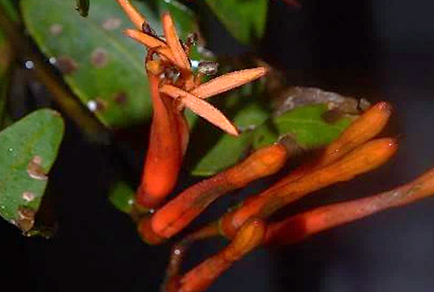
This paper presents a synopsis of Loranthaceae species occurring in São Paulo State (Brazil), offering essential tools for taxonomic identification. Eighteen species and two varieties of Struthanthus polyrrhizus have been identified within the study area, primarily in the Atlantic Forest. The taxonomic status of S. polyrrhizus var. oblongifolius and S. staphylinus was reestablished. The occurrence of S. polyanthus was confirmed for the study area, exclusively in the Cerrado. We provide three identification keys. For each taxon, we present taxonomic notes, information on general and specific geographical distribution, habitat, iconography, etymology, phenology, a list of analyzed materials, and photographs of the species in the field and laboratory.
References
- Abbiatti, D. (1946) Las Lorantáceas Argentinas. Revista del Museo de la Plata 7 (28): 1–10.
- Amico, G.C., Vidal-Russel, R., Garcia, M.A. & Nickrent, D.L. (2012) Evolutionary history of the South American mistletoe Tripodanthus (Loranthaceae) using nuclear and plastid markers. Systematic Botany 37: 218–225. https://doi.org/10.1600/036364412X616783
- APG. (2024) Angiosperm Phylogeny Website. Version 14, July 2017 [and more or less continuously updated since].” will do. Available from: http://www.mobot.org/MOBOT/research/APweb/ (accessed 20 July 2024)
- Arruda, R., Fadini, R.F., Carvalho, L.N., Del-Claro, K., Mourão, F.A., Jacobi, C.M., Teodoro, G.S., van den Berg, E., Caires, C.S. & Dettke, G.A. (2012) Ecology of neotropical mistletoes: an important canopy-dwelling component of Brazilian ecosystems. Acta Botanica Brasilica 26: 264–274. https://doi.org/10.1590/S0102-33062012000200003
- Beentje, H. (2010) The Kew Plant Glossary: an illustrated dictionary of plant terms. Royal Botanic Gardens, Kew, Richmond, 160 pp.
- Caires, C.S. (2018) Flora das cangas da Serra dos Carajás, Pará, Brasil: Loranthaceae. Rodriguésia 69: 133–146. https://doi.org/10.1590/2175-7860201869111
- Caires, C.S. (2022) Loranthaceae. In: Lemos, R.P.L. (Ed.) Flora de Alagoas: herbário MAC 40 anos—Famílias Botânicas da Coleção. IMA, Maceió, pp. 100–118.
- Caires, C.S. (2023) Passovia in Flora e Funga do Brasil. Jardim Botânico do Rio de Janeiro. Available from: https://floradobrasil.jbrj.gov.br/FB122000 (accessed 5 March 2023)
- Caires, C.S. & Dettke, G.A. (2023a) Struthanthus in Flora e Funga do Brasil. Jardim Botânico do Rio de Janeiro. Available from: https://floradobrasil.jbrj.gov.br/FB8702 (accessed 6 March 2023)
- Caires, C.S. & Dettke, G.A. (2023b) Tripodanthus in Flora e Funga do Brasil. Jardim Botânico do Rio de Janeiro. Available from: https://floradobrasil.jbrj.gov.br/FB8724 (accessed 8 March 2023)
- Caires, C.S., Dettke, G.A. & Proença, C.E.B. (2023) Loranthaceae in Flora e Funga do Brasil. Jardim Botânico do Rio de Janeiro. Available from: https://floradobrasil.jbrj.gov.br/FB152 (accessed 6 March 2023)
- Caires, C.S., Gomes-Bezerra, K.M., Machado, A.F.P. & Dettke, G.A. (2021) Nomenclatural novelties and synopsis of Passovia (Loranthaceae): new synonyms, new combinations and reinstated species. Rodriguésia 72: 2–24. https://doi.org/10.1590/2175-7860202172092
- Chamisso, A. & Schlechtendal, D.F.L. (1828) Journal für die Botanik. Linnaea, Berlin, 440 pp.
- Costa, E.A. (2021) Levantamento da ocorrência de ervas-de-passarinho na microrregião mata alagoana. Master’s thesis, Universidade Federal de Alagoas. Rio Largo, Alagoas, 70 pp.
- Davidar, P. (1983) Birds and neotropical mistletoes: effects on seedling recruitment. Oecologia 60: 271–273. https://doi.org/10.1007/BF00379532
- Desrousseaux, L.A.J. (1792) In: Lamarck, J.B.P.A.M. & Poiret, J.L.M. (Eds.) Encyclopédie Méthodique. Botanique. Missouri Botanical Garden, Peter H. Raven Library, 759 pp.
- Don, G. (1834) A General History of the Dichlamydeous Plants. Missouri Botanical Garden, 867 pp.
- Dettke, G.A. & Caires, C.S. (2023) Psittacanthus in Flora e Funga do Brasil. Jardim Botânico do Rio de Janeiro. Available from: https://floradobrasil.jbrj.gov.br/FB8698 (accessed 6 March 2023)
- Dettke, G.A. & Waechter, J.L. (2014) Estudo taxonômico das ervas-de-passarinho da Região sul do Brasil: I. Loranthaceae e Santalaceae. Rodriguésia 65: 939–953. https://doi.org/10.1590/2175-7860201465408
- Durigan, G. & Ratter, J.A. (2006) Successional Changes in Cerrado and Cerrado/Forest Ecotonal Vegetation in Western São Paulo State, Brazil, 1962–2000. Edinburgh Journal of Botany 63 (1): 119–130. https://doi.org/10.1017/S0960428606000357
- Eichler, A.W. (1868) Loranthaceae. In: Martius, C.F.P. (Ed.) Flora brasiliensis. pp. 136.
- Fidalgo, O. & Bononi, V.L.R. (1989) Técnicas de Coleta, Preservação e Herborização de Material Botânica. Instituto de Botânica de São Paulo, 62 pp.
- Filgueiras, T.S., Nogueira, P.E., Brochado, A.L. & Guala, G.F. (1994) Caminhamento: um método expedito para levantamentos florísticos qualitativos. Cadernos de Geociências 12: 39–43.
- Flora & Funga do Brasil. (cont. updated) Jardim Botânico do Rio de Janeiro. Available from: http://floradobrasil.jbrj.gov.br/ (accessed 28 January 2025)
- Guerra, T.J. & Marini, M.A. (2002) Bird frugivory on Struthanthus concinnus (Loranthaceae) in Southeastern Brazil. Ararajuba 10 (2): 187–192.
- Harris, J.G. & Harris, M.W. (2001) Plant identification terminology: An illustrated glossary. Spring Lake, Utah, 216 pp.
- Hooker, W.J. & Arnott, G.A.W. (1833) Contributions towards a flora of South America and the islands of the Pacific. Botanical Miscellany, 389 pp.
- IBGE. (2023) Área territorial brasileira 2020. Available from: https://www.ibge.gov.br/cidades-e-estados/sp.html (accessed 6 August 2023)
- IBGE. (2025) Panorama. Available from: https://cidades.ibge.gov.br/brasil/sp/panorama (accessed 29 January 2025)
- Jacquin, N.J. (1762) Enumeratio Stirpium pleraque quae sponte crescunt in Agro Vindobonensi Montibusque confinibus. Vindobonae, 483 pp. https://doi.org/10.5962/bhl.title.125456
- Jussieu, A.L. (1808) Annales du Muséum National d’Histoire Naturelle. Muséum national d’histoire naturelle 12: 292–303.
- Karsten, H. (1846) Bermerkungen des Hrn. Dr. H. Karsten zu den in der botan. Zeitung (St. 6) zum Verkauf ausgebotenen pflanzen aus Columbien: ein auszug aus dessen tagebuche. Botanische Zeitung 4: 105–112.
- Karsten, H. (1852) Beitrag zur entwickelungsgeschichte der Loranthaceen. Botanische Zeitung 10: 305–314.
- Krause, K. (1922) Contribuição ao conhecimento das Loranthaceae do Brasil Meridional. Anexos das Memórias do Instituto Butantan 16: 85–97.
- Kuijt, J. (1981) Inflorescence morphology of Loranthaceae—An evolutionary synthesis. Blumea: Biodiversity, Evolution and Biogeography of Plants 27: 1–73.
- Kuijt, J. (1994) Typification of the names of New World mistletoe taxa (Loranthaceae and Viscaceae) described by Martius and Eichler. Taxon 43: 187–199. https://doi.org/10.2307/1222877
- Kuijt, J. (2003) Miscellaneous mistletoe notes, 37–47. Novon 13: 72–88. https://doi.org/10.2307/3393568
- Kuijt, J. (2009a) Loranthaceae. In: Davidse, G.D., Sousa, M., Knapp, S. & Chiang, F. (Eds.) Flora Mesoamericana 2, pp. 542–577.
- Kuijt, J. (2009b) Miscellaneous mistletoe notes, 48–60: Descriptions of twelve new species of Loranthaceae and Viscaceae. Brittonia 61 (2): 144–162. https://doi.org/10.1007/s12228-008-9068-2
- Kuijt, J. (2009c) Monograph of Psittacanthus (Loranthaceae). Systematic Botany Monographs 282: 86.
- Kuijt, J. (2011) Pulling the skeleton out of the closet: resurrection of Phthirusa sensu Martius and consequent revival of Passovia (Loranthaceae). Plant Diversity and Evolution 129: 159–211. https://doi.org/10.1127/1869-6155/2011/0129-0049
- Kuijt, J. (2013) A brief taxonomic history of neotropical mistletoe genera, with a key to the genera. Blumea: Biodiversity, Evolution and Biogeography of Plants 58: 263–266. https://doi.org/10.3767/000651913X676664
- Kuijt, J. (2016) A nomenclatural note on Struthanthus acuminatus (Loranthaceae). Phytologia 98 (2): 118.
- Kuijt, J. & Hansen, B. (2015) Loranthaceae. In: Kubitzki, K. (Ed.) The families and genera of vascular plants. Flowering Plants Eudicots. Switzerland, pp. 73–120. https://doi.org/10.1007/978-3-319-09296-6_14
- Leaf Architecture Working Group. (1999) Manual of Leaf Architecture—morphological description and categorization of dicotyledonous and net-veined monocotyledonous angiosperms. Smithsonian Institution, Washington, 65 pp.
- Liu, B., Le, C.T., Barrett, R.L., Nickrent, D.L., Chen, Z., Lu, L. & Vidal-Russell, R. (2018) Historical biogeography of Loranthaceae (Santalales): Diversification agrees with emergence of tropical forests and radiation of songbirds. Molecular Phylogenetics and Evolution 124: 199–212. https://doi.org/10.1016/j.ympev.2018.03.010
- Martius, C.F.P. (1829) Loranthus. In: Schultes, J.A. & Schultes, J.H. Systema vegetabilium, 753 pp.
- Martius, C.F.P. (1830) Flora. Botanische Zeitung 13 (1): 392.
- Menezes, M.O.T., Stannard, B.L., Caires, C.S., Loiola, M.I.B. & Moro, M.F. (2022) Flora of Ceará, Brazil: Loranthaceae. Rodriguésia 73: 1–18. https://doi.org/10.1590/2175-7860202273082
- Monteiro, G.F., Barbosa, M., Antonini, Y., Passos, M.F.O., Novais, S. & Fernandes, G.W. (2020) The mistletoe Struthanthus flexicaulis reduces dominance and increases diversity of plants in campo rupestre. Flora 271 (5). https://doi.org/10.1016/j.flora.2020.151690
- Moreira, B.A. & Rizzini, C.M. (1997) As famílias Loranthaceae e Viscaceae da APA de Maricá, Rio de Janeiro, Brasil. Acta Botanica Brasilica 11 (1): 1–8. https://doi.org/10.1590/S0102-33061997000100001
- Mori, S.A., Silva, L.A.M., Lisboa, G. & Coradin, L. (1989) Manual de manejo do herbário fanerogâmico. Ilhéus, Centro de Pesquisas do Cacau, 104 pp.
- Nickrent, D.L. (2020) Parasitic angiosperms: How often and how many? Taxon 69: 5–27. https://doi.org/10.1002/tax.12195
- Nickrent, D.L. & Duff, R.J. (1996) Molecular studies of parasitic plants using ribosomal RNA. In: Moreno, M.T., Cubero, J.I., Berner, D., Joel, D.M., Musselman, L.J. & Parker, C. (Eds.) Advances in parasitic plant research. Junta de Andalucia, Dirección General de Investigación Agrária, Cordoba, Spain, pp. 28–52.
- Nickrent, D.L., Anderson, F. & Kuijt, J. (2019) Inflorescence evolution in Santalales: integrating morphological characters and molecular phylogenetics. American Journal of Botany 106: 402–414. https://doi.org/10.1002/ajb2.1250
- Nickrent, D.L., Malecót, V., Vidal-Russel, R. & Der, J.P. (2010) A revised classification of Santalales. Taxon 59 (2): 538–558. https://doi.org/10.1002/tax.592019
- QGIS development team. (2023) QGIS Geographic Information System. Open-Source Geospatial Foundation Project. Available from: http://www.qgis.org/ (accessed 19 July 2024)
- Radford, A.E., Dickson, W.C., Massey, J.R. & Bell, C.R. (1974) Vascular Plant Systematics. Harper and Row, New York, 891 pp.
- Reif, C. & Andreata, R.H.P. (2011) Contribuição à Taxonomia de Loranthaceae no Estado do Rio de Janeiro, Brasil. Pesquisas, série Botânica 62: 71–115.
- Ribeiro, M.C., Metzger, J.P., Martensen, A.C., Ponzoni, F.J. & Hirota, M.M. (2009) The Brazilian Atlantic Forest: how much is left, and how is the remaining forest distributed? Implications for conservation. Biological Conservation 142: 1141–1153. https://doi.org/10.1016/j.biocon.2009.02.021
- Rizzini, C.T. (1950) Struthanthi Brasiliae Eiusque Vicinorum. Revista Brasileira de Biologia 10: 405.
- Rizzini, C.T. (1956) Pars specialis prodromi monographiae Loranthacearum Brasiliae terrarunque finitimarum. Rodriguésia 30–31: 87–264.
- Rizzini, C.T. (1960) Flora of Panama: Loranthaceae. Annals of the Missouri Botanical Garden 47 (4): 263–290. https://doi.org/10.2307/2394921
- Rizzini, C.T. (1968) Lorantáceas. In: Reitz, R. (Ed.) Flora Ilustrada Catarinense. Herbário Barbosa Rodrigues, Itajaí, 44 pp.
- Rizzini, C.T. (1995) Flora da Serra do Cipó, Minas Gerais: Loranthaceae. Boletim de Botânica da Universidade de São Paulo 14: 207–221. https://doi.org/10.11606/issn.2316-9052.v14i0p207-221
- Rodrigues, R.R. & Bononi, V.L.R. (2008) Diretrizes para conservação e restauração da biodiversidade no Estado de São Paulo. Instituto de Botânica, São Paulo, 248 pp.
- Roldán, F.J. & Kuijt, J. (2005) A New, Red-Flowered Species of Tripodanthus (Loranthaceae) from Colombia. Novon 15 (1): 207–209.
- Ruiz, L.H. & Pavon, J.A. (1802) Flora Peruviana et Chilensis 3. Typis Gabrielis de Sancha, Madri, 95 pp.
- Sasaki, D. & Mello-Silva, R. (2008) Levantamento florístico no cerrado de Pedregulho, SP, Brasil. Acta Botanica Brasilica 22 (1): 187–202. https://doi.org/10.1590/S0102-33062008000100019
- Secretaria de Infraestrutura e Meio Ambiente. (2022) Meio ambiente paulista: relatório de qualidade ambiental. Coordenadoria de Planejamento Ambiental, São Paulo, 527 pp.
- Secretaria de Estado do Meio Ambiente. (2016) Resolução SMA-57, de 05-VI-2016. Lista Oficial das Espécies da Flora Ameaçadas de Extinção no Estado de São Paulo. Diário Oficial do Estado de São Paulo, 30-VI-2016, Seção I, pp. 55–57.
- Souza, V.C. & Lorenzi, H. (2019) Botânica Sistemática: Guia ilustrado para a identificação das famílias de fanerógamas nativas e exóticas no Brasil, baseado em APG IV. Ed. Plantarum, Nova Odessa, 768 pp.
- Stannard, B. (2004) Flora de Grão-Mogol, Minas Gerais: Loranthaceae. Boletim De Botânica 22 (2): 277–282. https://doi.org/10.11606/issn.2316-9052.v22i2p277-282
- Stevens, P.F. (2025) Angiosperm Phylogeny Website. Version 14. July 2017 [and more or less continuously updated since]. St. Louis (US): Missouri Botanical Garden. Available from: http://www. mobot.org/MOBOT/research/APweb/ (accessed 28 January 2025)
- Su, H.-J., Hu, J.-M., Anderson, F.E. & Nickrent, D.L. (2015) Phylogenetic relationships of Santalales with insights into the origins of holoparasitic Balanophoraceae. Taxon 64: 491–506. https://doi.org/10.12705/643.2
- Sugiyama, M. & Mantovani, W. (1987) Flora Fanerogâmica da Reserva do Parque Estadual das Fontes do Ipiranga (São Paulo, Brasil) —Loranthaceae. Hoehnea 14: 79–87.
- Sugiyama, M. (1992) Loranthaceae. In: Melo, M.M.R.F., Barros, F., Chiea, S.A.C., Wanderley, M.G.L., Jung-Mendaçolli, S.L. & Kirizawa, M. (Eds.) Flora Vascular da Ilha do Cardoso (São Paulo, Brasil). Instituto de Botânica, São Paulo, pp. 37–41.
- Sugiyama, M. (2011) Loranthaceae. In: Wanderley, M.G.L., Shepherd, G.J., Martins, S.E., Estrada, T.E.M.D., Romanini, R.P., Koch, I., Pirani, J.R., Melhem, T.S., Harley, A.M.G., Kinoshita, L.S., Magenta, M.A.G., Wagner, H.M.L., Barros, F., Lohmann, L.G., Amaral, M.C.E., Cordeiro, I., Aragaki, S., Bianchini, R.S. & Esteves, G.L. (Eds.) Checklist of Spermatophyta of the São Paulo State, Brazil. Biota Neotropica 11 (1): 193–390. https://doi.org/10.1590/S1676-06032011000500013
- Thiers, B. (2026 [constantly updated]) Index Herbariorum: A global directory of public herbaria and associated staff. New York Botanical Garden’s Virtual Herbarium. Available from: http://sweetgum.nybg.org/science/ih/ (accessed 22 May 2026)
- Tieghem, P. (1895) Sur le groupement des espèces en genres dans les Loranthées a calice dialysépale et anthères oscillantes ou Struthanthées. Bulletin de la Société Botanique de France, 743 pp.
- Tropicos. (2024) Tropicos.org. Missouri Botanical Garden. Available from: http://tropicos.org/ (accessed 19 July 2024)
- Vasconcelos, G.C.L. & Melo, J.I.M. (2015) Flora of the State of Paraíba, Brazil: Loranthaceae Juss. Acta Scientiarum. Biological Sciences 37 (2): 239–250. https://doi.org/10.4025/actascibiolsci.v37i2.26246
- Vaz, L.M.C., Dettke, G.A. & Simão-Bianchini, R. (2024) Struthanthus marginatus (Desr.) G.Don (Loranthaceae): a new record for the Santa Catarina State, Brazil. Hoehnea 51: e1032023. https://doi.org/10.1590/2236-8906e1032023
- Vaz, L.M.C. & Simão-Bianchini, R. (2025) Passovia alternifolia (Eichler) Tiegh. (Loranthaceae): a rare species from the Atlantic Forest, rediscovered for the São Paulo State, Brazil. Hoehnea 52: e1022023, 2025. https://doi.org/10.1590/2236-8906e1022023
- Vidal-Russell, R. & Nickrent, D.L. (2008) The first mistletoes: origins of aerial parasitism in Santalales. Molecular Phylogenetics and Evolution 47 (2): 523–537. https://doi.org/10.1016/j.ympev.2008.01.016