

Abstract
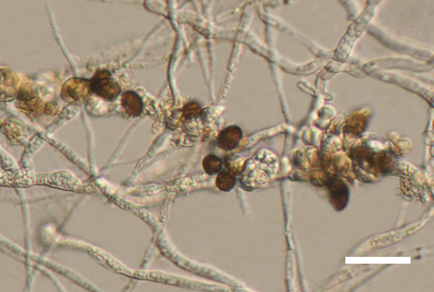
A novel species, Apiospora papiliomyceticola sp. nov., is described from Guizhou Province, China. The species was isolated from the sclerotium of the cordycipitoid fungus Papiliomyces longiclavatus. Phylogenetic analyses based on a concatenated dataset of ITS, nrLSU, tef-1α, and tub2 sequences revealed that the new taxon forms a distinct lineage within Apiospora and is phylogenetically related to A. rasikravindrae, A. marinum, A. acutiapica, and A. pseudorasikravindrae. Morphologically, the species is characterized by globose to subglobose or ovate conidia and conidiogenous cells arising directly from hyphae, distinguishing it from related taxa. Detailed morphological comparisons with phylogenetically related species are provided. The integration of multigene phylogenetic analyses and morphological characteristics supports the recognition of A. papiliomyceticola as a distinct species.
References
- Aiello, D., Gulisano, S., Gusella, G., Polizzi, G. & Guarnaccia, V. (2018) First report of fruit blight caused by Arthrinium xenocordella on Pistacia vera in Italy. Plant Disease 102 (9): 1853. https://doi.org/10.1094/PDIS-02-18-0290-PDN
- Carbone, I. & Kohn, L. (1999) A Method for Designing Primer Sets for Speciation Studies in Filamentous Ascomycetes. Mycologia 91: 553. https://doi.org/10.1080/00275514.1999.12061051
- Castresana, J. (2007) Topological variation in single-gene phylogenetic trees. Genome Biology 8: 216.
- Crous, P. & Groenewald, J. (2013) A phylogenetic re-evaluation of Arthrinium. IMA Fungus 4: 33–154. https://doi.org/10.5598/imafungus.2013.04.01.13
- Darriba, D., Taboada, G., Doallo, R. & Posada, D. (2012) jModelTest 2: more models, new heuristics and parallel computing. Nature Methods 9: 772. https://doi.org/10.1038/nmeth.2109
- Degnan, J.H. & Rosenberg, N.A. (2009) Gene tree discordance, phylogenetic inference and the multispecies coalescent.
- Ellis, M. (1965) Dematiaceous Hyphomycetes. VI. Mycological Papers 103: 1–46.
- Glass, N. & Donaldson, G. (1995) Development of primer sets designed for use with the PCR to amplify conserved genes from filamentous ascomycetes. Applied and Environmental Microbiology 61: 1323–1330. https://doi.org/10.1128/aem.61.4.1323-1330.1995
- Heo, Y.M., Kim, K., Ryu, S.M., Kwon, S.L., Park, M.Y., Kang, J.E., Hong, J.H., Lim, Y.W., Kim, C., Kim, B.S., Lee, D. & Kim, J.J. (2018) Diversity and ecology of marine Algicolous Arthrinium species as a source of bioactive natural products. Marine Drugs 16: 508. https://doi.org/10.3390/md16120508
- Hoang, D., Chernomor, O., von Haeseler, A., Minh, B. & Vinh, L. (2017) UFBoot2: improving the ultrafast bootstrap approximation. Molecular Biology and Evolution 35: 518–522. https://doi.org/10.1093/molbev/msx281
- Hopple, J. (1994) Phylogenetic investigations in the genus coprinus based on morphological and molecular characters. Ph.D. Dissertation, Duke University, Durham, NC, USA.
- Hudson, H. (1960) Pyrenomycetes of sugar cane and other grasses in Jamaica. I. Conidia of Apiospora camptospora and Leptosphaeria sacchari. Transactions of the British Mycological Society 43: 607–616. https://doi.org/10.1016/S0007-1536(60)80051-4
- Hudson, H. (1963) Pyrenomycetes of sugar cane and other grasses in Jamaica. II. Conidia of Apiospora montagnei. Transactions of the British Mycological Society 46: 19–23. https://doi.org/10.1016/S0007-1536(63)80003-0
- Hyde, K., Fröhlich, J. & Taylor, J. (1998) Fungi from palms. XXXVI. Reflections on unitunicate ascomycetes with apiospores. Sydowia 50 (1): 21–80.
- Hyde, K., Hongsanan, S., Jeewon, R., Bhat, D., McKenzie, E. & Jones, E. (2016) Fungal diversity notes 367-490: taxonomic and phylogenetic contributions to fungal taxa. Fungal Diversity 80: 1–270. https://doi.org/10.1007/s13225-016-0373-x
- Hyde, K., Norphanphoun, C., Maharachchikumbura, S., Bhat, D., Jones, E., Bundhun, D., Chen, Y., Bao, D., Boonmee, S. & Calabon, M. (2020) Refined families of Sordariomycetes. Mycosphere 11: 305–1059. https://doi.org/10.5943/mycosphere/11/1/7
- Jacobs, K., Bergdahl, D., Wingfield, M., Halik, S., Seifert, K., Bright, D. & Wingfield, B. (2004) Leptographium wingfieldii introduced into North America and found associated with exotic Tomicus piniperda and native bark beetles. Mycological Research 108: 411–418. https://doi.org/10.1017/s0953756204009748
- Jiang, H., Phookamsak, R., Hongsanan, S., Bhat, D., Mortimer, P., Suwannarach, N., Kakumyan, P. & Xu, J. (2022) A review of bambusicolous ascomycota in China with an emphasis on species richness in southwest China. Studies in Fungi 7: 1–33. https://doi.org/10.48130/SIF-2022-0020
- Jiang, N., Liang, Y.M. & Tian, C. (2020) A novel bambusicolous fungus from China, Arthrinium chinense (Xylariales). Sydowia 72: 77–83.
- Kalyaanamoorthy, S., Minh, B., Wong, T., von Haeseler, A. & Jermiin, L. (2017) ModelFinder: fast model selection for accurate phylogenetic estimates. Nature Methods 14: 587–589. https://doi.org/10.1038/nmeth.4285
- Kanzi, A.M., Trollip, C., Wingfield, M.J., Barnes, I., Van der Nest, M.A. & Wingfield, B.D. (2020) Phylogenomic incongruence in Ceratocystis: a clue to speciation? BMC genomics 21 (1): 362. https://doi.org/10.1186/s12864-020-6772-0
- Kwon, S., Cho, M., Lee, Y., Kim, C., Lee, S., Ahn, B., Lee, H. & Kim, J. (2022) Two unrecorded Apiospora species isolated from marine substrates in Korea with eight new combinations (A. piptatheri and A. rasikravindrae). Mycobiology 50: 46–54. https://doi.org/10.1080/12298093.2022.2038857
- Letunic, I. & Bork, P. (2024) Interactive Tree of Life (iTOL) v6: recent updates to the phylogenetic tree display and annotation tool. Nucleic Acids Research 52: 78–82. https://doi.org/10.1093/nar/gkae268
- Mavragani, D., Abdellatif, L., McConkey, B., Hamel, C. & Vujanovic, V. (2007) First report of damping-off of durum wheat caused by Arthrinium sacchari in the semi-arid Sas katchewan fields. Plant Disease 91: 469.10. https://doi.org/10.1094/pdis-91-4-0469a
- Minh, B., Schmidt, H., Chernomor, O., Schrempf, D., Woodhams, M., Von Haeseler, A. & Lanfear, R. (2020) IQ-TREE 2: New models and efficient methods for phylogenetic inference in the genomic era. Molecular Biology and Evolution 37: 1530–1534. https://doi.org/10.1093/molbev/msaa015
- Petrak, F. (1925) Mykologische Notizen VIII. Annales Mycologici 23: 1–143.
- Pintos, Á. & Alvarado, P. (2021) Phylogenetic delimitation of Apiospora and Arthrinium. Fungal Systematics Evolution 7: 197–221.3. https://doi.org/10.3114/fuse.2021.07.10
- Pintos, Á., Alvarado, P., Planas, J. & Jarling, R. (2019) Six new species of Arthrinium from Europe and notes about A. caricicola and other species found in Carex spp. hosts. MycoKeys 49: 13. https://doi.org/10.3897/mycokeys.49.32115
- Rokas, A., Williams, B.L., King, N. & Carroll, S.B. (2003) Genome-scale approaches to resolving incongruence in molecular phylogenies. Nature 425: 798–804. https://doi.org/10.1038/nature02053
- Ronquist, F., Teslenko, M., van der Mark, P., Ayres, D., Darling, A., Höhna, S., Larget, B., Liu, L., Suchard, M. & Huelsenbeck, J. (2012) MrBayes 3.2: Efficient Bayesian phylogenetic inference and model choice across a large model space. Systematic Biology 61 (3): 539–542. https://doi.org/10.1093/sysbio/sys029
- Saccardo, P. (1875) Conspectus generum pyrenomycetum italicorum additis speciebus fungorum Venetorum novis vel criticis, systemate carpologico dispositorum. Atti del la Società Veneto-Trentina di Scienze Naturali 4: 77–100.
- Samuels, G., McKenzie, E. & Buchanan, D. (1981) Ascomycetes of New Zealand 3. Two new species of Apiospora and their Arthrinium anamorphs on bamboo. New Zealand Journal of Botany 19: 137–149. https://doi.org/10.1080/0028825X.1981.10425113
- Senanayake, I., Bhat, J., Cheewangkoon, R. & Xie, N. (2020) Bambusicolous Arthrinium Species in Guangdong Province, China. Frontiers in Microbiology 11: 602773. https://doi.org/10.3389/fmicb.2020.602773
- Shrestha, P., Ibáñez, A., Bauer, S., Glassman, S., Szaro, T., Bruns, T. & Taylor, J. (2015) Fungi isolated from Miscanthus and sugarcane: Biomass conversion, fungal enzymes, and hydrolysis of plant cell wall polymers. Biotechnology for Biofuels 8: 1. https://doi.org/10.1186/s13068-015-0221-3
- Singh, S., Yadav, L., Singh, P., Hepat, R., Sharma, R. & Singh, S. (2012) Arthrinium rasikravindrii sp. nov. from Svalbard, Norway. Mycotaxon 122: 449–460. https://doi.org/10.5248/122.449
- Tang, X., Goonasekara, I., Jayawardena, R., Jiang, H., Li, J., Hyde, K. & Kang, J. (2021) Arthrinium bambusicola (Fungi, Sordariomycetes), a new species from Schizostachyum brachycladum in northern Thailand. Biodiversity Data Journal 8: e58755. https://doi.org/10.3897/BDJ.8.e58755
- Tian, X., Karunarathna, S., Mapook, A., Promputtha, I., Xu, J., Bao, D. & Tibpromma, S. (2021) One new species and two new host records of Apiospora from bamboo and maize in northern Thailand with thirteen new combinations. Life (Basel, Switzerland) 11: e1071. https://doi.org/10.3390/life11101071
- Vilgalys, R. & Hester, M. (1990) Rapid genetic identifcation and mapping of enzymatically amplifed ribosomal DNA from several Cryptococcus species. Journal of Bacteriology 172: 4238–4246. https://doi.org/10.1128/jb.172.8.4238-4246.1990
- von Höhnel, F. (1919) Fragmente zur Mykologie. XXII mitteilungen, nr. 1092 bis 1153. Sitzungsberichte der Akademie der Wissenschaften in Wien 127 (8–9): 549–634.
- Wang, M., Tan, X., Liu, F. & Cai, L. (2018) Eight new Arthrinium species from China. MycoKeys 1: 1–24. https://doi.org/10.3897/mycokeys.39.27014
- Wang, Y., Wang, Z., Thanarut, C., Dao, V., Wang, Y. & Yu, H. (2023) Phylogeny and species delimitations in the economically, medically, and ecologically important genus Samsoniella (Cordycipitaceae, Hypocreales). MycoKeys 99: 227–250. https://doi.org/10.3897/mycokeys.99.106474
- Wang, Y., Zhu, L., Chen, H., He, Y., Li, Q. & Wang, Y. (2026) Myxospora guizhouensis (Hypocreales, Stachybotryaceae), a new soil-borne species from Guizhou, China. Phytotaxa 750 (3): 197–206. https://doi.org/10.11646/phytotaxa.750.3.5
- White, T., Bruns, T., Lee, S. & Taylor, J. (1990) Amplification and direct sequencing of fungal ribosomal RNA genes for phylogenetics. In: PCR Protocols: A Guide to Methods and Applications, 18. pp. 315–322. https://doi.org/10.1016/B978-0-12-372180-8.50042-1
- Yin, C., Luo, F., Zhang, H., Fang, X., Zhu, T. & Li, S. (2021) First report of Arthrinium kogelbergense causing blight disease of Bambusa intermedia in Sichuan Province, China. Plant Disease 105: 214. https://doi.org/10.1094/PDIS-06-20-1159-PDN
- Zhang, Z., Pan, H., Tao, G., Li, X., Han, Y., Feng, Y., Tong, S. & Ding, C. (2024) Culturable Mycobiota from Guizhou Wildlife Park in China. Mycosphere 15 (1): 654–763. https://doi.org/10.5943/mycosphere/15/1/5