
Abstract
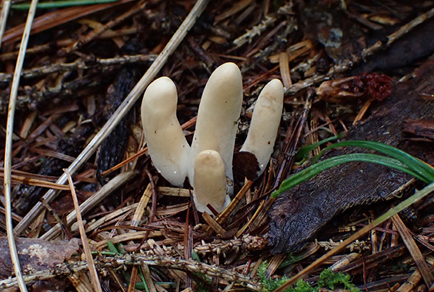
Based on morphological and molecular phylogenetic analyses, two new species of Trichoderma from China are described: Trichoderma jilinense and T. palmatum. Phylogenetic analyses based on a concatenated multi-gene (tef1-α and rpb2) dataset demonstrated that each new taxon formed an independent lineage with unique sequences, fulfilling the criteria for new Trichoderma species. Specifically, T. jilinense belongs to the Polysporum clade, and T. palmatum belongs to the Psychrophila clade. Morphologically, T. jilinense is diagnosed by relatively small part-ascospores and fresh beige to buff stromata that turn chestnut brown in 5% KOH, and relatively small part-ascospores. T. palmatum is distinguished by a fertile part that is palmate to irregular and typically laterally flattened.
References
- Atanasova, L., Druzhinina, I.S. & Jaklitsch, W.M. (2013) Two hundred Trichoderma species recognized on the basis of molecular phylogeny. In: Mukherjee, P.K., Horwitz, B.A., Singh, U.S., Mukherjee, M. & Schmoll, M. (Eds.) Trichoderma: biology and applications. CAB International, Croydon, pp. 10–42. https://doi.org/10.1079/9781780642475.0010
- Bissett, J. (1991) A revision of the genus Trichoderma II. Infrageneric classification. Canadian Journal of Botany 69: 2357–2372. https://doi.org/10.1139/b91-297
- Cai, F. & Druzhinina, I.S. (2021) In honor of John Bissett: Authoritative guidelines on molecular identification of Trichoderma. Fungal Diversity 107: 1–69. https://doi.org/10.1007/s13225-020-00464-4
- Cai, F., Dou, K., Wang, P., Chenthamara, K., Chen, J. & Druzhinina, I.S. (2022) The current state of Trichoderma taxonomy and species identification. In: Amaresan, N., Sankaranarayanan, A., Dwivedi, M.K. & Druzhinina, I.S. (Eds.) Advances in Trichoderma biology for agricultural applications. Springer International Publishing, Cham, pp. 3–35. https://doi.org/10.1007/978-3-030-91650-3_1
- Cao, Z.J., Zhao, J., Liu, Y., Wang, S.X., Zheng, S.Y. & Qin, W.T. (2024) Diversity of Trichoderma species associated with green mold contaminating substrates of Lentinula edodes and their interaction. Frontiers in Microbiology 14: 1–18. https://doi.org/10.3389/fmicb.2023.1288585
- Carbone, I. & Kohn, L.M. (1999) A method for designing primer sets for speciation studies in filamentous ascomycetes. Mycologia 91: 553–556. https://doi.org/10.1080/00275514.1999.12061051
- Chamberlain, H.L., Rossman, A.Y., Stewart, E.L., Ulvinen, T. & Samuels, G.J. (2004) The stipitate species of Hypocrea (Hypocreales, Hypocreaceae) including Podostroma. Karstenia 44: 1–24. https://doi.org/10.29203/ka.2004.395
- Chaverri, P. & Samuels, G.J. (2003a) Hypocrea/Trichoderma (Ascomycota, Hypocreales, Hypocreaceae): species with green ascospores. Studies in Mycology 48: 1–116.
- Chaverri, P., Castlebury, L.A., Overton, B.E. & Samuels, G.J. (2003b) Hypocrea/Trichoderma: species with conidiophore elongations and green conidia. Mycologia 95: 1100–1140. https://doi.org/10.2307/3761915
- Chen, K. & Zhuang, W.Y. (2017) Seven new species of Trichoderma from soil in China. Mycosystema 36: 1441–1462. https://doi.org/10.13346/j.mycosystema.170134
- Dai, Y.C., Yang, Z.L., Cui, B.K., Wu, G., Yuan, H.S., Zhou, L.W., He, S.H., Ge, Z.W., Wu, F., Wei, Y.L., Yuan, Y. & Si, J. (2021) Diversity and systematics of the important macrofungi in Chinese forests. Mycosystema 40: 770–805. https://doi.org/10.13346/j.mycosystema.210036
- Geng, Y., Chen, S., Lv, P., Li, Y., Li, J., Jiang, F., Wu, Z., Shen, Q. & Zhou, R. (2025) Positive role of Trichoderma harzianum in increasing plant tolerance to abiotic stresses: a review. Antioxidants 14: 807. https://doi.org/10.3390/antiox14070807
- Guindon, S., Dufayard, J.F., Lefort, V., Anisimova, M., Hordijk, W. & Gascuel, O. (2010) New algorithms and methods to estimate maximum-likelihood phylogenies: assessing the performance of PhyML 3.0. Systematic Biology 59: 307–321. https://doi.org/10.1093/sysbio/syq010
- Huang, D.-Y., Huang, Q.-R., Dong, Z.-Y., Luo, M. & Luo, M. (2026) Trichoderma maomingense (Sordariomycetes, Hypocreaceae), a New species isolated from bamboo in Guangdong province, China. New Zealand Journal of Botany 64 (1): e70057. https://doi.org/10.1002/nzb2.70057
- Jaklitsch, W.M., Komon, M., Kubicek, C.P. & Druzhinina, I.S. (2005) Hypocrea voglmayrii sp. nov. from the Austrian Alps represents a new phylogenetic clade in Hypocrea/Trichoderma. Mycologia 97: 1365–1378. https://doi.org/10.3852/mycologia.97.6.1365
- Jaklitsch, W.M., Komon, M., Kubicek, C.P. & Druzhinina, I.S. (2006) Hypocrea crystalligena sp. nov., a common European species with a white-spored Trichoderma anamorph. Mycologia 98: 499–513. https://doi.org/10.3852/mycologia.98.3.499
- Jaklitsch, W.M., Gruber, S. & Voglmayr, H. (2008) Hypocrea seppoi, a new stipitate species from Finland. Karstenia 48: 1. https://doi.org/10.29203/ka.2008.423
- Jaklitsch, W.M. (2009) European species of Hypocrea – Part I: The green-spored species. Studies in Mycology 63: 1–91. https://doi.org/10.3114/sim.2009.63.01
- Jaklitsch, W.M. (2011) European species of Hypocrea part II: Species with hyaline ascospores. Fungal Diversity 48: 1–250. https://doi.org/10.1007/s13225-011-0088-y
- Jaklitsch, W.M. & Voglmayr, H. (2015) Biodiversity of Trichoderma (Hypocreaceae) in southern Europe and macaronesia. Studies in Mycology 80: 1–87. https://doi.org/10.1016/j.simyco.2014.11.001
- Kalyaanamoorthy, S., Minh, B.Q., Wong, T.K., Von Haeseler, A. & Jermiin, L.S. (2017) ModelFinder: fast model selection for accurate phylogenetic estimates. Nature Methods 14: 587–589. https://doi.org/10.1038/nmeth.4285
- Katoh, K., Rozewicki, J. & Yamada, K.D. (2019) MAFFT online service: multiple sequence alignment, interactive sequence choice and visualization. Briefings in Bioinformatics 20: 1160–1166. https://doi.org/10.1093/bib/bbx108
- Kindermann, J., El-Ayouti, Y., Samuels, G.J. & Kubicek, C.P. (1998) Phylogeny of the genus Trichoderma based on sequence analysis of the internal transcribed spacer region 1 of the rDNA cluster. Fungal Genetics and Biology 24: 298–309. https://doi.org/10.1006/fgbi.1998.1049
- Kullnig-Gradinger, C.M., Szakacs, G. & Kubicek, C.P. (2002) Phylogeny and evolution of the fungal genus Trichoderma – a multigene approach. Mycological Research 106: 757–767. https://doi.org/10.1017/S0953756202006172
- Kumar, S., Stecher, G. & Tamura, K. (2016) MEGA7: molecular evolutionary genetics analysis version 7.0 for bigger datasets. Molecular Biology and Evolution 33: 1870–1874. https://doi.org/10.1093/molbev/msw054
- Larsson, E. & Örstadius, L. (2008) Fourteen coprophilous species of Psathyrella identified in the Nordic countries using morphology and nuclear rDNA sequence data. Mycological Research 112: 1165–1185. https://doi.org/10.1016/j.mycres.2008.04.003
- Liu, X., Tibpromma, S., Hughes, A., Chethana, K., Wijayawardene, N., Dai, D., Du, T., Elgorban, A., Stephenson, S., Suwannarach, N., Xu, J., Lu, L., Xu, R., Maharachchikumbura, S., Zhao, C., Bhat, D., Sun, Y., Karunarathna, S. & Mortimer, P. (2023) Culturable mycota on bats in central and southern Yunnan Province, China. Mycosphere 14: 497–662. http://dx.doi.org/10.5943/mycosphere/14/1/7
- Liu, Y.J., Whelen, S. & Hall, B.D. (1999) Phylogenetic relationships among ascomycetes: Evidence from an RNA polymerse II subunit. Molecular Biology and Evolution 16: 1799–1808. https://doi.org/10.1093/oxfordjournals.molbev.a026092
- Minh, B.Q., Nguyen, M.A.T. & Von Haeseler, A. (2013) Ultrafast approximation for phylogenetic bootstrap. Molecular Biology and Evolution 30: 1188–1195. https://doi.org/10.1093/molbev/mst024
- Nguyen, L.T., Schmidt, H.A., Von Haeseler, A. & Minh, B.Q. (2015) IQ-TREE: a fast and effective stochastic algorithm for estimating maximum-likelihood phylogenies. Molecular Biology and Evolution 32: 268–274. https://doi.org/10.1093/molbev/msu300
- Persoon, C.H. (1794) Dispositio methodica fungorum. Römer's neues Magazin Botanische 1: 81–128.
- Qin, W.T. & Zhuang, W.Y. (2016) Two new hyaline-ascospored species of Trichoderma and their phylogenetic positions. Mycologia 108: 205–214. https://doi.org/10.3852/15-144
- Ronquist, F., Teslenko, M., Van Der Mark, P., Ayres, D.L., Darling, A., Höhna, S., Larget, B., Liu, L., Suchard, M.A. & Huelsenbeck, J.P. (2012) MrBayes 3.2: efficient Bayesian phylogenetic inference and model choice across a large model space. Systematic Biology 61: 539–542. https://doi.org/10.1093/sysbio/sys029
- Wong, T.K.F., Ly-Trong, N., Ren, H., Banos, H., Roger, A.J., Susko, E., Bielow, C., Maio, N.D., Goldman, N., Hahn, M.W., Huttley, G., Lanfear, R. & Quang, B. (2026) IQ-TREE 3: Phylogenomic Inference Software using Complex Evolutionary Models. Molecular Biology and Evolution 43: 1–6. https://doi.org/10.1093/molbev/msag117
- Zeng, Z.Q., Wang, X.H. & Zhuang, W.Y. (2024) New species and new Chinese record of Hypocreaceae from China. Phytotaxa 650: 93–102. https://doi.org/10.11646/phytotaxa.650.1.8
- Zhang, G.Z., Yang, H.T., Zhang, X.J., Zhou, F.Y., Wu, X.Q., Xie, X.Y., Zhao, X.Y. & Zhou, H.Z. (2022) Five new species of Trichoderma from moist soils in China. MycoKeys 87: 133–157. https://doi.org/10.3897/mycokeys.87.76085
- Zhao, D., Ye, T., Gao, F., Jakovlić, I., La, Q., Tong, Y., Liu, X., Song, R., Liu, F., Lian, Z.M., Zou, H., Li, W.X., Wang, G.T., Zeng, B. & Zhang, D. (2025) PhyloSuite v2: The Development of an All-in-One, Efficient and Visualization-Oriented Suite for Molecular Dating Analysis and Other Advanced Features. iMeta 4: e70095. https://doi.org/10.1002/imt2.70095
- Zhao, R., Chen, K.-Y., Mao, L.-J. & Zhang, C.-L. (2025) Eleven new species of Trichoderma (Hypocreaceae, Hypocreales) from China. Mycology 16: 180–209. https://doi.org/10.1080/21501203.2024.2330400
- Zhou, X.Y. & Bau, T. (2024) Four new species of Cystolepiota (Agaricaceae, Agaricales) from northeastern China. Frontiers in Microbiology 15: 1358612. https://doi.org/10.3389/fmicb.2024.1358612
- Zhu, Z.X. & Zhuang, W.Y. (2015) Three new species of Trichoderma with hyaline ascospores from China. Mycologia 107: 328–345. https://doi.org/10.3852/14-141
- Zhuang, W.Y. (2020) Flora fungorum sinicorum (Vol. LX): Hypocreaceae. Science Press, Beijing. 452 pp.