
Abstract
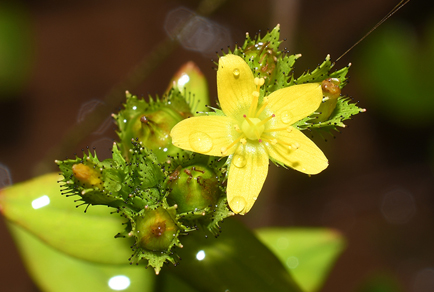
Based on a comprehensive examination of herbarium specimens, field investigations, and phylogenetic analyses, we demonstrate that Hypericum austroyunnanicum , previously reported from Menglian county, Yunnan province, China, is conspecific with H. wightianum. According, H. austroyunnanicum is here reduced to synonymy under H. wightianum. A morphological description and photographic illustrations of H. wightianum are provided.
References
- APG IV. (2016) An update of the angiosperm phylogeny group classification for the orders and families of flowering plants: APG IV. Botanical Journal of the Linnean Society 181: 1–20. https://doi.org/10.1111/boj.12385
- Bai, R.Z., He, Z.L., Celep, F., Wang, L. & Xiang, C.L. (2025) Hypericum chishuiense (Hypericaceae, sect. Ascyreia), a new St. John’s wort species from Guizhou, China. Turkish Journal of Botany 49: 133–142. https://doi.org/10.55730/1300-008X.2848
- Bai, R.Z., Yu, J.X., Zhao, F., Asafaw, F., Drew, B.T., Chen, Y.P., Seregin, A.P., Cai, J., Menemen, Y., Celep, F., He, Z.S., Ertaş, Ş., Xu, G, & Xiang, C.L. (2026) Phylogenetic insights into Hypericum (Hypericaceae) from China based on genome-skimming data. Taxon 75: e70166 https://doi.org/10.1002/tax.70166
- Bai, R.Z., Zhao, F., Cai, J., Shen, S.K. & Xiang, C.L. (2023a) Hypericum podocarpoides N. Robson (Hypericaceae): a newly recorded species from China. Plant Science Journal 41: 1–6.
- Bai, R.Z., Zhao, F., Drew, B.T., Xu, G., Cai, J., Shen, S.K. & Xiang, C.L. (2023b) Seed morphology of Hypericum (Hypericaceae) in China and its taxonomic significance. Microscopy Research and Technique 86: 1496–1509. https://doi.org/10.1002/jemt.24372
- Blume, C.L. (1823) Cratoxylum. Verhandelingen van het Bataviaasch Genootschap van Kunsten en Wetenschappen 9: 174–177.
- Capella-Gutiérrez, S., Silla-Martínez, J.M. & Gabaldón, T. (2009) trimAl: a tool for automated alignment trimming in large-scale phylogenetic analyses. Bioinformatics 25: 1972–1973. https://doi.org/10.1093/bioinformatics/btp348
- Chen, S.F., Zhou, Y.Q., Chen, Y. & Gu, J. (2018) fastp: an ultra-fast all-in-one FASTQ preprocessor. Bioinformatics 34: 884–890. https://doi.org/10.1093/bioinformatics/bty560
- Claude, S.J., Park, K.T. & Park, S. (2026) Plastome evolution at the edge: structural rearrangements, IR expansion, and gene flux in Hypericaceae (Malpighiales). BMC Plant Biology 26: 222. https://doi.org/10.1186/s12870-025-07888-7
- Doyle, J.J. & Doyle, J.L. (1987) A rapid DNA isolation procedure for small quantities of fresh leaf tissue. Phytochemical Bulletin 19: 11–15.
- Hooker, J.D. & Thomson, T. (1874) Hypericineae. In: Hooker, J.D. (Ed.) The Flora of British India, Vol. 1. L. Reeve & Co., London, pp. 255. https://doi.org/10.5962/bhl.title.54393
- IUCN Standards and Petitions Committee (2024) Guidelines for Using the IUCN Red List Categories and Criteria. Version 16. Prepared by the Standards and Petitions Committee. Available from: http//www.iucnredlist.org/documents/RedListGuidelines.pdf (accessed 11 May 2026)
- Jin, J.J., Yu, W.B., Yang, J.B., Song, Y., dePamphilis, C.W., Yi, T.S. & Li, D.Z. (2020) GetOrganelle: a fast and versatile toolkit for accurate de novo assembly of organelle genomes. Genome Biology 21: 241. https://doi.org/10.1186/s13059-020-02154-5
- Katoh, K. & Standley, D.M. (2013) MAFFT multiple sequence alignment software version 7: improvements in performance and usability. Molecular Biology and Evolution 30: 772–780. https://doi.org/10.1093/molbev/mst010
- Kearse, M., Moir, R., Wilson, A., Stones-Havas, S., Cheung, M., Sturrock, S., Buxton, S., Cooper, A., Markowitz, S., Duran, C., Thierer, T., Ashton, B., Meintjes, P. & Drummond, A. (2012) Geneious basic: an integrated and extendable desktop software platform for the organization and analysis of sequence data. Bioinformatics 28: 1647–1649. https://doi.org/10.1093/bioinformatics/bts199
- Linnaeus, C. (1753) Species plantarum, vol. 2. Impensis Laurentii Salvii, Holmiae, pp. 783–785.
- Li, X.W. & Robson, N.K.B. (2007) Hypericum. In: Wu, C.Y. & Raven, P.H. (Eds.) Flora of China, Vol. 13. Science Press & Missouri Botanical Garden Press, Beijing & St. Louis, pp. 2–35.
- Marchese, C. (2015) Biodiversity hotspots: A shortcut for a more complicated concept. Global Ecology and Conservation 3: 297–309. https://doi.org/10.1016/j.gecco.2014.12.008
- Martius, C.F.P. (1823) durch Brasilien auf Befehl Sr. Majestät Maximilian Joseph I., Königs von Baiern, in den Jahren 1817–1820 gemacht und beschrieben, Vol. 1. Lindauer, München, pp. 552.
- Meseguer, A.S., Aldasoro, J.J. & Sanmartín, I. (2013) Bayesian inference of phylogeny, morphology and range evolution reveals a complex evolutionary history in St. John’s wort (Hypericum). Molecular Phylogenetics and Evolution 67: 379–403. https://doi.org/10.1016/j.ympev.2013.02.007
- Myers, N., Mittermeier, R.A., Mittermeier, C.G., Da Fonseca, G.A. & Kent, J. (2000) Biodiversity hotspots for conservation priorities. Nature 403: 853–858. https://doi.org/10.1038/35002501
- Nürk, N.M., Madriñán, S., Carine, M.A., Chase, M.W. & Blattner, F.R. (2013) Molecular phylogenetics and morphological evolution of St. John’s wort (Hypericum; Hypericaceae). Molecular Phylogenetics and Evolution 66: 1–16. https://doi.org/10.1016/j.ympev.2012.08.022
- Ou, X.Y., Chu, Z.F., Ouyang, W.X., Qin, W.Q., Quan, Z.X., Zhang, M.H., Zhang, D.G. & Xiao, J.W. (2025) Hypericum shunhuangshanense (Hypericaceae), a new species from Hunan, China. PhytoKeys 260: 13–23. https://doi.org/10.3897/phytokeys.260.153988
- Qu, X.J., Moore, M.J., Li, D.Z. & Yi, T.S. (2019) PGA: a software package for rapid, accurate, and flexible batch annotation of plastomes. Plant Methods 15: 50. https://doi.org/10.1186/s13007-019-0435-7
- Robson, N.K.B. (1977) Studies in the genus Hypericum L. (Guttiferae): 1. Infrageneric classification. Bulletin of the British Museum (Natural History), Botany Series 5: 293–355.
- Robson, N.K.B. (2001) Studies in the genus Hypericum L. (Guttiferae) 4 (1). Sections 7. Roscyna to 9. Hypericum sensu lato (part 1). Bulletin of the British Museum (Natural History), Botany Series 31: 66–76. https://doi.org/10.1017/S096804460200004X
- Robson, N.K.B. (2002) Studies in the genus Hypericum L. (Guttiferae) 4 (2). Section 9. Hypericum sensu lato (part 2): subsection 1. Hypericum series 1. Hypericum. Bulletin of the British Museum (Natural History), Botany Series 32: 61–123. https://doi.org/10.1017/S096804460200004X
- Robson, N.K.B. (2012) Studies in the genus Hypericum L. (Hypericaceae). 9. Addenda, corrigenda, keys, lists and general discussion. Phytotaxa 72: 1–111. https://doi.org/10.11646/phytotaxa.72.1.1
- Robson, N.K.B. (2016) And then came molecular phylogenetics—Reactions to a monographic study of Hypericum (Hypericaceae). Phytotaxa 255: 181–198. https://doi.org/10.11646/phytotaxa.255.3.1
- Rocha, L., Ribeiro, P.L., Endress, P.K. & Rapini, A. (2019) A brainstorm on the systematics of Turnera (Turneraceae, Malpighiales) caused by insights from molecular phylogenetics and morphological evolution. Molecular Phylogenetics and Evolution 137: 44–63. https://doi.org/10.1016/j.ympev.2019.04.015
- Shihab, D., Al-Hatem, J. & Alkhashab, F. (2025) The Molecular Identification of Hypericum perforatum L. Growing in Nineveh Governorate. Journal of Wahj Al-Ulom for Pure Sciences 1: 1–8. https://doi.org/10.33899/jwups.v1i3.21914
- Spach, É. (1836) Conspectus monographiae Hypericorum. Annales des Sciences Naturelles, série 2, Botanique 5: 349–371.
- Stamatakis, A. (2014) RAxML version 8: a tool for phylogenetic analysis and post-analysis of large phylogenies. Bioinformatics 30: 1312–1313. https://doi.org/10.1093/bioinformatics/btu033
- Stöver, B.C. & Müller, K.F. (2010) TreeGraph 2: combining and visualizing evidence from different phylogenetic analyses. BMC bioinformatics 11: 7. https://doi.org/10.1186/1471-2105-11-7
- Thiers, B. (2026) Index Herbariorum: A Global Directory of Public Herbaria and Associated Staff; New York Botanical Garden’s Virtual Herbarium. Available online: http://sweetgum.nybg.org/science/ih/ (accessed 16 January 2026)
- Vandelli, D. (1788) Vismia. Florae Lusitanicae et Brasilienis specimen. Ex typographia Academico-Regia, Conimbricae, 51 pp.
- Wu, L.H., Yang, D.P. & Wang, F.S. (2002) Hypericum austroyunnanicum, a new species of Hypericaceae from Yunnan, China. Journal of Systematic and Evolution 40: 77–79.
- Wu, T.R., Xu, J., An, M.T., Yu, J.H., Liu, F. & Chen, Z.R. (2024) Hypericum liboense (Hypericaceae), a new species from Guizhou, China. PhytoKeys 237: 37–49. https://doi.org/10.3897/phytokeys.237.110482
- Ying, S.S. (2022) A new species of genus Hypericum (Hypericaceae) from Taiwan—(Hypericum eastmostianum S.S. Ying). In: Ying, S.S. (Ed.) New taxa and new names, Vol. 3. Research Center of Flora of Taiwan, Taipei, pp. 74–78.
- Zhang, D., Gao, F., Jakovlić, I., Zou, H., Zhang, J., Li, W.X. & Wang, G.T. (2020) PhyloSuite: an integrated and scalable desktop platform for streamlined molecular sequence data management and evolutionary phylogenetics studies. Molecular Ecology Resources 20: 348–355. https://doi.org/10.1111/1755-0998.13096
- Zhang, N.N., Stull, G.W., Zhang, X.J., Fan, S.J., Yi, T.S. & Qu, X.J. (2025) PlastidHub: an integrated analysis platform for plastid phylogenomics and comparative genomics. Plant Diversity 47: 544–560. https://doi.org/10.1016/j.pld2025.05.0.05
- Zou, L., Bai, R.Z., Xiang, C.L. & Li, L. (2024) Characterization of the complete chloroplast genome sequence of Hypericum petiolulatum (Hypericaceae). Korean Journal of Plant Taxonomy 54: 80–85. https://doi.org/10.11110/kjpt.2024.54.1.80