
Abstract
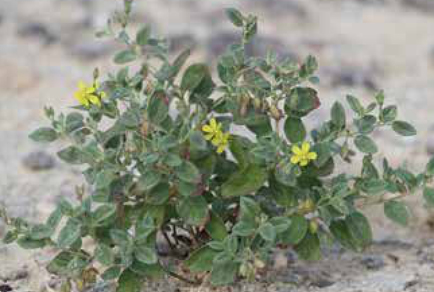
Indian populations of Helianthemum (Cistaceae), previously identified as H. lippii, are re-evaluated here using an integrative approach combining morphology, molecular systematics based on plastid (ndhF, psbA-trnH, trnL-trnF) and nuclear (ITS) DNA sequences, and cytogenetic data. The morphological traits and phylogenetic results suggest a close relationship with a Helianthemum lineage from the southern Arabian Peninsula and the Horn of Africa, particularly with H. citrinum. The Indian plants are described here as H. citrinum subsp. kachchhicum. The phylogenetic reconstructions provided evidence that this subspecies likely originated from a recent dispersal event from the southern Arabian Peninsula around 120,000 years ago. Overall, this study carries significant biogeographical and evolutionary implications and highlights the limited understanding of Helianthemum beyond its Mediterranean biodiversity hotspot.
References
- Albaladejo, R.G., Martín-Hernanz, S., Reyes-Betancort, J.A., Santos-Guerra, A., Olangua-Corral, M. & Aparicio, A. (2021) Reconstruction of the spatio-temporal diversification and ecological niche evolution of Helianthemum (Cistaceae) in the Canary Islands using genotyping-by-sequencing data. Ann Bot 127: 597–611. https://doi.org/10.1093/aob/mcaa090
- Aparicio, A., Escudero, M., Valdés-Florido, A., Pachón, M., Rubio, E., Albaladejo, R.G., Martín-Hernanz, S. & Pradillo, M. (2019) Karyotype evolution in Helianthemum (Cistaceae): dysploidy, achiasmate meiosis and ecological specialization in H. squamatum, a true gypsophile. Botanical Journal of the Linnean Society 191: 484–501. https://doi.org/10.1093/botlinnean/boz066
- Aparicio, A., Martín-Hernanz, S., Parejo-Farnés, C., Arroyo, J., Lavergne, S., Yeşilyurt, E.B., Zhang, M., Rubio, E. & Albaladejo, R.G. (2017) Phylogenetic reconstruction of the genus Helianthemum (Cistaceae). using plastid and nuclear DNA-sequences: Systematic and evolutionary inferences. Taxon 66: 868–885. https://doi.org/10.12705/664.5
- Altinordu, F., Peruzzi, L., Yu, Y. & He, X. (2016) A tool for the analysis of chromosomes: KaryoType. Taxon 66: 586–592. https://doi.org/10.12705/653.9
- Baker, J.G. (1875) Descriptions of new Asparagaceae. Journal of the Linnean Society, Botany 14: 608. https://doi.org/10.1111/j.1095-8339.1875.tb00349.x
- Baker, J.G. (1894) Helianthemum argyreum Baker. Bulletin of Miscellaneous Information (Kew) 1894: 329. https://doi.org/10.2307/4118332
- Bharucha, F.R. & Meher-Homji, V.M. (1964) On the floral elements of the semi-arid zones of India and their ecological significance. New Phytologist 64: 330–342. https://doi.org/10.1111/j.1469-8137.1965.tb05403.x
- Boissier, P.E. (1849) Diagnoses plantarum Orientalium novarum. Apud B. Hermann, Lipsiae (Leipzig), 49 pp.
- Bornmüller, J.F.N. (1930) Helianthemum germanicopolitanum Bornm., eine neue Art der Sektion Ortholobium-Polystachyum aus Kleinasien. Repertorium specierum novarum regni vegetabilis 27: 352. https://doi.org/10.1002/fedr.4870272904
- Chiovenda, E. (1929) Flora Somala. 327 pp.
- Christensen, C. (1922) Flora Aegyptiaco-Arabica, sive, Plantarum, quas per Aegyptum et Arabiam felicem collegit, descriptiones et icones. Dansk Botanisk Arkiv 4: 20.
- Davis, P.D. & Coode, J.E. (1965) Helianthemum antitauricum. Notes from the Royal Botanic Garden Edinburgh 26: 201.
- De Candolle, A.P. (1824) Prodromus Systematis Naturalis Regni Vegetabilis. 240 pp.
- Decaisne, J. (1843) Periploca aphylla. In: Voyage dans l’Inde pendant les années 1828 à 1832. Arthus Bertrand, Paris, pp. 109, t. 116.
- Delile, A.R. (1813) Helianthemum kahiricum Delile. Description de l’Égypte, ou recueil des observations et recherches qui ont été faites en Égypte pendant l’expédition de l’armée française 2: 237.
- Drummond, A.J., Suchard, M.A., Xie, D. & Rambaut, A. (2012) Bayesian phylogenetics with BEAUti and the BEAST 1.7. Molecular Biology and Evolution 29: 1969–1973. https://doi.org/10.1093/molbev/mss075
- Dumont de Courset, G.L.M. (1802a) Description, culture, et usages de la plus grande partie des plantes étrangères, naturalisées et indigènes, cultivées en France, en Autriche, en Italie, et en Angleterre, rangées suivant la méthode de Jussieu. Le Botaniste Cultivateur, 129 pp.
- Dumont de Courset, G.L.M. (1802b) Description, culture, et usages de la plus grande partie des plantes étrangères, naturalisées et indigènes, cultivées en France, en Autriche, en Italie, et en Angleterre, rangées suivant la méthode de Jussieu. Le Botaniste Cultivateur, 130 pp.
- Fischer, F.E.L. & Mey, C.A. (1841) Cistineae. In: Enumeratio plantarum novarum a cl. Schrenk lectarum, vol. 1. pp. 94. https://doi.org/10.5962/bhl.title.45100
- GBIF. (2024) GBIF.org. Available from: https://doi.org/10.15468/dl.s3enf5 (accessed 20 August 2024)
- Ghazanfar, S.A. (2002) A new species of Helianthemum from the Sultanate of Oman. Willdenowia 32: 69. https://doi.org/10.3372/wi.32.32106
- Ghazanfar, S.A. (2003) Cistaceae. In: Ghazanfar, S.A. (Ed.) Flora of the Sultanate of Oman: Piperaceae–Primulaceae, vol. 1. National Botanic Garden of Belgium, Meise, pp. 116–118.
- Gillett, J.B. (1954) The genus Helianthemum (Cistaceae) in Somaliland. Kew Bulletin 9: 493. https://doi.org/10.2307/4108830
- Grosser, W.C.H. (1903) Helianthemum. In: Engler, A. (Ed.) Das Pflanzenreich. Regni Vegetabilis Conspectus. Wilhelm Engelmann, Lipsiae (Leipzig), pp. 62.
- Hubbard, C.E. (1947) Urochondra setulosa (Trin.) C. E. Hubbard. In: Hooker’s Icones Plantarum. Royal Botanic Gardens, Kew, London, pp. 3457.
- Hrynowiecka, A. & Winter, H. (2016) Paleoclimatic changes in the Holsteinian Interglacial (Middle Pleistocene) on the basis of indicator-species method—Palynological and macrofossils remains from Nowiny Żukowskie site (SE Poland). Quaternary International 409B: 255–269. https://doi.org/10.1016/j.quaint.2015.08.036
- Kilian, N., Hein, P. & Hubaishan, M.A. (2002) New and noteworthy records for the flora of Yemen, chiefly of Hadhramout and Al-Mahra. Willdenowia 32: 239–269. https://doi.org/10.3372/wi.32.32207
- López-González, G. (1992) Apuntes para justificar el tratamiento del género Helianthemum Miller, s.l. (Cistaceae) en Flora Iberica. Anales del Jardín Botánico de Madrid 50: 43.
- Martín-Hernanz, S., Albaladejo, R.G., Lavergne, S., Rubio, E., Grall, A. & Aparicio, A. (2021a) Biogeographic history and environmental niche evolution in the Palearctic genus Helianthemum (Cistaceae). Molecular Phylogenetics and Evolution 163: 107238. https://doi.org/10.1016/j.ympev.2021.107238
- Martín-Hernanz, S., Albaladejo, R.G., Lavergne, S., Rubio, E., Marín-Rodulfo, M., Arroyo, J. & Aparicio, A. (2023a) Strong conservatism of floral morphology during the rapid diversification of the genus Helianthemum. American Journal of Botany 110: e16155. https://doi.org/10.1002/ajb2.16155
- Martín-Hernanz, S., Albaladejo, R.G., Rubio, E., Volkova, P., Miara, M.D., Ulukuş, D., Sezgin, M. & Aparicio, A. (2023b) Comparative karyological study in the genus Helianthemum (Cistaceae): chromosome number evolution, karyotype length and asymmetry. Anales del Jardín Botánico de Madrid 80: e136. https://doi.org/10.3989/ajbm.576
- Martín-Hernanz, S., Albaladejo, R.G, Viruel, J., Matos, R., Brito López, S., Rubio, E., Castro, M., Loureiro, J., Volkova, P. & Aparicio, A. (2026) Genome size evolution in Helianthemum (Cistaceae): Dynamic genomes within a conserved chromosomal framework. Molecular Phylogenetics and Evolution 221: 108627. https://doi.org/10.1016/j.ympev.2026.108627
- Martín-Hernanz, S., Aparicio, A., Fernández-Mazuecos, M., Rubio, E., Reyes-Betancort, A., Santos-Guerra, A., Olangua-Corral, M. & Albaladejo, R.G. (2019) Maximize Resolution or Minimize Error? Using Genotyping-By-Sequencing to Investigate the Recent Diversification of Helianthemum (Cistaceae). Frontiers in Plant Science 10: 1416. https://doi.org/10.3389/fpls.2019.01416
- Martín-Hernanz, S., Aparicio, A., Viruel, J., Widén, B., Volkova, P., Miara, M.D., Rubio, E. & Albaladejo, R.G. (2024) Delimiting taxa boundaries in complex plant groups by genomic, morphometric, and ecological data: the case of the Mediterranean genus Helianthemum. Oral communication in the XX Int. Bot. Congr., Madrid.
- Martín-Hernanz, S., Velayos, M., Albaladejo, R.G. & Aparicio, A. (2021b) Systematics implications upon a robust species and subspecies-level phylogenetic reconstruction of the genus Helianthemum (Cistaceae) based on genotyping-by-sequencing GBS data. Anales del Jardín Botánico de Madrid 78: e113. https://doi.org/10.3989/ajbm.2601
- Menke, B. (1976) Pliozäne und ältestquartäre Sporen-und Pollenflora von Schleswig-Holstein. Geologisches Jahrbuch, Reihe A 32: 3–197.
- Miller, M.A., Pfeiffer, W. & Schwartz, T. (2010) Creating the CIPRES Science Gateway for inference of large phylogenetic trees. In: 2010 Gateway Computing Environments Workshop (GCE). New Orleans, LA, USA, pp. 1–8. https://doi.org/10.1109/GCE.2010.5676129
- Miller, P. (1754) Gardeners dictionary. J. & J. Rivington, London, 94 pp.
- Miller, P. (1768) Gardeners dictionary. J. & J. Rivington, London, 293 pp.
- Naud, G. & Suc, J.P. (1975) Contribution à l’étude paléofloristique des Coirons (Ardèche): Premières analyses polliniques dans les alluvions sous-basaltiques et interbasaltiques de Mirabel (Miocène supérieur). Bulletin de la Société Géologique de France 17: 820–827. https://doi.org/10.2113/gssgfbull.S7-XVII.5.820
- Paszko, B. (2006) A critical review and a new proposal of karyotype asymmetry indices. Plant Systematics and Evolution 258: 39–48. https://doi.org/10.1007/s00606-005-0389-2
- Patel, R.M. & Gosavi, K.V.C. (2016) Cistaceae, a new family record for India. Rheedea 26: 21–25. https://doi.org/10.22244/rheedea.2016.26.01.03
- Persoon, C.H. (1806) Synopsis Plantarum, seu Enchiridium botanicum, complectens enumerationem systematicam specierum hucusque cognitarum. 78 pp. https://doi.org/10.5962/bhl.title.638
- Peruzzi, L. & Eroğlu, H.E. (2013) Karyotype asymmetry: again, how to measure and what to measure? Comp Cytogenet 7: 1–9. https://doi.org/10.3897/compcytogen.v7i1.4431
- Plants of the World Online (POWO). (2024) Available from: https://powo.science.kew.org/ (accessed 26 September 2024)
- Posada, D. & Crandall, K. (1998) Modeltest: Testing the model of DNA substitution. Bioinformatics 14: 817–818. https://doi.org/10.1093/bioinformatics/14.9.817
- Ronquist, F., Teslenko, M., van der Mark, P., Ayres, D.L., Darling, A., Höhna, S., Larget, B., Liu, L., Suchard, M.A. & Huelsenbeck, J.P. (2012) MrBayes 3.2: Efficient Bayesian Phylogenetic Inference and Model Choice Across a Large Model Space. Systematic Biology 61: 539–542. https://doi.org/10.1093/sysbio/sys029
- Ruprecht, F.J. (1869) Flora Caucasi. Typis Academiae Imperialis Scientiarum, St. Petersburg, 143 pp.
- Sánchez-Gómez, P., Jiménez, J.F. & Vera, J.B. (2011) Helianthemum motae (Cistaceae), a New Species from Southeastern Spain. Annales Botanici Fennici 48: 50. https://doi.org/10.5735/085.048.0107
- Snow, R. (1963) Alcoholic hydrochloric acid-carmine as a stain for chromosomes in squash preparations. Stain Technology 38: 9–13. https://doi.org/10.3109/10520296309061161
- Spach, É. (1836a) Argyrolepis (sect. in Helianthemum). In: Annales des Sciences Naturelles; Botanique 6: 363.
- Spach, È. (1836b) Tuberaria (Dunal) Spach. In: Annales des Sciences Naturelles. Botanique. Chez les Professeurs du Muséum d’Histoire Naturelle, Paris, pp. 364.
- Stebbins, G.L. (1971) Chromosomal evolution in Higher Plants. Edward Arnold Ltd., London.
- Sventenius, E.R. (1960) Additamentum ad Floram Canariensem. Instituto Nacional de Investigaciones Agronómicas (Madrid), 35 pp.
- Thulin, M. (1984) A new species of Helianthemum (Cistaceae) form N. Somalia. Garcia de Orta, Série de Botanica 6: 69.
- Thulin, M. (1993) Cistaceae. In: Thulin, M. (Ed.) Flora of Somalia: Pteridophyta; Gymnospamae; Angiospermae (Annonacae–Fabaceae), vol. 1. Royal Botanic Gardens, Kew, pp. 207–208.
- Thulin, M. (2002) A new species and new records of Helianthemum (Cistaceae) from the Horn of Africa region. Nordic Journal of Botany 22: 41. https://doi.org/10.1111/j.1756-1051.2002.tb01618.x
- Tjio, J.H. & Levan, A. (1950) The use of oxyquinoline in chromosome analysis. Anales de la Estación Experimental de Aula Dei 2: 21–64.
- Valerio-Arana, M. (2024) Systematics and biogeographic reconstruction of Helianthemum subg. Eriocarpum (Cistaceae) through target-capture sequencing. Master’s Thesis, University of Seville, Spain, 21 pp.
- Verdcourt, B. (1966) The family Cistaceae in tropical Africa. Boletim da Sociedade Broteriana sér. 2 40: 57.
- Webb, P.B. (1849) Niger flora. H. Baillière, Londres, 102 pp.
- Willkomm, H.M. (1862) Icones et Descriptiones Plantarum Novarum aut Minus Cognitarum. Sumptibus Wilhelm Engelmann, Lipsiae (Leipzig), 139 pp.
- Zhao, Y.Z., Cao, R. & Zhu, Z.Y. (2000) A new species of Helianthemum. Acta Phytotaxonomica Sinica 38: 294.