

Abstract
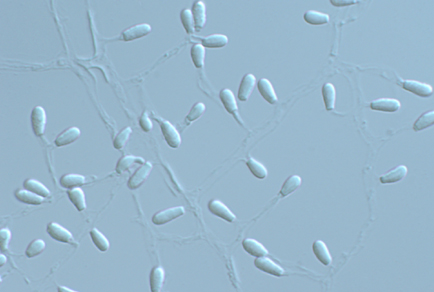
During a survey of keratinophilic fungi in karst caves, three isolates of chrysosporium-like fungi were isolated from cave soil collected in Guizhou Province, China, following enrichment using hair bait. Phylogenetic analyses based on combined ITS and LSU sequence data revealed that they belong to an undescribed Keratinophyton species. Morphologically, K. speluncicola differs from other species in the genus by producing 1-celled, 3.5‒8 × 1.5‒3 µm conidia that are smooth to finely roughened, and by the absence of observed intercalary conidia and chlamydospores. Based on these results, the new species Keratinophyton speluncicola sp. nov. is formally described.
References
- Cabanes, F.J., Sutton, D.A. & Guarro, J. (2014) Chrysosporium-related fungi and reptiles: a fatal attraction. PLOS Pathogens 10: e1004367. https://doi.org/10.1371/journal.ppat.1004367
- Drummond, A.J. & Rambaut, A. (2007) BEAST: Bayesian evolutionary analysis by sampling trees. BMC Evolutionary Biology 7: 214. https://doi.org/10.1186/1471-2148-7-214
- Gabriel, C.R. & Northup, D.E. (2013) Microbial ecology: caves as an extreme habitat. In: Cheeptham, N. (Ed.) Cave microbiomes: a novel resource for drug discovery. Springer, New York, pp. 85–108. https://doi.org/10.1007/978-1-4614-5206-5_5
- Hajsig, M., de Vries, G.A., Sertic, V. & Naglic, T. (1974) Chrysosporium evolceanui from pathologically changed dog skin. Veterinarski Arhiv 44: 209–211.
- Hyde, K.D., Noorabadi, M.T., Thiyagaraja, V., He, M.Q., Johnston, P.R., Wijesinghe, S.N. & Dissanayake, L.S. (2024) The 2024 outline of Fungi and fungus-like taxa. Mycosphere 15: 5146–6239. https://doi.org/10.5943/mycosphere/15/1/25
- Crous, P.W., Wingfield, M.J., Richardson, D.M., Le Roux, J.J., Strasberg, D., Edwards, J. & Roets, F. (2016) Fungal Planet description sheets: 400–468. Persoonia 36: 316–458. https://doi.org/10.3767/003158516X692185
- Jeewon, R. & Hyde, K.D. (2016) Establishing species boundaries and new taxa among fungi: recommendations to resolve taxonomic ambiguities. Mycosphere 7: 1669–1677. https://doi.org/10.5943/mycosphere/7/11/4
- Jiang, J.R., Cai, L. & Liu, F. (2017) Oligotrophic fungi from a carbonate cave, with three new species of Cephalotrichum. Mycology 8: 164–177. https://doi.org/10.1080/21501203.2017.1366370
- Kalyaanamoorthy, S., Minh, B.Q., Wong, T.K.F., Von, H.A. & Jermiin, L.S. (2017) ModelFinder: fast model selection for accurate phylogenetic estimates. Nature methods 14 (6): 587–589. https://doi.org/10.1038/nmeth.4285
- Kandemir, H., Dukik, K., Teixeira, M.de M., Stielow, J.B., Delma, F.Z., Al‑Hatmi, A.M.S. & Ahmed, S.A. (2022) Phylogenetic and ecological reevaluation of the order Onygenales. Fungal Diversity 115: 1–72. https://doi.org/10.1007/s13225-022-00506-z
- Katoh, K. & Standley, D.M. (2013) MAFFT multiple sequence alignment software version 7: improvements in performance and usability. Molecular Biology and Evolution 30 (4): 772–780. https://doi.org/10.1093/molbev/mst010
- Labuda, R., Scheffenacker, V., Schüller, A., Voleková, B., Kubátová, A., Kandemir, H. & Maritim, W.C. (2024) Two novel members of Onygenales, Keratinophyton kautmanovae and K. keniense spp. nov. from soil. Scientific Reports 14: 16525. https://doi.org/10.1038/s41598-024-67475-y
- Labuda, R., Bernreiter, A., Hochenauer, D., Kubátová, A., Kandemir, H. & Schüller, C. (2021) Molecular systematics of Keratinophyton: the inclusion of species formerly referred to Chrysosporium and description of four new species. IMA Fungus 12: 17. https://doi.org/10.1038/s41598-024-67475-y
- Li, X., Zhang, Z.Y., Chen, W.H., Liang, J.D., Liang, Z.Q. & Han, Y.F. (2022) Keratinophyton chongqingense sp. nov. and Keratinophyton sichuanense sp. nov., from soil in China. International Journal of Systematic and Evolutionary Microbiology 72: 005468. https://doi.org/10.1099/ijsem.0.005468
- Minh, B.Q., Nguyen, M.A.T. & Von, H.A. (2013) Ultrafast approximation for phylogenetic bootstrap. Molecular biology and Evolution 30 (5): 1188–1195. https://doi.org/10.1093/molbev/mst024
- Nguyen, L.T., Schmidt, H.A., von Haeseler, A. & Minh, B.Q. (2015) IQ-TREE: A fast and effective stochastic algorithm for estimating maximum-likelihood phylogenies. Molecular biology and Evolution 32 (1): 268–274. https://doi.org/10.1093/molbev/msu300
- Ogórek, R., Suchodolski, J., Piecuch, A., Przywara, K. & Višňovská, Z. (2022) Keratinophilic and keratinolytic fungi in cave ecosystems: A culture-based study of Brestovská cave and Demänovská Ľadová and Slobody caves (Slovakia). Applied Sciences 12 (3): 1455. https://doi.org/10.3390/app12031455
- Pan, H., Feng, Y., Wang, Y., Tao, G. & Zhang, Z.Y. (2025) Morphological characterization and phylogenetic placement of Ramiconidium sinense gen. et sp. nov. (Microascaceae, Microascales). International Journal of Systematic and Evolutionary Microbiology 75: 006761. https://doi.org/10.1099/ijsem.0.006761
- Rambaut, A. (2012) FigTree, version 1.4.2. University of Edinburgh, Edinburgh.
- Randhawa, H.S. & Sandhu, R.S. (1963) On the occurrence of two new species of Trichophyton in Indian soils. Mycopathologia et Mycologia Applicata 20 (3–4): 225–238. https://doi.org/10.1007/bf02089211
- Randhawa, H.S. & Sandhu, R.S. (1964) Keratinophyton terreum gen. nov. sp. nov., a keratinophilic fungus from soil in India. Sabouraudia 3: 251–257. https://doi.org/10.1080/00362176485190421
- Ronquist, F., Teslenko, M., van der, M.P., Ayres, D.L., Darling, A., Höhna, S. & Larget, B. (2012) MrBayes 3.2: Efficient Bayesian phylogenetic inference and model choice across a large model space. Systematic Biology 61 (3): 539–542. https://doi.org/10.1093/sysbio/sys029
- Sutton, D.A., Marín, Y., Thompson, E.H., Wickes, B.L., Fu, J., García, D. & Swinford, A. (2013) Isolation and characterization of a new fungal genus and species, Aphanoascella galapagosensis, from carapace keratitis of a Galapagos tortoise (Chelonoidis nigra microphyes). Medical Mycology 51: 113–120. https://doi.org/10.3109/13693786.2012.701767
- Tamura, K., Stecher, G., Peterson, D., Filipski, A. & Kumar, S. (2013) MEGA6: molecular evolutionary genetics analysis version 6.0. Molecular Biology and Evolution 30 (12): 2725–2729. https://doi.org/10.1093/molbev/mst197
- Vidal, P., Sanchez-Puellez, J.M., Milan, D. & Guarro, J. (2000) Chrysosporium fluviale, a new keratinophilic species from river sediments. Mycological Research 104 (2): 244–250. https://doi.org/10.1017/s0953756299001082
- Vilgalys, R. & Hester, M. (1990) Rapid genetic identification and mapping of enzymatically amplified ribosomal DNA from several Cryptococcus species. Journal of Bacteriology 172 (8): 4238–4246. https://doi.org/10.1128/jb.172.8.4238-4246.1990
- White, T.J., Bruns, T., Lee, S. & Taylor, J. (1990) Amplification and direct sequencing of fungal ribosomal RNA genes for phylogenetics. https://doi.org/10.1016/B978-0-12-372180-8.50042-1
- Xiang, C.Y., Gao, F.L., Jakovlić, I., Lei, H.P., Hu, Y., Zhang, H. & Zou, H. (2023) Using PhyloSuite for molecular phylogeny and tree‐based analyses. iMeta 2 (1): e87. https://doi.org/10.1002/imt2.87
- Zhang, Z.F., Liu, F., Zhou, X., Liu, X.Z., Liu, S.J. & Cai, L. (2017) Culturable mycobiota from Karst caves in China, with descriptions of 20 new species. Persoonia 39: 1–31. https://doi.org/10.3767/persoonia.2017.39.01
- Zhang, Z.F., Zhou, S.Y., Eurwilaichitr, L., Ingsriswang, S., Razav, M., Chen, Q., Zhao, P., Liu, F. & Cai, L. (2021) Culturable mycobiota from Karst caves in China II, with descriptions of 33 new species. Fungal Diversity 106: 29–136. https://doi.org/10.1007/s13225-020-00453-7