
Abstract
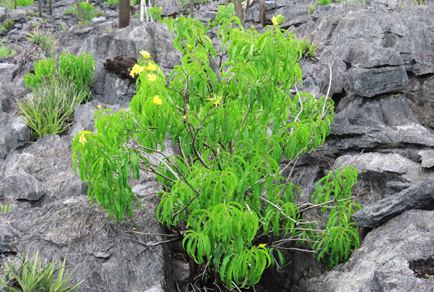
Allamanda is a Neotropical genus of Apocynaceae consisting of shrubs, treelets or scandent plants usually with verticillate leaves and intrapetiolar colleters, showy flowers, foliaceous sepals, corolla tubular-campanulate, usually yellow or sometimes purple, violet, lilac to red, cream, salmon, and dehiscent capsular fruits characterized by echinate, smooth or muricate surfaces. During field expeditions in the limestone outcrops of Tocantins State in central Brazil this new species was discovered. Herein we describe Allamanda karstica, a unique species in the genus due to its smooth fruit surface with spines limited to dehiscing fissures. Color photographs, a distribution map, preliminary conservation assessment, morphological comparisons with the related species, as well as an identification key to Allamanda occurring in limestone outcrops of Brazil are presented herein.
References
- Alves-Silva, J.W. & Coutinho, T.S. (2023) Allamanda alagoana (Apocynaceae), a remarkable new species from Northeastern Brazil. Phytotaxa 613: 187–193. https://doi.org/10.11646/phytotaxa.613.2.8
- Azevedo, L., Zappi, D.C., Oliveira, D.M.G., Meyer, L., Lughadha, E.N., Clegg, E., Meireles, L.D., Melo, P.H.A., Pennington, R.T. & Neves, D.M. (2019) On the rocks: Biogeography and floristic identity of rocky ecosystems in eastern South America. Journal of Systematics and Evolution 62: 305–320. https://doi.org/10.1111/jse.13052
- Bachman, S., Moat, J., Hill, A.W., de la Torre, J. & Scott, B. (2011) Supporting Red List threat assessments with GeoCAT: geospatial conservation assessment tool. ZooKeys 150: 117–126. https://doi.org/10.3897/zookeys.150.2109.figure1
- Beentje, H. (2016) The Kew Plant Glossary: An Illustrated Dictionary of Plant Terms, 2nd Edition. Royal Botanic Gardens, Kew.
- BirdLife International (cont. updated) Important Bird Areas factsheet: Aurora do Tocantins / Taguatinga. BirdLife International. Available from: http://datazone.birdlife.org/site/factsheet/22259 (accessed 16 May 2026)
- Bystriakova, N., Melo, P.H.A., Moat, J., Lughadha, E.N. & Monro, A.K. (2019) A preliminary evaluation of the Karst flora of Brazil using collections data. Scientific Reports 9: 17037. https://doi.org/10.1038/s41598-019-53104-6
- Candolle, A. (1844) Prodromus systematis naturalis regni vegetabilis. Sumptibus Sociorum Treuttel et Würtz, Parisiis [Paris], v. 8, pp. 317–319.
- CECAV/ICMBio (2009) Mapa das Regiões Cársticas do Brasil. Centro Nacional de Pesquisa e Conservação de Cavernas, Brasília. Available from: http://www.icmbio.gov.br/cecav/images/stories/projetos-e-atividades/regioes_carsticas/regioes_carsticas_BR_SAD69_2009.zip (accessed 9 February 2018)
- Endress, M.E., Liede-Schumann, S. & Meve, U. (2014) An updated classification for Apocynaceae. Phytotaxa 159: 175–194. https://doi.org/10.11646/phytotaxa.159.3.2
- Endress, M.E., Meve, U., Middleton, D.J. & Liede-Schumann, S. (2019) Apocynaceae. In: Kadereit, J.W. & Bittrich, V. (Eds.) The families and genera of vascular plants. Vol. 15. Springer, Cham, pp. 207–411. https://doi.org/10.1007/978-3-319-93605-5_3
- Flora e Funga do Brasil. (2026) Allamanda in Flora e Funga do Brasil. Jardim Botânico do Rio de Janeiro. Available from: https://floradobrasil.jbrj.gov.br/FB4507 (accessed 12 February 2026)
- Ford, D. & Williams, P. (2007) Karst Hydrogeology and Geomorphology. John Wiley & Sons Ltd, West Sussex, England. https://doi.org/10.1002/9781118684986
- Global Forest Watch (cont. updated) GWF Interactive Map. Global Forest Watch, Washington, DC. Available from: www.globalforestwatch.org (accessed 16 May 2026)
- ICMBIO (2012) Instituto Chico Mendes de Conservação da Biodiversidade. Portaria nº 108, 11 de outubro de 2012.
- IUCN (2024) Guidelines for Using the IUCN Red List Categories and Criteria, Version 16. Prepared by the Standards and Petitions Committee, International Union for Conservation of Nature, Gland and Cambridge. Available from: https://www.iucnredlist.org/documents//RedList Guidelines.pdf (accessed 25 August 2023)
- Linnaeus, C.A. (1771) Mantissa Plantarum Altera Generum Editionis VI et Specierum Editionis II. Laurentii Salvii, Stockholm, 443 pp. https://doi.org/10.5962/bhl.title.69083
- Marcusso, G.M., Monro, A.K., Melo, P.H.A. & Lombardi, J.A. (2020) Acanthostachys calcicola (Bromeliaceae, Bromelioideae), a new species from a limestone outcrop in Tocantins State, Brazil. Phytotaxa 472: 201–206. https://doi.org/10.11646/phytotaxa.472.2.10
- Melo, P.H.A. (2022) Biogeografia de florestas estacionais deciduais sobre afloramentos calcários em diferentes biomas brasileiros. Tese de doutorado, Universidade Estadual Paulista (Unesp), Instituto de Biociências, Rio Claro, 78 pp.
- Melo, P.H.A. & Lombardi, J.A. (2019) First record of Oziroë argentinensis (Lillo & Hauman) Speta (Asparagaceae) for Brazil. Feddes Repertorium 130: 376–378. https://doi.org/10.1002/fedr.201900003
- Morales, J.F. (2005) Estudios en las Apocynaceae neotropicales XIX: La familia Apocynaceae s. str. (Apocynoideae, Rauvolfioideae) de Costa Rica. Darwiniana 43: 90–191.
- Morales, J.F. (2014) Studies in Neotropical Apocynaceae L: the genus Allamanda in Colombia and a new combination. Phytotaxa 162: 51–56. https://doi.org/10.11646/phytotaxa.162.1.5
- Pohl, J.E. (1827) Plantarum Brasiliae icones et descriptiones hactenus ineditae :iussu et auspiciis Francisci Primi, imperatoris et regis augustissimi (Vol. 1). Antonii Strauss. https://doi.org/10.5962/bhl.title.451
- POWO (2026) Plants of the World Online. Facilitated by the Royal Botanic Gardens, Kew. Available from: https://powo.science.kew.org/ (accessed 24 February 2026)
- Sakane, M. & Shepherd, G.J. (1986) Uma revisão do gênero Allamanda L. (Apocynaceae). Revista Brasileira de Botânica 9: 125–149.
- Simões, A.O., Livshultz, T., Conti, E. & Endress, M.E. (2007) Phylogeny and systematics of the Rauvolfioideae (Apocynaceae) based on molecular and morphological evidence. Annals of the Missouri Botanical Garden 94: 268–297. https://doi.org/10.3417/0026-6493(2007)94[268:PASOTR]2.0.CO;2
- Simões, A.O., Farinaccio, M.A., Koch, I., Konno, T. & Morales, J.F. (2013) Flora de Sergipe—Apocynaceae. In: Prata, A.P.N., Amaral, M.C.E., Farias, M.C.V. & Alves, M.V. (Eds.) Flora de Sergipe. 1ed. Gráfica e Editora Triunfo, Aracaju, pp. 48–86.
- Souza-Silva, R.F. & Rapini, A. (2009) Allamanda calcicola (Apocynaceae), an overlooked new species from limestone outcrops in the States of Minas Gerais and Bahia, Brazil. Kew Bulletin 64: 171–174.
- Thiers, B. (continuously updated) Index Herbariorum: A global directory of public herbaria and associated staff. New York Botanical Gardens Virtual Herbarium. Available from: http://sweet gum.nybg.org/science/ih/ (accessed 10 February 2026)
- Zarucchi, J.L., Morillo, G.N., Endress, M.E., Hansen, B.F. & Leeuwenberg, A.J.M. (1995) Apocynaceae. In: Berry, P.E., Holst, B.K. & Yatskievych, K. (Eds.) Flora of the Venezuelan Guayana. Volume 2. Pteridophytes, Spermatophytes; Acanthaceae—Araceae. Missouri Botanical Garden, St. Louis, pp. 341–406. [and Oregon: Timber Press, Inc.]