

Abstract
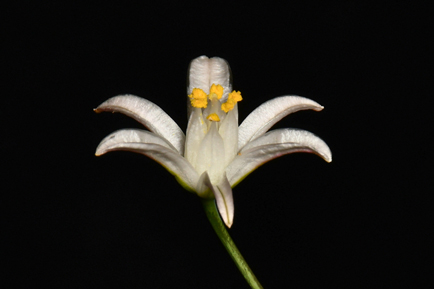
The subfamily Scilloideae (Asparagaceae) is represented in South America exclusively by the bulbous genus Oziroë, the sister lineage to the remainder of the subfamily, currently comprising five recognized species distributed across arid, semiarid, and Mediterranean ecosystems. In this study, we describe Oziroë imbricata, a new species endemic to the coastal desert of the Atacama Region in northern Chile. The species was discovered during a “Desierto Florido” event on inland plains south of the Totoral River (27°S, 70°W), in a fog-influenced xerophytic scrubland. Oziroë imbricata is morphologically remarkable within the genus for its large, strongly reflexed, canaliculate tepals and filaments overlapping one another and forming a conspicuous tube-like structure around the ovary and style, a unique combination of traits in the genus Oziroë. We provide a detailed morphological description supported by photographs, illustrations, a distribution map, and a comparative table contrasting the new species with its closest morphological relatives, O. biflora and O. arida. Currently, the species is known from a narrow coastal belt between Totoral and the Huasco River, at elevations of ca. 90–450 m a.s.l., where it inhabits open desert scrub, including populations recorded along the northwestern boundary of Llanos de Challe National Park. Using GeoCAT, we estimate an Extent of Occurrence (EOO) of 715 km² and an Area of Occupancy (AOO) of 28 km². We propose the category Vulnerable (VU) under IUCN criterion B2ab(iii), based on its small AOO, few known localities, and multiple anthropogenic threats, including mining, photovoltaic development, and unregulated grazing. An updated key to the South American species of Oziroë is also provided.
References
- Ali, S.S., Yu, Y., Pfosser, M. & Wetschnig, W. (2012) Inferences of biogeographical histories within subfamily Hyacinthoideae using S-DIVA and Bayesian binary MCMC analysis implemented in RASP (reconstruct ancestral state in phylogenies). Annals of Botany 109: 95–107. https://doi.org/10.1093/aob/mcr274
- Alves-de-Lima, L., Calixto, E.S., Oliveira, M.L.D., Novaes, L.R., Almeida, E.A. & Torezan-Silingardi, H.M. (2023) Flowering time variation in two sympatric tree species contributes to avoid competition for pollinator services. Plants 12 (19): 3347. https://doi.org/10.3390/plants12193347
- Armesto, J.J., Vidiella, P.E. & Gutiérrez, J.R. (1993) Plant communities of the fog-free coastal desert of Chile: plant strategies in a fluctuating environment. Revista Chilena de Historia Natural 66: 271–282.
- Bachman, S., Moat, J., Hill, A.W., de la Torre, J. & Scott, B. (2011) Supporting Red List threat assessments with GeoCAT: geospatial conservation assessment tool. ZooKeys 150: 117–126. https://doi.org/10.3897/zookeys.150.2109
- Baker, J.G. (1874) Scilla acaulis. Journal of Botany, British and Foreign 12: 364.
- Buerki, S., Jose, S., Yadav, S.R., Goldblatt, P., Manning, J.C. & Forest, F. (2012) Contrasting biogeographic and diversification patterns in two Mediterranean-type ecosystems. PLoS ONE 7 (6): e39377. https://doi.org/10.1371/journal.pone.0039377
- Cádiz-Véliz, A. & Casale, J.-F. (2026) Oxalis bifurcatifolia (O. sect. Carnosae, Oxalidaceae), a new succulent species endemic to the Atacama Desert, Chile. Phytotaxa 742 (4): 278–288. https://doi.org/10.11646/phytotaxa.742.4.2
- Chase, M.W., Reveal, J.L. & Fay, M.F. (2009) A subfamilial classification for the expanded asparagalean families Amaryllidaceae, Asparagaceae and Xanthorrhoeaceae. Botanical Journal of the Linnean Society 161: 132–136. https://doi.org/10.1111/j.1095-8339.2009.00999.x
- de Melo, P.H.A. & Lombardi, J.A. (2019) First record of Oziroë argentinensis (Lillo & Hauman) Speta (Asparagaceae) for Brazil. Feddes Repertorium 130 (4): 376–378. https://doi.org/10.1002/fedr.201900003
- Gajardo, R. (1994) La vegetación natural de Chile: Clasificación y distribución geográfica. Editorial Universitaria, Santiago, Chile, 165 pp.
- Guaglianone, E.R. & Arroyo-Leuenberger, S. (2002) The South American genus Oziroë (Hyacinthaceae–Oziroëoideae). Darwiniana 40 (1–4): 61–76. [https://www.jstor.org/stable/23225166]
- Guerrero, P.C., Rosas, M., Arroyo, M.T. & Wiens, J.J. (2013) Evolutionary lag times and recent origin of the biota of an ancient desert (Atacama—Sechura). Proceedings of the National Academy of Sciences of the United States of America 110 (28): 11469–11474. https://doi.org/10.1073/pnas.1308721110
- Hoffmann, A., Watson, J. & Flores, A. (2015) Flora silvestre de Chile. Cuando el desierto florece. Vol. 1. Monocotiledóneas y otros taxones. Fundación Claudio Gay, Santiago, Chile, 261 pp.
- Howard, C.C., Nanyeni, L., Mollel, N., Chuba, D., Zuntini, A.R., Malakasi, P., Harvey, T.S. & Cellinese, N. (2023) From southern Africa and beyond: Historical biogeography of a monocotyledonous bulbous geophyte. Journal of Biogeography 50 (9): 1623–1638. https://doi.org/10.1111/jbi.14627
- iNaturalist (2025) iNaturalist Research-grade Observations. Available from: https://www.inaturalist.org/ (accessed 1 November 2025)
- IUCN (2022) Guidelines for Using the IUCN Red List Categories and Criteria. Version 15.1. Standards and Petitions Committee, Gland, Switzerland. Available from: https://www.iucnredlist.org/documents/RedListGuidelines.pdf (accessed 20 December 2025)
- Kunth, C.S. (1843) Enumeratio Plantarum Omnium Hucusque Cognitarum, Secundum Familias Naturales Disposita, Adjectis Characteribus, Differentiis et Synonymis. Vol. 4. J.G. Cottae, Stuttgart & Tübingen, 752 pp.
- Lindley, J. (1832) Camassia. Edwards’s Botanical Register 24: 1486.
- Linnaeus, C. (1753) Species Plantarum. Vol. 1. Laurentii Salvii, Stockholm, 560 pp.
- Luebert, F. & Pliscoff, P. (2017) Sinopsis Bioclimática y Vegetacional de Chile. 2ª ed. Editorial Universitaria, Santiago, 381 pp.
- Lynch, A.H., Rudall, P.J. & Cutler, D.F. (2006) Leaf anatomy and systematics of Hyacinthaceae. Kew Bulletin 61 (2): 145–159. [https://www.jstor.org/stable/20443254]
- Macbride, J.F. (1931) Publications of the Field Museum of Natural History, Botanical Series. Vol. 11. Chicago, 9 pp.
- Moreira-Muñoz, A. (2011) Plant Geography of Chile. Springer, Dordrecht, 351 pp. https://doi.org/10.1007/978-90-481-8748-5
- Philippi, R.A. (1860) Florula Atacamensis seu Enumeratio Plantarum quas in itinere per Desertum Atacamense. E. Anton, Halle, 62 pp. https://doi.org/10.5962/bhl.title.162865
- Poellnitz, K. von (1942) Anthericum limaense. Revista Sudamericana de Botánica 7: 100.
- Poeppig, E.F. (1833) Fragmentum Synopseos Plantarum Phanerogamum ab Auctore Annis MDCCCXXVII ad MDCCCXXIX in Chile Lectarum. Leipzig, 13 pp.
- Rafinesque, C.S. (1837) Flora Telluriana. Vol. 3. H. Probasco, Philadelphia, PA, 100 pp. https://doi.org/10.5962/bhl.title.7751
- Ravenna, P. (1998) Oziroë antedating Fortunatia (Hyacinthaceae) and a new species from Argentina. Onira 14 (3): 40–41.
- Rodríguez, R., Marticorena, C., Alarcón, D., Baeza, C., Cavieres, L., Finot, V.L., Fuentes, N., Kiessling, A., Mihoc, M., Pauchard, A., Ruiz, E., Sánchez, P. & Marticorena, A. (2018) Catálogo de las plantas vasculares de Chile. Gayana Botánica 75 (1): 1–430. https://doi.org/10.4067/S0717-66432018000100001
- Ruiz, H. & Pavón, J.A. (1802) Flora Peruviana et Chilensis. Vol. 3. Typis Gabrielis de Sancha, Madrid, 95 pp.
- SERNAGEOMIN (Servicio Nacional de Geología y Minería) (2025) Catastro de concesiones mineras. Santiago, Chile. Available from: https://catastro.sernageomin.cl/ (accessed 28 November 2025)
- SONAMI (Sociedad Nacional de Minería de Chile) (2025) Mapa minero de Chile. Available from: https://www.sonami.cl/mapaminero (accessed 21 November 2025)
- Speta, F. (1998) Systematic analysis of the genus Scilla L. s.l. (Hyacinthaceae). Phyton (Horn, Austria) 38: 1–141.
- Thiers, B. (2025 [continuously updated]) Index Herbariorum: a global directory of public herbaria and associated staff. New York Botanical Garden’s Virtual Herbarium, New York. Available from: http://sweetgum.nybg.org/science/ih/ (accessed 1 December 2025)
- Toledo, S., Ferrio, J.P., García-Beltrán, J.A., Guerrero, P.C., Sierra-Almeida, Á. & Squeo, F.A. (2025) Geographic patterns of fog-driven isotopic niches and root adaptations in cacti across the arid- to hyperarid gradients of the Atacama Desert. Journal of Biogeography 52: e70106. https://doi.org/10.1111/jbi.70106