
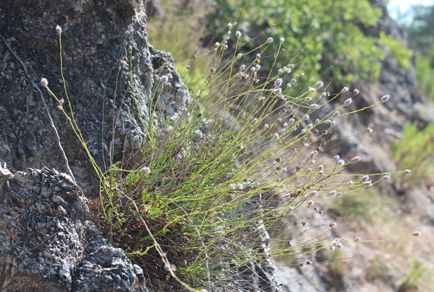

Abstract
Globularia elmasii is described as a new species from southwestern Anatolia. It is currently known only from a single locality in Muğla province, making it a narrow endemic with a highly restricted distribution. The new species exhibits the closest morphological affinity to G. anatolica, from which it differs by several diagnostic characters, including its elongated, narrowly ovoid to oblong-cylindric capitula, higher number of capitula per stem, terminal capitulum distinctly larger than the lateral ones, more numerous and densely pilose involucral bracts, strongly undulate basal leaves (contrasting with the flat cauline leaves), larger calyx, and its subprolate pollen grains. Due to its extremely restricted distribution range, low number of mature individuals, and ongoing anthropogenic threats, the conservation status of G. elmasii is assessed as Critically Endangered (CR) according to the IUCN Red List Categories and Criteria. An identification key to members of sect. Polycephalium is provided. Finally, the Turkish vernacular name “elmas küreçiçeği” is proposed for the new species.
References
- QGIS Association (2024) QGIS Geographic Information System. Open Source Geospatial Foundation Project. Available from: http://www.qgis.org (accessed 17 June 2026)
- Affenzeller, M., Kadereit, J.W. & Comes, H.P. (2018) Parallel bursts of recent and rapid radiation in the Mediterranean and Eritreo-Arabian biodiversity hotspots as revealed by Globularia and Campylanthus (Plantaginaceae). Journal of Biogeography 45: 552–566. https://doi.org/10.1111/jbi.13155
- APG (1998) An ordinal classification for the families of flowering plants. Annals of the Missouri Botanical Garden 85: 531–553. https://doi.org/10.2307/2992015
- APG II (2003) An update of the Angiosperm Phylogeny Group classification for the orders and families of flowering plants: APG II. Botanical Journal of the Linnean Society 141: 399–436. https://doi.org/10.1046/j.1095-8339.2003.t01-1-00158.x
- Argue, C.L. (1993) Pollen morphology in the Selagineae, Manuleae (Scrophulariaceae), and selected Globulariaceae, and its taxonomic significance. American Journal of Botany 80: 723–733. https://doi.org/10.1002/j.1537-2197.1993.tb15242.x
- Bertolini, A. (1835) Flora Italica, Vol. 2. Richard Masio, Bologna, pp. 3–12.
- Boissier, E. (1872) Flora orientalis, Vol. 2. H. Georg, Geneva & Basel, pp. 528–531.
- Bozkurt, E. (2001) Neotectonics of Turkey-a synthesis. Geodinamica Acta 14: 3–30. https://doi.org/10.1080/09853111.2001.11432432
- Comes, H.P. & Kadereit, J.W. (2003) Spatial and temporal patterns in the evolution of the flora of the European Alpine System. Taxon 52: 451–462. https://doi.org/10.2307/3647445
- Contandriopoulos, J. (1978) Contribution a l’étude cytobiogeographique du genre Globularia L. Revue de Biologie et d’Ecologie Méditerranéenne 5: 3–14.
- Danışman, B. (2015) Türkiye’de Yayılış Gösteren Globularia orientalis L. Globularia trichosantha Fisch. & Mey. ssp. trichosantha, Globularia sintenisii Hausskn. & Wettst ve Globularia alypum L. (Globulariaceae)’un Polen Morfolojileri Üzerinde Bir Çalışma. Nevşehir Haci Bektaş Veli University, Türkiye, 52 pp.
- Duman, H. (2001) A new species of Globularia L. (Globulariaceae) from south Anatolia. Botanical Journal of the Linnean Society 137: 425–428. https://doi.org/10.1006/bojl.2001.0489
- Duran, A., Çetin, Ö. & Öztürk, M. (2009) Globularia anatolica sp. nov. (Globulariaceae) from the Honaz Mountain National Park, southwest Turkey. Nordic Journal of Botany 27: 232–237. https://doi.org/10.1111/j.1756-1051.2009.00412.x
- Edmondson, J.R. (1982) Globularia L. In: Davis, P.H. (Ed.) Flora of Turkey and the East Aegean Islands. Vol. 7. Edinburgh University Press, Edinburgh, pp. 27–31.
- Ekim, T. & Güner, A. (2000) The floristic richness of Turkey. In: Güner, A., Özhatay, N., Ekim, T. & Başer, K.H.C. (Eds.) Flora of Turkey and the East Aegean Islands (Vol. 11, Suppl. 2). Edinburgh University Press, Edinburgh, pp. 1–15.
- Faegri, K. & Iversen, J. (1989) Textbook of pollen analysis. 4th ed. Faegri K., Kaland P.E., Krzywinski K. John Wiley, Sons, Chichester, 328 pp.
- Fischer, F.E.L. & Meyer, C.A. (1839) Index quintus seminum, quae hortus botanicus Imperialis Petropolitanus pro mutua commutatione offert: Accedunt animadversiones botanicae nonnullae, vol. 5. Academiae Caesareae Petropolitanae, Petropoli, 43 pp.
- Heß, H.E., Landolt, E. & Hirzel, R. (1972) Flora der Schweiz und angrenzender Gebiete: Band 3: Plumbaginaceae bis Compositae. Birkhäuser, Basel, pp. 269–271. https://doi.org/10.1007/978-3-0348-7655-1
- Holländer, K. & Jäger, E.J. (1994) Morphologie, Biologie und ökogeographische Differenzierung von Globularia. Mitteilungen aus dem Botanischen Garten der Martin-Luther-Universität Halle Nr. 139. Flora, 189: 223–254. https://doi.org/10.1016/S0367-2530(17)30598-4
- Innangi, M., Friščić, M., Hazler Pilepić, K., Danise, T., Conti, F., Bartolucci, F., Fioretto, A. & Peruzzi, L. (2020) Explaining intricate morphometric variability with environmental predictors: The case of Globularia cordifolia species complex. Plants 9: 314. https://doi.org/10.3390/plants9030314
- IUCN, Standards and Petitions Committee (2024) Guidelines for using the IUCN red list categories and criteria. Version 16. Prepared by the standards and petitions committee of the IUCN species survival commission. [https://www.iucnredlist.org/resources/redlistguidelines]
- Kadereit, J.W., Griebeler, E.M. & Comes, H.P. (2004) Quaternary diversification in European alpine plants: pattern and process. Philosophical Transactions of the Royal Society of London. Series B: Biological Sciences 359: 265–274. https://doi.org/10.1098/rstb.2003.1389
- Kadereit, J.W. & Comes, H.P. (2005) The temporal course of alpine plant diversification in the quaternary. In: Bakker, F.T., Chatrou, L.W., Gravendeel, B. & Pelser, P. (Eds.) Plant species-level systematics: Patterns, processes and new applications. Regnum Vegetabile, pp. 117–130.
- Linnaeus, C. (1753) Species Plantarum. Salvius, Stockholm, pp. 95–97.
- Médail, F. & Quézel, P. (1997) Hot-spots analysis for conservation of plant biodiversity in the Mediterranean Basin. Annals of the Missouri Botanical Garden 84: 112–127. https://doi.org/10.2307/2399957
- Menemen, Y., Aytaç, Z. & Kandemir, A. (2021) Türkçe bilimsel bitki, mantar, suyosunu ve bakteri adları yönergesi. Bağbahçe Bilim Dergisi 8 (3): 188–195. https://doi.org/10.35163/bagbahce.1030948
- Özkan, G. (2015) Türkiye’de Yayılış Gösteren Bazı Globularia L. (Globulariaceae) Türlerinin Polen Morfolojisi. Nevşehir Haci Bektaş Veli University, Türkiye, 39 pp.
- Pilepić, K.H., Friščić, M., Duran, A., Maslo, S., Garić, R., Čuljak, S. & Šutalo, K. (2016) Contribution to Globularia phylogeny based on nuclear ribosomal spacer and two chloroplast DNA regions. Periodicum Biologorum 118: 417–424. https://doi.org/10.18054/pb.v118i4.3856
- Punt, W. & Marks, A. (1991) The northwest European pollen flora, 49-Globulariaceae. Review of Palaeobotany and Palynology 69: 109–112. https://doi.org/10.1016/0034-6667(91)90069-F
- Punt, W., Hoen, P.P., Blackmore, S., Nilsson, S. & Le Thomas, A. (1994) A glossary of pollen and spore terminology. LPP Foundation, Utrecht, 71 pp.
- Rechinger, K.H. (ed.) (1966) Flora Iranica, Vol. 17. Akademische Druck- u, Vienna, pp. 1–4.
- Sales, F. & Hedge, I.C. (2001) Globularia L. In: Castroviejo, S., Paiva, J., Sales, F., Matías, M., Hedge, I., Aedo, C., Aldasoro, J.J., Herrero, A. & Velayos, M. (ed.) Flora Iberica XIV. Myoporaceae-Campanulaceae. Real Jardín Botánico, CSIC, Madrid, pp. 7–20.
- Schischkin, B.K. (ed.) (1953) (English 2000). Flora of the USSR, Vol 23: Bignoniaceae – Valerianaceae. Akademia Nauk, Leningrad, pp. 123–125.
- Schwarz, O. (1938) Die Gattung Globularia. Botanische Jahrbücher für Systematik, Pflanzengeschichte und Pflanzengeographie 69: 318–373.
- Schwarz, O. (1949) A new Anatolian Globularia. Kew Bulletin 4: 309–310. https://doi.org/10.2307/4109192
- Schwarz, O. (1963) Chromosomenzahlen, Lebensformen und Evolution der Gattung Globularia L. Drudea 3: 5–16.
- Şengör, A.M.C., Görür, N. & Şaroğlu, F. (1985) Strike-slip faulting and related basin formation in zones of tectonic escape: Turkey as a case study. In: Biddle, K.T. & Christie-Blick, N. (Eds.) Strike-slip deformation, basin formation, and sedimentation. Society of Economic Paleontologists and Mineralogists, pp. 227–264. https://doi.org/10.2110/pec.85.37.0227
- Şentürk, M. (2025) Globularia L. (Plantaginaceae) Cinsinin Türkiye Revizyonu [Revision of the Genus Globularia L. (Plantaginaceae) in Türkiye]. Mersin University, Mersin, 226 pp.
- Tutin, T.G., Heywood, V.H., Burges, N.A., Moore, D.M., Valentine, D.H., Walters, S.M. & Webb, D.A. (eds.) (1972) Flora Europaea. Vol. 3: Diapensiaceae to Myoporaceae. Cambridge University Press, Cambridge, pp. 280–282. https://doi.org/10.2307/1218149
- Villar, L., Sesé, J.A. & Ferrández, J.V. (1997) Sobre Globularia gracilis y su híbrido con G. repens subsp. repens en el Pirineo: G. x losae hybr. nov. Collectanea Botanica 23: 137–142.
- Wagenitz, G. (2004) Globulariaceae. In: Kubitzki, K. (Ed.) The Families and Genera of Vascular Plants 7. Springer, Berlin, pp. 159–162. https://doi.org/10.1007/978-3-642-18617-2_9
- Wettstein, R.V. (1895) Globulariaceen-Studien. Bulletin de l’Herbier Boissier 3: 274–276.
- WFO (2025) World Flora Online. Published on the Internet. Available from: http://www.worldfloraonline.org (accessed 21 November 2025)
- Wodehouse, R.P. (1935) Pollen grains. McGraw-Hill, New York, 574 pp.
- Zohary, M. (1973) Geobotanical foundations of the Middle East (Vols. 1–2). Gustav Fischer Verlag, Stuttgart, 739 pp.