
Abstract
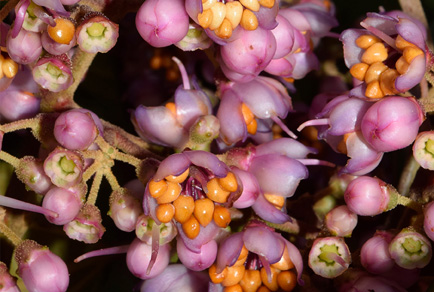
Eleven new species of Axinaea (Melastomataceae, Merianieae) are described and illustrated from the Andes. The new species are A. auriculata and A. johnjuliusii from Venezuela, A. frustrata, A. paisa and A. titanica from Colombia, A. andina, A. kiru, A. matangae and A. olivacea from Ecuador, A. huancabambae from Ecuador and Peru, and A. yunga from Bolivia. We provide morphological descriptions along with comments on related species and geographic distribution. Also, we discuss the current diversity and taxonomy of Axinaea in the Andes. With these discoveries, Venezuela, Colombia, Ecuador, Peru, and Bolivia now have a total of seven, 12, 21, 18, and two species of Axinaea, respectively. Finally, we present a preliminary list of the 50 currently accepted Axinaea species.
References
- Basso-Alves, J.P., Goldenberg, R. & Teixeira, S.P. (2017) Ontogeny elucidates the double calyx of Leandra melastomoides (Miconieae, Melastomataceae). International Journal of Plant Sciences 178: 740–752. https://doi.org/10.1086/694079
- Bachman, S., Moat, J., Hill, A.W., de la Torre, J. & Scott, B. (2011) Supporting Red List threat assessments with GeoCAT: geospatial conservation assessment tool. ZooKeys 150: 117–126. https://doi.org/10.3897/zookeys.150.2109
- Beentje, H. (2016) The Kew Plant Glossary, an illustrated dictionary of plants terms, Second Edition. Royal Botanic Gardens, Kew, 184 pp.
- Burke, J.M. & Michelangeli, F.A. (2018) Six new species of Miconia (Miconieae, Melastomataceae) described from the Andes. Phytotaxa 361: 131–150. https://doi.org/10.11646/phytotaxa.361.2.1
- Cotton, E., Borchsenius, F. & Balslev, H. (2014) A revision of “Axinaea” (Melastomataceae). Scientia Danica Series B, Biologica 4: 1–120.
- Dellinger, A.S., Penneys, D., Staedler, Y.M., Fragner, L., Weckwerth, W. & Schönenberger, J. (2014) A Specialized Bird Pollination System with a Bellows Mechanism for Pollen Transfer and Staminal Food Body Rewards. Current Biology 24 (14): 1615–1619. https://doi.org/10.1016/j.cub.2014.05.056
- Dellinger, A.S., Chartier, M., Fernández-Fernández, D., Penneys, D.S., Alvear, M., Almeda, F., Michelangeli, F.A., Staedler, Y., Armbruster, W.S. & Schönenberger, J. (2018) Beyond buzz-pollination – departures from an adaptive plateau lead to new pollination syndromes. New Phytologist 221 (2): 1136–1149. https://doi.org/10.1111/nph.15468
- Dellinger, A.S., Kopper, C., Kagerl, K. & Schönenberger, J. (2022) Pollination in Melastomataceae: a family-wide update on the little we know and the much that remains to be discovered. In: Goldenberg, R., Michelangeli, F.A. & Almeda, F. (Eds.) Systematics, Evolution, and Ecology of Melastomataceae. Springer, Cham, pp. 585–607. https://doi.org/10.1007/978-3-030-99742-7_26
- Dorr, L.J. & Eichhorn, S.K. (1997) Annotated list of the publications of John J. Wurdack. BioLlania Edición Especial 6: 1–34.
- Eves, D.S. (1936) A revision of the genus Axinaea (Melastomataceae). Bulletin of the Torrey Botanical Club 63: 211–226. https://doi.org/10.2307/2480904
- Fernández-Fernández, D., Ulloa Ulloa, C. & Penneys, D.S. (2016) A new species of Blakea (Blakeeae, Melastomataceae) from Ecuador. Phytotaxa 284 (1): 69–74. https://doi.org/10.11646/phytotaxa.284.1.7
- Fernandez-Hilario, R., Rojas, R., Lajo, L., Pillaca-Huacre, L., Wong, A.A., Paredes-Burneo, D., Villanueva-Espinoza, R., Michelangeli, F.A. & Goldenberg, R. (2022) Nine new species and new country record for Meriania (Melastomataceae) from Peru. Willdenowia 52: 39–74. https://doi.org/10.3372/wi.52.52103
- Fernandez-Hilario, R., Goldenberg, R. & Michelangeli, F.A. (2023) A synopsis of Meriania (Melastomataceae: Merianieae) in Peru. Phytotaxa 602: 1–101. https://doi.org/10.11646/phytotaxa.602.1.1
- Fernandez-Hilario, R., Pillaca-Huacre, L., Villanueva-Espinoza, R., Riva-Regalado, S., Rojas, R., Goldenberg, R. & Michelangeli, F.A. (2024) Taxonomic and chorological novelties in Blakea (Melastomataceae: Pyxidantheae) from Peru with a list of species for the country. Phytotaxa 635: 1–42. https://doi.org/10.11646/phytotaxa.635.1.1
- Font Quer, P. (2001) Diccionario de Botánica. Península, Barcelona.
- Gomez, J.P. (2025a) iNaturalist observation. Available from: https://www.inaturalist.org/observations/281155945 (accessed 24 July 2025)
- Gomez, J.P. (2025b) iNaturalist observation. Available from: https://www.inaturalist.org/observations/281162264 (accessed 24 July 2025)
- Hokche, O., Berry, P.E. & Huber, O. (Eds.) (2008) Nuevo catálogo de la Flora Vascular de Venezuela. Universidad Central de Venezuela, Fundación Instituto Botánico de Venezuela Dr. Tobias Lasser, Caracas, 859 pp.
- Ibisch, P.L., Beck, S.G., Gerkmann, B. & Carretero, A. (2003) Ecorregiones y Ecosistemas. In: Ibish, P.L. & Mérida, G. (Eds.) Biodiversidad: La riqueza de Bolivia. Santa Cruz, Bolivia, pp. 47–88.
- ITHAKA (2025) JSTOR Global Plants. Available from: https://plants.jstor.org (accessed 20 July 2025)
- IUCN (2012) Categorías y Criterios de la Lista Roja de la IUCN: Versión 3.1. IUCN Red List Unit, Gland & Cambridge. Available from: https://www.iucnredlist.org/es/resources/categories-and-criteria
- IUCN (2024) Guidelines for using the IUCN Red List categories and criteria: Versión 16. Standards and Petitions Committee, IUCN Red List Unit, Gland. Available from: https://www.iucnredlist.org/es/resources/redlistguidelines
- Jørgensen, P.M., Nee, M.H. & Beck, S.G. (Eds.) (2014) Catálogo de las Plantas Vasculares de Bolivia. Monograhs in Systematic Botany from the Missouri Botanical Garden 127: 1–1744.
- Judd, W.S. (2007) Revision of Miconia Sect. Chaenopleura (Miconieae, Melastomataceae) in the Greater Antilles. Systematic Botany Monographs 81: 1–235.
- Judd, W.S., Majure, L.C., Michelangeli, F.A., Goldenberg, R., Almeda, F., Penneys, D.S. & Stone, R.D. (2022) Morphological variability within the Melastomataceae (Myrtales), including a discussion of the associated terminology. In: Goldenberg, R., Michelangeli, F.A. & Almeda, F. (Eds.) Systematics, Evolution, and Ecology of Melastomataceae. Springer, Cham, pp. 45–85. https://doi.org/10.1007/978-3-030-99742-7_3
- Mendoza-Cifuentes, H. & Fernández-Alonso, J.L. (2010) Evaluación de caracteres del cáliz y de los estambres en la tribu Merianieae (Melastomataceae) y definición de homologías. Revista de la Academia Colombiana de Ciencias 34: 143–172.
- Mendoza-Cifuentes, H. & Fernández-Alonso, J.L. (2012) Novedades en Centronia y Meriania (Merianieae, Melastomataceae) y revisión taxonómica de Meriania grupo brachycera. Anales del Jardín Botánico de Madrid 69: 259–293. https://doi.org/10.3989/ajbm.2317
- Mendoza-Cifuentes, H. & Vargas, W.G. (2025) Axinaea filandiensis (Melastomataceae, Merianieae), a new species from Colombia, and comments on the circumscription of Axinaea and groups in Meriania. Acta Botanica Mexicana 132: e2421. https://doi.org/10.21829/abm132.2025.2421
- Mendoza-Cifuentes, H. (2021) Revisión taxonómica del género Meriania (Melastomataceae) en Colombia. Acta Botánica Mexicana 128-e1734: 1–137. https://doi.org/10.21829/abm128.2021.1734
- Michelangeli, F.A. & Paredes‑Burneo, D. (2018) Miconia canoi (Melastomataceae, Miconieae), a new species from southern Ecuador and northern Peru. Brittonia 71 (1): 55–63. https://doi.org/10.1007/s12228-018-9549-x
- Michelangeli, F.A., Almeda, F., Goldenberg, R. & Penneys, D. (2020) A guide to curating New World Melastomataceae collections with a linear generic sequence to world-wide Melastomataceae. Preprints 2020100203. https://doi.org/10.20944/preprints202010.0203.v2
- Michelangeli, F.A., Dellinger, A.S., Goldenberg, R., Almeda, F., Mendoza-Cifuentes, H., Fernández-Fernández, D., Ulloa Ulloa, C. & Penneys, D.S. (2022) Phylogenetics and Taxonomy of the Tribe Merianieae. In: Goldenberg, R., Michelangeli, F.A. & Almeda, F. (Eds.) Systematics, Evolution, and Ecology of Melastomataceae. Springer, Cham, pp. 255–273. https://doi.org/10.1007/978-3-030-99742-7_11
- Nicolson, D.H., Stergios, B. & Dorr, L.J. (1997) Plant taxa named by John J. Wurdack. BioLlania Edición Especial 6: 35–66.
- Paredes-Burneo, D., Michelangeli, F. & Cano, A. (2018) Twelve new records of Melastomataceae from northern Peru. Phytotaxa 349: 237–246. https://doi.org/10.11646/phytotaxa.349.3.4
- QGIS Development Team (2025) QGIS Geographic Information System version 3.40.8. Open Source Geospatial Foundation Project. Available from: http://www.qgis.org/
- Thiers, B. (2025) [continuously updated] Index Herbariorum: A global directory of public herbaria and associated staff. New York Botanical Garden’s Virtual Herbarium. Available from: http://sweetgum.nybg.org/ih/ (accessed 20 July 2025)
- Tenelema, M.V. & Morocho, D.O. (2024) Evaluación del efecto de incendios forestales históricos sobre propiedades del suelo en el bosque protector Tambillo. Universidad de Cuenca, Ecuador, 76 pp.
- Turland, N.J., Wiersema, J.H., Barrie, F.R., Gandhi, K.N., Gravendyck, J., Greuter, W., Hawksworth, D.L., Herendeen, P.S., Klopper, R.R., Knapp, S., Kusber, W.H., Li, D.-Z., May, T.W., Monro, A.M., Prado, J., Price, M.J., Smith, G.F. & Zamora Señoret, J.C. (Eds.) (2025) International Code of Nomenclature for Algae, Fungi, and Plants (Madrid Code). Regnum Vegetabile 162. University of Chicago Press, Chicago. https://doi.org/10.7208/chicago/9780226839479.001.0001
- Weigend, M. (2002) Observations on the biogeography of the Amotape-Huancabamba Zone in northern Peru. The Botanical Reviews 68: 38–54. https://doi.org/10.1663/0006-8101(2002)068[0038:ootbot]2.0.co;2
- Weigend, M. (2004) Additional observations on the biogeography of the Amotape-Huancabamba zone in Northern Peru: defining the South-Eastern limits. Revista Peruana de Biología 11: 127–134. https://doi.org/10.15381/rpb.v11i2.2447
- Wurdack, J.J. (1973) Melastomataceae (Memecyleae by Morley, T.). In: Lasser, T. (Ed.) Flora de Venezuela. No. 8. Instituto Botánico, Ministerio de Agricultura y Cría, Caracas, pp. 819.
- Wurdack, J.J. (1980) Melastomataceae. In: Harling, G. & Sparre, B. (Eds.) Flora of Ecuador. No. 13. Univ. Göteborg & Riksmuseum, Stockholm, pp. 406.
- Wurdack, J.J. (1986) Atlas of hairs for Neotropical Melastomataceae. Smithsonian Contributions to Botany 63: 1–80. https://doi.org/10.5479/si.0081024x.63