

Abstract
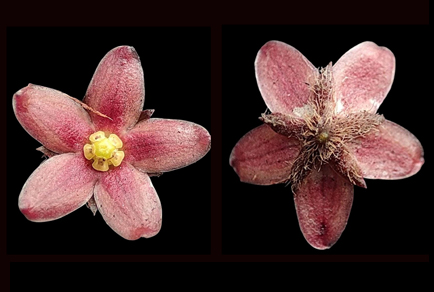
Vincetoxicum pulneyensis, a new species of Apocynaceae, is described from Kodaikanal Wildlife Sanctuary, Dindigul district, Tamil Nadu, India. The newly collected Vincetoxicum specimen distinguishes itself from its closest relatives, V. balakrishnanii and V. cordifolium, through several key vegetative and reproductive characters. Vincetoxicum pulneyensis possesses a villous stem and hirtellous follicles; it contrasts with V. balakrishnanii, which typically exhibits a glabrous to puberulous stem and glabrous follicles. The velvety, ovate to ovate-lanceolate leaves with a mucronate apex differ from the cordate base and acuminate apex in V. cordifolium. The specimen is characterised by a longer peduncle and hirsute bracteoles, whereas they have shorter peduncles and glabrous or ciliate bracteoles in V. balakrishnanii and V. cordifolium. Also, the presence of an ovate-elliptic calyx lobe and a fusiform follicle with a persistent calyx provides a distinct morphological departure from the more linear-lanceolate calyx lobes and standard follicle shapes found in the other two closely allied taxa. These distinct morphological characters of this species allow us to describe a new species within Vincetoxicum for the flora of India.
References
- Ali, S.I. & Khatoon, S. (1982) Genus Vincetoxicum von Wolf (Asclepiadaceae) in Pakistan. Pakistan Journal of Botany 14 (1): 61–68.
- Endress, M.E., Meve, U., Middleton, D.J. & Liede-Schumann, S. (2019) Apocynaceae: Periplocaceae Schltr.(1905). In: Flowering Plants. Eudicots: Apiales, Gentianales (except Rubiaceae). Cham: Springer International Publishing, pp. 207–411.
- Fuentes, V. (1982) El Género Espadaea A. Richard. Revista del Jardín Botánico Nacional 3 (3): 51–70.
- Güven, S., Coşkunçelebi, K. & Makbul, S. (2021) A new Vincetoxicum (Apocynaceae) species from Eastern Anatolia and its relationship based on biosystematic properties. Nordic Journal of Botany 39 (12). https://doi.org/10.1111/njb.03405
- Hooker, J.D. (1883) Asclepiadaceae. In: Hooker, J.D. (Ed.) Flora of British India, 4. L. Reeve & Co., London, pp. 29. https://doi.org/10.1016/j.ympev.2015.09.021
- Jagtap, A.P. & Singh, N.P. (1999) Asclepiadaceae and Periplocaceae. Fascicles of flora of India, Botanical Survey of India, Kolkata. Fascicle 24. Botanical Survey of India, Kolkata, pp. 211–241.
- Jayanthi, J., Jagtap, A.P. & Singh, N.P. (2022) Asclepiadaceae. In: Jayanthi, J. & Mao, A.A. (Eds.) Flora of India 17, Asclepiadaceae-Menyanthaceae, 17. Botanical Survey of India, Kolkata, pp. 1–245.
- Jiang, L.Q., Li, Y.Y., Zhu, X.X., Wang, Y.H. & Peng, H. (2018) Vincetoxicum xinpingense (Asclepiadeae, Asclepiadoideae, Apocynaceae), a new species from Yunnan Province, China. Phytotaxa 361 (1): 56–64. https://doi.org/10.11646/phytotaxa.361.1.4
- Kidyoo, A. (2016) Vincetoxicum siamicum sp. nov. (Asclepiadeae, Asclepiadoideae, Apocynaceae), a rheophyte from northeastern Thailand and preliminary observation on its in situ pollen germination. Phytotaxa 289 (1): 49–58. https://doi.org/10.11646/phytotaxa.289.1.3
- Kitamura, S. (1960) Flora of Afghanistan. L. Reeve & Co. Ltd., 2, 486 pp.
- Li, P.T., Gilbert, M.G. & Stevens, W.D. (1995) Asclepiadaceae. In: Wu, Z.Y. & Raven, P.H. (Eds.) Flora of China, 16. Science Press & Missouri Botanical Garden, Beijing & St. Louis, pp. 189–270.
- Liede, S. & Kunze, H. (2002) Cynanchum and the Cynanchinae (Apocynaceae—Asclepiadeae)—a molecular, anatomical and latex triterpenoid study. Organisms, Diversity & Evolution 2: 239–269. https://doi.org/10.1078/1439-6092-00045
- Liede, S. (1996) Cynanchum—Rhodostegiella—Vincetoxicum—Tylophora: new considerations on an old problem. Taxon 45: 193–211. https://doi.org/10.2307/1224660
- Liede-Schumann, S., Khanum, R., Mumtaz, A.S., Gherghel, I. & Pahlevani, A. (2016) Going west—A subtropical lineage (Vincetoxicum, Apocynaceae: Asclepiadoideae) expanding into Europe. Molecular Phylogenetics and Evolution 94: 436–446. https://doi.org/10.1016/j.ympev.2015.09.021
- Liede-Schumann, S. & Meve, U. (2018) Vincetoxicum (Apocynaceae—Asclepiadoideae) expanded to include Tylophora and allies. Phytotaxa 369 (3): 129–184. https://doi.org/10.11646/phytotaxa.369.3.1
- Liede-Schumann, S., Kong, H.H., Meve, U. & Thiv, M. (2012) Vincetoxicum and Tylophora (Apocynaceae: Asclepiadoideae: Asclepiadeae)- two sides of the same medal: Independent shifts from tropical to temperate habitats. Taxon 61: 803–825. https://doi.org/10.1002/tax.614007
- Liede-Schumann, S. (2024) The Apocynaceae TEN (Taxonomic Expert Network). Taxon 73 (5): 1130–1139. https://doi.org/10.1002/tax.13220
- Mochizuki, K., Nemoto, S., Murata, J. & Ohi-Toma, T. (2024) Vincetoxicum nakaianum (Asclepiadoideae, Apocynaceae), a new species from Japan for Cynanchum magnificum Nakai, nomen nudum. PhytoKeys 247: 191–201. https://doi.org/10.3897/phytokeys.247.125070
- Murugan, C. & Kamble, M.Y. (2012) A new species of Tylophora (Apocynaceae—Asclepiadoideae—Asclepiadeae) from the Nicobar Islands, India. Rheedea 22 (2): 83–87. https://doi.org/10.22244/rheedea.2012.22.02.03
- Parker, R.N. (1956) A forest flora for the Punjab with Hazara and Delhi. Govt. Printing Press, Lahore, 584 pp. [(3rd edn.)]
- POWO (2025) Plants of the World Online. Facilitated by the Royal Botanic Gardens, Kew. Published on the Internet. Available from: https://powo.science.kew.org/ (accessed 5 August 2025)
- Salim, P.M., Jose, M., Regy, Y., Joseph, J.P. & Jithin, M.M. (2017) Towards a review of the Tylophora R.Br. (Apocynaceae) in India: Two distinctive new species and a new combination. NeBIO 8 (3): 130–138.
- Shah, S.A., Sultan, A.S., Wen, W.J., Nisa, S.U., Xu, S.X., Iqbal, J.I. & Mumtaz, A.S. (2018) Vincetoxicum luridum (Asclepiadeae, Asclepiadoideae, Apocynaceae), a new and long misunderstood endemic species from Balochistan, Pakistan. Phytotaxa 357 (2): 117–125. https://doi.org/10.11646/phytotaxa.357.2.4
- Shah, S.A., Sultan, A., Wen, J., Ullah, Z., Un Nisa, S., Ren, Z., Alam, M.M., Iqbal, J. & Mumtaz, A.S. (2021) Taxonomy of Vincetoxicum s.str. (Asclepiadoideae, Apocynaceae) from southern Asia including three new species and resurrected names. PhytoKeys 179: 35–73. https://doi.org/10.3897/phytokeys.179.62514
- WFO (2025) World Flora Online. Published on the Internet. Available from: http://www.worldfloraonline.org (accessed 13 December 2025)
- Wen-Bin, X.U., Yan-Ling, L.I.U., Xin-Wei, L.I., Jing-Jing, Y.A.N. & Jian-Yong, S.H.E.N. (2024) Vincetoxicum gongshanense (Apocynaceae), a new species from Yunnan, China. Taiwania 69 (2). https://doi.org/10.6165/tai.2024.69.168
- Wight, R. (1834) Contributions to the Botany of India. Parbury, Allen & Co., London, 136 pp.
- Yamashiro, T., Fukuda, T., Yokoyama, J. & Maki, M. (2004) Molecular phylogeny of Vincetoxicum (Apocynaceae–Asclepiadoideae) based on the nucleotide sequences of cpDNA and nrDNA. Molecular Phylogenetics and Evolution 31: 689–700. https://doi.org/10.1016/j.ympev.2003.08.016
- Yamashiro, T., Fukuda, T., Yokoyama, J. & Maki, M. (2004a) Molecular phylogeny of Vincetoxicum (Apocynaceae–Asclepiadoideae) based on the nucleotide sequences of cpDNA and nrDNA. Molecular Phylogenetics and Evolution 31: 689–700. https://doi.org/10.1016/j.ympev.2003.08.016
- Yamashiro, T., Yokoyama, J. & Maki, M. (2004b) Two new species of Vincetoxicum (Apocynaceae-Asclepiadoideae) from Japan. Acta Phytotaxonomica et Geobotanica 55 (1): 1–8. https://doi.org/10.18942/apg.KJ00004622799
- Zaeifi, M. (1999) Two new species of genus Vincetoxicum (Asclepiadaceae) from Iran. Iranian Journal of Botany 8 (1): 105–110.