
Abstract
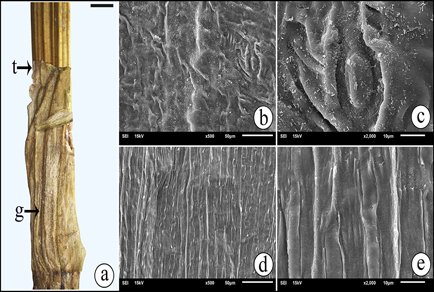
Persicaria (Polygonaceae) is recognized as a taxonomically problematic genus due to the morphological variations. Therefore, additional distinctive characters are needed to classify members of Persicaria. Ocrea is a structure formed by the fusion of stipules, and it is known that ocrea morphology varies among taxa and is of taxonomic importance. Therefore, the study aims to examine the ocrea morphology using the light and scanning electron microscopy of twelve Persicaria taxa distributed in Türkiye. The examinations were conducted on herbarium specimens stored in the Herbarium of the Department of Biology, Recep Tayyip Erdoğan University (RUB). The data obtained showed that ocrea morphology exhibited significant variability among the studied taxa, contributing to the differentiation of these taxa at a specific level. It has been observed that the most important characters contributing to the differentiation of taxa are ocrea length, apex shape, pubescence, epidermal cell shape on the adaxial surface, and the ornamentation of epicuticular wax on both adaxial and abaxial surfaces.
References
- Agrawal, D.K. & Saxena, N.P. (2012) Anatomy of ochrea and stipule in Polygonaceae. Journal of the Indian Botanical Society 91: 299–309.
- Assenov, V.I. (1966) Flora na Narodna Republika Bulgariya, vol. 3. Izdatelstvo na Bulgarskata Akademiia na Naukite, Sofia, 239 pp.
- Ayman, O.M., Mahrous, E.A., Mohsen, E. & Ezzat, S.M. (2024) Persicaria species native to the North African region: A comprehensive review of its botany, ethnomedicinal uses, phytochemistry and biological activities. South African Journal of Botany 172: 529–543. https://doi.org/10.1016/j.sajb.2024.04.021
- Barthlott, W., Neinhuis, C., Cutler, D., Ditsch, F., Meusel, I., Theisen, I. & Wilhelmi, H. (1998) Classification and terminology of plant epicuticular waxes. Botanical Journal of the Linnean Society 126: 237–260. https://doi.org/10.1006/bojl.1997.0137
- Brown, R. (1810) Prodromus Florae Novae Hollandiae et Insulae van-Diemen, vol. 1. R. Taylor et socii, Londini, 420 pp. https://doi.org/10.5962/bhl.title.6720
- Choi, K., Hwang, Y., Hong, J.K. & Park, S.Y. (2025) Genetic diversity and structure of Persicaria amphibia (Polygonaceae) in South Korea using genotyping by sequencing. Genes & Genomics 47: 11–18. https://doi.org/10.1007/s13258-024-01571-1
- Coode, M.J.E. & Cullen, J. (1966) Polygonum L. In: Davis, P.H. (Ed.) Flora of Turkey and the east Aegean Islands, vol. 2. Edinburgh University Press, Edinburgh, pp. 269–280.
- Danser, B.H. (1927) Die Polygonaceen Niederländisch-Ostindiens. Bulletin du Jardin Botanique de Buitenzorg 3: 119–261.
- Delarbre, A. (1800) Flore d’Auvergne: Ou, Recueil des plantes de cette ci-devant province, vol. 2. B. Beauvert et L. Deschamps, Clermont-Ferrand, 519 pp.
- Freeman, C.C. & Reveal, J.L. (2005) Polygonaceae Juss. In: Flora of North America Editorial Committee (Ed.) Flora of North America, vol. 5. Oxford University Press, New York, pp. 216–218.
- Galasso, G., Banfi, E., De Mattia, F., Grassi, F., Sgorbati, S. & Labra, M. (2009) Molecular phylogeny of Polygonum L. s.l. (Polygonoideae, Polygonaceae), focusing on European taxa: preliminary results and systematic considerations based on rbcL plastidial sequence data. Atti della Società Italiana di Scienze Naturali e del Museo Civico di Storia Naturale di Milano 150: 113–148.
- Germishuizen, G. & Robbertse, P.J. (1989) The genera Polygonum and Bilderdykia (Polygonaceae) in southern Africa: morphology and taxonomic value of the ocrea and fruit. Bothalia 19: 175–178. https://doi.org/10.4102/abc.v19i2.956
- Gitsopoulos, T.K., Vasilakoglou, I. & Tsoktouridis, G. (2013) Persicaria amphibia, a serious terrestrial weed in northern Greece: a combined molecular and morphological approach to identification and taxonomy. Biotechnology & Biotechnological Equipment 27: 4236–4242. https://doi.org/10.5504/BBEQ.2013.0088
- Gray, S.F. (1821) Natural Arrangement of British Plants, According to Their Relation to Each Other, vol. 2. Baldwin, Cradock, and Joy, London, 269 pp. https://doi.org/10.5962/bhl.title.43804
- Gross, H. (1913) Beitrage zur Kenntnis der Polygonaceen. Botanische Jahrhiicher fiir Systematik 49: 234–339.
- Haraldson, K. (1978) Anatomy and taxonomy in Polygonaceae subfam. Polygonoideae Meisn. emend. Jaretzky. Acta Universitatis Upsaliensis, Symbolae Botanicae Upsalienses 22: 1–95.
- Hassannejad, S. & Ghafarbi, S.P. (2017) A taxonomic revision of genus Polygonum L. sensu lato (Polygonaceae) for flora of Iran. Annual Research & Review in Biology 14: 1–5. https://doi.org/10.9734/ARRB/2017/27339
- Hedberg, O. (1946) Pollen morphology in the genus Polygonum L. s.l. and its taxonomical significance. Svensk Botanisk Tidskrift 40: 371–404.
- Hudson, W. (1762) Flora Anglica; exhibens Plantas per Regnum Angliae Sponte Crescentes, Distributas Secundum Systema Sexuale: cum Differentiis Specierum, Synonymis Auctorum, Nominibus Incolarum, Solo Locorum, Tempore Florendi, Officinalibus Pharmacopoerum, vol. 1. Impensis auctoris, Londini, 148 pp. https://doi.org/10.5962/bhl.title.124863
- Kantachot, C., Chantaranothai, P. & Simson, D.A. (2010) A synopsis of the genus Persicaria (Polygonaceae) in Thailand. Thai Forest Bulletin (Botany) 38: 128–149.
- Keskin, M. & Severoğlu, Z. (2020) The genus Persicaria (Polygonaceae) in Turkey with a new taxon record. EMU Journal of Pharmaceutical Sciences 3: 97–105.
- Keskin, M. & Severoğlu, Z. (2021a) A new species as a member of the flora of Turkey: Persicaria hydropiperoides (Polygonaceae). Frontiers in Life Sciences & Related Technology 2: 85–91. https://doi.org/10.51753/flsrt.951412
- Keskin, M. & Severoğlu, Z. (2021b) Türkiye florası için yeni bir Persicaria L. taksonu ve İstanbul’un Polygonaceae taksonlarının taksonomik durumu. Afyon Kocatepe University Journal of Science and Engineering 21: 764–775. https://doi.org/10.35414/akufemubid.869563
- Kim, S.T. & Donoghue, M.J. (2008) Molecular phylogeny of Persicaria (Persicarieae, Polygonaceae). Systematic Botany 33: 77–86. https://doi.org/10.1600/036364408783887302
- Komarov, V.L. (1936) Polygonum L. In: Komarov, V.L. (Ed.) Flora of the USSR, vol. V. Publishing House of the Academy of Sciences of the USSR, pp. 394–701.
- Kundakçı, S., Coşkunçelebi, K., Gültepe, M. & Makbul, S. (2024a) Subiberi [Persicaria hydropiper (L.) Delarbre] türü üzerine taksonomik notlar. Bağbahçe Bilim Dergisi 11: 209–219.
- Kundakçı, S., Gültepe, M., Makbul, S. & Coşkunçelebi, K. (2024b) Contributions to the description and distribution of Persicaria amphibia (Polygonaceae). Türler ve Habitatlar 5: 64–74. https://doi.org/10.53803/turvehab.1518947
- Leblebici, E. (1990) The genus Polygonum L. in Turkey. Doga Turkish Journal of Botany 14: 203–214.
- Li, A., Bao, B., Grabovskaya-Borodina, A.E., Hong, S.P., McNeill, J., Mosyakin, S.L. & Park, C.W. (2003) Polygonaceae. In: Flora of China, vol. 5. pp. 277–350.
- Linnaeus, C. (1753) Species plantarum, vol. 1. Laurentii Salvii, Holmiae, 560 pp.
- Linnaeus, C. (1759) Systema Naturae, vol. 10 (2). Laurentii Salvii, Holmiae, 1005 pp.
- Löve, A. (1948) Rit Landbunaoardeildar, vol. 3. Atvinnudeild Haskolans., B-Flokkur, Reykyavik, 109 pp.
- Makbul, S., Kundakçı, S., Gültepe, M., Güzel, M.E. & Coşkunçelebi, K. (2023) Polygonum terzioglui sp. nov. (Polygonaceae), from northeast Turkey. Phytotaxa 625: 248–264. https://doi.org/10.11646/phytotaxa.625.3.2
- Meissner, C.F. (1826) Monographiae Generis Polygoni Prodromus: Accedunt tabulae aeneae septem. Sumtibus Auctoris, Typis A. Lador, Geneva, 117 pp. https://doi.org/10.5962/bhl.title.51543
- Meissner, C.F. (1857) Addenda et Corrigenda in toto volumine quatuordecomo. Polygonaceae. Subordo Polygoneae. In: Candolle, A.P. de (Ed.) Prodromus Systematis Naturalis Regni Vegetabilis, vol. 14. Masson, Paris, pp. 693–695.
- Miller, P. (1754) The Gardeners Dictionary Ed. 4, vol. 1. Rivington, London, unpaginated.
- Mozaffarian, V. (2012) A revision of Polygonum L. sensu lato (Polygonaceae) in Iran. Iranian Journal of Botany 18: 159–174.
- Opiz, P.M. (1824) Naturalientausch, vol. 8. 74 pp.
- Opiz, P.M. (1852) Seznam Rostlin Kvetney Cesk, vol. 1. V Kommissí u Fr. Řivnáce, Praha, 152 pp.
- Persoon, C.H. (1753) Synopsis Plantarum: seu Enchiridium botanicım, complectens enumerationem systematicam specierum hucusque cognitarum, vol. 1. C.F. Cramerum, Parisiis Lutetiorum, 440 pp.
- POWO (2026) Persicaria Mill. In: Plants of the World Online. Royal Botanic Gardens, Kew. Available from: https://powo.science.kew.org/taxon/urn:lsid:ipni.org:names:60433517-2 (accessed 1 April 2026)
- Raei Niaki, N.A., Attar, F., Mirtadzadini, M., Mahdigholi, K. & Sheidai, M. (2019) Micromorphological studies of leaf epidermis on the genus Cotoneaster Medik in Iran and its implication. Nordic Journal of Botany 37: e02074. https://doi.org/10.1111/njb.02074
- Rechinger, K.H. & Schiman-Czeika, H. (1968) Polygonaceae. In: Rechinger, K.H. (Ed.) Flora Iranica, vol. 43. Akademische Druck-U. Verlagsantalt, Graz, pp. 46–83.
- Sanchez, A., Schuster, T.M. & Kron, K.A. (2009) A large-scale phylogeny of Polygonaceae based on molecular data. International Journal of Plant Sciences 170: 1044–1055. https://doi.org/10.1086/605121
- Sanchez, A., Schuster, T.M., Burke, J.M. & Kron, K.A. (2011) Taxonomy of Polygonoideae (Polygonaceae): a new tribal classification. Taxon 60 (1): 151–160. https://doi.org/10.1002/tax.601013
- Schuster, T.M., Reveal, J.L., Bayly, M.J. & Kron, K.A. (2015) An updated molecular phylogeny of Polygonoideae (Polygonaceae): Relationships of Oxygonum, Pteroxygonum, and Rumex, and a new circumscription of Koenigia. Taxon 64: 1188–1208. https://doi.org/10.12705/646.7
- Schrank, F.P. (1789) Baiersche Flora, vol. 1. Joh. Bapt. Strohl, Munchen, 668 pp. https://doi.org/10.5962/bhl.title.6609
- Siebold, P.F. & Zuccarini, J.G. (1846) Abhandlungen der Mathematisch-Physikalischen Classe der Königlich Bayerischen Akademie der Wissenschaften, vol. 4 (3). Auf Kosten der academie, Munchen, 208 pp.
- Sojak, J. (1974) Věstník (Časopis) Československé botanické společnosti. Bulletin de la Société Botanique Tchecoslovaque a Prague 42 (2), 153 pp.
- Spach, E. (1841) Histoire Naturelle des Végétaux, vol. 10. Phanerogames. Librairie encyclopédique de Roret, Paris, 537 pp.
- Steward, A.N. (1930) The Polygonaceae of Eastern Asia. Contributions from the Gray Herbarium of Harvard University 88: 1–129. https://doi.org/10.5962/p.336124
- Ter-Voskanyan, H.P. (2013) Revision of genus Polygonum L. s.l. in flora of Armenia. International Journal of Bioengineering and Life Sciences 7 (10): 970–973.
- Tzvelev, N.N. (1987) Novosti Sistematiki Vysshikh Rastenii. Moscow, vol. 24. Leningrad, 75 pp.
- Watson, S. (1873) On section Avicularia of the genus Polygonum. The American Naturalist 7 (11): 662–665. https://doi.org/10.1086/271218
- Wilcox, M. (2021) Recording Persicaria maculosa and P. lapathifolia (Polygonaceae). British and Irish Botany 3: 349–361. https://doi.org/10.33928/bib.2021.03.349
- Wilson, K.L. (1988) Polygonum sensu lto (Polygonceae) in Australia. Telopea 3 (2): 176–182. https://doi.org/10.7751/telopea19884806
- Verloove, F., Otto, R., Janssens, S. & Kim, S.T. (2021) A cryptic invader of the genus Persicaria (Polygonaceae) in La Palma and Gran Canaria (Spain, Canary Islands). Diversity 13: 551. https://doi.org/10.3390/d13110551
- Ye, X. & De Craene, L.P.R. (2024) Morphological and anatomical characteristics of the ocrea provide taxonomically valuable data among different members of Polygonaceae. Plants 13: 191–242. https://doi.org/10.1093/botlinnean/boad076
- Yıldırımlı, S. (2011) Three new species from Turkey. Ot Sistematik Botanik Dergisi 18: 1–13.