
Abstract
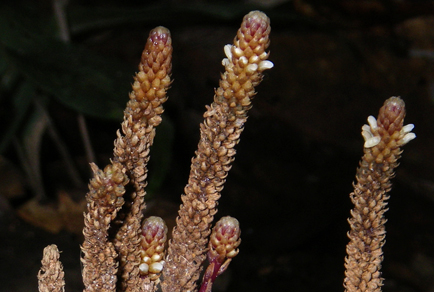
A taxonomic revision of Epirixanthes, the only mycoheterotrophic genus of Polygalaceae, is presented for Vietnam. Two species are recognized, of which E. elongata is known to be widely distributed across tropical Asia and E. kinabaluensis was considered endemic to Malesia prior to our study. Several nomenclatural inconsistencies are resolved for the names related to Epirixanthes. The original spelling of the generic name is confirmed as nomenclaturally correct because of being derived from conventional phonetic variants in Medieval Latin. Morphological descriptions of both Vietnamese species are significantly amended, reflecting novel data on the gross structure of their flowers and on intraspecific variation. For each species, the distinction from its most similar congener is summarized. Extensive illustrations of inflorescences and flowers of both species are provided; the inner structure of the intact flowers is illustrated with 3D images produced using X-ray microtomography.
References
- Anh, T.T.P., Quang, B.H., Nguyen, D.V., Nguyen, K.S., Sennikov, A.N. & Nuraliev, M.S. (2025) The genus Decaisnea in Vietnam, with a key to Vietnamese Lardizabalaceae. Phytotaxa 731 (3): 208–220. https://doi.org/10.11646/phytotaxa.731.3.2
- Aung, Y.L., Aung, M.H., Tan, Y. & Jin, X. (2025) An updated checklist of vascular plants of Myanmar. PhytoKeys 261: 135–164. https://doi.org/10.3897/phytokeys.261.154986
- Backer, C.A. & Bakhuizen van den Brink, R.C. (1963) Flora of Java, vol. 1. N.V.P. Noordhoff, Groningen, 648 pp.
- Ban, N.T. (2003) Polygalaceae R. Br. 1814. In: Ban, N.T. (Ed.) Checklist of plant species of Vietnam, vol. 2. Agriculture Publishing House, Hanoi, pp. 1050–1057. [in Vietnamese]
- Banerjee, R.N. (1993) Polygalaceae. In: Sharma, B.D. & Balakrishnan, N.P. (Eds.) Flora of India, vol. 2. Botanical Survey of India, Calcutta, pp. 450–499.
- Bello, M.A., Hawkins, J.A. & Rudall, P.J. (2010) Floral ontogeny in Polygalaceae and its bearing on the homologies of keeled flowers in Fabales. International Journal of Plant Sciences 171 (5): 482–498. https://doi.org/10.1086/651945
- Bennett, A.W. (1872) Order XVI. Polygaleae. In: Hooker, J.D. (Ed.) The flora of British India, vol. 1. L. Reeve & Co, London, pp. 200–211.
- Bentham, G. & Hooker, J.D. (1862) Genera plantarum: ad exemplaria imprimis in herberiis Kewensibus servata definita, vol. 1. Reeve & Co., London, pp. 1–454. https://doi.org/10.5962/bhl.title.747
- Blume, C.L. (1823) Catalogus van eenige der merkwaardigste zoo in- als uit-heemsche gewassen, te vinden in ‘s lands plantentuin te Buitenzorg. Ter Lands Drukkery, Batavia [Jakarta], 112 pp.
- Blume, C.L. (1828) Flora Javae nec non insularum adjacentium, vol. 1. Libraria J. Frank, Bruxellis [Brussels], 196 pp. https://doi.org/10.5962/bhl.title.48445
- Chen, S.K. (1983) Polygalaceae. In: Wu, C.Y. & Li, H.W. (Eds.) Flora Yunnanica, vol. 3. Science Press, Beijing, pp. 261–293. [in Chinese]
- Chen, S.K. (1997) Polygalaceae. In: Chen, S.K. (Ed.) Flora Reipublicae Popularis Sinicae, vol. 43 (3). Science Press, Beijing, pp. 132–203. [in Chinese]
- Chen, S.K., Ma, H.Y. & Parnell, J.A.N. (2008) Polygalaceae. In: Wu, Z.Y. & Raven, P.H. (Eds.) Flora of China, vol. 11. Science Press, Beijing: & Missouri Botanical Garden Press, St. Louis, pp. 139–159.
- Chodat, R. (1896) Polygalaceae. In: Engler, A. & Prantl, K. (Eds.) Die Natürlichen Pflanzenfamilien, vol. 3 (4). W. Engelmann, Leipzig, pp. 323–345.
- Chun, W.Y. (1964) Polygalaceae. In: Chun, W.Y. (Ed.) Flora Hainanica, vol. 1. Science Press, Beijing, pp. 362–369. [in Chinese]
- Dančák, M., Hroneš, M., Sukri, R.S., Metali, F. & Joffre, A.A. (2017) Novitates bruneienses, 9. A synopsis of Epirixanthes (Polygalaceae) in Brunei Darussalam and notes on species elsewhere. Gardens’ Bulletin Singapore 69 (2): 179–187. https://doi.org/10.26492/gbs69(2).2017-03
- Dinkova-Bruun, G. (2011) Medieval Latin. In: Clackson, J. (Ed.) A companion to the Latin Language. Wiley-Blackwell, Malden, pp. 284–302. https://doi.org/10.1002/9781444343397.ch17
- Endlicher, S. (1839) Genera Plantarum secundum Ordines Naturales disposita. S. Beck, Vindobona [Vienna], 1483 pp. https://doi.org/10.5962/bhl.title.728
- Eriksen, B. & Persson, C. (2007) Polygalaceae. In: Kubitzki, K. (Ed.) The families and genera of vascular plants, vol. 9. Springer, Berlin, pp. 345–363. https://doi.org/10.1007/978-3-540-32219-1
- Gagnepain, F. (1909a) Nouveautés asiatiques de l'herbier du Muséum. Bulletin de la Société Botanique de France 56 (1): 15–22. https://doi.org/10.1080/00378941.1909.10831360
- Gagnepain, F. (1909b) Polygalacées. In: Lecomte, H. (Ed.) Flore générale de l’Indo-Chine, vol. 1. Masson et Cie, Paris, pp. 247–262.
- Griffith, W. (1845a) On the root-parasites referred by authors to Rhizantheae, and their allies [end]. Proceedings of the Linnean Society of London 1 (23): 221.
- Griffith, W. (1845b) On the root-parasites referred by authors to Rhizantheae, and their allies. Annals and Magazine of Natural History 15 (97): 190–195. https://doi.org/10.1080/037454809495293
- Griffith, W. (1845c) On the root-parasites referred by authors to Rhizantheae, and on various plants related to them. Transactions of the Linnean Society of London os-19 (4): 303–347. https://doi.org/10.1111/j.1096-3642.1842.tb00369.x
- Griffith, W. (1848) Itinerary notes of plants collected in the Khasyah and Bootan mountains, 1837–38, in Affghanisthan and neighbouring countries, 1839 to 1841. J.F. Bellamy, Calcutta, 435 pp. https://doi.org/10.5962/bhl.title.70351
- Griffith, W. (1854) Posthumous papers bequeathed to the Honourable, the East India Company, and printed by order of the Government of Bengal. Notulae ad plantas Asiaticas. Part 4. Dicotyledonous plants. Charles A. Serrao, Calcutta, 764 pp.
- Hasskarl, I.C. (1863) Polygalaceae, praesertim Indicae. Annales Musei Botanici Lugduno-Batavi 1: 142–196.
- Ho, P.H. (2003) An illustrated flora of Vietnam, vol. 2. Youth Publishing House, Ho Chi Minh City, 982 pp. [in Vietnamese]
- Hooker, J.D. (1860) XIV. Illustrations of the floras of the Malayan Archipelago and of Tropical Africa. Transactions of the Linnean Society of London 23 (1): 155–172. https://doi.org/10.1111/j.1096-3642.1860.tb00128.x
- Hsieh, C.F., Hsieh, T.H. & Lai, I.L. (1995) Epirixanthes elongata Bl.—a new record to the flora of Taiwan. Taiwania 40 (4): 381–384. https://doi.org/10.6165/tai.1995.40.381
- Huang, S.M. (1991) Polygalaceae. In: Wu, T.L. (Ed.) Flora of Guangdong, vol. 2. Guangdong Science and Technology Press, Guangzhou, pp. 49–62. [in Chinese]
- Imhof, S. (2007) Specialized mycorrhizal colonization pattern in achlorophyllous Epirixanthes spp. (Polygalaceae). Plant Biology 9 (6): 786–792. https://doi.org/10.1055/s-2007-965613
- Jayanthi, J., Karthigeyan, K. & Sumathi, R. (2012) Epirixanthes Blume – a new genus addition to the mycoheterotrophic flora of Andaman & Nicobar Islands, India. Indian Journal of Forestry 35: 273–274. https://doi.org/10.54207/bsmps1000-2012-0TIGD1
- Joseph, J. (1970) Notes on some rare plants from Nongpoh, K. and J. Hills, Meghalaya. Bulletin of the Botanical Survey of India 12 (1–4): 73–76. https://doi.org/10.20324/nelumbo/v12/1970/75805
- King, G. (1890) Materials for a flora of the Malayan Peninsula. The Journal of the Asiatic Society of Bengal 59 part 2: 113–206.
- Koorders, S.H. (1912) Exkursionsflora von Java, vol. 2. G. Fischer, Jena.
- Kress, W.J., DeFilipps, R.A., Farr, E. & Kyi, D.Y.Y. (2003) A checklist of the trees, shrubs, herbs and climbers of Myanmar. Contributions from the United States National Herbarium 45: 1–590.
- Kundu, S.R. (2009) A synopsis of Polygalaceae in Indian Subcontinent: its distribution and endemism. Acta Botanica Venezuelica 32 (1): 63–77.
- Ling, C.Y., Tsukaya, H. & Mustapeng, A.M.A. (2019) Mycoheterotrophic plants of Tama Abu Protected Forest, Ulu Baram, Sarawak. Transactions on Science and Technology 6 (1–2): 119–126.
- Linnaeus, C. (1753) Species plantarum. L. Salvius, Holmia [Stockholm], 1200 pp. https://doi.org/10.5962/bhl.title.669
- Liu, X.X. (1987) Polygalaceae. In: Flora Fujianica Editorial Group (Eds.) Flora Fujianica, vol. 3. Fujian Science and Technology Press, Fuzhou, pp. 157–165. [in Chinese]
- Loureiro, J. (1790) Flora Cochinchinensis: sistens plantas in regno Cochinchina nascentes, vol. 1. Academia das Ciências de Lisboa, Ulyssipo [Lisbon], 353 pp. https://doi.org/10.5962/bhl.title.40199
- Meisner, C.F. (1841) Plantarum vascularium genera: secundum Ordines Naturales digesta eorumque differentiae et affinitates tabulis diagnosticis expositae. Libraria Weidmannia, Lipsia [Leipzig], 401 pp. https://doi.org/10.5962/bhl.title.44043
- Mennes, C.B., Moerland, M.S., Rath, M., Smets, E.F. & Merckx, V.S.F.T. (2015) Evolution of mycoheterotrophy in Polygalaceae: The case of Epirixanthes. American Journal of Botany 102 (4): 598–608. https://doi.org/10.3732/ajb.1400549
- Merckx, V.S.F.T., Freudenstein, J.V., Kissling, J., Christenhusz, M.J.M., Stotler, R.E., Crandall-Stotler, B., Wickett, N., Rudall, P.J., Maasvan de Kamer, H. & Maas, P.J.M. (2013) Taxonomy and classification. In: Merckx, V.S.F.T. (Ed.) Mycoheterotrophy: The biology of plants living on fungi. Springer, New York, pp. 19–101. https://doi.org/10.1007/978-1-4614-5209-6_2
- Merrill, E.D. (1918) Notes on the flora of Loh Fau Mountain, Kwangtung Province, China. The Philippine Journal of Science 13: 123–161.
- Merrill, E.D. & Chun, W.Y. (1935) Additions to our knowledge of the Hainan flora II. Sunyatsenia 2 (3–4): 203–332.
- Miller, P. (1768) Gardener’s dictionary, ed. 8. Printed for the author, London. https://doi.org/10.5962/bhl.title.541
- Mueller, C. (1868) Annales botanices systematicae [Walpers], vol. 7. Ambrosius Abel, Lipsia [Leipzig], 960 pp. https://doi.org/10.5962/bhl.title.7556
- Newman, M., Ketphanh, S., Svengsuksa, B., Thomas, P., Sengdala, K., Lamxay, V. & Armstrong, K. (2007) A checklist of the vascular plants of Lao PDR. Royal Botanic Garden Edinburgh, Edinburgh, 394 pp.
- Nuraliev, M.S., Schori, M., Tagane, S., Kuznetsov, A.N., Kuznetsova, S.P. & Utteridge, T.M. (2022) Citronella suaveolens, a new generic record for Vietnam, with a key to Vietnamese Cardiopteridaceae. Phytotaxa 532 (1): 67–77. https://doi.org/10.11646/phytotaxa.532.1.5
- Pendry, C.A. (2001) Polygalaceae. In: Santisuk, T. & Larsen, K. (Eds.) Flora of Thailand, vol. 7, part 3. The Forest Herbarium, Royal Forest Department, Bangkok, pp. 498–538.
- Pendry, C.A. (2010) Epirixanthes compressa Pendry, a new mycoheterotrophic species of Polygalaceae from Thailand. Thai Forest Bulletin (Botany) 38: 184–186.
- Pendry, C.A. (2014) Polygalaceae. In: Newman, M. & Hul, S. (Eds.) Flora of Cambodia, Laos and Vietnam, vol. 34. Royal Botanical Garden Edinburgh, Edinburgh and Muséum National d’Histoire Naturelle, Paris, pp. 1–63.
- Penzig, O. (1901) Beiträge zur Kenntniss der Gattung Epirrhizanthes Bl. Annales du Jardin Botanique de Buitenzorg 17: 142–170.
- Pilger, R. (1908) Polygalaceae. In: Engler, A. & Prantl, K. (Eds.) Die Natürlichen Pflanzenfamilien. Ergänzungshefte II, Nachtr. 3. W. Engelmann, Leipzig, pp. 190.
- Qin, Y., Mou, G. & Liu, Y. (2018) A newly recorded genus of Polygalaceae from Guangxi, China. Journal of Guangxi Normal University (Natural Science Edition) 36 (1): 126–128. [in Chinese] https://doi.org/10.16088/j.issn.1001-6600.2018.01.018
- Reuter, G.F. (1847) Ordo Orobanchaceae. In: De Candolle, A. (Ed.) Prodromus systematis universalis regni vegetabilis, vol. 11. V. Masson, Paris, pp. 1–45.
- Rickett, H.W. (1954) On orthographic changes. Taxon 3 (5): 138–140. https://doi.org/10.2307/1217324
- Ridley, H.N. (1922) The flora of the Malay Peninsula, vol. 1. Polypetalae. L. Reeve & Co., Ltd., London, 912 pp. https://doi.org/10.5962/bhl.title.10921
- Sennikov, A.N. & Belyaeva, I.V. (2025) Correctable or not? The case of plant epithets derived from the Elbrus/Elburs Mountains in Iran, with further notes on taxonomic grey literature. Taxon. https://doi.org/10.1002/tax.70064
- Smitinand, T. (1955) Some noteworthy plants from Thailand (Siam). Thai Forest Bulletin (Botany) 2: 1–35.
- Sokoloff, D.D., Remizowa, M.V., Severova, E.E. & Sennikov, A.N. (2023) Inference of ploidy level in 19th-century historical herbarium specimens reveals the identity of five Acorus species described by Schott. Diversity 15 (6): e766. [1–22] https://doi.org/10.3390/d15060766
- Stotz, P. (1996) Handbuch zur lateinischen Sprache des Mittelalters, Bd. 3. Lautlehre. Beck, München, 352 pp.
- Tan, K. (1991) Family 91. Polygalaceae. In: Grierson, A.J.C. & Long, D.G. (Eds.) Flora of Bhutan, vol. 2, part 1. Royal Botanic Garden, Edinburgh, pp. 42–52.
- Thiers, B. (2026 [continuously updated]) Index Herbariorum: A global directory of public herbaria and associated staff. New York Botanical Garden’s Virtual Herbarium. Available from: http://sweetgum.nybg.org/science/ih/ (accessed 19 January 2026)
- Tsukaya, H. & Okada, H. (2012) A color variation of Epirixanthes species (Polygalaceae) found in West Kalimantan, Borneo, Indonesia. Acta Phytotaxonomica et Geobotanica 62 (2/3): 95–97. https://doi.org/10.18942/apg.KJ00008111421
- Tsukaya, H., Suleiman, M. & Okada, H. (2016) A new species of Epirixanthes (Polygalaceaea) from Imbak Canyon, Sabah, Borneo. Phytotaxa 266 (2): 146–150. https://doi.org/10.11646/phytotaxa.266.2.9
- Turland, N.J., Wiersema, J.H., Barrie, F.R., Gandhi, K.N., Gravendyck, J., Greuter, W., Hawksworth, D.L., Herendeen, P.S., Klopper, R.R., Knapp, S., Kusber, W.-H., Li, D.Z., May, T.W., Monro, A.M., Prado, J., Price, M.J., Smith, G.F. & Zamora Señoret, J.C. (2025) International Code of nomenclature for algae, fungi, and plants (Madrid Code). Regnum Vegetabile 162. University of Chicago Press, Chicago. https://doi.org/10.7208/chicago/9780226839479.001.0001
- van der Meijden, R. (1988) Polygalaceae. In: van Steenis, C.G.G.J. & de Wilde, W.J.J.O. (Eds.) Flora Malesiana, vol. 10, part 3. Kluwer, Dordrecht, pp. 455–539.
- Vietnam Administrative Atlas (2015) Vietnam Administrative Atlas. Vietnam Publishing House of Natural Resources, Environment and Cartography, Hanoi, 131 pp.
- Walpers, W.G. (1844) Repertorium botanices systematicae, vol. 3. F. Hofmeister, Lipsia [Leipzig], 1002 pp. https://doi.org/10.5962/bhl.title.7553
- Wirz, H. (1910) Beiträge zur Entwicklungsgeschichte von Sciaphila spec. und von Epirrhizanthes elongata Bl. Flora 101 (4): 395–446. https://doi.org/10.1016/S0367-1615(17)32327-3
- Wu, J.Y., Tzeng, H.Y. & Aleck Yang, T.Y. (2025) Taxonomic revision of Polygalaceae (Fabales) in Taiwan. PhytoKeys 262: 73–103. https://doi.org/10.3897/phytokeys.262.162234
- Xia, N.H. (2008) Polygalaceae. In: Hong Kong Herbarium and South China Botanical Garden (Eds.) Flora of Hong Kong, vol. 2. Agriculture, Fisheries and Conservation Department, Government of the Hong Kong Special Administrative Region, Hong Kong, pp. 251–255.
- Yudina, S.V., Logacheva, M.D., Lyskov, D.F., Dančák, M., Hroneš, M., Pendry, C., Tsukaya, H., Schelkunov, M.I., Kopylov-Guskov, Y.O., Tagane, S., Le, T.A., Jaafar, S., Sukri, R.S. & Nuraliev, M.S. (2026) Phylogeny, morphological evolution and taxonomic diversity of the mycoheterotrophic genus Epirixanthes (Polygalaceae). Botanical Journal of the Linnean Society. https://doi.org/10.1093/botlinnean/boag020