

Abstract
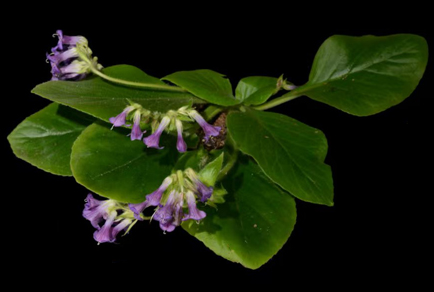
Primulina lipuensis, a new cave-dwelling species from limestone areas of Guangxi, China, is described and illustrated here. It is morphologically similar to P. guihaiensis (Y.G.Wei, B.Pan & W.X.Tang) Mich.Möller & A.Weber, but can be distinguished by multiple morphological characters, particularly in the number of staminodes and the shape of the stigma. Furthermore, phylogenetic analyses based on nrITS and trnL-F sequences indicate that P. lipuensis is distantly related to P. guihaiensis, supporting the recognition of P. lipuensis as a distinct new species. According to IUCN category and criteria, it is accessed to be Vulnerable (VU D2).
References
- Chen, D.Y., Zeng, X.H., Cai, W.L., Wu, X.G., Gao, Y.Y. & Xu, G.L. (2024) Primulina adenopoda (Gesneriaceae), a new species from the limestone karst area of Jiangxi Province, China. Taiwania 69 (1): 74–82. https://doi.org/10.6165/tai.2024.69.74
- Chen, W.H., Möller, M., Shui, Y.M., Wang, H., Yang, J.B. & Li, G.Y. (2014) Three new species of Petrocodon (Gesneriaceae), endemic to the limestone areas of southwest China, and preliminary insights into the diversification patterns of the genus. Systematic Botany 39 (1): 316–330. https://doi.org/10.1600/036364414X678189
- Ding, L., Ke, X.C. & Wen, F. (2024) A new lithophilous species of Gesneriaceae, Primulina jinyu, from the limestone area of Hubei Province, China. Taiwania 69 (2): 178–184. https://doi.org/10.6165/tai.2024.69.178
- Doyle, J.J. & Doyle, J.L. (1987) A rapid DNA isolation procedure for small quantities of fresh leaf material. Phytochemical Bulletin 19: 11–15.
- Fu, L.F., Monro, A.K. & Wei, Y.G. (2022) Cataloguing vascular plant diversity of karst caves in China. Biodiversity Science 30 (7): 21537. https://doi.org/10.17520/biods.2021537
- GRC (2026) Gesneriaceae Resource Centre. Royal Botanic Garden Edinburgh. Available from: https://padme.rbge.org.uk/GRC (accessed 28 January 2026)
- Gu, J.M., He, S.T., Wen, F., Bai, X.X. & Li, M.J. (2025) Primulina xingyiensis (Gesneriaceae), a new species in the karst landforms of Guizhou Province, China. PhytoKeys 251: 1–12. https://doi.org/10.3897/phytokeys.251.135126
- Hance, H.F. (1883) New Chinese Cyrtandreae. Journal of Botany 21: 165–170.
- IPNI (2026) International Plant Names Index. The Royal Botanic Gardens, Kew, Harvard University Herbaria & Libraries and Australian National Herbarium. Available from: http://www.ipni.org (accessed 28 January 2026)
- IUCN (2024) Guidelines for Using the IUCN Red List Categories and Criteria. Version 16. Prepared by the Standards and Petitions Committee. Available from: http://www.iucnredlist.org/documents/RedListGuidelines.pdf (accessed 11 June 2026)
- Kalyaanamoorthy, S., Minh, B.Q., Wong, T.K.F., von Haeseler, A. & Jermiin, L.S. (2017) ModelFinder: fast model selection for accurate phylogenetic estimates. Nature methods 14 (6): 587–589. https://doi.org/10.1038/nmeth.4285
- Lai, B.D., Huang, Y.Q., Shi, M.J., Deng, Z.Y. & Wen, F. (2025) Primulina aureipurpurea (Gesneriaceae), a new species from Guangxi Zhuang Autonomous Region, China. PhytoKeys 257: 125–133. https://doi.org/10.3897/phytokeys.257.155007
- Li, S., Xin, Z.B., Chou, W.C., Huang, Y., Pan, B., Maciejewski, S. & Wen, F. (2019) Five new species of the genus Primulina (Gesneriaceae) from Limestone Areas of Guangxi Zhuangzu Autonomous Region, China. PhytoKeys 127: 77–91. https://doi.org/10.3897/phytokeys.127.35445
- Liu, K., Mou, C., Lv, H., Ge, Y.Z. & Wen, F. (2025) Primulina yangmingshanensis (Gesneriaceae), a new species from Hunan province, China. Taiwania 70 (1): 75–80. https://doi.org/10.6165/tai.2025.70.75
- Long, S.T., Xin, Z.B., Maciejewski, S. & Fu, L.F. (2025) Primulina minima, a new species of cave-dwelling Gesneriaceae from the karst landscape of northwestern Guangxi, China. Phytotaxa 696 (4): 294–299. https://doi.org/10.11646/phytotaxa.696.4.4
- Luo, J.C., Li, Y.Q., Li, Y., She, M.Z., Zeng, Y.J., Wang, F.G. & Chen, H.F. (2025) Primulina nanlingensis (Gesneriaceae), a new species from the Limestone Karst of Guangdong, China. PhytoKeys 254: 99–111. https://doi.org/10.3897/phytokeys.254.145138
- Ma, W.Q., Shen, L., Chou, W.C., Chen, T.R. & Wen, F. (2025) Primulina longanica sp. nov. (Gesneriaceae) from a limestone area of Guangxi, China. Taiwania 70 (4): 639–645. https://doi.org/10.6165/tai.2025.70.639
- Möller, M. (2019) Species discovery in time: an example from Gesneriaceae in China. Guangxi Sciences 26 (1): 1–16. https://doi.org/10.13656/j.cnki.gxkx.20190307.002
- Monro, A.K., Bystriakova, N., Fu, L.F., Wen, F. & Wei, Y.G. (2018) Discovery of a diverse cave flora in China. PLoS ONE 13 (2): e0190801. https://doi.org/10.1371/journal.pone.0190801
- Nguyen, L.T., Schmidt, H.A., Von Haeseler, A. & Minh, B.Q. (2015) IQ-TREE: a fast and effective stochastic algorithm for estimating maximum-likelihood phylogenies. Molecular biology and evolution 32 (1): 268–274. https://doi.org/10.1093/molbev/msu300
- Ronquist, F., Teslenko, M., van der Mark, P., Ayres, D.L., Darling, A., Höhna, S., Larget, B., Liu, L., Suchard, M.A. & Huelsenbeck, J.P. (2012) MrBayes 3.2: efficient Bayesian phylogenetic inference and model choice across a large model space. Systematic biology 61 (3): 539–542. https://doi.org/10.1093/sysbio/sys029
- Swofford, D.L. (2002) PAUP*: Phylogenetic Analysis Using Parsimony (* and other Methods). Version 4. Sinauer Associates, Sunderland.
- Taberlet, P., Gielly, L., Pautou, G. & Bouvet, J. (1991) Universal primers for amplification of three non-coding regions of chloroplast DNA. Plant Molecular Biology 17: 1105–1109. https://doi.org/10.1007/BF00037152
- Tan, K., Ning, Y., Wang, R.F., Wang, Q., Liang, D.P., Xin, Z.B. & Wen, F. (2025) A dataset on the checklist and geographical distribution of Gesneriaceae in China. Biodiversity Science 33: 23275. https://doi.org/10.17520/biods.2023275
- Wang, W.T., Pan, K.Y. & Li, K.Y. (1990) Gesneriaceae. In: Wang, W.T. (Ed.) Flora Reipublicae Popularis Sinicae, Vol. 69. Science Press, Beijing, pp. 141–271.
- Wang, W.T., Pan, K.Y., Li, Z.Y., Weitzman, A.L. & Skog, L.E. (1998) Gesneriaceae. In: Wu, Z.Y. & Raven, P.H. (Eds.) Flora of China, Vol. 18. Science Press, Beijing & Missouri Botanical Garden Press, St. Louis, pp. 254–401.
- Weber, A., Middleton, D.J., Forrest, A., Kiew, R., Lim, C.L., Rafidah, A.R., Sontag, S., Triboun, P., Wei, Y.G., Yao, T.L. & Möller, M. (2011a) Molecular systematics and remodeling of Chirita and associated genera (Gesneriaceae). Taxon 60 (3): 767–790. https://doi.org/10.1002/tax.603012
- Weber, A., Wei, Y.G., Puglisi, C., Wen, F., Mayer, V. & Möller, M. (2011b) A new definition of the genus Petrocodon (Gesneriaceae). Phytotaxa 23: 49–67. https://doi.org/10.11646/phytotaxa.23.1.3
- Wei, Y.G. (2006) A new species of Lagarosolen WT Wang (Gesneriaceae) from Guangxi province, China. Kew Bulletin 61 (2): 273–275.
- Wei, Y.G. (2018) The Distribution and Conservation Status of Native Plants in Guangxi, China. China Forestry Publishing House, Beijing.
- Wei, Y.G. (2023) Catalogue and Red List of Plant Species in Guangxi. China Forestry Publishing House, Beijing.
- Wei, Y.G., Fu, L.F., Monro, A.K. & Wen, F. (2025) Karst Cave Plants in China. China Forestry Publishing House, Beijing.
- Wei, Y.G., Pan, B. & Tang, W.X. (2008) Chirita guihaiensis sp. nov. (Gesneriaceae) from Guangxi, China. Nordic Journal of Botany 25 (5-6): 296–298. https://doi.org/10.1111/j.0107-055X.2007.00182.x
- White, T.J., Bruns, T., Lee, S. & Taylor, J. (1990) Amplification and direct sequencing of fungal ribosomal RNA genes for phylogenetics. In: Innis, M., Gelfand, D., Sninsky, J. & White, T. (Eds.) PCR protocols: A guide to methods and applications. Academic Press, San Diego, pp. 315–322. https://doi.org/10.1016/B978-0-12-372180-8.50042-1
- Xu, M.Z., Yang, L.H., Kong, H.H., Wen, F. & Kang, M. (2021) Congruent spatial patterns of species richness and phylogenetic diversity in karst flora: Case study of Primulina (Gesneriaceae). Journal of Systematics and Evolution 59 (2): 251–261. https://doi.org/10.1111/jse.12558
- Zhang, D., Gao, F.L., Jakovlić, I., Zou, H., Zhang, J., Li, W.X. & Wang, G.T. (2020) PhyloSuite: An integrated and scalable desktop platform for streamlined molecular sequence data management and evolutionary phylogenetics studies. Molecular Ecology Resources 20 (1): 348–355. https://doi.org/10.1111/1755-0998.13096
- Xiang, C.Y., Gao, F.L., Jakovlić, I., Lei, H.P., Hu, Y., Zhang, H., Zou, H., Wang, G.T. & Zhang, D. (2023) Using PhyloSuite for molecular phylogeny and tree-based analyses. Imeta 2 (1): e87. https://doi.org/10.1002/imt2.87
- Zou, L.L., Wei, J., Fu, J.X., Pan, B. & Wen, F. (2025) Primulina quanzhouensis, a new species of Gesneriaceae from Guangxi, China. Phytotaxa 714 (4): 292–300. https://doi.org/10.11646/phytotaxa.714.4.4