
Abstract
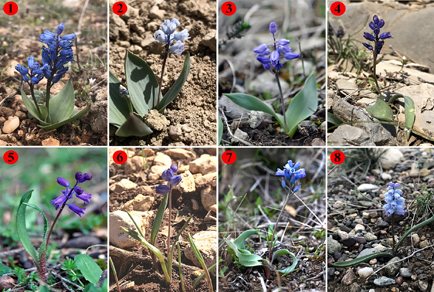
Plant systematics encompasses not only classical taxonomic tasks but also the study of biological processes, natural variation, speciation, and reproductive biology. Morphological, phytochemical, and molecular characteristics assessed relationships and cluster analysis of Hyacinthella species.The data obtained revealed 11 morphologically distinctive characters and the presence of 56 different phenolic compounds in leaf methanol extracts. Furthermore, 3 different phylogenetic regions were amplified for 11 Hyacinthella species. Based on Principal Component Analysis, the Unweighted Pair Group Method, and the Bayesian Inference method for DNA sequences, H. siirtensis and H. nervosa were closely positioned, which indicates geographical proximity. Presence of quinic acid in all species was considered a potential key indicator for Hyacinthella species. H. siirtensis and H. nervosa were found in proximity in both morphological and chemotaxonomic aspects. In the phylogenetic analysis, the regions were analysed both individually and in combination to form trees. In the matK phylogram, H. heldreichii, H. micrantha, H. siirtensis, and H. venusta were grouped . The species H. campanulata, H. nervosa, and H. siirtensis formed a group in the terminal part of the tree with a PP value of 0.98 in the combined tree. We aimed to combine accurate and reliable diagnostic methods by analyzing different distinguishing characteristics. Our findings underscore the importance of integrating morphological, chemotaxonomic, phylogenetic data for comprehensive and accurate diagnostic studies. Ideally, a description should be as comprehensive as possible.
References
- Alfarhan, A.H., Al-Turki, T.A. & Basahy, A.Y. (2005) Flora of Jizan region. Final Report Supported by King Abdulaziz City. Science and Technology 1 (2): 545.
- Arslan, E. (2004) RAPD-PCR yöntemiyle Türkiye’deki Hyacinthella Schur (Liliaceae) türleri arasındaki polimorfizm ve filogenetik ilişkilerin belirlenmesi. Selçuk Üniversitesi Fen Edebiyat Fakültesi Fen Dergisi 23: 27–32.
- Atayer, E. (2007) Bazı endemik Hyacinthella Schur (Liliaceae) taksonlarının morfolojik ve anatomik özellikleri. Ms Thesis, Konya.
- Aydın, Ç. & Mammadov, R. (2017) Phenolic composition, antioxidant, antibacterial, larvacidal against Culex pipiens, and cytotoxic activities of Hyacinthella lineata s teudel extracts. International Journal of Food Properties 20 (10): 2276–2285. https://doi.org/10.1080/10942912.2016.1236271
- Bandaranayake, P.C., Naranpanawa, N., Chandrasekara, C.B., Samarakoon, H., Lokuge, S., Jayasundara, S. & Wijesundara, D.S.A. (2023) Chloroplast genome, nuclear ITS regions, mitogenome regions, and Skmer analysis resolved the genetic relationship among Cinnamomum species in Sri Lanka. Plos one 18 (9): e0291763. https://doi.org/10.1371/journal.pone.0291763
- Bhargava, V.V., Patel, S.C. & Desai, K.S. (2013) Importance of terpenoids and essential oils in chemotaxonomic approach. International Journal of Herbal Medicine 1 (2): 14–21.
- Chase, M.W. & Reveal, J.L. (2009) A phylogenetic classification of the land plants to accompany APG III. Botanical Journal of the Linnean Society 161: 122–127. https://doi.org/10.1111/j.1095-8339.2009.01002.x
- Chouard, M.P. (1931) Révision de quelques genres et sous-genres de Liliacées bulbeuses d’aprés le développement l’appareil végetatif (Scilla, Endymion, Hyacinthus). Bulletin du Museìum national D’histoire Natürelle 2: 176–180.
- Dane, F. (2006) Cytological and histological studies on reproductive system of hexaploid Bellevalia edirnensis Özhatay & Mathew (Hyacinthaceae). Acta Biologica Hungarica 57 (3): 339–354.
- Darriba, D., Posada, D., Kozlov, A.M., Stamatakis, A., Morel, B. & Flouri, T. (2020) ModelTest-NG: A new and scalable tool for the selection of DNA and protein evolutionary models. Molecular Biology and Evolution 37: 291–294. https://doi.org/10.1093/molbev/msz189
- Dashwood, M. & Mathew, B. (2005) Hyacinthaceae-little blue bulbs. RHS Plant Trials and Awards. Bulletin Number 11. Royal Horticultural Society, Wisley.
- Demirci, K.S. (2024) Hyacinthella/Dağsümbülü. In: Güner, A., Kandemir, A., Menemen, Y., Yıldırım, H., Aslan, S., Çimen, A.Ö., Güner, I., Bona, G.E. & Gökmen, F.Ş. (Eds.) Resimli Türkiye Florası (Illustrated Flora of Türkiye), 4a. ANG Vakfı Nezahat Gökyiğit Botanik Bahçesi Yayınları, İstanbul, pp. 280–307.
- Ekim, T. (2012) Hyacinthella Schur. In: Güner, A., Aslan, S., Ekim, T., Vural, M. & Babaç, M.T. (Eds.) Türkiye bitkileri listesi (Damarlı Bitkiler). Nezahat Gökyiğit Botanik Bahçesi ve Flora Araştırmaları Derneği Yayını, İstanbul, pp. 97–98.
- Enke, N., Gemeinholzer, B. & Zidorn, C. (2012) Molecular and phytochemical systematics of the subtribe Hypochaeridinae (Asteraceae, Cichorieae). Organisms Diversity & Evolution 12: 1–16. https://doi.org/10.1007/s13127-011-0064-0
- Eroğlu, H., Karaismailoglu, M.C., Fidan, M. & Pinar, S.M. (2022) Seed morphological and anatomical structures as taxonomy tool for Turkish Hyacinthella Schur (Asparagaceae) Taxa. Phytotaxa 564 (2): 191–207. https://doi.org/10.11646/phytotaxa.564.2.3
- Fenzl, E. (1858) Delectus Seminum in Horto Botanico Universitatis Vindobonensis Collectorum. Vienna, pp. 4–12.
- Grundmann, M., Rumsey, F.J., Ansell, S.W., Russell, S.J., Darwin, S.C., Vogel, J.C. & Schneider, H. (2010) Phylogeny and taxonomy of the bluebell genus Hyacinthoides, Asparagaceae [Hyacinthaceae]. Taxon 59 (1): 68–82. https://doi.org/10.1002/tax.591008
- Haider, N. (2018) A brief review on plant taxonomy and its components. The Journal of Plant Science Research 34 (2): 277–292. https://doi.org/10.32381/JPSR.2018.34.02.17
- Hassemer, G., Prado, J. & Baldini, R.M. (2020) Diagnoses and descriptions in plant taxonomy. Taxon 69 (1): 1–4. https://doi.org/10.1002/tax.12200
- Hazzazi, Y., Sumayli, M., El-Shabasy, A., Al-Andal, A., Hanif, U. & Khamis, A. (2025) Morphological and chemotaxonomical characterization of some species of the genus Euphorbia L. in Jazan region, KSA. PLoS One 20 (11): e0335519. https://doi.org/10.1371/journal.pone.0335519
- Kiran, Y., Kılıç, S., Dogan, G., Eroğlu, H. & Pınar, S.M. (2024) Karyological investigation of four endemic Hyacinthella species from Turkey. Cytologıa 89 (1): 53–56. https://doi.org/10.1508/cytologia.89.53
- Legendre, P. & Legendre, L. (2012) Numerical Ecology. Elsevier, Amsterdam.
- Manning, J.C., Forest, F., Devey, D.S., Fay, M.F. & Goldblatt, P. (2009) A molecular phylogeny and a revised classification of Ornithogaloideae (Hyacinthaceae) based on an analysis of four plastid DNA regions. Taxon 58 (1): 77–107. https://doi.org/10.1002/tax.581011
- Mathew, B. (1973) A new Hyacinthella (Liliaceae) from Turkey. Kew Bulletin 28: 517–519. https://doi.org/10.2307/4108895
- Michener, C.D. & Sokal, R.R. (1957) A quantitative approach to a problem in classification. Evolution 11 (2): 130–162. https://doi.org/10.1111/j.1558-5646.1957.tb02884.x
- Miller, P. (1754) The Gardeners Dictionary. Ed. 4. London, pp. 926–929.
- Persson, K. & Persson, J. (1992) A new species and additional chromosome counts of Hyacinthella in Turkey. Nordic Journal of Botany 12 (6): 615–620. https://doi.org/10.1111/j.1756-1051.1992.tb01838.x
- Persson, K. & Wendelbo, P. (1981) Taxonomy and cytology of the genus Hyacinthella (Liliaceae—Scilloideae) with special reference to the species in S.W. Asia. Part I. Candollea 36: 513–541.
- Persson, K. & Wendelbo, P. (1984) Hyacinthella Schur. In: Davis, P.H. (Ed.) Flora of Turkey and the East Aegean Islands 8. Edinburgh University Press, Edinburgh, pp. 274–279.
- Persson, K. (2000) Two new bulbous species from the central Taurus mountains of Turkey. New Plantsman 7: 200–208.
- Pfosser, M., Knirsch, W., Pinter, M., Ali, S.S., Dutta, S. & Wetschnig, W. (2012) Phylogenetic relationships of Malagasy Hyacinthaceae. Plant Ecology and Evolution 145 (1): 65–72. https://doi.org/10.5091/plecevo.2012.590
- Pfosser, M., Wetschnig, W., Ungar, S. & Prenner, G. (2003) Phylogenetic relationships among genera of Massonieae (Hyacinthaceae) inferred from plastid DNA and seed morphology. Journal of Plant Research 116: 115–132. https://doi.org/10.1007/s10265-003-0076-8
- Puizina, J., Schneeweiss, H., Harand, A.P., Kamenjarin, J., Trinajstic, I., Riha, K. & Schweizer, D. (2003) Karyotype analysis in Hyacinthella dalmatica (Hyacinthaceae) reveals vertebrate-type telomere repeats at the chromosome ends. Genome 46: 1070–1076. https://doi.org/10.1139/g03-078
- Rambaut, A. (2010) FigTree v1.3.1. University of Edinburgh, Institute of Evolutionary Biology, Edinburgh.
- Rohlf, F.J. (1982) Consensus indices for comparing classifications. Mathematical Biosciences 59 (2): 131–144. https://doi.org/10.1016/0025-5564(82)90112-2
- Ronquist, F. & Huelsenbeck, J.P. (2003) MRBAYES 3: Bayesian phylogenetic inference under mixed models. Bioinformatics 19: 1572–1574. https://doi.org/10.1093/bioinformatics/btg180
- Schur, F. (1856) Zur Flora von Siebenbürgen. Österreichisches Botanisches Wochenblatt 6: 225–229. https://doi.org/10.1007/bf02073715
- Singh, R. (2018) Chemotaxonomy of medicinal plants: possibilities and limitations. In: Natural Products and Drug Discovery. Elsevier, pp. 119–136. https://doi.org/10.1016/B978-0-08-102081-4.00006-X
- Singh, R. (2016) Chemotaxonomy: A tool for plant classification. Journal of Medicinal Plant Studies 4 (2): 90–93.
- Stafleu, F.A. & Cowan, R.S. (1985) Taxonomic literature: a selective guide to botanical publications and collections with dates, commentaries and types. Vol. V: Sal–Ste. Edition 2. Bohn, Scheltema and Holkema, Utrecht. https://doi.org/10.5962/t.206494
- Şahin, A. & Eroğlu, H. (2022) Pollen morphology of the genus Hyacinthella (Asparagaceae) and Muscari azureum in Türkiye. Phytotaxa 564 (1): 39–58. https://doi.org/10.11646/phytotaxa.564.1.3
- Tamura, K., Stecher, G., Peterson, D., Filipski, A.M. & Kumar, S. (2013) MEGA 6: Molecular evolutionary genetics analysis version 6.0. Molecular Biology Evolution 30 (12): 2725–2729. https://doi.org/10.1093/molbev/mst197
- Wink, M. (2003) Evolution of secondary metabolites from an ecological and molecular phylogenetic perspective. Phytochemistry 64: 3–19. https://doi.org/10.1016/S0031-9422(03)00300-5
- Wold, S., Esbensen, K. & Geladi, P. (1987) Principal component analysis. Chemometrics and Intelligent Laboratory Systems 2 (1–3): 37–52. https://doi.org/10.1016/0169-7439(87)80084-9
- World Flora Online (2025) Available from: http://www.worldfloraonline.org/ (accessed 21 February 2025)
- Yilmaz, M.A. (2020) Simultaneous quantitative screening of 53 phytochemicals in 33 species of medicinal and aromatic plants: A detailed, robust and comprehensive LC–MS/MS method validation. Industrial Crops and Products 149: 112347. https://doi.org/10.1016/j.indcrop.2020.112347
- Zidorn, C. (2019) Plant chemophenetics—A new term for plant chemosystematics/plant chemotaxonomy in the macro-molecular era. Phytochemistry 163: 147–148. https://doi.org/10.1016/j.phytochem.2019.02.013