
Abstract
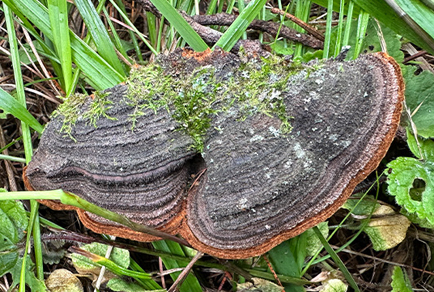
Porodaedalea species cause white rot on coniferous trees and show clear host preferences, with a broad distribution across Northern Hemisphere. In this study, a new species, Porodaedalea tabuliformis, is described from Qinling Mountain, Shaanxi Province, China, representing the first record of this genus on the plant Pinus tabuliformis. The species is characterized by larger pores (2–3 per mm), broadly ellipsoid basidiospores. Phylogenetic analyses suggested that it formed a distinct lineage closely related to P. chinensis, P. schrenkianae, and P. yunnanensis based on the ITS, nLSU, rpb2, and tef1-α sequences. To date, a total of 20 species has been recognized in Porodaedalea, and an updated key to the taxa of Porodaedalea is provided in this study.
References
- Anonymous. (1969) Flora of British fungi. Colour identification chart. Her Majesty’s Stationery Office, London, pp. 1–3.
- Aqdus, F. & Khalid, A.N. (2021) Porodaedalea indica (Hymenochaetaceae, Hymenochaetales), a new record for Pakistan. Nova Hedwigia 113: 151–159. https://doi.org/10.1127/nova_hedwigia/2021/0639
- Bashir, H., Jabeen, S. & Khalid, A.N. (2021) Porodaedalea himalayensis and P. indica from Pakistan. Nova Hedwigia 113: 339–351. https://doi.org/10.1127/nova_hedwigia/2021/0651
- Brazee, N.J. & Lindner, D.L. (2013) Unravelling the Phellinus pini s.l. complex in North America: a multilocus phylogeny and differentiation analysis of Porodaedalea. Forest Pathology 42: 132–143. https://doi.org/10.1111/efp.12008
- Cui, Y.J., Wang, C.G., Dai, Y.C., Liu, S., Ren, Y.H., Schultes, N.P., Kaishian, P.O., Paine, E., Yuan, Y., Li, D.E. & Zhao, H. (2025) Phylogeny, divergence times, and biogeography of the phytopathogenic fungal genus Phaeolus (Basidiomycota, Polyporales). Journal of Systematics and Evolution 64 (1): 4–14. https://doi.org/10.1111/jse.13187
- Dai, S.J., Vlasák, J. & Wu, F. (2017) Porodaedalea chinensis (Hymenochaetaceae, Basidiomycota)—a new polypore from China. Mycosphere 8 (6): 986–993. https://doi.org/10.5943/mycosphere/8/6/1
- Dai, Y.C. (2010) Hymenochaetaceae (Basidiomycota) in China. Fungal Diversity 45: 131–343. https://doi.org/10.1007/s13225-010-0066-9
- Dai, Y.C., Yang, Z.L., Cui, B.K., Wu, G., Yuan, H.S., Zhou, L.W., He, S.H., Ge, Z.W., Wu, F., Wei, Y.L., Yuan, Y. & Si, J. (2021) Diversity and systematics of the important macrofungi in Chinese forests. Mycosystema 40: 770–805. https://doi.org/10.13346/j.mycosystema.210036
- Darriba, D., Posada, D., Kozlov, A.M., Stamatakis, A., Morel, B. & Flouri, T. (2020) ModelTest‐NG: A new and scalable tool for the selection of DNA and protein evolutionary models. Molecular Biology and Evolution 37: 291–294. https://doi.org/10.1093/molbev/msz189
- Fischer, M. (1994) Pairing tests in the Phellinus pini group. Mycologia 86: 524–539. https://doi.org/10.1080/00275514.1994.12026446
- Gilbertson, R.L. & Ryvarden, L. (1987) North American polypores. Fungiflora, Oslo, Norway, pp. 1–448.
- Katoh, K. & Standley, D.M. (2013) MAFFT multiple sequence alignment software version 7: improvements in performance and usability. Molecular Biology and Evolution 30: 772–780. https://doi.org/10.1093/molbev/mst010
- Matheny, P.B. (2005) Improving phylogenetic inference of mushrooms with RPB1 and RPB2 nucleotide sequences (Inocybe, Agaricales). Molecular Phylogenetics and Evolution 35: 1–20. https://doi.org/10.1016/j.ympev.2004.11.014
- Niemelä, T., Kinnunen, J., Larsson, K.H., Schigel, D.S. & Larsson, E. (2005) Genus revisions and new combinations of some North European polypores. Karstenia 45: 75–80. https://doi.org/10.29203/ka.2005.406
- Petersen, J.H. (1996) The Danish Mycological Society´s colour-chart. Foreningen til Svampekundskabens Fremme, Greve, pp. 1–6.
- Rehner, S.A. & Buckley, E. (2005) A Beauveria phylogeny inferred from nuclear ITS and EF1–alpha sequences: evidence for cryptic diversification and links to Cordyceps teleomorphs. Mycologia 97: 84–98. https://doi.org/10.3852/mycologia.97.1.84
- Ronquist, F., Teslenko, M., Van Der Mark, P., Ayres, D.L., Darling, A., Höhna, S., Larget, B., Liu, L., Suchard, M.A. & Huelsenbeck, J.P. (2012) MrBayes 3.2: efficient Bayesian phylogenetic inference and model choice across a large model space. Systematic Biology 61 (3): 539–542. https://doi.org/10.1093/sysbio/sys029
- Ryvarden, L. & Gilbertson, R.L. (1994) European polypores 2. Synopsis Fungorum 6–7: 1–743.
- Ryvarden, L. & Melo, I. (2014) Poroid fungi of Europe. Synopsis Fungorum 31: 1–455.
- Stamatakis, A. (2014) RAxML version 8: A tool for phylogenetic analysis and post‐analysis of large phylogenies. Bioinformatics 30: 1312–1313. https://doi.org/10.1093/bioinformatics/btu033
- Tomšovský, M. & Kout, J. (2013) Porodaedalea cedrina (Basidiomycota, Agaricomycetes, Hymenochaetales): a new polypore from the Mediterranean area. Nova Hedwigia 96: 419–426. https://doi.org/10.1127/0029-5035/2013/0087
- Tomšovský, M., Sedlák, P. & Jankovský, L. (2010a) Species recognition and phylogenetic relationships of European Porodaedalea (Basidiomycota, Hymenochaetales). Mycological Progress 9: 225–233. https://doi.org/10.1007/s11557-009-0628-y
- Wanger, T. & Fischer, M. (2001) Natural groups and a revised system for the European poroid Hymenochaetales (Basidiomycota) supported by nLSU rDNA sequence data. Mycological Research 105 (7): 773–782. https://doi.org/10.1017/S0953756201004257
- White, T.J., Bruns, T., Lee, S. & Taylor, J. (1990) Amplification and direct sequencing of fungal ribosomal RNA genes for phylogenetics. In: Innis, M.A., Gelfand, D.H., Sninsky, J.J. & White, T.J. (Eds.) PCR protocols, a guide to methods and applications. Academic Press, New York, pp. 315–322. https://doi.org/10.1016/b978-0-12-372180-8.50042-1
- Wu, F., Dai, S.J., Vlasák, J., Spirin, V. & Dai, Y.C. (2019) Phylogeny and global diversity of Porodaedalea, a genus of gymnosperm pathogens in the Hymenochaetales. Mycologia 111: 40–53. https://doi.org/10.1080/00275514.2018.1526618
- Wu, F., Zhou, L.W., Vlasák, J. & Dai, Y.C. (2022) Global diversity and systematics of Hymenochaetaceae with poroid hymenophore. Fungal Diversity 113: 1–192. https://doi.org/10.1007/s13225-021-00496-4
- Wu, Y.D. & Yuan, Y. (2020) Morphological characters and molecular data reveal a new species of Porodaedalea (Hymenochaetaceae, Basidiomycota) from China. Mycosystema 39: 256–264. https://doi.org/10.13346/j.mycosystema.190364
- Xiang, C.Y., Gao, F., Jakovlić, I., Lei, H.P., Hu, Y., Zhang, H., Zou, H., Wang, G.Y. & Zhang, D. (2023) Using PhyloSuite for molecular phylogeny and tree‐based analyses. iMeta 2: e87. https://doi.org/10.1002/imt2.87
- Yuan, Y., Bian, L.S., Wu, Y.D., Chen, J.J., Wu, F., Liu, H.G., Zeng, G.Y. & Dai, Y.C. (2023) Species diversity of pathogenic wood-rotting fungi (Agaricomycetes, Basidiomycota) in China. Mycology 14 (3): 204–226. https://doi.org/10.1080/21501203.2023.2238779
- Yuan, Y., Chen, J.J., Korhonen, K., Martin, F. & Dai, Y.C. (2021) An updated global species diversity and phylogeny in the forest pathogenic genus Heterobasidion (Basidiomycota, Russulales). Frontiers in Microbiology 11: 596393. https://doi.org/10.3389/fmicb.2020.596393
- Yuan, Y., Wu, Y.D., Wang, Y.R., Zhou, M., Qiu, J.Z., Li, D.W., Vlasák, J., Liu, H.G. & Dai, Y.C. (2022) Two new forest pathogens in Phaeolus (Polyporales, Basidiomycota) on Chinese coniferous trees were confirmed by molecular phylogeny. Frontiers in Microbiology 13: 942603. https://doi.org/10.3389/fmicb.2022.942603
- Zhao, H., Cui, Y.J., Guan, Q.X., Wang, K., Zhuang, L., Zeng, G.Y., Wei, Y.L., Wu, F. & Yuan, H.S. (2025b) Global species diversity and distribution patterns within the order Hymenochaetales (Agaricomycetes, Basidiomycota). Mycosphere 16 (1): 3257–3280. https://doi.org/10.5943/mycosphere/16/1/24
- Zhao, H., Wu, F., Dai, Y.C., Vlasák, J., Ghobad-Nejhad, M., Liu, H.G. & Yuan, Y. (2025a) Divergence time and biogeography of the fungal genus Porodaedalea (Basidiomycota, Hymenochaetales), obligate phytopathogens on coniferous trees. Molecular Phylogenetics and Evolution 212: 108425. https://doi.org/10.1016/j.ympev.2025.108425
- Zhao, H., Zhou, M., Liu, X.Y., Wu, F. & Dai, Y.C. (2022) Phylogeny, divergence time estimation and biogeography of the genus Onnia (Basidiomycota, Hymenochaetaceae). Frontiers in Microbiology 13: 907961. https://doi.org/10.3389/fmicb.2022.907961
- Zhao, H., Yuan, H.S., Cui, Y.J., Wang, K., Wu, F., Dai, Y.C. & Yuan, Y. (2026) Global polypore diversity and distribution patterns. Fungal Diversity 136 (1): 136002. https://doi.org/10.65390/fdiv.2026.136002
- Zhou, L.W., Vlasák, J. & Dai, Y.C. (2016) Taxonomy and phylogeny of Phellinidium (Hymenochaetales, Basidiomycota): a redefinition and the segregation of Coniferiporia gen. nov. for forest pathogens. Fungal Biology 120: 988–1001. https://doi.org/10.1016/j.funbio.2016.04.008