

Abstract
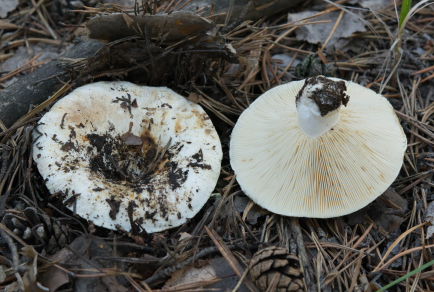
The fungal biodiversity of Central Asia, particularly within the vast pine forests of Kazakhstan, remains significantly under-studied. In this study, a new species, Russula viatica (Russulaceae), is described based on morphological and molecular evidence. The specimens were collected from Pinus sylvestris forests of the Kokshetau Hills. Taxonomically, R. viatica belongs to subgenus Brevipes, subsection Pallidosporinae. The new species is distinguished by its association with pine forests, an ochre spore print (Romagnesi IIIb), and subreticulate amyloid spore ornamentation, along with characteristic dimensions of basidia and basidiospores. An integrative taxonomic approach was employed, combining detailed macro- and microscopic examinations with phylogenetic analyses of ITS rDNA sequences. The results demonstrate that R. viatica represents a genetically distinct lineage, clearly separated from known Eurasian taxa. Detailed descriptions and illustrations are provided, and the phylogenetic position of the new species is discussed in the context of recent systematic revisions of the subgenus. Finally, to facilitate correct identification of similar taxa, a key to the Eurasian species of Russula subgen. Brevipes with dark spore prints is provided.
References
- Abdrahmanov, O.A. (1986) Microflora of the Karkaraly mountain-forest massif. Morfofiziologicheskie i ekologicheskie osobennosti rastitel’nogo mira Central’nogo Kazahstana. Karaganda, pp. 97–107.
- Adamčík, S., Looney, B., Caboň, M., Jančovičová, S., Adamčíková, K., Avis, P.G., Barajas, M., Bhatt, R.P., Corrales, A., Das, K., Hampe, F., Ghosh, A., Gates, G., Kälviäinen, V., Khalid, A.N., Kiran, M., De Lange, R., Lee, H., Lim, Y.W., Kong, A., Manz, C., Ovrebo, C., Saba, M., Taipale, T., Verbeken, A., Wisitrassameewong, K. & Buyck, B. (2019) The quest for a globally comprehensible Russula language. Fungal Diversity 99 (1): 369–449. https://doi.org/10.1007/s13225-019-00437-2
- Bills, G.F. (1986) Russula vesicatoria and Russula angustispora sp. nov., two confusing species of Russula subsection Lactarioideae. Mycotaxon 25 (2): 607–620. https://doi.org/10.5962/p.417107
- Bon, M. (1987) Novitates. Validations et taxons noveaux. Documents mycologiques 17 (65): 51–56.
- Bon, M. (1988) Clé monographique des russules d’Europe. Documents mycologiques 18 (70–71): 1–125.
- Bowman, E.A. & Arnold, A.E. (2018) Distributions of ectomycorrhizal and foliar endophytic fungal communities associated with Pinus ponderosa along a spatially constrained elevation gradient. American Journal of Botany 105 (4): 687–699. https://doi.org/10.1002/ajb2.1072
- Burlingham, G.S. (1944) Studies in North American Russulae. Mycologia 36 (1): 104–120. https://doi.org/10.1080/00275514.1944.12017531
- Buyck, B., Duhem, B., Das, K., Jayawardena, R.S., Niveiro, N., Pereira, O.L., Prasher, I.B., Adhikari, S., Albertó, E.O., Bulgakov, T.S., Castañeda-Ruiz, R.F., Hembrom, M.E., Hyde, K.D., Lewis, D.P., Michlig, A., Nuytinck, J., Parihar, A., Popoff, O.F., Ramirez, N.A., Silva, M.D., Verma, R.K. & Hofstetter, V. (2017) Fungal Biodiversity Profiles 21–30. Cryptogamie, Mycologie 38 (1): 101–146. https://doi.org/10.7872/crym/v38.iss1.2017.101
- Buyck, B., Horak, E., Cooper, J.A. & Wang, X.H. (2024) Introducing Russula subgen. Cremeo-ochraceae, a new and very small lineage sharing with Multifurca (Russulaceae) an identical, largely circum-Pacific distribution pattern. Fungal Systematics and Evolution 14 (1): 109–126. https://doi.org/10.3114/fuse.2024.14.07
- Buyck, B., Zoller, S. & Hofstetter, V. (2018) Walking the thin line… ten years later: the dilemma of aboveversus below-ground features to support phylogenies in the Russulaceae (Basidiomycota). Fungal Diversity 89: 267–292. https://doi.org/10.1007/s13225-018-0397-5
- Cao, B., Phurbu, D., Ralaiveloarisoa, A., Liimatainen, K., Niskanen, T., Ramírez-Cruz, V., Bradshaw, A.J., Dentinger, B.T.M., Ramírez-Guillén, F., Cortés-Pérez, A., Guzmán-Dávalos, L., Villalobos-Arámbula, A.R., Castro-Jauregui, O., Da Silva, P.S., Day, R., Davoodian, N., Lebel, T., Castellano, M., May, T.W., Toome, M., Vasey, J., Hofer, K., Thangavel, R., Braithwaite, M., Braithwaite, L., Dutta, A.K., Chattopadhyay, P., Roy, N., Tanti, B., Biswas, P.R., Arumugam, E., Kezo, K., Kaliyaperumal, M., Murugadoss, R., Ji, J.-X., Kakishima, M., Cooper, J., Nuytinck, J., Luo, Z.-L., Wang, W.-P., Zhang, X., Wen, T.-C., Jia, A.-L., Fan, X.-L., Jiang, N., Jiao, N., Zhang, Y., Manawasinghe, I.S., Li, H., Xiong, Y.-R., Zhou, T., Tan, Q.-L., Hoshino, T., Lagaet, P., De Lange, R., Verbeken, A., Tondeleir, L., Manz, C., Hampe, F., Zhao, C.-L., Yang, Y., Zhang, G.-Q., Dai, D.-Q., Tomšovský, M., Denchev, T.T., Denchev, C.M., Léveillé-Bourret, É., Kemler, M., Chen, Y.-P., Maharachchikumbura, S.S.N., Feng, Z.-X., Wang, L., Wang, Q.-M., Wan, S.-P., Yu, F.-Q., Liu, J.-K., Du, H.-Z., Wu, N., Hu, H.-L., Su, J.-Y., Wang, Z.-H., Hu, Y.-P., Yu, H., Wang, J., Yang, Y.-H., Dong, W., Shu, Y.-X., Zhao, H.-J., Wang, C.-Q., Xia, W.-X., Liao, C.-F., Doilom, M., Li, G.-J., Suwannarach, N., Senwanna, C., Gafforov, Y., Flakus, A., Suchan, T., Plata, O., Rodriguez-Flakus, P., Tamang, J., Acharya, K., Yang, H.-D., Jayawardena, R.S., Tiendrebeogo, A., Decock, C., Somda, I., Legrève, A., Yang, Y., Xiao, Y.-P., Zhou, X.-Z., Li, J.-X., Thongklang, N., Han, X.-X., Yang, W.-Q., Wang, S.-H., He, M.-Q., Hyde, K.D. & Zhao, R.-L. (2025) Fungal diversity notes 1919–2016: taxonomic and phylogenetic contributions to fungal taxa. Fungal Diversity 132 (1): 425–651. https://doi.org/10.1007/s13225-025-00556-z
- Carter-House, D., Stajich, J.E., Unruh, S. & Kurbessoian, T. (2020) Fungal CTAB DNA Extraction v1. https://doi.org/10.17504/protocols.io.bhx8j7rw
- Chen, Y., An, M., Liang, J., Li, W., Deng, C., Wang, J., Li, Y. & Liang, J. (2023) Morphological Characteristics and Molecular Evidence Reveal four New Species of Russula subg. Brevipedum from China. Journal of Fungi 9 (1): 61. https://doi.org/10.3390/jof9010061
- Fedorenko, V.A. (2019) Annotated checklist of Basidiomycota new to Republic of Kazakhstan. Current Research in Environmental & Applied Mycology (Journal of Fungal Biology) 9 (1): 271–287. https://doi.org/10.5943/cream/9/1/23
- Garcia, M.O., Smith, J.E., Luoma, D.L. & Jones, M.D. (2016) Ectomycorrhizal communities of ponderosa pine and lodgepole pine in the south-central Oregon pumice zone. Mycorrhiza 26 (4): 275–286. https://doi.org/10.1007/s00572-015-0668-x
- Guindon, S., Dufayard, J.-F., Lefort, V., Anisimova, M., Hordijk, W. & Gascuel, O. (2010) New Algorithms and Methods to Estimate Maximum-Likelihood Phylogenies: Assessing the Performance of PhyML 3.0. Systematic Biology 59 (3): 307–321. https://doi.org/10.1093/sysbio/syq010
- Haelewaters, D., Dirks, A.C., Kappler, L.A., Mitchell, J.K., Quijada, L., Vandegrift, R., Buyck, B. & Pfister, D.H. (2018) A Preliminary Checklist of Fungi at the Boston Harbor Islands. Northeastern Naturalist 25 (sp9): 45. https://doi.org/10.1656/045.025.s904
- Hoang, D.T., Chernomor, O., Von Haeseler, A., Minh, B.Q. & Vinh, L.S. (2018) UFBoot2: Improving the Ultrafast Bootstrap Approximation. Molecular Biology and Evolution 35 (2): 518–522. https://doi.org/10.1093/molbev/msx281
- Hongo, T. (1954) Two new Agaricus from Ōmi. Acta Phytotaxonomica et Geobotanica 15 (4): 102–104.
- Hongsanan, S., Hyde, K.D., Bahkali, A.H., Camporesi, E., Chomnunti, P., Ekanayaka, H., Gomes, A.A.M., Hofstetter, V., Jones, E.B.G., Pinho, D.B., Pereira, O.L., Tian, Q., Wanasinghe, D.N., Xu, J.-C. & Buyck, B. (2015) Fungal Biodiversity Profiles 11–20. Cryptogamie, Mycologie 36 (3): 355–380. https://doi.org/10.7872/crym/v36.iss3.2015.355
- Izzo, A., Agbowo, J. & Bruns, T.D. (2005) Detection of plot‐level changes in ectomycorrhizal communities across years in an old‐growth mixed‐conifer forest. New Phytologist 166 (2): 619–630. https://doi.org/10.1111/j.1469-8137.2005.01354.x
- Kalyaanamoorthy, S., Minh, B.Q., Wong, T.K.F., Von Haeseler, A. & Jermiin, L.S. (2017) ModelFinder: fast model selection for accurate phylogenetic estimates. Nature Methods 14 (6): 587–589. https://doi.org/10.1038/nmeth.4285
- Katoh, K., Rozewicki, J. & Yamada, K.D. (2019) MAFFT online service: multiple sequence alignment, interactive sequence choice and visualization. Briefings in Bioinformatics 20 (4): 1160–1166. https://doi.org/10.1093/bib/bbx108
- Kleine, C.S., McClean, T. & Miller, S.L. (2013) Genetic divergence among disjunct populations of three Russula spp. from Africa and Madagascar. Mycologia 105 (1): 80–89. https://doi.org/10.3852/11-067
- Konrad, P. & Josserand, M. (1934) Notes sur la classification des Russules. Bulletin trimestriel de la Société Mycologique de France 50: 253–269.
- Kornerup, A. & Wanscher, J.H. (1978) Methuen Handbook of Colour. 3. ed. Methuen, London, 252 pp.
- Larsson, A. (2014) AliView: a fast and lightweight alignment viewer and editor for large datasets. Bioinformatics 30 (22): 3276–3278. https://doi.org/10.1093/bioinformatics/btu531
- Lebel, T. & Tonkin, J.E. (2007) Australasian species of Macowanites are sequestrate species of Russula (Russulaceae, Basidiomycota). Australian Systematic Botany 20 (4): 355–381. https://doi.org/10.1071/SB07007
- Leonhardt, T., Borovička, J., Sácký, J., Šantrůček, J., Kameník, J. & Kotrba, P. (2019) Zn overaccumulating Russula species clade together and use the same mechanism for the detoxification of excess Zn. Chemosphere 225: 618–626. https://doi.org/10.1016/j.chemosphere.2019.03.062
- Li, G.-J., Deng, C.-Y., Shi, L.-Y., Wang, J., Meng, Q.-F. & Li, S.-M. (2020) Three new species of Russula subsect. Lactarioideae from China. Mycosystema 39 (4): 618–636. https://doi.org/10.13346/j.mycosystema.190414
- Lu, J.-R., Lei, L., Yu, F.-M., Zhu, X.-T., Liang, J.-F., Jia, L.-K., Mu, L.-H., Zhang, J.-M., Wang, G.-S., Zhang, Y., Hyde, K.D., Yang, Z.-L. & Zhao, Q. (2025) Diversity of macrofungi in southeast Xizang, China 2. Mycology 17 (1). https://doi.org/10.1080/21501203.2025.2525864
- Maba, D.L. (2016) The genus Lactifluus (Basidiomycota Russulales) from West Africa: What do we know? Diversity, morpho-anatomy, molecular phylogeny and new species presenting thromboplerous hyphae with knobs. In: Diversity, Molecular phylogeny, Ecology and Distribution of the genera Lactifluus and Lactarius (Russulales, Basidiomycota) in West Africa. pp. 121–166.
- Marxmüller, H., Hampe, F., Temmerman, I., De Lange, R., Verbeken, A. & Kleine, J. (2025) Russula subpallidospora sp. nov.—ein seltener cremesporiger Weißtäubling. Zeitschrift für Mykologie 91 (2): 295–318.
- Nam, G.A. (1985) To the flora of agaric mushrooms of the Almaty Nature Reserve. Botanicheskie materialy gerbariya Instituta botaniki Akademii nauk KazSSR 14: 68–73.
- Nam, G.A., Rakhimova, E.V., Ermekova, B.D., Abiev, S.A., Esengulova, B.Zh. & Kyzmetova, L.A. (2011) Mushrooms of the Kazakh Altai (species summary). RPK «Intellekt», Almaty, 299 pp.
- Nguyen, L.-T., Schmidt, H.A., Von Haeseler, A. & Minh, B.Q. (2015) IQ-TREE: A Fast and Effective Stochastic Algorithm for Estimating Maximum-Likelihood Phylogenies. Molecular Biology and Evolution 32 (1): 268–274. https://doi.org/10.1093/molbev/msu300
- Noffsinger, C. & Cripps, C.L. (2021) Systematic analysis of Russula in the North American Rocky Mountain alpine zone. Mycologia 113: 1–38. https://doi.org/10.1080/00275514.2021.1947695
- Olariaga, I., Ballester, L., Fernandes, U., López-Amiano, J.I., Magaña, V., Martínez-Gil, R., Martín, J., Pancorbo, F., Pérez-Daniëls, P., Pérez-del-Amo, C., Rodríguez-Andrade, E., Rodríguez-Arribas, C., Sánchez-Dueñas, G., Teres, J.L., Torres, D. & Traba, J.M. (2020) II Encuentro de la Sociedad Ibérica de Micología (Cerler, 26-30 de septiembre de 2018): hallazgo de 103 especies nuevas para Aragón, 15 para la Península Ibérica y 11 especies nuevas para la ciencia. Fungi Iberici 1: 7–80. https://doi.org/10.51436/funiber/01.001
- Osuji, C., Mowobi, S.A.G., Nweke, O., Etim, V. & Onyenekwe, P. (2015) Extraction of Good Quality Genomic DNA from Dry woody Mushroom Samples for Molecular Analysis: A Case Study of Ganoderma lucidum. Translational Medicine and Biotechnology 3 (5): 1–9.
- Pagès, H., Aboyoun, P., Gentleman, R. & DebRoy, S. (2025) Biostrings: Efficient manipulation of biological strings. R package version 2.46.0. https://doi.org/10.18129/B9.bioc.Biostrings
- Paradis, E. & Schliep, K. (2019) ape 5.0: an environment for modern phylogenetics and evolutionary analyses in R. Bioinformatics 35 (3): 526–528. https://doi.org/10.1093/bioinformatics/bty633
- Rakhimova, E.V., Nam, G.A., Ermekova, B.D., Dzhetigenova, U.K., Kyzmetova, L.A. & Esengulova, B.Zh. (2017) Diversity of mushrooms in the desert lowlands of southeastern Kazakhstan and the Ketmen ridge. LLP Luxe Media Publishing, Almaty, 296 pp.
- Rambaut, A. (2018) FigTree (Version 1.4.5) [Computer software]. Institute of Evolutionary Biology, University of Edinburgh. [http://tree.bio.ed.ac.uk/software/figtree/]
- Rambaut, A., Drummond, A.J., Xie, D., Baele, G. & Suchard, M.A. (2018) Posterior Summarization in Bayesian Phylogenetics Using Tracer 1.7. Systematic Biology 67 (5): 901–904. https://doi.org/10.1093/sysbio/syy032
- Robert, V., Vu, D., Amor, A.B.H., Van De Wiele, N., Brouwer, C., Jabas, B., Szoke, S., Dridi, A., Triki, M., Daoud, S.B., Chouchen, O., Vaas, L., De Cock, A., Stalpers, J.A., Stalpers, D., Verkley, G.J.M., Groenewald, M., Dos Santos, F.B., Stegehuis, G., Li, W., Wu, L., Zhang, R., Ma, J., Zhou, M., Gorjón, S.P., Eurwilaichitr, L., Ingsriswang, S., Hansen, K., Schoch, C., Robbertse, B., Irinyi, L., Meyer, W., Cardinali, G., Hawksworth, D.L., Taylor, J.W. & Crous, P.W. (2013) MycoBank gearing up for new horizons. IMA Fungus 4 (2): 371–379. https://doi.org/10.5598/imafungus.2013.04.02.16
- Romagnesi, H. (1967) Les Russules d’Europe et d’Afrique du Nord. Essai sur la valeur taxinomique et spécifique des caractères morphologiques et microchimiques des spores et des revêtements. Bordas, Paris, 998 pp.
- Romagnesi, H. (1972) Sur deux Russules nouvelles de la moitié sud de la France. Bulletin trimestriel de la Société mycologique de France 88 (1): 29–33.
- Ronquist, F., Teslenko, M., Van Der Mark, P., Ayres, D.L., Darling, A., Höhna, S., Larget, B., Liu, L., Suchard, M.A. & Huelsenbeck, J.P. (2012) MrBayes 3.2: Efficient Bayesian Phylogenetic Inference and Model Choice Across a Large Model Space. Systematic Biology 61 (3): 539–542. https://doi.org/10.1093/sysbio/sys029
- Samgina, D.I. (1981) Flora of spore plants in Kazakhstan. Agaricales. Vol. 13 (1). “Nauka” Kazahskoj SSR, Alma-Ata, 272 pp.
- Schliep, K.P. (2011) phangorn: phylogenetic analysis in R. Bioinformatics 27 (4): 592–593. https://doi.org/10.1093/bioinformatics/btq706
- Shaffer, R.L. (1964) The Subsection Lactarioideae of Russula. Mycologia 56 (2): 202–231. https://doi.org/10.1080/00275514.1964.12018102
- Smith, M.E., Henkel, T.W., Uehling, J.K., Fremier, A.K., Clarke, H.D. & Vilgalys, R. (2013) The Ectomycorrhizal Fungal Community in a Neotropical Forest Dominated by the Endemic Dipterocarp Pakaraimaea dipterocarpacea. PLoS ONE 8 (1): e55160. https://doi.org/10.1371/journal.pone.0055160
- Song, J., Li, H., Wu, S., Chen, Q., Yang, G., Zhang, J., Liang, J. & Chen, B. (2022) Morphological and Molecular Evidence for Two New Species within Russula Subgenus Brevipes from China. Diversity 14 (2): 112. https://doi.org/10.3390/d14020112
- Suh, H., Lupala, A.S., Cho, H.J., Jo, S., Choi, J. & Lim, Y.W. (2025) Exploring Macrofungal Biodiversity and Distribution on Kyodong Island, Republic of Korea. Mycobiology 53 (4): 466–479. https://doi.org/10.1080/12298093.2025.2510724
- Tedersoo, L., Bahram, M., Jairus, T., Bechem, E., Chinoya, S., Mpumba, R., Leal, M., Randrianjohany, E., Razafimandimbison, S., Sadam, A., Naadel, T. & Kõljalg, U. (2011) Spatial structure and the effects of host and soil environments on communities of ectomycorrhizal fungi in wooded savannas and rain forests of Continental Africa and Madagascar. Molecular Ecology 20 (14): 3071–3080. https://doi.org/10.1111/j.1365-294X.2011.05145.x
- Truong, C., Mujic, A.B., Healy, R., Kuhar, F., Furci, G., Torres, D., Niskanen, T., Sandoval‐Leiva, P.A., Fernández, N., Escobar, J.M., Moretto, A., Palfner, G., Pfister, D., Nouhra, E., Swenie, R., Sánchez‐García, M., Matheny, P.B. & Smith, M.E. (2017) How to know the fungi: combining field inventories and DNA‐barcoding to document fungal diversity. New Phytologist 214 (3): 913–919. https://doi.org/10.1111/nph.14509
- White, T.J., Bruns, T., Lee, S. & Taylor, J. (1990) Amplification and Direct Sequencing of Fungal Ribosomal RNA Genes for Phylogenetics. In: PCR Protocols: A Guide to Methods and Applications. Academic Press, New York, pp. 315–322. https://doi.org/10.1016/B978-0-12-372180-8.50042-1
- Xie, X.-C., Buyck, B. & Song, Y. (2023) Species of Russula subgenera Archaeae, Compactae and Brevipedum (Russulaceae, Basidiomycota) from Dinghushan Biosphere Reserve. European Journal of Taxonomy 864: 28–63. https://doi.org/10.5852/ejt.2023.864.2085
- Xing, P., Xu, Y., Gao, T., Li, G., Zhou, J., Xie, M. & Ji, R. (2020) The community composition variation of Russulaceae associated with the Quercus mongolica forest during the growing season at Wudalianchi City, China. PeerJ 8: e8527. https://doi.org/10.7717/peerj.8527
- Zhou, H., Cheng, G. & Hou, C. (2022) A new species, Russula luteolamellata (Russulaceae, Russulales) from China. Phytotaxa 556 (2): 136–148. https://doi.org/10.11646/phytotaxa.556.2.3