

Abstract
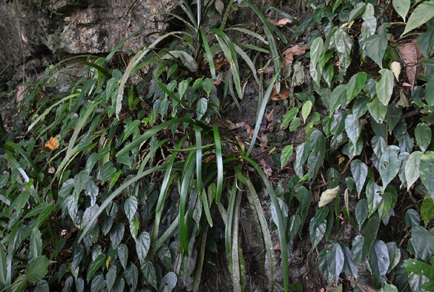
Based on extensive field investigations in karst habitats of southern China (Guangxi) and adjacent Indochina, cultivation and detailed morphological examination of living plants, and critical study of herbarium specimens (including types), a taxonomic revision of the genus in this region is presented. This study demonstrates that two species previously subsumed into the broadly defined O. intermedius complex (O. compressus and O. longipedicellatus) possess stable diagnostic morphological characters and distinct ecological niches, warranting their reinstatement as independent species. Furthermore, three new species from the limestone areas of Guangxi are discovered and described: O. dahuaensis, O. crassifilamentus, and O. napoensis.
References
- Andrews, H.C. (1810) Peliosanthes teta. Botanists’ repository, for new, and rare plants 9: t. 605. [https://www.biodiversitylibrary.org/item/108763#page/106/mode/1up]
- APG IV (2016) An update of the Angiosperm Phylogeny Group classification for the orders and families of flowering plants: APG IV. Botanical Journal of the Linnean Society 181: 1–20. https://doi.org/10.1111/boj.12385
- Averyanov, L.V., Tanaka, N., Nguyen, K.S. & Nguyen, T.H. (2016) New species of Ophiopogon and Peliosanthes (Asparagaceae) from Laos and Vietnam. Taiwania 61 (3): 201–217. https://doi.org/10.6165/tai.2016.61.201
- Averyanov, L.V., Tanaka, N., Nguyen, K.S., Nguyen, Q.N., Maisak, T.V. & Nguyen, T.H. (2017) New species of Peliosanthes, Rohdea and Tupistra (Asparagaceae) from Laos and Vietnam. Nordic Journal of Botany 35: 697–710. https://doi.org/10.1111/njb.01660
- Averyanov, L.V., Tanaka, N., Nguyen, K.S. & Maisak, T.V. (2020) New or insufficiently known species of Ophiopogon, Peliosanthes and Rohdea (Asparagaceae) for the flora of Laos and Vietnam. Taiwania 65 (1): 61–73. https://doi.org/10.6165/tai.2020.65.61
- Baillon, H. (1893) Les plantes alliées aux Tupistra (suite). Bulletin Mensuel de la Société Linnéenne de Paris 2: 1113–1117.
- Chase, M.W., Reveal, J.L. & Fay, M.F. (2009) A subfamilial classification for the expanded asparagalean families Amaryllidaceae, Asparagaceae and Xanthorrhoeaceae. Botanical Journal of the Linnean Society 161: 132–136. https://doi.org/10.1111/j.1095-8339.2009.00999.x
- Chen, Q.H. (1987) A new species of Tupistra (Liliaceae) from Guizhou. Acta Phytataxonomica Sinica 25 (1): 69–70.
- Chen, S.C. (1988) An addition to the lily flora of China. Acta Phytotaxonomica Sinica 26 (2): 139–143.
- Chen, X.Q. & Tamura, M.N. (2000) Ophiopogon Ker-Gawl. In: Wu, Z.Y., Raven, P.H. & Hong, D.Y. (Eds.) Flora of China, vol. 24. Science Press, Beijing, and Missouri Botanical Garden Press, St. Louis, pp. 252–261.
- Clarke, C.B. (1889) On the plants of Kohima and Muneypore. The Journal of the Linnean Society 25: 1–107. https://doi.org/10.1111/j.1095-8339.1889.tb00793.x
- Deng, Y.F. (2017) Rohdea fargesii, the correct name for Rohdea chinensis (Asparagaceae). Phytotaxa 302 (3): 298–299. https://doi.org/10.11646/phytotaxa.302.3.12
- Diels, L. (1900) Die flora von Central-China. Botanische Jahrbucher fur Systematik, Pflanzengeschichte und Pflanzengeographie 29 (2): 169–320.
- Don, D. (1825) Prodromus florae Nepalensis: sive Enumeratio vegetabilium quae in itinere per Nepaliam proprie dictam et regiones conterminas, ann. 1802-1803. J. Gale, Londini, 249 pp. https://doi.org/10.5962/bhl.title.86
- Fang, D. (1998) Three new species of Ophiopogon (Liliaceae) from Guangxi, China. Journal of Tropical and Subtropical Botany 6 (2): 97–100.
- Feng, H.Z., Peng, C.X., Tan, K. & Lin, Q.W. (2025) Identity of Ophiopogon tonkinensis and O. ogisui, with a new species O. tiandengensis from Guangxi, China. Phytotaxa 700 (1): 45–59. https://doi.org/10.11646/phytotaxa.700.1.4
- Gan, X.J., Feng, H.Z., Chen, H.J., Zhong, P.S. & Fan, Q. (2024) Taxonomic studies on the genus Ophiopogon (Asparagaceae) I:—identity of O. albimarginatus and O. pseudotonkinensis, and a new species O. guangzhouensis from Guangdong, China. Phytotaxa 662 (2): 121–136. https://doi.org/10.11646/phytotaxa.662.2.1
- Hao, J.C., Feng, H.Z., Tan, K. & Lin, Q.W. (2025) Ophiopogon malipoensis (Asparagaceae), a new species from Yunnan, Southern China. Phytotaxa 714 (3): 246–252. https://doi.org/10.11646/phytotaxa.714.3.5
- Hao, J.C., Feng, H.Z., Tan, K., Liu, L.A. & Lin, Q.W. (2025) Ophiopogon ximengensis, a new species from Yunnan, Southern China. Phytotaxa 684 (2): 243–253. https://doi.org/10.11646/phytotaxa.684.2.7
- Herbert, W. (1837) Amaryllidaceae. James Ridgway and Sons, London, 428 pp. https://doi.org/10.5962/bhl.title.116651
- Hooker, J.D. (1892) Ophiopogon. In: Flora of British India, vol. 6. L. Reeve, London, pp. 267–270.
- Huang, J.L. & Li, H. (1990) Study on the taxonomic system of the genus Tupistra. Acta Botanica Yunnanica Supple 3: 49–61.
- IUCN (2024) Guidelines for using the IUCN red list categories and criteria, version 16 (March 2024). Prepared by the Standards and Petitions Committee. Available from: https://www.iucnredlist.org/documents/RedListGuidelines.pdf (accessed 15 January 2026)
- Ker Gawler, J.B. (1807) Ophiopogon. Curtis’s Botanical Magazine 27: t. 1063. [https://www.biodiversitylibrary.org/page/472608#page/9/mode/1up]
- Kunth, K.S. (1850) Ophiopogoneae. Enumeratio plantarum omnium hucusque cognitarum : secundum familias naturales disposita, adjectis characteribus, differentiis et synonymis 5: 297–309. https://doi.org/10.5962/bhl.title.67381
- Le, T.M.L., Ly, N.S., Pham, V.T., Nguyen, P.H., Tran, D.B., Dong, L.N., Averyanov, L.V., Tanaka, N. & Nguyen, K.S. (2023) Molecular Phylogeny of Convallarioideae (Asparagaceae), with emphasis on Vietnamese species. Academia Journal of Biology 45 (4): 93–109. https://doi.org/10.15625/2615-9023/18765
- Léveillé, A.A.H. (1905) Liliacées, Amaryllidacées, Iridacées et Hemodoracées de Chine. Memorie della Pontificia Accademia Romana dei Nuovi Lincei 23: 333–379.
- Li, G.Z., Gao, Q. & Lin, C.R. (2016) Ophiopogon. In: Li, S.G. (Eds.) Flora of Guangxi 5. Guangxi Science & Technology Publishing House, Nanning, pp. 209–220.
- Lin, Q.W., Le, C.T., Yu, Z.Y., Sun, G.F. & Liu, B. (2021) Ophiopogon elatior, a new species of Asparagaceae from Yunnan, China. Phytotaxa 525 (1): 46–50. https://doi.org/10.11646/phytotaxa.525.1.5
- Loureiro, J.de. (1790) Flora Cochinchinensis 1. Typis academicis, Ulyssipone, 353 pp. [https://www.biodiversitylibrary.org/item/192210#page/7/mode/1up]
- Masamune, G. (1937) Deux nouvelles especes des Philippines (Liliacees et Rutacees). Bulletin de la Société Botanique de France 84: 90–91. https://doi.org/10.1080/00378941.1937.10833042
- Merrill, E.D. (1918) Notes on the flora of Loh Fau Mountain, Kwangtung province, China. The Philippine journal of science C13: 123–163.
- Merrill, E.D. & Chun, W.Y. (1935) Hainan flora. Sunyatsenia 2: 220–221.
- Nguyen, K.S., Tanaka, N., Averyanov, L.V., Maisak, T.V., Nguyen, P.H. & Tran, D.B. (2021) Two new species, Ophiopogon dolichocaulis and O. trigonantherus (Asparagaceae), from northern Vietnam. Phytotaxa 523 (4): 291–298. https://doi.org/10.11646/phytotaxa.523.4.3
- Nong, D.X., Lu, H.Z., Huang, X.Y. & Huang, B.Y. (2023) Ophiopogon sclerophyllus, a new species of Ophiopogon (Asparagaceae) from Guangxi, China. Phytotaxa 578 (2): 207–212. https://doi.org/10.11646/phytotaxa.578.2.7
- Pham, V.T., Tanaka, N., Averyanov, L.V., Maisak, T.V., Tran, H.T., Nguyen, H.C. & Nguyen, K.S. (2023) Ophiopogon muongnhensis (Asparagaceae, Convallrioideae), a new species from northwest Vietnam. Phytotaxa 591 (2): 171–176. https://doi.org/10.11646/phytotaxa.591.2.9
- POWO (2025) Ophiopogon. In: Plants of the World Online. [Retrieved 25 November 2025]
- Rodriguez, M.L. (1928) Ophiopogon nouveaux d’Indochine. Bulletin de la Société Botanique de France 75: 987–999. https://doi.org/10.1080/00378941.1928.10837127
- Rodriguez, M.L. (1934) Hémodoracées nouvelles d'Indochine. Bulletin du Museum national d'histoire naturelle 2 6: 95–106. https://doi.org/10.1080/00378941.1928.10837127
- Smith, W.W. (1921) Ophiopogon grandis. Notes from the Royal Botanic Garden 13: 171.
- Tamura, M.N. & Xu, J.M. (2007) A new species of the genus Ophiopogon (Asparagaceae) from Guangxi, China. Acta Phytotaxonomica et Geobotanica 58: 39–41.
- Tanaka, N. (1998) Taxonomic notes on Ophiopogon of South Asia I. The Journal of Japanese Botany 73 (6): 301–313. https://doi.org/10.51033/jjapbot.73_6_9293
- Tanaka, N. (1999a) Taxonomic notes on Ophiopogon of South Asia II. The Journal of Japanese Botany 74 (1): 25–33. https://doi.org/10.51033/jjapbot.74_1_9312
- Tanaka, N. (1999b) Taxonomic notes on Ophiopogon of South Asia III. The Journal of Japanese Botany 74 (5): 261–267. https://doi.org/10.51033/jjapbot.74_5_9367
- Tanaka, N. (1999c) Taxonomic notes on Ophiopogon of South Asia IV. The Journal of Japanese Botany 74 (6): 321–328. https://doi.org/10.51033/jjapbot.74_6_9377
- Tanaka, N. (2000a) Taxonomic notes on Ophiopogon of South Asia V. The Journal of Japanese Botany 75 (2): 69–79. https://doi.org/10.51033/jjapbot.75_2_9399
- Tanaka, N. (2000b) Taxonomic notes on Ophiopogon of South Asia VI. The Journal of Japanese Botany 75 (3): 127–136. https://doi.org/10.51033/jjapbot.75_3_9414
- Tanaka, N. (2000c) Taxonomic notes on Ophiopogon of South Asia VII. The Journal of Japanese Botany 75 (4): 191–212. https://doi.org/10.51033/jjapbot.75_4_9425
- Tanaka, N. (2000d) Taxonomic notes on Ophiopogon of South Asia VIII. The Journal of Japanese Botany 75 (5): 265–269. https://doi.org/10.51033/jjapbot.75_5_9439
- Tanaka, N. (2000e) Taxonomic notes on Ophiopogon of South Asia IX. The Journal of Japanese Botany 75 (6): 360–367. https://doi.org/10.51033/jjapbot.75_6_9463
- Tanaka, N. (2001a) Taxonomic notes on Ophiopogon of South Asia X. The Journal of Japanese Botany 76 (1): 11–19. https://doi.org/10.51033/jjapbot.76_1_9478
- Tanaka, N. (2001b) Taxonomic notes on Ophiopogon (Convallariaceae) of East Asia (I). The Journal of Japanese Botany 76 (2): 59–76. https://doi.org/10.51033/jjapbot.76_2_9491
- Tanaka, N. (2001c) Taxonomic notes on Ophiopogon (Convallariaceae) of East Asia (II). The Journal of Japanese Botany 76 (3): 151–165. https://doi.org/10.51033/jjapbot.76_3_9507
- Tanaka, N. (2001d) Taxonomic notes on Ophiopogon (Convallariaceae) of East Asia (III). The Journal of Japanese Botany 76 (4): 205–218. https://doi.org/10.51033/jjapbot.76_4_9520
- Tanaka, N. (2003) New combinations in Rohdea (Convallariaceae). Novon 13: 329–333. https://doi.org/10.2307/3393269
- Tanaka, N. & Nguyen, K.S. (2023) Nolinoideae (Asparagaceae) in APG III needs replacing with Convallarioideae. Phytotaxa 583 (3): 297–299. https://doi.org/10.11646/phytotaxa.583.3.9
- Tanaka, N., Truong, B.V., Averyanov, L.V. & Maisak, T.V. (2025) Ophiopogon heterotepalus (Asparagaceae), a new species from north-western Vietnam. Phytotaxa 700 (2): 243–250. https://doi.org/10.11646/phytotaxa.700.2.7
- Wang, F.T. & Tang, T. (1937) Notes on Chinese Liliaceae 4. Bulletin of the Fan Memorial Institute of Biology 7: 281–304.
- Wang, F.T. & Tang, T. (1948) Notes on Chinese Liliaceae VII. Contributions from the Institute of Botany 6: 17–21.
- Wang, F.T. & Tang, T. (Eds.) (1978) Flora Reipublicae Popularis Sinicae 15. Science Press, Beijing, 280 pp.
- Wan, Y. (1987) New species of Liliaceae from Guangxi. Acta Phytotaxonomica Sinica 25 (5): 396–400.
- Yamashita, J. & Tamura, M.N. (2004) Phylogenetic analyses and chromosome evolution in Convallarieae (Ruscaceae sensu lato), with some taxonomic treatments. Journal of Plant Research 117: 363–370. https://doi.org/10.1007/s10265-004-0169-z
- Yang, Y.P. & Li, H. (1990) New taxa of Ophiopogon from Yunnan. Acta Botanica Yunnanica Supple 3: 91–93.
- Zhu, Z.Y. (1994) Some new taxa of Ophopogon from Sichuan. Guihaia 14 (3): 205–208.