

Abstract
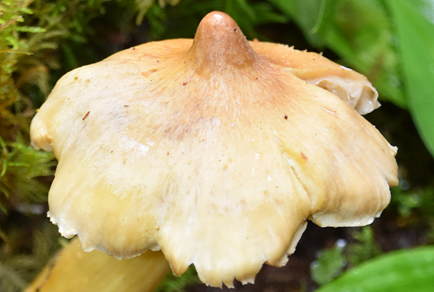
A new species of Tricholoma sect. Muscaria, Tricholoma flavomastoideum sp. nov, collected from Xizang, China, is described based on both morphological and molecular analyses. Morphologically, T. flavomastoideum is mainly characterized by its dull yellowish buff umbonate pileus, with a light-yellow undulate pileus margin, silky-fibrillose and light buff stipe, well-differentiated subpellis comprising inflated cells with yellow to brown intracellular pigment. Phylogenetic analysis using Bayesian Inference (BI) and Maximum Likelihood (ML) based on the combined internal transcribed spacer (ITS) and the second largest subunit of RNA polymerase II (RPB2) dataset indicated that the specimens formed a separate lineage. Morphological and molecular evidence converged to support the recognition of this fungus as a novel species within the sect. Muscaria, adding to the known diversity of the genus in the alpine ecosystems of the Xizang Plateau.
References
- Christensen, M. & Noordeloos, M.E. (1999) Notulae ad floram agaricinam neerlandicam—XXXVI. Tricholoma. Persoonia 17: 295–317.
- Clericuzio, M., Serra, S. & Vidari, G. (2024) No evidence was found for the presence of terreolides, terreumols or saponaceolides H-S in the fruiting bodies of Tricholoma terreum (Basidiomycota, Agaricales). Molecules 29 (8): Article 1794. https://doi.org/10.3390/molecules29081794
- Cui, Y.Y., Ding, X.X., Kost, G. & Yang, Z.L. (2022) Tricholoma sect. Tricholoma (Tricholomataceae) from China: Molecular phylogeny and taxonomy. Mycological Progress 21 (3): Article 35. https://doi.org/10.1007/s11557-022-01788-y
- Ding, X.X., Cui, Y.Y. & Yang, Z.L. (2022) Two new species of Tricholoma sect. Genuina (Agaricales) from China based on molecular phylogenetic and morphological evidence. Mycological Progress 21 (3): Article 37. https://doi.org/10.1007/s11557-022-01797-x
- Ding, X.X., Xu, X., Cui, Y.Y., Kost, G., Wang, P.M. & Yang, Z.L. (2023) A fifty-locus phylogenetic analysis provides deep insights into the phylogeny of Tricholoma (Tricholomataceae, Agaricales). Persoonia 50: 1–26. https://doi.org/10.3767/persoonia.2023.50.01
- Hall, T.A. (1999) BioEdit: A user-friendly biological sequence alignment editor and analysis program for Windows 95/98/NT. Nucleic Acids Symposium Series 41: 95–98.
- Heilmann-Clausen, J., Christensen, M., Frøslev, T.G. & Kjøller, R. (2017) Taxonomy of Tricholoma in northern Europe based on ITS sequence data and morphological characters. Persoonia 38: 38–57. https://doi.org/10.3767/003158517X693174
- Hongo, T. (1959) The Agaricales of Japan I. Memoirs of the Faculty of Liberal Arts and Education, Shiga University, Natural Science 9: 47–94. https://doi.org/10.5109/1524328
- Hosen, M.I., Li, T.H., Li, T., Zhong, X.J. & Chen, Y. (2016) Tricholoma sinoacerbum, a bitter species from Guangdong Province of China. Mycoscience 57 (4): 233–238. https://doi.org/10.1016/j.myc.2016.02.002
- Kalyaanamoorthy, S., Minh, B.Q., Wong, T.K.F., von Haeseler, A. & Jermiin, L.S. (2017) ModelFinder: Fast model selection for accurate phylogenetic estimates. Nature Methods 14: 587–589. https://doi.org/10.1038/nmeth.4285
- Katoh, K. & Standley, D.M. (2013) MAFFT multiple sequence alignment software version 7: Improvements in performance and usability. Molecular Biology and Evolution 30 (4): 772–780. https://doi.org/10.1093/molbev/mst010
- Kornerup, A. & Wanscher, J.H.K. (1978) The Methuen handbook of colour (3rd ed.).
- Mao, N., Yang, J.J., Zhang, Y.X., Li, T. & Fan, L. (2025) Species diversity of Tricholoma (Agaricales, Tricholomataceae) from Shanxi Province of northern China with the description of four new species. MycoKeys 112: 59–80. https://doi.org/10.3897/mycokeys.112.132652
- Murray, A.F., Moore, A.J. & Munafo, J.P., Jr. (2020) Key odorants from the American matsutake, Tricholoma magnivelare. Journal of Agricultural and Food Chemistry 68 (36): 9768–9775. https://doi.org/10.1021/acs.jafc.0c03372
- Noordeloos, M.E. & Christensen, M. (1999) Tricholoma. In: Bas, C., Kuyper, T.W., Noordeloos, M.E., et al. (Eds.) Flora Agaricina Neerlandica. Balkema, pp. 107–148.
- Ovrebo, C.L. (1986) Three new species of Tricholoma with a description of Tricholoma luteomaculosum. Mycologia 78 (3): 418–425. https://doi.org/10.1080/00275514.1986.12025267
- Ovrebo, C.L., Hughes, K.W. & Halling, R.E. (2019) Three new species of Tricholoma from Costa Rica. Phytotaxa 392 (1): 33–44. https://doi.org/10.11646/phytotaxa.392.1.3
- Peck, C.H. (1900) New species of fungi. Bulletin of the Torrey Botanical Club 27 (12): 609–613. https://doi.org/10.2307/2477998
- Pu, Y., Yin, C., Zhang, L., Fang, X., Zhong, X., Tian, Y., Tao, A., Yang, Y. & Xia, C. (2025) Extraction, purification, structural characterization, pharmacological activities, and applications of Tricholoma polysaccharides: A review. Journal of Ethnopharmacology 350: Article 120053. https://doi.org/10.1016/j.jep.2025.120053
- Qi, Y., Yu, X.D., Hou, J.X., Guo, H.B., Yang, R.H. & Xu, A.G. (2024) Addition to the genus Harmajaea (Agaricales, Pseudoclitocybaceae): A new and a known species from China. Phytotaxa 665 (2): 157–166. https://doi.org/10.11646/phytotaxa.665.2.6
- Rambaut, A. (2018) FigTree v1.4.4: Tree figure drawing tool [Computer software]. [https://github.com/rambaut/figtree/releases]
- Reschke, K., Popa, F., Yang, Z.L. & Kost, G. (2018) Diversity and taxonomy of Tricholoma species from Yunnan, China, and notes on species from Europe and North America. Mycologia 110 (6): 1081–1109. https://doi.org/10.1080/00275514.2018.1512295
- Riva, A. (1988) Tricholoma (Fr.) Staude. In: Fungi Europaei: Vol. 3. Tricholoma. Candusso.
- Ronquist, F., Teslenko, M., van der Mark, P., Ayres, D.L., Darling, A., Höhna, S., Larget, B., Liu, L., Suchard, M.A. & Huelsenbeck, J.P. (2012) MrBayes 3.2: Efficient Bayesian phylogenetic inference and model choice across a large model space. Systematic Biology 61 (3): 539–542. https://doi.org/10.1093/sysbio/sys029
- Sánchez-García, M. & Matheny, P.B. (2016) Is the switch to an ectomycorrhizal state an evolutionary key innovation in mushroom-forming fungi? A case study in the Tricholomatineae (Agaricales). Evolution 71 (1): 51–65. https://doi.org/10.1111/evo.13099
- Singer, R. (1986) The Agaricales in modern taxonomy (4th ed.).
- Stamatakis, A. (2014) RAxML version 8: A tool for phylogenetic analysis and post-analysis of large phylogenies. Bioinformatics 30 (9): 1312–1313. https://doi.org/10.1093/bioinformatics/btu033
- Tedersoo, L., May, T.W. & Smith, M.E. (2010) Ectomycorrhizal lifestyle in fungi: Global diversity, distribution, and evolution of phylogenetic lineages. Mycorrhiza 20: 217–263. https://doi.org/10.1007/s00572-009-0274-x
- White, T.J., Bruns, T., Lee, S. & Taylor, J.W. (1990) Amplification and direct sequencing of fungal ribosomal RNA genes for phylogenetics. In: Innis, M.A., Gelfand, D.H., Sninsky, J.J. & White, T.J. (Eds.) PCR protocols: A guide to methods and applications. Academic Press, pp. 315–322. https://doi.org/10.1016/B978-0-12-372180-8.50042-1
- Xu, X., Cui, Y.Y. & Yang, Z.L. (2020) Two new species of Tricholoma sect. Genuina (Agaricales) from China. Phytotaxa 443 (2): 155–166. https://doi.org/10.11646/phytotaxa.443.2.3
- Yang, J.J., Xu, Y.Y., Lv, J.C. & Fan, L. (2023) Tricholoma lishanense (Tricholomataceae, Agaricales), a new species from China revealed by morphology and phylogenetic analysis. Phytotaxa 598 (1): 89–96. https://doi.org/10.11646/phytotaxa.598.1.7
- Yang, Z.L., Ding, X.X., Kost, G. & Rexer, K.H. (2017) New species in the Tricholoma pardinum complex from Eastern Himalaya. Phytotaxa 305 (1): 1–10. https://doi.org/10.11646/phytotaxa.305.1.1
- Yu, F.Q., Wang, Y. & Liu, P.G. (2006) Tricholoma lavendulophyllum, a new species from Yunnan, China. Mycotaxon 95: 305–308. https://doi.org/10.5962/p.418141
- Zhang, J., Shen, X. & Wang, B. (2015) Changes in precipitation extremes in southeastern Tibet, China. Quaternary International 380–381: 49–59. https://doi.org/10.1016/j.quaint.2014.12.051
- Zhao, Z.X., Song, J.G., Senanayake, I.C., Wu, D.S., Wang, G.Q. & Xu, B. (2022) Tricholoma tianshanense sp. nov., in Tricholoma sect. Caligata from Tianshan Mountains in China evidenced by morphological characters and phylogenetic analyses. Phytotaxa 549 (1): 22–30. https://doi.org/10.11646/phytotaxa.549.1.2