

Abstract
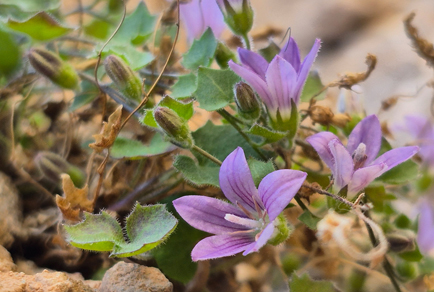
A new chasmophytic species of Campanula from the İncekaya (Por) Caldera in Bitlis Province (Eastern Anatolia, Türkiye), is described and illustrated. The new species named C. porensis is closest to C. mardinensis, from which it differs by several morphological traits, as yellowish-green to green, subglabrous to sparsely hirsute leaves, a relatively long and narrowly infundibular, intensely bluish-purple corolla, short calyx lobes, a widely obconical capsule, and a generally sparse indumentum on both vegetative and floral parts. Campanula porensis shows a superficial resemblance to C. acutiloba in habitus but it is easily distinguished by its smaller, widely infundibular, deeply lobed corolla, pale to dark violet in colour, and reniform to cordate leaves. Campanula porensis grows in restricted moist, shaded magmatic rocky cliffs at 1650–1700 m a.s.l. A detailed morphological description, diagnostic comparisons with related taxa, ecological notes, distributional data, SEM micrographs, and a conservation assessment are provided. Based on IUCN criteria, the species is assessed as Vulnerable (VU D1).
References
- Arroyo, J., Abellán, P., Arista, M., Ariza, M.J., de Castro, A., Escudero, M., Lorite, J., Martínez-Borda, E., Mejías, J.A., Molina-Venegas, R., Pleguezuelos, J.M., Simón-Porcar, V. & Viruel, J. (2022) Sierra Nevada, a Mediterranean biodiversity super hotspot. In: The Landscape of the Sierra Nevada: A Unique Laboratory of Global Processes in Spain. Springer International Publishing, Cham, pp. 11–30. https://doi.org/10.1007/978-3-030-94219-9_2
- Boissier, P.E. (1875) Flora Orientalis, Vol. 3. H. Georg, Geneva & Basel.
- Bornmüller, J. (1905) Novitiae florae orientalis. Ser. I. Mitteilungen des Thüringischen Botanischen Vereins, Neue Folge 20: 1–51.
- Brullo, S., Tomaselli, V. & Wagensommer, R.P. (2015) A new species of Odontites (Orobanchaceae) from southern Italy. Phytotaxa 213 (3): 271–281. https://doi.org/10.11646/phytotaxa.213.3.7
- Chepinoga, V.V., Barkalov, V.Y., Ebel, A.L., Knyazev, M.S., Baikov, K.S., Bobrov, A.A., Chkalov, A.V., Doronkin, V.M., Efimov, P.G., Friesen, N.V., German, D.A., Gontcharov, A.A., Grabovskaya-Borodina, A.E., Gureyeva, I.I., Ivanenko, Y.A., Kechaykin, A.A., Korobkov, A.A., Korolyuk, E.A., Kosachev, P.A., Kupriyanov, A.N., Luferov, A.N., Melnikov, D.G., Mikhailova, M.A., Nikiforova, O.D., Orlova, L.V., Ovchinnikova, S.V., Pinzhenina, E.A., Poliakova, T.A., Shekhovstsova, I.N., Shipunov, A.B., Shmakov, A.I., Smirnov, S.V., Tkach, N., Troshkina, V.I., Tupitsyna, N.N., Vasjukov, V.M., Vlasova, N.V., Verkhozina, A.V., Anenkhonov, O.A., Efremov, A.N., Glazunov, V.A., Khoreva, M.G., Kiseleva, T.I., Krestov, P.V., Kryukova, M.V., Kuzmin, I.V., Lashchinskiy, N.N., Pospelov, I.N., Pospelova, E.B., Zolotareva, N.V. & Sennikov, A.N. (2024) Checklist of vascular plants of Asian Russia. Botanica Pacifica 13: 3–310. https://doi.org/10.17581/bp.2024.13S01
- Damboldt, J. (1976) Materials for a flora of Turkey 32: Campanulaceae. Notes from the Royal Botanic Garden Edinburgh 35: 39–52. https://doi.org/10.24823/nrbge.1976.3049
- Damboldt, J. (1978) Campanula L. In: Davis, P.H. (Ed.) Flora of Turkey and the East Aegean Islands 6. Edinburgh University Press, Edinburgh, pp. 2–64.
- Davis, P.H. (1971) Distribution patterns in Anatolia with particular reference to endemism. In: Davis, P.H., Harper, P.C. & Hedge, I.C. (Eds.) Plant Life of South-West Asia. Botanical Society of Edinburgh, Edinburgh, pp. 15–27.
- Davis, P.H., Mill, R.R. & Tan, K. (1988) Campanula L. In: Davis, P.H., Mill, R.R. & Tan, K. (Eds.) Flora of Turkey and the East Aegean Islands 10 (Suppl. 1). Edinburgh University Press, Edinburgh, pp. 177–180.
- Elgadi, S., Zine, H., Dallahi, Y. & Ouhammou, A. (2024) Unveiling floristic diversity in the High Atlas: Insights from a protected reserve in a global Mediterranean biodiversity hotspot. Biosystems Diversity 32 (4): 416–425. https://doi.org/10.15421/012445
- Fedorov, A.A. (1957) Campanula L. In: Komarov, V.L. (Ed.) Flora of the USSR 24. Academy of Sciences of the USSR, Moscow & Leningrad, pp. 126–501.
- Fedorov, A.A. & Kovanda, M. (1976) Campanula L. In: Tutin, T.G., Heywood, V.H., Burges, N.A. & Valentine, D.H. (Eds.) Flora Europaea 4. Cambridge University Press, Cambridge, pp. 74–93.
- Fırat, M., Özüdoğru, B. & Yıldırım, H. (2022) A new bellflower, Campanula dersimensis (Campanulaceae), from eastern Anatolia, Turkey. Willdenowia 52: 167–177. https://doi.org/10.3372/wi.52.52202
- Güner, A. (2000) Campanula L. In: Güner, A., Özhatay, N., Ekim, T. & Başer, K.H.C. (Eds.) Flora of Turkey and the East Aegean Islands 11 (Suppl. 2). Edinburgh University Press, Edinburgh, pp. 171–175.
- Huntley, B. (1993) Species-richness in north-temperate zone forests. Journal of Biogeography 20 (2): 163–180. https://doi.org/10.2307/2845669
- IUCN (2024) Guidelines for using the IUCN red list categories and criteria. Version 16. Prepared by the Standards and Petitions Committee. Available from: https://www.iucnredlist.org/resources/redlistguidelines (accessed 11 March 2026)
- Jones, K.E., Korotkova, N., Petersen, J., Henning, T., Borsch, T. & Kilian, N. (2017) Dynamic diversification history with rate upshifts in Holarctic bell-flowers (Campanula and allies). Cladistics 33: 637–666. https://doi.org/10.1111/cla.12187
- Jussieu, A.L. (1789) Genera Plantarum secundum ordines naturales disposita. Apud Viduam Herissant & Theophilum Barrois, Parisiis, 498 pp.
- Lammers, T.G. (2007) Campanulaceae Juss. In: Kadereit, J.W. & Jeffrey, C. (Eds.) The Families and Genera of Vascular Plants 8. Springer, Berlin & Heidelberg, pp. 26–57.
- Linnaeus, C. (1753) Species plantarum, exhibentes plantas rite cognitas, ad genera relatas, cum differentiis specificis, nominibus trivialibus, synonymis selectis, locis natalibus, secundum systema sexuale digestas. Vol. 1. Laurentii Salvii, Holmiae, pp. 1–560. https://doi.org/10.5962/bhl.title.59734
- Liveri, E., Crowl, A.A., Mavrodiev, E., Yıldırım, H., Kamari, G. & Cellinese, N. (2020) Another piece of the puzzle, another brick in the wall: the inevitable fate of Campanula section Quinqueloculares (Campanulaceae: Campanuloideae). Taxon 69: 1239–1258. https://doi.org/10.1002/tax.12372
- Ma, S., Li, W., Tojibaev, K.S., Turginov, O., Yang, W. & Ma, K. (2024) Regionwide and Nationwide Floristic Richness Reveal Vascular Plant Diversity in Central Asia. Plants 13: 2275. https://doi.org/10.3390/plants13162275
- Menemen, Y., Aytaç, Z. & Kandemir, A. (2016) Türkçe bilimsel bitki adları yönergesi. Bağbahçe Dergisi 3: 1–3.
- Oak, M.-K., Yang, S., Choi, G. & Song, J.-H. (2021) Comparative floral and pollen micromorphology of Leonurus japonicus and L. macranthus (Lamiaceae). Diversity 13 (11): 533. https://doi.org/10.3390/d13110533
- Özdöl, T., Altıoğlu, Y. & Yıldırım, H. (2022) Türkiye’den Campanula (Campanulaceae) için yeni bir varyete. Türler ve Habitatlar 3: 7–16. https://doi.org/10.53803/turvehab.1102036
- Perrino, E.V., Tomaselli, V., Costa, R. & Pavone, P. (2013) Conservation status of habitats (Directive 92/43 EEC) of coastal and low hill belts in a mediterranean biodiversity hot spot (Gargano—Italy). Plant Biosystems 147 (4): 1006–1028. https://doi.org/10.1080/11263504.2013.860052
- POWO (2025) Plants of the World Online. Royal Botanic Gardens, Kew. Available from: https://www.plantsoftheworldonline.org/ (accessed 10 January 2026)
- Roquet, C., Sáez, L., Aldasoro, J.J., Susanna, A., Alarcón, M.L. & Garcia-Jacas, N. (2008) Natural delineation, molecular phylogeny and floral evolution in Campanula L. Systematic Botany 33: 203–217. https://doi.org/10.1600/036364408783887465
- Şen Gökmen, F., Özbek, F. & Duman, H. (2024) Morphological features of pollen, fruits, and seeds of Turkish Cistus species (Cistaceae). Plant Biosystems 158 (4): 650–667. https://doi.org/10.1080/11263504.2024.2347864
- Thiers, B. (2026) Index Herbariorum: A global directory of public herbaria and associated staff. New York Botanical Garden’s Virtual Herbarium. Available from: http://sweetgum.nybg.org/science/ih/ (accessed 11 March 2026)
- Vatke, W. (1884) Notulae in Campanulaceas herbarii regii berolinensis. Linnaea 38 (4): 699–735.
- Wagensommer, R.P. (2023) Floristic studies in the light of biodiversity knowledge and conservation. Plants 12 (16): 2973. https://doi.org/10.3390/plants12162973
- Yıldırım, H. (2013) Campanula mugeana sp. nov. (Campanulaceae) from western Anatolia, Turkey. Nordic Journal of Botany 31: 419–425. https://doi.org/10.1111/j.1756-1051.2012.01566.x
- Yıldırım, H. (2018) Campanula leblebicii (Campanulaceae), a new chasmophyte species from western Turkey. Phytotaxa 376: 114–122. https://doi.org/10.11646/phytotaxa.376.2.5
- Yıldırım, H., Özdöl, T. & Pirhan, A.F. (2023) Campanula quercetorum subsp. densiflora: a new taxon of Campanula (Campanulaceae) from eastern Anatolia (Türkiye). Türler ve Habitatlar 4: 79–90. https://doi.org/10.53803/turvehab.1297608
- Yıldırım, H. & Şenol, S.G. (2014) Campanula alisan-kilincii (Campanulaceae), a new species from eastern Anatolia, Turkey. Turkish Journal of Botany 38: 22–30. https://doi.org/10.3906/bot-1302-17
- Yıldırım, H., Şentürk, O., Özdöl, T. & Pirhan, A.F. (2019) A new bellflower, Campanula phitosiana sp. nov. (Campanulaceae) from western Anatolia, Turkey. Phytotaxa 399: 25–36. https://doi.org/10.11646/phytotaxa.399.1.3