
Abstract
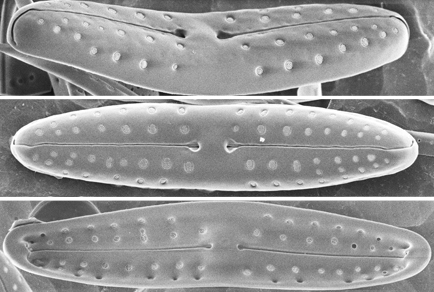
Achnanthes gainii, a marine diatom species, was described as Achnanthepyla gainii in 1921 by Maurice Peragallo from Petermann Island (Antarctic Peninsula area). For over a century, this taxon remained solely known from its original description and illustration of a single raphe valve. More detailed observations of the species are lacking, but a literature search showed that during the last century it was transferred to the genus Achnanthes three times. In this paper, we document and illustrate using both light and scanning electron microscope observations, the morphology of valves from a large population from South Bay, Livingston Island (Maritime Antarctica), matching well the description of this historic taxon. Since the search for the original material in the Peragallo Collection in Bordeaux a couple of years ago proved unsuccessful, in the absence of the original material and slides of A. gainii, the original drawing by M. Peragallo in 1921 is designated as lectotype, and the new population from Livingston Island is designated as epitype to the designated lectotype. The species is separated from other similar taxa, including a taxon recently identified as Achnanthes bongrainii, of which observations and scanning electron microscope illustrations are also provided in this work for comparison, based on populations from South Bay. Finally, several researchers previously commented the similarity of A. gainii to Achnanthes groenlandica. Therefore, the Antarctic records of the latter species were also verified, to the extent possible. This resulted in the discovery that a number of the published illustrations of A. groenlandica from Antarctica represent Achnanthes bongrainii, but not A. gainii.
References
- Al-Handal, A.Y. & Wulff, A. (2008) Marine benthic diatoms from Potter Cove, King George Island, Antarctica. Botanica Marina 51: 51–68. https://doi.org/10.1515/BOT.2008.007
- Al-Handal, A.Y., Torstensson, A. & Wulff, A. (2022) Revisiting Potter Cove, King George Island, Antarctica, 12 years later: new observations of marine benthic diatoms. Botanica Marina 65: 81–103. https://doi.org/10.1515/bot-2021-0066
- Bory de Saint-Vincent, J.B.G.M. (1822) Achnanthes. In: Bory de Saint-Vincent, J.B.G.M. (Ed.) Dictionnaire classique d’histoire naturelle. Tome premier. Rey et Gravier & Baudoin Fils, Paris, pp. 79–80.
- Carlson, G.W.F. (1913) Süsswasser-Algen aus der Antarktis, Süd-Georgien und den Falkland Inseln. Wissenschaftliche Ergebnisse der Schwedischen Südpolar-Expedition 1901–1903, unter leitung von Dr. Otto Nordenskjöld. Lithographisches Institut des Generalstabs, Stockholm, pp. 1–94.
- Cleve, P.T. (1873) On Diatoms from the Arctic Sea. Bihang till Kongliga Svenska Vetenskaps-Akademiens Handlingar 1: 1–28.
- Cleve, P.T. (1895) Synopsis of the Naviculoid Diatoms, Part II. Kongliga Svenska-Vetenskaps Akademiens Handlingar 27: 1–219.
- Cleve, P.T. & Grunow, A. (1880) Beiträge zur Kenntniss der arctischen Diatomeen. Kongliga Svenska Vetenskaps-Akademiens Handlingar 17: 1–121.
- Cleve-Euler, A. (Cleve, A.) (1953) Die Diatomeen von Schweden und Finnland. Part III. Monoraphideae, Biraphideae 1. Kongliga Svenska Vetenskaps-Akademiens Handligar, ser. 4, 4: 1–255.
- Cox, E.J. (2006) Achnanthes sensu stricto belongs with genera of the Mastogloiales rather than with other monoraphid diatoms (Bacillariophyta). European Journal of Phycology 41: 67–81. https://doi.org/10.1080/09670260500491543
- Frenguelli, J. (1939) Diatomeas del golfo de San Matías (Río Negro). Revista del Museo de la Plata, Nueva Serie, Sección Botánica 2: 201–226.
- Fukushima, H. (1963) Diatoms from Bybog Osane (Antarctic Continent) and Ongul Kalven Island. Antarctic Record 17: 55–58.
- Giffen, M.H. (1973) Diatoms of the marine littoral of Steenberg’s Cove in St. Helena Bay Cape Province, South Africa. Botanica Marina 16: 32–48. https://doi.org/10.1515/botm.1973.16.1.32
- Hasle, G.R. & Fryxell, G.A. (1970) Diatoms: cleaning and mounting for light and electron microscopy. Transactions of the American Microscopical Society 89: 469–474. https://doi.org/10.2307/3224555
- Heiden, H. & Kolbe, R.W. (1928) Die marinen Diatomeen der Deutschen Südpolar-Expedition 1901–1903. In: Deutsche Sudpolar-Expedition, 1901–1903, herausgegeben von Erich von Drygalski. Vol. VIII, Botanik (no. 5). Walter de Gruyter & Co., Berlin & Leipzig, pp. 447–715.
- Hendey, N.I. (1964) An introductory account of the smaller algae of British coastal waters. Part V: Bacillariophyceae (Diatoms). Her Majesty’s Stationery Office, London, 317 pp.
- Hirano, M. (1983) Fresh water algae from Skarvsnes, near Syowa Station, Antarctica. Memoirs of National Institute of Polar Research, Series E, 35: 1–31.
- Kellogg, T.B. & Kellogg, D.E. (2002) Non-marine and littoral diatoms from Antarctic and sub-Antarctic locations. Distribution and updated taxonomy. Diatom Monographs 1: 1–795.
- Kociolek, J.P., Blanco, S., Coste, M., Ector, L., Liu, Y., Karthick, B., Kulikovskiy, M., Lundholm, N., Ludwig, T., Potapova, M., Rimet, F., Sabbe, K., Sala, S., Sar, E., Taylor, J., Van de Vijver, B., Wetzel, C.E., Williams, D.M., Witkowski, A. & Witkowski, J. (2026) DiatomBase. Available from: https://www.diatombase.org (accessed 2 March 2026)
- Kützing, F.T. (1833) Synopsis Diatomearum oder Versuch einer systematischen Zusammenstellung der Diatomeen. Linnaea 8: 529–620, pls. XIII–XIX. https://doi.org/10.5962/bhl.title.65634
- Lee, S.D., Park, J.S. & Lee, J.H. (2013) Taxonomic study of the genus Achnanthes (Bacillariophyta) in Korean coastal waters. Journal of Ecology and Environment 36: 391–406. https://doi.org/10.5141/ecoenv.2013.391
- Majewska, R., De Stefano, M., Ector, L., Bolaños, F., Frankovich, T.A., Sullivan, M.J., Ashworth, M.P. & Van de Vijver, B. (2017) Two new epizoic Achnanthes species (Bacillariophyta) living on marine turtles from Costa Rica. Botanica Marina 60: 303–318. https://doi.org/10.1515/bot-2016-0114
- Mann, A. (1937) Scientific Reports. Series C—Zoology and Botany. Vol.1, Part 1. Diatoms. Australasian Antarctic Expedition 1911–14, under the leadership of Sir Douglas Mawson, O.B.E, B.E, D.Sc, F.R.S. David Harold Paisley, Government Printer—1937, Sydney, 82 pp.+Pl.
- McIntire, C.D. & Reimer, C.W. (1974) Some marine and brackish-water Achnanthes from Yaquina Estuary, Oregon (U.S.A.). Botanica Marina 17: 164–175. https://doi.org/10.1515/botm.1974.17.3.164
- Østrup, E. (1897) Kyst-Diatoméer fra Grønland. Meddelelser om Grønland 15: 305–362. https://doi.org/10.7146/mog.v15.139857
- Peragallo, M. (1921) Diatomées d’eau douce et diatomées d’eau salée. In: Deuxième Expédition Antarctique Française (1908–1910) commandée par le Dr. Jean Charcot. Sciences Naturelles, Documents Scientifiques, Botanique, Masson et Cie, Paris, 96 pp. + pl. https://doi.org/10.5962/bhl.title.64272
- Ross, R., Cox, E.J., Karayeva, N.I., Mann, D.G., Paddock, T.B.B., Simonsen, R. & Sims, P.A. (1979) An amended terminology for the siliceous components of the diatom cell. Nova Hedwigia Beihefte 64: 513–533.
- Round, F.E., Crawford, R.M. & Mann, D.G. (1990) The Diatoms. Biology and morphology of the genera. Cambridge University Press, Cambridge, 747 pp.
- Simonsen, R. (1992) The diatom types of Heinrich Heiden in Heiden & Kolbe 1928. Bibliotheca Diatomologica 24: 1–100.
- Temniskova-Topalova, D., Chipev, N. & Manoilova, K. (1996) Preliminary Report on Diatoms from the Livingston Island, South Shetland Islands, Antarctic. Bulgarian Antarctic Research, Life Sciences 1: 31–61.
- Temniskova-Topalova, D. & Chipev, N. (2001) Diatoms from Livingston Island, the South-Shetland Islands, Antarctica. In: Economou-Amilli, A. (Ed.) Proceedings of the 16th International Diatom Symposium, 25 Aug.—1 Sept. 2000, Athens & Aegean Islands. pp. 291–314.
- Toyoda, K. & Williams, D.M. (2004) Description of Achnanthes Bory (Bacillariophyceae) based on Kützing’s type slides and materials I: new morphological information on Achnanthes brevipes var. intermedia (Kütz.) Cleve. Diatom 20: 159–165.
- Toyoda, K., Cox, E.J., Sims, P.A. & Williams, D.M. (2005) The typification of Achnanthes Bory based on Echinella stipitata Lyngbye, with an account of the morphology and fine structure of Lyngbye’s species. Diatom Research 20: 375–386. https://doi.org/10.1080/0269249X.2005.9705643
- Witkowski, A., Lange-Bertalot, H. & Metzeltin, D. (2000) Diatom flora of marine coasts I. Iconographia Diatomologica 7: 1–925.
- Zidarova, R., Kopalová, K. & Van de Vijver, B. (2016) Diatoms from the Antarctic Region, Maritime Antarctica. Iconographia Diatomologica 24: 1–504.
- Zidarova, R., Ivanov, P., Hineva, E. & Dzhembekova, N. (2022) Diversity and habitat preferences of benthic diatoms from South Bay (Livingston Island, Antarctica). Plant Ecology and Evolution 155: 70–106. https://doi.org/10.5091/plecevo.84534