

Abstract
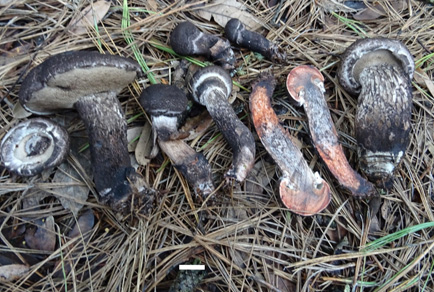
The genus Strobilomyces constitutes a phylogenetically distinct lineage within the Boletaceae family, recognized for its significant biocultural, economic and forestry relevance. However, its diversity and distribution within Mexico remain notably understudied. Here in, Strobilomyces pedireticulatus is formally described based on specimens collected from mixed-conifer forest ecosystems in Tlaxcala State, Mexico. Morphological characteristics and molecular phylogenetic analyses provide the diagnostic evidence for this identification. Additionally, it has specific biocultural importance within this region. Comprehensive documentation includes detailed macro- and microscopic descriptions, photographic record of fresh basidiomata in situ and ex situ, and analytical illustrations of key diagnostic features. Descriptions, photographs and illustrations of Strobilomyces pedireticulatus are provided.
References
- Ayala-Vásquez, O., Valenzuela, R., Aguirre-Acosta, E., Raymundo, T. & García-Jiménez, J. (2025) Species of Boletaceae (Boletales, Basidiomycota) with ornamented spores from temperate forests at the state of Oaxaca, Mexico. Studies in Fungi 3 (1): 271–292. https://doi.org/10.5943/sif/3/1/28
- Ayala-Vásquez, O. (2021) Taxonomía, biogeografía y filogenia de hongos del orden Boletales en la Sierra Norte de Oaxaca, México. Instituto Tecnológico de Ciudad Victoria, Tamaulipas, México, 304 pp.
- Bessette, A., Roody, W.C. & Bessette, A.R. (2017) North American boletes: a color guide to the flesh and pored mushrooms. Syracuse University Press, New York, pp. 364–365.
- Burrola Aguilar, C., Garibay Orijel, R., Zepeda Gómez, C. & White Olascoaga, L. (2024) Diversidad de recursos fúngicos comestibles del Estado de México. In: White Olascoaga, L. & Chávez Mejía, M.C. (Eds.) Sociedad-ambiente-cultura, Relación benéfica de los bosques templados del Estado de México. Ediciones y Gráficos Eón; Toluca, Estado de México: Universidad Autónoma del Estado de México, pp. 13–46.
- Deng, H., Wang, Y., Lei, J.R., Chen, Z.Z., Liang, Z.Q. & Zeng, N.K. (2023) Four New Species of Strobilomyces (Boletaceae, Boletales) from Hainan Island, Tropical China. Journal of Fungi 9: 1128. https://doi.org/10.3390/jof9121128
- Frandsen, P.B., Calcott, B., Mayer, C. & Lanfear, R. (2015) Automatic selection of partitioning schemes for phylogenetic analyses using iterative k-means clustering of site rates. BMC Evolutionary Biology 15: 1–17. https://doi.org/10.1186/s12862-015-0283-7
- García-Jiménez, J. & Castillo, J. (1981) Las especies de Boletáceos y Gomfidiaceos conocidos en el Estado de Nuevo León. Boletín de la Sociedad micológica 15: 121–197.
- Garibay-Orijel, R., Martínez-Ramos, M. & Cifuentes, J. (2009) Disponibilidad de esporomas de hongos comestibles en los bosques de pino-encino de Ixtlán de Juárez, Oaxaca. Revista Mexicana de Biodiversidad 80 (2): 521–534. https://doi.org/10.22201/ib.20078706e.2009.002.615
- Hall, T.A. (1999) BioEdit: A User-Friendly Biological Sequence Alignment Editor and Analysis Program for Windows 95/98/NT. Nucleic Acids Symposium Series 41: 95–98.
- Han, L.H., Wu, G., Horak, E., Halling, R.E., Xu, J., Ndolo, E.S.T., Sato, H., Fechner, N., Sharma, Y.P. & Yang, Z.L. (2020) Phylogeny and species delimitation of Strobilomyces (Boletaceae), with an emphasis on the Asian species. Persoonia 44 (1): 113–139. https://doi.org/10.3767/persoonia.2020.44.05
- Huelsenbeck, J.P. & Ronquist, F. (2001) MrBayes: Bayesian inference of phylogeny. Bioinformatics 17: 754–755. https://doi.org/10.1093/bioinformatics/17.8.754
- Katoh, M. & Kuma, M. (2002) MAFFT: A novel method for rapid multiple sequence alignment based on fast Fourier transform. Nucleic Acids Research 30 (14): 3059–3066. https://doi.org/10.1093/nar/gkf436
- Katoh, K. & Standley, D.M. (2013) MAFFT multiple sequence alignment software version 7: improvements in performance and usability. Molecular Biology and Evolution 30 (4): 772–780. https://doi.org/10.1093/molbev/mst010
- Kornerup, A. & Wanscher, J.H. (1978) Methuen handbook of colour, 3rd edn. Methuen, London, 252 pp.
- Lanfear, R., Calcott, B., Kainer, D., Mayer, C. & Stamatakis, A. (2014) Selecting optimal partitioning schemes for phylogenomic datasets. BMC Evolutionary Biology 14: 1–14. https://doi.org/10.1186/1471-2148-14-82
- Lanfear, R., Frandsen, P.B., Wright, A.M., Senfeld, T. & Calcott, B. (2017) PartitionFinder 2: New methods for selecting partitioned models of evolution for molecular and morphological phylogenetic analyses. Molecular Biology and Evolution 34: 772–773. https://doi.org/10.1093/molbev/msw260
- Li, H., Tian, Y., Menolli Jr, N., Ye, L., Karunarathna, C.S., Perez-Moreno, J., Rahman, M.M., Rashid, Md H., Phengsintham, P., Rizal, L., Kasuya, T., Lim, W.Y., Dutta, A.K., Khalid, A.N., Le Thanh Huyen, Balolong, M.P., Baruah, G., Madawala, S., Thongklang, N., Hyde, K.D., Kirk, P.M., Xu, J., Sheng, J., Boa, E. & Mortimer, P.E. (2021) Reviewing the world’s edible mushroom species: A new evidence‐based classification system. Comprehensive Reviews in Food Science and Food Safety 20 (2): 1982–2014. https://doi.org/10.1111/1541-4337.12708
- Lodge, D.J., Ammirati, J.F., O´Dell, T.E. & Müller, G. (2004) Collecting and describing macrofungi. In: Muller, G., Bills, G. & Foster, M. (Eds.) Biodiversity of fungi inventory and monitoring methods. Elsevier Academic Press, California, pp. 128–153.
- Maddison, W.P. & Maddison, D.R. (2021) Mesquite: a modular system for evolutionary analysis. Available from: http:// mesquiteproject.org (accessed 17 July 2025)
- Martínez-González, C.R., Ramírez-Mendoza, R., Jiménez-Ramírez, J., Gallegos-Vázquez, C. & Luna-Vega, I. (2017) Improved method for genomic DNA extraction for Opuntia Mill. (Cactaceae). Plant Methods 13: 1–10. https://doi.org/10.1186/s13007-017-0234-y
- Müller, K., Quandt, D., Müller, J. & Neinhuis, C. (2005) PhyDE®-Phylogenetic data editor. Program distributed by the authors, version 10.0. Available from: https://www.phyde.de (accessed 20 July 2025)
- Ramírez-Carbajal, E., Martínez-Reyes, M., Ayala-Vásquez, O., Rodríguez-Evangelista, F., Lagunes Reyes, M., Hernández-Santiago, F., Rangel Villafranco, M., Yu, F. & Pérez-Moreno, J. (2025) Revitalizing endangered mycocultural heritage in Mesoamerica: The case of the Tlahuica‐Pjiekakjoo culture. Plants, People, Planet. https://doi.org/10.1002/ppp3.70014
- Stamatakis, A. (2014) RAxML version 8: a tool for phylogenetic analysis and post-analysis of large phylogenies. Bioinformatics 30: 1312–1313. https://doi.org/10.1093/bioinformatics/btu033
- Swofford, D.L. (2002) PAUP: phylogenetic analysis using parsimony, version 4.0 b10.
- Sato, H., Yumoto, T. & Murakami, N. (2007) Cryptic species and host specificity in the ectomycorrhizal genus Strobilomyces (Strobilomycetaceae). American Journal of Botany 94 (10): 1630–1641. https://doi.org/10.3732/ajb.94.10.1630
- Sato, H. & Murakami, N. (2009) Strobilomyces verruculosus sp. nov. from Japan. Mycoscience 50 (3): 173–178. https://doi.org/10.1007/s10267-008-0469-6
- Sato, H., Tanabe, A.S. & Toju, H. (2017) Host shifts enhance diversification of ectomycorrhizal fungi: diversification rate analysis of the ectomycorrhizal fungal genera Strobilomyces and Afroboletus with an 80‐gene phylogeny. New Phytologist 214 (1): 443–454. https://doi.org/10.1111/nph.14368
- Singer, R. (1986) The Agaricales in Modern Taxonomy, 4th ed. Koeltz Scientific Books, Königstein, pp. 1–981.
- Rambaut, A., Suchard, M.A., Xie, D. & Drummond, A.J. (2014) Tracer v1.6. Available from: http://beast.bio.ed.ac.uk/Tracer (accessed 20 July 2025)
- Rambaut, A., Drummond, A.J., Xie, D., Baele, G. & Suchard, M.A. (2018) Posterior summarization in Bayesian phylogenetics using Tracer 1.7. Systematic Biology 67 (5): 901–904. https://doi.org/10.1093/sysbio/syy032
- Rathnayaka, A.R., Tennakoon, D.S., Jones, G.E.B., Wanasinghe, D.N., Bhat, D.J., Priyashantha, A.K.H., Stephenson, S.L., Tibpromma, S. & Karunarathna, S.C. (2024) Significance of precise documentation of hosts and geospatial data of fungal collections, with an emphasis on plant associated fungi. New Zealand Journal of Botany. https://doi.org/10.1080/0028825X.2024.2381734
- Weber, S.N. & Smith, H.A. (1985) A Field Guide to Southern Mushrooms. The University of Michigan Press, pp. 67–113.
- White, T.J., Bruns, T., Lee, S. & Taylor, J. (1990) Amplification and direct sequencing of fungal ribosomal RNA genes for phylogenies. In: Innis, M.A., Gelfand, D.H., Sninsky, J.J. & White, T.J. (Eds.) PCR protocols: a guide to methods and applications. Academic Press, San Diego, pp. 315–322. https://doi.org/10.1016/B978-0-12-372180-8.50042-1
- Wu, G., Feng, B., Xu, J., Zhu, X.T., Li, Y.C., Zeng, N.K., Hosen, M.I. & Yang, Z.L. (2014) Molecular phylogenetic analyses redefine seven major clades and reveal 22 new generic clades in the fungal family Boletaceae. Fungal Diversity 69 (1): 93–115. https://doi.org/10.1007/s13225-014-0283-8
- Wu, G., Li, Y.C., Zhu, X.T., Zhao, K., Han, L.H., Cui, Y.Y. & Yang, Z.L. (2016) One hundred noteworthy boletes from China. Fungal Diversity 81: 25–188. https://doi.org/10.1007/s13225-016-0375-8
- Zang, M. (1985) Notes on the Boletales from Eastern Himalayas and adjacent of China. Acta Botanica Yunnanica 7 (4): 383–401.
- Zhang, Z., Schwartz, S., Wagner, L. & Miller, W. (2000) A greedy algorithm for aligning DNA sequences. Journal of Computational Biology 7: 203–214. https://doi.org/10.1089/10665270050081478