
Abstract
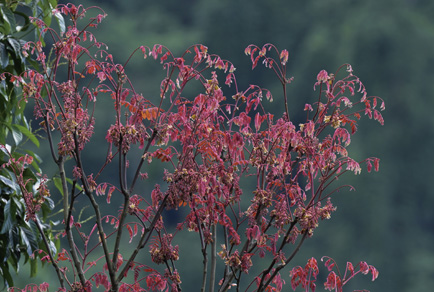
A total of six species of the genus Gymnocladus are recognized herein, five of which are distributed in Asia: G. angustifolius, G. assamicus, G. burmanicus, G. chinensis, along with G. sanctus that is described and illustrated as new. The new species resembles the only North American species, G. dioicus, but differs by its generally lanceolate-ovate to oblong (vs. ovate) leaflets, which are thinly coriaceous (vs. chartaceous), pinkish (vs. white to greenish-white) flowers, and generally smaller and thicker (8–12 × 3–4.5 × 2.5–3 cm vs. 12–25 × 3–7 × 0.6–0.8 cm), sparsely puberulent (vs. glaucous) pods. Additionally, a lectotype is designated for G. assamicus. An updated key encompassing all six species and a distribution map for the five Asian species are also provided.
References
- Bachman, S., Moat, J., Hill, A.W., de la Torre, J. & Scott, B. (2011) Supporting Red List threat assessments with GeoCAT: geospatial conservation assessment tool. ZooKeys 150: 117–126. https://doi.org/10.3897/zookeys.150.2109
- Baillon, M.H. (1875) Sur les Gousses Chinoises de Shang-haï et sur les Gymnocladus. Compte Rendu de la Association Française pour l’Avancement des Sciences 3: 418–423.
- Beckman, E., Meyer, A., Pivorunas, D., Hoban, S. & Westwood, M. (2021) Conservation Gap Analysis of Kentucky Coffeetree. The Morton Arboretum, Lisle, 15 pp.
- Botany Vietnam Group (2007 onwards) Gymnocladus angustifolius. Vietnam Plant Data Center: Plant Database. Available from: https://www.botanyvn.com/cnt.asp?param=edir&v=Gymnocladus%20angustifolius&list=species&lg=en (accessed 7 October 2025)
- Brummitt, R.K. (2000) Report of the Committee for Spermatophyta: 49. Taxon 49 (2): 261–278. https://doi.org/10.2307/1223840
- Bruneau, A., Forest, F., Herendeen, P.S., Klitgaard, B.B. & Lewis, G. (2001) Phylogenetic relationships in the Caesalpinioideae (Leguminosae) as inferred from chloroplast trnL intron sequences. Systematic Botany 26 (3): 487–514. https://doi.org/10.1043/0363-6445-26.3.487
- Bruneau, A., Mercure, M., Lewis, G.P. & Herendeen, P.S. (2008) Phylogenetic patterns and diversification in the caesalpinioid legumes. Botany 86: 697–718. https://doi.org/10.1139/B08-058
- Carrero, C. (2020) Gymnocladus dioicus. The IUCN Red List of Threatened Species 2020: e.T62026160A62026162. https://doi.org/10.2305/iucn.uk.2020-2.rlts.t62026160a62026162.en
- Chen, Y. (1924) Synopsis of Chinese trees (24) [中國樹木誌略(第二十四續)]. Journal of the Agricultural Association of China 36: 23–37.
- Chen, Y. (1937) Illustrated Manual of Chinese Trees and Shrubs. The Agricultural Association of China, Nanking, 1191 pp.
- Chen, D., Zhang, D. & Larsen, K. (2010a) Gymnocladus. In: Wu, Z.Y., Raven, P.H. & Hong, D.Y. (Eds.) Flora of China 10. Science Press, Beijing and Missouri Botanical Garden Press, St Louis, pp. 36.
- Chen, D., Zhang, D. & Larsen, K. (2010b) Gleditsia. In: Wu, Z.Y., Raven, P.H. & Hong, D.Y. (Eds.) Flora of China 10. Science Press, Beijing and Missouri Botanical Garden Press, St Louis, pp. 36–39.
- Choudhury, B.I. & Khan, M.L. (2020) The Himalayan Soap Pod Tree (Gymnocladus assamicus): An Ecologically and Economically Important Tree on the Brink of Extinction. CABI, Oxfordshire, 173 pp. https://doi.org/10.1079/9781786391988.0000
- Choudhury, B., Khan, M.L., Arunachalam, A. & Das, A.K. (2007) Ecology and conservation of the Critically Endangered tree species Gymnocladus assamicus in Arunachal Pradesh, India. Research Letters in Ecology 2007: 59282. https://doi.org/10.1155/2007/59282
- Choudhury, B.I., Khan, M.L. & Das, A.K. (2009) Seed dormancy and germination in Gymnocladus assamicus: An endemic legume tree from Northeast India. Seed Science and Technology 37 (3): 582–588. https://doi.org/10.15258/sst.2009.37.3.07
- Choudhury, B.I., Khan, M.L. & Dayanandan, S. (2014) Functional androdioecy in critically endangered Gymnocladus assamicus (Leguminosae) in the eastern Himalayan region of Northeast India. PLoS ONE 9 (2): e87287. https://dx.doi.org/10.1371/journal.pone.0087287
- de Kok, R. (2024) Gymnocladus burmanicus. The IUCN Red List of Threatened Species 2024: e.T224088253A224134657. https://doi.org/10.2305/iucn.uk.2024-1.rlts.t224088253a224134657.en
- Duocet Group (2016 onwards) Duocet Wiki of Plants. Available from: http://duocet.ibiodiversity.net (accessed 8 June 2025)
- Fiori, A. (1911) Boschi e piante legnose dell’Eritrea (continuazione, vedi fasc. 8 dell’anno 1910). L’Agricoltura coloniale 5: 41–61.
- Forsskål, P. & Niebuhr, C. (1775) Flora Aegyptiaco-Arabica. ex officina Mölleri, Hauniæ (Copenhagen), 220 pp. https://doi.org/10.5962/bhl.title.41
- Gaertner, Joseph (1791) De Fructibus Seminibus et Plantarum Volumen 2. Typis Guilielmi Henrici Schrammii, Tubingae, 520 pp. https://doi.org/10.5962/bhl.title.53838
- Gagnepain, F. (1952) Cæsalpinées Nouvelles D’Indochine. Bulletin du Muséum national d’histoire naturelle sér. 2, 24: 317–320.
- György, Z. & Tuda, M. (2020) Host-plant range expansion to Gymnocladus dioica by an introduced seed predatory beetle Megabruchidius dorsalis. Entomological Science 23: 28–32. https://doi.org/10.1111/ens.12393
- Hajra, P.K., Verma, D.M. & Giri, G.S. (1996) Materials for the flora of Arunachal Pradesh. Botanical Survey of India, Calcutta, 693 pp.
- Han, B., Botanic Gardens Conservation International (BGCI) & IUCN SSC Global Tree Specialist Group (2019) Gymnocladus chinensis. The IUCN Red List of Threatened Species 2019: e.T147637781A147637783. https://doi.org/10.2305/iucn.uk.2019-2.rlts.t147637781a147637783.en
- Harriman, N.A. (1998) (1376) Proposal to conserve the name Gymnocladus (Leguminosae: Caesalpinioideae) with a conserved gender and type. Taxon 47 (4): 875–876. https://doi.org/10.2307/1224196
- Herendeen, P.S. & Bruneau, A. (2024) 3. Tribe Gleditsieae. In: Bruneau, A., de Queiroz, L.P. & Ringelberg, J.J. (Eds.) Advances in Legume Systematics 14. Classification of Caesalpinioideae. Part 2: Higher-level classification. PhytoKeys 240: 70–77. https://doi.org/10.3897/phytokeys.240.101716
- Herendeen, P.S., Bruneau, A. & Lewis, G.P. (2003a) Phylogenetic relationships in caesalpinioid legumes: a preliminary analysis based on morphological and molecular data. In: Klitgaard, B.B. & Bruneau, A. (Eds.) Advances in Legume Systematics Part 10: Higher Level Systematics. Royal Botanic Gardens, Kew, pp. 37–62. https://doi.org/10.1080/10635150590945232
- Herendeen, P.S., Lewis, G.P. & Bruneau, A. (2003b) Floral morphology in caesalpinioid legumes: testing the monophyly of the “Umtiza clade”. International Journal of Plant Science 164 (5 suppl.): S393–S407. https://doi.org/10.1086/376881
- Hu, C. & Cheng, H. (1988) Gymnocladus. In: Chen, T. (Ed.) Flora Reipublicae Popularis Sinicae 39. Science Press, Beijing, pp. 79–82.
- Huang, L., Tian, L., Huang, L., Jin, C., Hu, S., Zhang, Z., Yan, E., Jim, C.Y., Yang, Y., Lindenmayer, D.B. & Tang, Z. (2025) Religious temples are long-term refuges for old trees in human-dominated landscapes in China. Current Biology 35: 1–7. https://doi.org/10.1016/j.cub.2025.05.030
- Huang, P. & Yao, Q. (1980) Species novae Gymnocladi Sinicae. Journal of Nanjing Technological College of Forest Products 1980 (1): 126–127.
- Huang, S.H. (1997) Caesalpiniaceae. In: Chen, S.K. (Ed.) Flora Yunnanica 8. Science Press, Beijing, pp. 408–493.
- IUCN Standards and Petitions Subcommittee (2024) Guidelines for using the IUCN Red List categories and criteria. Version 16. Available from: https://www.iucnredlist.org/resources/redlistguidelines (accessed 8 June 2025)
- Kanjilal, P.C. & Das, A. (1934) Gymnocladus assamicus U. N. Kanjilal ex P. C. Kanjilal. Leguminosae—Cæsalpinieae. Assam Forest Records, Botany 1: 7–8.
- Koch, K. (1869) Dendrologie. F. Enke1, Erlangen, 735 pp.
- Kress, W.J., DeFilipps, R.A., Farr, E. & Kyi, D.Y.Y. (2003) A checklist of the trees, shrubs, herbs, and climbers of Myanmar. Contributions from the United States National Herbarium 45: 1–590. https://doi.org/10.2307/23493222
- Lamarck, J.-B.P.A.de M.de (1785) Encyclopédie méthodique Botanique 1. Liège, Paris, 752 pp.
- Lamarck, J.-B.P.A.de M.de (1786) Encyclopédie méthodique Botanique 2. Liège, Paris, 774 pp.
- Larsen, K., Larsen, S.S. & Vidal, J.E. (1980) Leguminosae (Fabaceae): Caesalpinioideae. In: Aubréville, A. & Leroy, J.-F. (Eds.) Flore du Cambodge du Laos et du Viêt-Nam 18. Muséum National D’Histore Naturelle, Laboratoire de Phanérogamie, Paris, pp. 1–227. https://doi.org/10.1111/j.1756-1051.2001.tb01334.x
- Lee, Y.-T. (1976) The genus Gymnocladus and its tropical affinity. Journal of the Arnold Arboretum 57 (1): 91–112. https://doi.org/10.5962/bhl.part.28162
- Lewis, G.P. (2005) Tribe Caesalpinieae. In: Lewis, G., Schrire, B., Mackinder, B. & Lock, M. (Eds.) Legumes of the World. Royal Botanic Gardens, Kew, pp. 124–161. https://doi.org/10.1017/s0960428606190198
- Lan, K.M. (1989) Gymnocladus. In: Ye, N.G. (Ed.) Flora of Guizhou 7. Sichuan Ethnic Publishing House, Chengdu, pp. 340–342.
- Li, S.Z. (1596) Compendium of Materia Medica [Bencao Gangmu, 本草綱目], Vol. 35: Woods II [木之二]. (In: Complete Books of the Four Storehouses [Siku Quanshu, 四庫全書], Zi: 5 [子部五], Qing Dynasty compilation 1772–1783, revised and supplemented 1783–1803). 193 pp.
- Lin, Q.W. (2012) Gymnocladus sp., PPBC id: 8132321. Plant Photo Bank of China, PPBC. Available from: https://ppbc.iplant.cn/tu/8132321 (accessed 7 November 2025)
- Linnaeus, C. (1753a) Species Plantarum 1. Impensis Laurentii Salvii, Holmiae, 560 pp.
- Linnaeus, C. (1753b) Species Plantarum 2. Impensis Laurentii Salvii, Holmiae, pp. 561–1200.
- Linnaeus, C. (1767) Systema Naturae 2. Impensis Laurentii Salvii, Holmiae, 736 pp.
- Liu, L.H. (2010) Gymnocladus. In: Li, B.G. & Liu, L.H. (Eds.) Flora of Hunan 3. Hunan Science & Technology Press, pp. 589–592.
- Manzanilla, V. & Bruneau, A. (2012) Phylogeny reconstruction in the Caesalpinieae grade (Leguminosae) based on duplicated copies of the sucrose synthase gene and plastid markers. Molecular Phylogenetics and Evolution 65: 149–162. https://doi.org/10.1016/j.ympev.2012.05.035
- Nakai, T. (1943) Ordines, familiae, tribi, genera, sectiones, species, varietates, formae et combinationes novae a Prof. Nakai Takenosin adhuc ut novis edita. Appendix. Universitatis Imperialis Tokyoensis, Hokyukan, Japan, 256 pp.
- Ngày (2025) Cây lá đỏ rực rỡ ở Lâm Đồng, du khách hiếu kỳ đi trăm km tới check-in. Trang Thông Tin Điện Tử Tổng Hợp: Lifestyle. Available from: https://eva.vn/di-dau-xem-gi/cay-la-do-ruc-ro-o-lam-dong-du-khach-hieu-ky-di-tram-km-toi-check-in-c40a625670.html (accessed 7 October 2025)
- Nordman, C. (2025) Gymnocladus dioicus. Nature Serve Explorer. Available from: https://explorer.natureserve.org/Taxon/ELEMENT_GLOBAL.2.151008/Gymnocladus_dioicus (accessed 12 May 2026)
- Oliver, D. (1883) Erythrophlœum fordii Oliv. In: Hooker, J.D. (Ed.) Hooker’s Icones Plantarum 15. Williams, London and Nograte, Edinburgh, pp. 7–8.
- Parkinson, C.E. (1928) Gymnocladus burmanicus. Bulletin of Miscellaneous Information 1928 (8): 333.
- Pho, C. (2023) Finding the name of the mesmerizing lonely red-leaf tree in Lam Dong. Vietnam Times: Multimedia. Available from: https://vietnamtimes.thoidai.com.vn/finding-the-name-of-the-mesmerizing-lonely-red-leaf-tree-in-lam-dong-56928.html (accessed 7 October 2025)
- Phuc, L.V., Tuyen, K.N., Hong, L.S. & Thoa, N.T. (2021) Structure and regeneration characteristics of (Gymnocladus angustifolius (Gagnep.) J.E. Vidal) species in Tuyen Quang Province. TNU Journal of Science and Technology 226: 205–213. https://doi.org/10.34238/tnu-jst.4838
- Polhill, R.M. & Vidal, J.E. (1981) Caesalpinieae. In: Polhill, R.M. & Raven, P.H. (Eds.) Advances in Legume Systematics 1. Royal Botanical Gardens, Kew, pp. 81–95.
- Reveal, J.M. (1997) Guilandina dioica L. In: Turland, N.J. & Jarvis, C.E. (1997) Typification of Linnaean specific and varietal names in the Leguminosae (Fabaceae). Taxon 46: 457–485. [https://onlinelibrary.wiley.com/doi/epdf/10.2307/1224388] https://doi.org/10.2307/1224388
- Ringelberg, J.J., Koenen, E.J.M., Iganci, J.R., de Queiroz, L.P., Murphy, D.J., Gaudeul, M., Bruneau, A., Luckow, M., Lewis, G.P. & Hughes, C.E. (2022) Phylogenomic analysis of 997 nuclear genes reveals the need for extensive generic re-delimitation in Caesalpinioideae (Leguminosae). PhytoKeys 205: 3–58. https://doi.org/10.3897/phytokeys.205.85866
- Row, J.M. & Geyer, W. (2007) Plant Guide: Kentucky Coffeetree [Gymnocladus dioicus (L.) K. Koch]. United States Department of Agriculture (USDA) & Natural Resources Conservation Service (NRCS), 6 pp. Available from: https://plants.usda.gov/DocumentLibrary/plantguide/pdf/cs_gydi.pdf (accessed 22 October 2025)
- Saha, D., Ved, D., Ravikumar, K. & Haridasan, K. (2015) Gymnocladus assamicus. The IUCN Red List of Threatened Species 2015: e.T50126611A50131355. https://doi.org/10.2305/iucn.uk.2015-2.rlts.t50126611a50131355.en
- Sanjappa, M. (2000) Checklist of the Leguminosae of South Asia. ILDIS World Database of Legumes Ver. 6, 4th International Legume Conference, Canberra, Australia.
- Schnabel, A. & Wendel, J.F. (1998) Cladistic biogeography of Gleditsia (Leguminosae) based on ndhF and rpl16 chloroplast gene sequences. American Journal of Botany 85 (12): 1753–1765. https://doi.org/10.2307/2446510
- Schnabel, A., McDonel, P.E. & Wendel, J.F. (2003) Phylogenetic relationships in Gleditsia (Leguminosae) based on ITS sequences. American Journal of Botany 90 (2): 310–320. https://doi.org/10.3732/ajb.90.2.310
- Sim, T.R. (1907) The Forests and Forest Flora of the Colony of the Cape of Good Hope. Taylor and Henderson, 361 pp.
- Singh, R.K., Srivastava, R.C., Adi Community & Mukherjee, T.K. (2009) Culturally important Dekang (Gymnocladus burmanicus C. E. Parkinson) − An addition to the flora of India from Arunachal Pradesh. Indian Journal of Traditional Knowledge 8 (4): 482–484.
- Singh, R.K., Srivastava, R.C., Adi tribe, Monpa tribe, Khasi tribe, Manipuri Community & Mukherjee, T.K. (2010) Minangmose (Gymnocladus assamicus) and Dekang (Gymnocladus burmanicus): culturally important and endangered trees of eastern Himalayas-conservation perspectives. Indian Journal of Traditional Knowledge 9 (3): 419–429. [Retracted]
- Thiers, B.M. (2025 [continuously updated]) Index Herbariorum. Available from: https://sweetgum.nybg.org/science/ih (accessed 1 July 2025)
- Turland, N.J., Wiersema, J.H., Barrie, F.R., Gandhi, K.N., Gravendyck, J., Greuter, W., Hawksworth, D.L., Herendeen, P.S., Klopper, R.R., Knapp, S., Kusber, W.-H., Li, D.-Z., May, T.W., Monro, A.M., Prado, J., Price, M.J., Smith, G.F. & Zamora Sefioret, J.C. (2025) International Code of Nomenclature for algae, fungi, and plants (Madrid Code). University of Chicago Press, Chicago, 303 pp. https://doi.org/10.7208/chicago/9780226839479.001.0001
- Vahl, M. (1790) Symbolae Botanicae, Pars 1. Nicolaus Möller & fil., Hauniae, 85 pp.
- Veesommai, U. & Larsen, K. (2002) Gymnocladus C. E. Parkinson (Leguminosae-Caesalpinioideae), a new generic record from Thailand. Thai Forest Bulletin (Botany) 30: 31–38.
- Venugopal, N. & Pamidimarri, S. (2015) Rediscovery of critically endangered Gymnocladus assamicus Kanjilal ex P.C. Kanjilal (Leguminosae: Caesalpinioideae) from West Khasi Hills District of Meghalaya. Pleione 9 (1): 186–192.
- Verdcourt, B. (1985) A synopsis of the Moringaceae. Kew Bulletin 40 (1): 1–23. https://doi.org/10.2307/4108470
- Yao, Q. & Huang, P. (1980) Synopsis of the Caralpha and Gymnocladus in Eastern Asian and North America. Journal of Nanjing Technological College of Forest Products 1980 (1): 122–125.
- Zaya, D.N. & Howe, H.F. (2009) The anomalous Kentucky coffeetree: megafaunal fruit sinking or extinction? Oecologia 161: 221–226. https://doi.org/10.1007/s00442-009-1372-3
- Zhu, M., Dai, S., Ma, Q. & Li, S. (2021) Identification of the initial water-site and movement in Gleditsia sinensis seeds and its relation to seed coat structure. Plant Methods 17-55: 1–13. https://doi.org/10.1186/s13007-021-00756-z
- Zhuang, C. (fl. 1127–1139) Chicken Rib Chronicles [Jilei Bian, 雞肋編]. In: Complete Books of the Four Storehouses [Siku Quanshu, 四庫全書], Zi: 12 [子部十二], Qing Dynasty compilation 1772–1783, revised and supplemented 1783–1803. 335 pp.