
Abstract
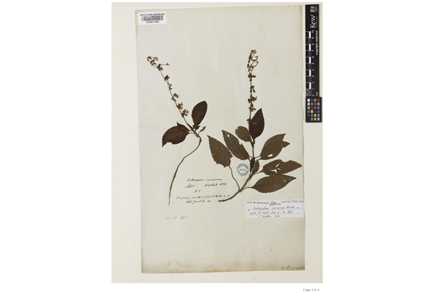
Orthosiphon incurvus (Lamiaceae) is a morphologically variable taxon distributed across the Himalaya & Indo-Myanmar region and its infraspecific boundaries have been interpreted inconsistently throughout the literature. The present study resolved the O. incurvus taxonomic complex and recognized two distinct varieties, i.e. var. incurvus and var. elata. The names of both taxa are lectotypified in order to stabilize their nomenclature, on the basis of specimens preserved at K.
References
- Burnett, G.T. (1835) Outlines of Botany. Henry Renshaw, London, 971 pp.
- Candolle, A.P. de (1848) Prodromus systematis naturalis regni vegetabilis, vol. 12. Treuttel & Würtz, Paris, 52 pp.
- Hooker, J.D. (1885) The Flora of British India, vol. 4. L. Reeve and Co., London, 615 pp.
- Hooker, W.J. (1841) Curtis’s Botanical Magazine: Or, Flower-Garden Displayed. Vol. 67. Samuel Curtis, London, pp. 226–228, t. 3847.
- IPNI (2026) International Plant Names Index. The Royal Botanic Gardens, Kew, Harvard University Herbaria & Libraries and Australian National Herbarium. Available from: https://www.ipni.org (accessed 18 January 2026)
- Khanam, M. & Hassan, M.A. (2008) Flora of Bangladesh 58. Bangladesh National Herbarium, Dhaka, pp. 1–161.
- Kumar, V.S., Banerjee, S., Singh, V., Pandey, R.P., Kumar, P.S. & Lodh, P. (2020) Lamiaceae. In: Dash, S.S. & Mao, A.A. (Eds.) Flowering plants of India: an annotated checklist vol.2. Botanical Survey of India, Kolkata, pp. 334–379.
- Martinov, I.I. (1820) Tekhno-botanicheskii slovar. 355 pp.
- Maund, B. (ed.) (1839) The Botanist: containing accurately coloured figures of tender and hardy ornamental plants; with descriptions, scientific and popular. Vols. 3–4. R. Groombridge, London, t. 173.
- Mukerjee, S.K. (1940) A Revision of the Labiatae of the Indian Empire. Bishen Singh Mahendra pal Singh, Dehradun, pp. 162–181.
- Perrino, E.V., Wagensommer, R.P., Mezzapesa, G.N. & Trani, A. (2024) Stachys italica Mill.: synecology, functional compounds and potential use of an Italian endemic taxon. Planta 260: 138. https://doi.org/10.1007/s00425-024-04571-3
- POWO (2026) Plants of the World Online. Available from: https://powo.science.kew.org (accessed 18 March 2026)
- Press, J.R., Shrestha, K.K. & Sutton, D.A. (2000) Annotated Checklist of the Flowering Plants of Nepal. The Natural History Museum, London. [http://www.efloras.org/florataxon.aspx?flora_id=110&taxon_id=242423568]
- Rajbhandari, K.R., Rai, S.K. & Chhetri, R. (2022) A handbook of the flowering plants of Nepal. vol 4. Department of Plant Resources, Thapathali, Kathmandu, Nepal, pp. 1–52.
- Sydenham, E., Lindley, J. & Ridgway, J. (1829) Edwards’s Botanical Register, vol. 15. James Ridgway, London, t. 1300. [https://www.biodiversitylibrary.org/page/6095724]
- Thiers, B.M. (2026, continuously updated) Index Herbariorum: A global directory of public herbaria and associate staff. New York Botanical Garden’s Virtual Herbarium, New York. Available from: http://sweetgum.nybg.org/science/ih/ (accessed 18 March 2026)
- TROPICOS (2026) Missouri Botanical Garden. Available from: https://www.tropicos.org/home (accessed 18 March 2026)
- Turland, N.J., Wiersema, J.H., Barrie, F.R., Gandhi, K.N., Gravendyck, J., Greuter, W., Hawksworth, D.L., Herendeen, P.S., Klopper, R.R., Knapp, S., Kusber, W.-H., Li, D.-Z., May, T.W., Monro, A.M., Prado, J., Price, M.J., Smith, G.F. & Señoret, J.C. (2025) International Code of Nomenclature for algae, fungi, and plants (Madrid Code). In: RegnumVegetabile, 162. University of Chicago Press, Chicago. https://doi.org/10.7208/chicago/9780226839479.001.0001
- Uikey, J. (2024) Reviewing of plant belonging to Lamiaceae family. International Journal of Scientific Development and Research 9: 186–191. https://doi.org/10.5281/zenodo.13309903
- Wagensommer, R.P., Perrino, E.V., Albano, A., Medagli, P. & Passalacqua, N.G. (2016) Lectotypification of four Lacaita’s names in the genus Centaurea (Asteraceae). Phytotaxa 269 (1): 54–58. https://doi.org/10.11646/phytotaxa.269.1.7
- Wallich, N., Curtis, C.M., Drake, S.A., Gorachaud & Vishnupersaud (1830) Plantae Asiaticae rariores, or, Descriptions and figures of a select number of unpublished East Indian plants. Vol. 2. Treuttel & Würtz, London, 15 pp. https://doi.org/10.5962/bhl.title.468
- Wang, R., Qiu, L., Zhang, Q.-W. & Lin, L. (2025) Ethnopharmacology, phytochemistry and pharmacology of the genus Orthosiphon: a review. Phytomedicine Plus 5 (1): 100748. https://doi.org/10.1016/j.phyplu.2025.100748