

Abstract
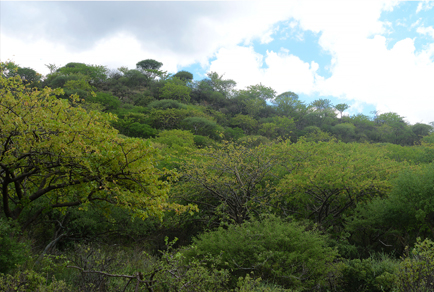
Euphorbia leleensis, a new species from Lele Hill, Bale Zone, southeastern Ethiopia, is described and illustrated based on morphological and molecular evidence. Morphologically, the new species resembles E. suborbicularis, E. polyantha, and E. agowensis, but differs in having broadly ovate to suborbicular leaf blades, with a rounded to shallowly cordate base, caducous stipules, broadly ovate to triangular-cordate bracts, yellowish-green glands with a 3–4-lobed margin, subglobose to broadly oblong and sparsely pubescent capsules, and oblong to ovoid seeds. Phylogenetic analyses based on the nuclear ITS region recover two accessions of E. leleensis as a strongly supported clade (BS = 100 %; PP = 1), sister to E. agowensis (BS = 95%; PP = 1). These results place the new species Euphorbia sect. Scatorhizae within Euphorbia subg. Chamaesyce, confirming its recognition as a distinct species. The species is preliminary assessed as Endangered (EN) according to the IUCN Red List criteria.
References
- Aubriot, X., Lowry, P.P., Cruaud, C., Couloux, A. & Haevermans, T. (2013) DNA barcoding in a biodiversity hot spot: potential value for the identification of Malagasy Euphorbia L. listed in CITES appendices I and II. Molecular Ecology Resources 13 (1): 57–65. https://doi.10.1111/1755-0998.12028
- Beentje, H. (2010) The Kew plant glossary: an illustrated dictionary of plant terms. Royal Botanic Gardens, Kew, London, 160 pp.
- Bisseret, P. & Dioli, M. (2005) Euphorbia bertemariae a new species from Ethiopia. Cactus and Succulent Journal 77: 208–209. https://doi.org/10.2985/0007-9367(2005)77[208:ebansf]2.0.co;2
- Boissier, E. (1862) Euphorbieae. In: Candolle, A.P. de (Ed.) Prodromus systematis naturalis regni vegetabilis. Vol. 15 (2). Victor Masson & Filii. Press, Paris, pp. 3–188.
- Bruyns, P. (2022) Euphorbia in Southern Africa. Vol. 2. Springer, Cham, pp. 475–985. https://doi.org/10.1007/978-3-030-49399-8
- Bruyns, P.V., Mapaya, R.J. & Hedderson, T. (2006) A new subgeneric classification for Euphorbia (Euphorbiaceae) in southern Africa based on ITS and psbA-trnH sequence data. Taxon 55: 397–420. https://doi.org/10.2307/25065587
- Bruyns, P.V., Klak, C. & Hanáček, P. (2011) Age and diversity in old world succulent species of Euphorbia (Euphorbiaceae). Taxon 60: 1717–1733. https://doi.org/10.1002/tax.606016
- Capella-Gutiérrez, S., Silla-Martínez, J.M. & Gabaldón, T. (2009) trimAl: a tool for automated alignment trimming in large-scale phylogenetic analyses. Bioinformatics 25 (15): 1972–1973. https://doi.org/10.1093/bioinformatics/btp348
- Dorsey, B.L., Haevermans, T., Aubriot, X., Morawetz, J.J., Riina, R., Steinmann, V.W. & Berry, P.E. (2013) Phylogenetics, morphological evolution, and classification of Euphorbia subgenus Euphorbia. Taxon 62: 291–315. https://doi.org/10.12705/622.1
- Edwards, S., Tadesse, M. & Hedberg, I. (1995) Flora of Ethiopia and Eritrea Volume 2 Part 2. Canellaceae to Euphorbiaceae. National Herbarium, Biology Dept., Science Faculty, Addis Ababa University; Dept. of Systematic Botany, Uppsala University, pp. 331–380.
- Evans, M., Aubriot, X., Hearn, D., Lanciaux, M., Lavergne, S., Cruaud, C., Lowry II, P.P. & Haevermans, T. (2014) Insights on the evolution of plant succulence from a remarkable radiation in Madagascar (Euphorbia). Systematic Biology 63 (5): 697–711. https://doi.org/10.1093/sysbio/syu035
- Gilbert, M.G. (1995) Euphorbiaceae. In: Edwards, S., Tadesse, M. & Hedberg, I. (Eds.) Flora of Ethiopia and Eritrea Volume 2 Part 2: 265–380. National Herbarium, Biology Dept., Science Faculty, Addis Ababa University; Dept. of Systematic Botany, Uppsala University.
- Haevermans, T., Hoffmann, P., Lowry, P.P., Labat, J.N. & Randrianjohany, E. (2004) Phylogenetic analysis of the Madagascan Euphorbia subgenus Lacanthis based on ITS sequence data. Annals of the Missouri Botanical Garden 91 (2): 247–259.
- Harris, J.G. & Harris, M.W. (1994) Plant identification terminology: an illustrated glossary. Spring Lake Publishing, Springlake, 206 pp.
- Horn, J.W., Van Ee, B.W., Morawetz, J.J., Riina, R., Steinmann, V.W., Berry, P.E. & Wurdack, K.J. (2012) Phylogenetics and the evolution of major structural characters in the giant genus Euphorbia L. (Euphorbiaceae). Molecular Phylogenetics and Evolution 63: 305–326. https://doi.org/10.1016/j.ympev.2011.12.022
- IUCN (2024) Guidelines for using the IUCN Red List Categories and Criteria, Version 16. Prepared by the Standards and Petitions Committee of the IUCN Species Survival Commission. Available from: [https://www.iucnredlist.org/resources/redlistguidelines]
- Katoh, K. & Standley, D. (2013) MAFFT multiple sequence alignment software version 7: improvements in performance and usability. Molecular Biology and Evolution 30: 772–780. https://doi.org/10.1093/molbev/mst010
- Kearse, M., Moir, R., Wilson, A., Kearse, M., Ashton, B., Moir, R., Wilson, A., Stones-Havas, S., Cheung, M., Sturrock, S., Buxton, S., Cooper, A., Markowitz, S., Duran, C., Thierer, T., Meintjes, P. & Drummond, A. (2012) Geneious Basic: an integrated and extendable desktop software platform for the organization and analysis of sequence data. Bioinformatics 28 (12): 1647–1649. https://doi.org/10.1093/bioinformatics/bts199
- Lanfear, R., Frandsen, P.B., Wright, A.M., Senfeld, T. & Calcott, B. (2017) PartitionFinder 2: new methods for selecting partitioned models of evolution for molecular and morphological phylogenetic analyses. Molecular Biology and Evolution 34: 772–773. https://doi.org/10.1093/molbev/msw260
- Letunic, I. & Bork, P. (2024) Interactive Tree of Life (iTOL) v6: recent updates to the phylogenetic tree display and annotation tool. Nucleic Acids Research 52: W78–W82. https://doi.org/10.1093/nar/gkae268
- Linnaeus, C. (1753) Species plantarum, Vol. 1. Laurentius salvius, stockholm, 560 pp. https://doi.org/10.5962/bhl.title.669
- Nguyen, L., Schmidt, H., Haeseler, A. & Minh, B. (2015) IQ-TREE: a fast and effective stochastic algorithm for estimating maximum-likelihood phylogenies. Molecular Biology and Evolution 32 (1): 268–274. https://doi.org/10.1093/molbev/msu300
- Pax, F. (1909) Euphorbia polyantha. In: Engler, A. (Ed.) Botanische Jahrbücher für systematik, Pflanzengeschichte und Pflanzengeographie, 43. pp. 87.
- Pax, F.A. & Hoffmann, K. (1921) Euphorbiaceae. In: Engler, A. (Ed.) Die Pflanzenwelt Afrikas, insbesondere seiner tropischen Gebiete. Die Vegetation der Erde. Vol. 9. Wilhelm Engelmann, Leipzig, pp. 147.
- Peirson, J.A., Bruyns, P.V., Riina, R., Morawetz, J.J. & Berry, P.E. (2013) A molecular phylogeny and classification of the largely succulent and mainly African Euphorbia subg. Athymalus (Euphorbiaceae). Taxon 62: 1178–1199. https://doi.org/10.12705/626.12
- Persoon, C.H. (1807) Synopsis plantarum: seu enchiridium botanicum, complectens enumerationem systematic specierum hucusque cognitarum Part 2. Apud Bibliopolas Treuttel et Würtz, Parisiis Lutetiorum, Apud J.G Cottam, Tubingae, 656 pp.
- Rafinesque, C.S. (1817) Second decade of undescribed American plants. The American Monthly Magazine and Critical Review 2: 119–120.
- Reichenbach, H.G.L. (1829) Conspectus regni vegetabilis per gradus naturales evoluti: Tentamen. Part 1. C. Cnobloch, Leipzig, 194 pp.
- Riina, R., Peirson, J.A., Geltman, D.V., Molero, J., Frajman, B., Pahlevani, A., Barres, L., Morawetz, J.J., Salmaki, Y., Zarre, S., Kryukov, A., Bruyns, P.V. & Berry, P.E. (2013) A worldwide molecular phylogeny and classification of the leafy spurges, Euphorbia subgenus Esula (Euphorbiaceae). Taxon 62 (2): 316–342. https://doi.org/10.12705/622.3
- Ronquist, F., Teslenko, M., Van Der Mark, P., Ayres, D., Darling, A., Höhna, S., Larget, B., Liu, L., Huelsenbeck, J. & Suchard, M. (2012) MrBayes 3.2: efficient Bayesian phylogenetic inference and model choice across a large model space. Systematic Biology 61 (3): 539–542. https://doi.org/10.1093/sysbio/sys029
- Steinmann, V.W. & Porter, J.M. (2002) Phylogenetic relationships in Euphorbieae (Euphorbiaceae) based on ITS and ndhF sequence data. Annals of the Missouri Botanical Garden 89 (4): 453–490. https://doi.org/10.2307/3298591
- Thiers, B. (2026, continuous update) Index herbariorum: a global directory of public herbaria and associated staff. New York Botanical Garden's Virtual Herbarium. Available from: http://sweetgum.nybg.org/science/ih/ (accessed 13 February 2026)
- Thulin, M. (2009) New species of Euphorbia (Euphorbiaceae) from eastern Ethiopia. Kew Bulletin 64: 469–476. https://doi.org/10.1007/S12225-009-9138-Y
- Wei, N., Pérez-Escobar, O.A., Musili, P.M., Huang, W.C., Yang, J.B., Hu, A.Q., Hu, G.W., Grace, O.M. & Wang, Q.F. (2021a) Plastome evolution in the hyperdiverse genus Euphorbia (Euphorbiaceae) using phylogenomic and comparative analyses: Large-scale expansion and contraction of the Inverted Repeat region. Frontiers in Plant Science 12: 712064. https://doi.org/10.3389/fpls.2021.712064
- Wei, N., Mutie, F.M., Mwachala, G., Grace, O.M., Hu, G.W. & Wang, Q.F. (2021b) Euphorbia mbuinzauensis, a new succulent species in Kenya from the Synadenium group in Euphorbia sect. Monadenium (Euphorbiaceae). PhytoKeys 183: 21–23. https://doi.org/10.3897/phytokeys.183.70285
- Yang, Y. & Berry, P.E. (2011) Phylogenetics of the Chamaesyce clade (Euphorbia, Euphorbiaceae): reticulate evolution and long‐distance dispersal in a prominent C4 lineage. American Journal of Botany 98 (9): 1486–1503. https://doi.org/10.3732/AJB.1000496
- Yang, Y., Riina, R., Morawetz, J.J., Haevermans, T., Aubriot, X. & Berry, P.E. (2012) Molecular phylogenetics and classification of Euphorbia subgenus Chamaesyce (Euphorbiaceae). Taxon 61 (4): 764–789. https://doi.org/10.1002/tax.614005
- Zhang, D., Gao, F., Jakovlić, I., Zou, H., Zhang, J., Li, W.X. & Wang, G.T. (2020) PhyloSuite: an integrated and scalable desktop platform for streamlined molecular sequence data management and evolutionary phylogenetics studies. Molecular Ecology Resources 20 (1): 348–355. https://doi.org/10.1111/1755-0998.13096