
Abstract
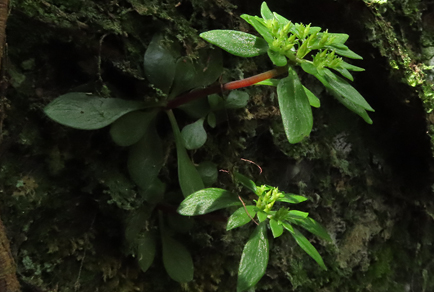
A new species, Sedum umbraculiforme, was confirmed in Fujian Province of China, based on morphological and phylogenetic analyses. Phylogenetic analysis based on the ITS sequence showed that the new species belongs to S. sect. Sedum, and is adjacent to S. lipingense on the same clade with high support values (SH-aLRT=96.9, UFBS=99). S. bulbiferum, S. kawaraense and S. baileyi were also placed on the same clade with them, while it is distantly related to S. jinglanii and S. tianmushanense. S. umbraculiforme is morphologically similar to S. lipingense, but it can be distinguished by the inflorescence (dichasiums vs. cymes), a greater number of branch flowers (2–6 flowers vs. 1–2 flowers), longer sepals (4–5 mm vs. 2 mm), and the differently shaped nectar blades (oblong vs. broadly cuneate). According to the IUCN Red List Categories and Criteria, S. umbraculiforme qualifies as Vulnerable (VU) on the basis of Criterion D1, as the total number of individuals is fewer than 1,000.
References
- Chai, M.L., Wu, Y.M., Zhang, Y., Pu, J.B., Chen, B., Xu, Y.L. & Li, P. (2023) Sedum xunvense, a new species from Southeast China. Taxon 644: 258–270. https://doi.org/10.11646/phytotaxa.644.4.2
- Doyle, J.J. & Doyle, J.L. (1987) A rapid DNA isolation procedure for small quantities of fresh leaf tissue. Phytochemical Bulletin 19: 11–15.
- Fu, K.T., Ohba, H. & Gilbert, M.G. (2001) Crassulaceae. In: Fu, K.J. & Ohaba (Ed.) Flora of China 8. Science Press, Beijing & Missouri Botanical Garden Press, St Louis, pp. 202–268.
- Fröderström, H. (1931) The genus Sedum L. A systematic essay. Acta Horti Gothoburgensis 6 (appendix): 1–111.
- Hart, H.T. & Jarvis, C.E. (1993) Typification of Linnaeus's names for European species of Sedum subgen. Sedum (Crassulaceae). Taxon 42: 399–410. https://doi.org/10.2307/1223149
- Huang, Y.S., Meng, K.K., Sun, Y.Y., Chen, Z.X. & Fan, Q. (2023) A new species of Sedum (Crassulaceae) from Mount Danxia in Guangdong, China. Phytokeys 221: 117–129. https://doi.org/10.3897/phytokeys.221.97495
- Ho, Y.C. (1989) New taxa of Sedum from Zhejiang. Bulletin of Botanical Research 9: 32–35.
- Ito, T., Chen, R., Yang, Q.E., Saito, Y., Yokota, M. & Kokubugata, G. (2014a) Taxonomic reexamination of Sedum formosanum (Crassulaceae) in Japan, Taiwan, and the Philippines based on molecular data. The journal of phytogeography and taxonomy 62: 1–9.
- Ito, T., Kanemitsu, H., Hoson, T. & Yahara, T. (2023) A new species of succulent plant discovered in limestone areas of Kyushu, Japan: Sedum kawaraense (Crassulaceae). Phytotaxa 587: 149–160. https://doi.org/10.11646/phytotaxa.587.2.4
- Ito, T., Nakamura, K., Park, C., Song, G., Maeda, A., Watanabe, Y. & Kokubugata, G. (2014b) Nuclear and plastid DNA data confirm that Sedum tosaense (Crassulaceae) has a disjunct distribution between Pacific mainland Japan and Jeju Island, Korea. Phytotaxa 177: 221–230. https://doi.org/10.11646/phytotaxa.177.4.3
- Ito, T., Yu, C.C., Nakamura, K., Chung, K.F., Yang, Q.E., Fu, C.X., Qi, Z.C. & Kokubugata, G. (2017a) Unique parallel radiations of high-mountainous species of the genus Sedum (Crassulaceae) on the continental island of Taiwan. Molecular Phylogenetics and Evolution 113: 9–22. https://doi.org/10.1016/j.ympev.2017.03.028
- Ito, T., Nakanishi, H., Chichibu, Y., Minoda, K. & Kokubugata, G. (2017b) Sedum danjoense (Crassulaceae), a new species of succulent plants from the Danjo Islands in Japan. Phytotaxa 309: 23–34. https://doi.org/10.11646/phytotaxa.309.1.2
- IUCN. (2012) IUCN Red List Categories and Criteria: Version 3.1. Second edition. IUCN, Gland, Switzerland and Cambridge, UK, 16–22 pp.
- Kalyaanamoorthy, S., Minh, B.Q., Wong, T.K.F., Haeseler, A.V. & Jermin, L.S. (2017) Modelfinder: fast model selection for accurate phylogenetic estimates. Nature Methods 14: 587–589. https://doi.org/10.1038/nmeth.4285
- Letunic, I. & Bork, P. (2024) Interactive Tree of Life (iTOL) v6: recent updates to the phylogenetic tree display and annotation tool. Nucleic Acids Research 52: W78–W82. https://doi.org/10.1093/nar/gkae268
- Linnaeus, C. (1753) Species Plantarum. Laurentii Salvii, Holmiae, 560 pp.
- Mayuzumi, S. & Ohba, H. (2004) The Phylogenetic Position of Eastern Asian Sedoideae (Crassulaceae) Inferred from Chloroplast and Nuclear DNA Sequences. Systematic Botany 29: 587–598. https://doi.org/10.1600/0363644041744329
- Meng, S.Y., Chen, B. & Sodmergen (2023) Sedum danxiacola (Crassulaceae), an endemic new species from the Danxia landform, China. Kew Bulletin 78: 673–681. https://doi.org/10.1007/s12225-023-10122-y
- Minh, B.Q., Schmidt, H.A., Chernomor, O., Schrempf, D., Woodhams, M.D., Haeseler, A.V. & Lanfear, R. (2020) IQ-TREE 2: New Models and Efficient Methods for Phylogenetic Inference in the Genomic Era. Molecular Biology and Evolution 37: 1530–1534. https://doi.org/10.1093/molbev/msaa015
- Mort, M.E., Soltis, D.E., Soltis, P.S., Francisco-Ortega, J. & Santos-Guerra, A. (2002) Phylogenetics and Evolution of the Macaronesian Clade of Crassulaceae Inferred from Nuclear and Chloroplast Sequence Data. Systematic Botany 27: 271–288.
- Praeger, L.R. (1932) An Account of the Sempervivum Group. Royal Horticultural Society, Great Britain, 265 pp.
- Saint-Hilaire, J.H.J. (1805) Exposition des Familles Naturelles. BiblioBazaar, Charleston, 572 pp.
- Seemann, W.E.G. & Seemann, B. (1853) Bonplandia. Zeitschrift für die gesammte Botanik. C. Rmpler, Hannover, 342 pp.
- Tamura, K., Stecher, G. & Kumar, S. (2021) MEGA11: Molecular Evolutionary Genetics Analysis version 11. Molecular Biology and Evolution 38: 3022–3027. https://doi.org/10.1093/molbev/msab120
- Thiede, J. & Eggli, U. (2007) Crassulaceae. In: Kubitzki, K. (ed.) The Families and Genera of Vascular Plants vol. 9. Springer, Berlin Heidelberg, pp. 83–118.
- White, T.J., Bruns, T., Lee, S. & Taylor, J. (1990) Amplification and direct sequencing of fungal ribosomal RNA genes for phylogenetics. PCR protocols: A Guide to Methods and Applications 18: 315–322. https://doi.org/10.1016/B978-0-12-372180-8.50042-1
- Williams, J.G.K., Kubelik, A.R.K., Livak, K.J., Rafalski, J.A. & Tingey, S.V. (1990) DNA polymorphisms amplified by arbitrary primers are useful as genetic markers. Nucleic Acids Research 19: 6531–6535. https://doi.org/10.1093/nar/18.22.6531
- Xie, D.M., Peng, D.Y., Fang, C.W., Qin, M.J., Wang, D.Q. & Huang, L.Q. (2014) Sedum spiralifolium (Crassulaceae): A new species from Anhui Province, China. Phytotaxa 183: 171–182. https://doi.org/10.11646/phytotaxa.183.3.4
- Zhang, J.Q., Meng, S.Y., Wen, J. & Rao, G.Y. (2014) Phylogenetic Relationships and Character Evolution of Rhodiola (Crassulaceae) based on Nuclear Ribosomal ITS and Plastid trnL-F and psbA-trnH Sequences. Systematic Botany 39: 441–451. https://doi.org/10.1600/036364414X680753
- Zhang, R.B., Deng, T., Dou, Q.L., He, L., Lv, X.Y. & Jiang, H. (2019) Sedum lipingense (Crassulaceae) identifying a new stonecrop species in SE Guizhou, China, based on morphological and molecular evidence. PhytoKeys 134: 125–133. https://doi.org/10.3897/phytokeys.134.38287
- Zhu, Z.W., Chen, B. & Chen, S.P. (2024) A new species of Sedum from Jiangxi: Sedum fluviale. Acta Botanica Boreali-Occidentalia Sinica 44: 673–680. https://doi.org/10.7606/j.issn.1000-4025.20230632
- Zhu, Z.W., Le, X.G., Chen, S.P. & Chen, B. (2023) Sedum yangjifengensis (Crassulaceae), a new species from Jiangxi, China. Phytotaxa 607: 105–113. https://doi.org/10.11646/phytotaxa.607.1.9
- Zou, C.Y., Meng, S.Y., Xu, W.B. & Liu, Y. (2023) Notes on Sedum L. (Crassulaceae) of Guangxi. Guihaia 43: 2213–2223. https://doi.org/10.11931/guihaia.gxzw202301036