

Abstract
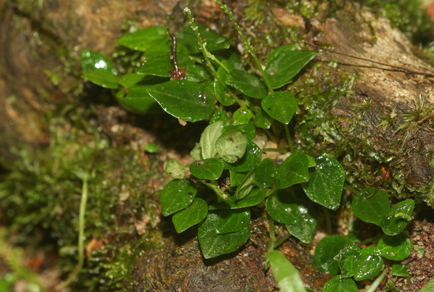
Peperomia daironii is described and illustrated as a new species of Peperomia subgenus Tildenia from the Guiana Shield of Colombia. It is a geophytic, rupicolous herb with a tuberous root that grows embedded in rock crevices on understory rocky outcrops in the surroundings of Caño Cristales, Caño Barro, and the Serranía de la Lindosa, in the basins of the Guayabero and Orinoco rivers, municipality of La Macarena, in the transition zone between the Orinoquia and Amazon regions. The new species resembles Peperomia klopfensteinii in its rupicolous habit and peltate leaves but differs in its diminutive size (4–8 cm tall), leaf blades with venation lighter than the lamina, and spadices up to three times longer than the petioles. Specimens of subgenus Tildenia from Colombia collected above 2600 m elevation in Cundinamarca and Boyacá have previously been identified as Peperomia peruviana. However, P. daironii, recorded below 300 m elevation, differs markedly in leaf blade morphology.
Se describe e ilustra Peperomia daironii como una nueva especie de Peperomia subgénero Tildenia del Escudo Guayanés de Colombia. Es una hierba geofítica, rupícola, con raíz tuberosa que crece incrustada en grietas rocosas en afloramientos rocosos del sotobosque en los alrededores de Caño Cristales, Caño Barro y la Serranía de la Lindosa, en las cuencas de los ríos Guayabero y Orinoco, municipio de La Macarena, en la zona de transición entre la Orinoquía y la Amazonía. La nueva especie se asemeja a Peperomia klopfensteinii en su hábito rupícola y hojas peltadas, pero difiere en su tamaño diminuto (4–8 cm de altura), láminas foliares con nervadura más clara que la lámina y espádices hasta tres veces más largos que los pecíolos. Los especímenes del subgénero Tildenia de Colombia, recolectados por encima de los 2600 m de altitud en Cundinamarca y Boyacá, se habían identificado previamente como Peperomia peruviana. Sin embargo, P. daironii, registrada por debajo de los 300 m de altitud, presenta una marcada diferencia en la morfología de la lámina foliar.
Palabras clave: Colombia, Orinoquia, Peperomias, especies rupicola, Serranía de la Macarena
References
- Aublet, J. (1775) Histoire des plantes de la Guiane Françoise. P.F. Didot jeune, Londres, 621 pp. https://doi.org/10.5962/bhl.title.48831
- Bachman, S., Moat, J., Hill, A.W., de la Torre, J. & Scott, B. (2011) Supporting red list threat assessments with geoCaT: geospatial conservation assessment tool. ZooKeys 150: 117–126. https://doi.org/10.3897/zookeys.150.2109
- Bernal, R., Gradstein, S.R. & Celis, M. (2016) Catálogo de Plantas y líquenes de Colombia. Vol 1. Instituto de Ciencias Naturales, Universidad Nacional de Colombia, Bogotá, 1501 pp.
- Candolle, D.C. (1917) III Piperaceae neotropicae. Notizblatt des Königlichen botanischen Gartens und Museums zu Berlin 62 6: 434–483.
- Frenzke, L., Scheiris, E., Pino, G., Symmank, L., Goetghebeur, P., Neinhuis, C., Wanke, S. & Samain, M.S. (2015) A revised infrageneric classification of the genus Peperomia Ruiz & Pav. (Piperaceae). Taxon 64: 424–444. https://doi.org/10.12705/643.4
- IUCN (2024) The IUCN red list categories and criteria. Version 16. Prepared by the Standards and Petitions Committee. Available from: http://www.iucnredlist.org/documents/RedListGuidelines.pdf (accessed 30 September 2025)
- Frenzke, L., Goetghebeur, P., Neinhuis, C., Samain, M.S. & Wanke, S. (2016) Evolution of Epiphytism and Fruit Traits Act Unevenly on the Diversification of the Species-Rich Genus Peperomia (Piperaceae). Frontiers in Plant Science 7: 1–13. https://doi.org/10.3389/fpls.2016.01145
- Krömer, T. & Batke, S.P. (2025) Epiphytic plants: perspective on their diversity, distribution, systematics and conservation in the changing environment. Plants 14: 2265. https://doi.org/10.3390/plants14152265
- Linnaeus, C.f. (1782) Supplementum plantarum Systematis vegetabilium editionis decimae tertiae, Generum plantarum editionis sextae, et Specierum plantarum editionis secundae. Impensis Orphanotrophei, Brunsvigae, 628 pp.
- Mathieu, G. (2001–2025) Taxonomic Repertory of the Genus Peperomia. Available from: www.peperomia.net/ (accessed 20 November 2025)
- Mathieu, G., Symmank, L., Callejas, R., Wanke, S., Neinhuis, C., Goetghebeur, P. & Samain, M.S. (2011) Nuevas especies geofíticas de Peperomia (Piperaceae) de México, Belice y Costa Rica. Revista Mexicana De Biodiversidad 82 (2). https://doi.org/10.22201/ib.20078706e.2011.2.1199
- Mendoza-Cifuentes, H., Cárdenas, D., Aguilar-Cano, J., Ramírez-Padilla, B., Dueñas-Cepeda, A. & Carbonó-Delahoz, E. (2018) Representatividad de plantas vasculares en los Parques Nacionales Naturales de Colombia: ¿cuántas especies alberga el sistema? Biota colombiana 19 (2): 21–34. https://doi.org/10.21068/c2018.v19n02a03
- Miquel, F.A.W. (1843) Systema Piperacearum. H. A. Kramers, Rotterdam, 575 pp.
- Miquel, F.A.W. (1845) De Phenakospermi, Musacearum generis, charactere botanico. Botanische Zeitung 3: 345–346.
- Paba, F. & van der Hammen, T. (1958) Sobre la geología de la parte sur de la Macarena. Boletín Geológico 6 (1–3): 4–30. https://doi.org/10.32685/0120-1425/bolgeol6.1-3.1958.285
- Philbrick, C.T., Ruhfel, B.R. & Bove, C.P. (2018) Contributions to the taxonomy of Rhyncholacis (Podostemaceae): Evidence of monophyly, description of a new species, and transfer of the monotypic Macarenia. Phytotaxa 357 (2): 107–116. https://doi.org/10.11646/phytotaxa.357.2.3
- Pino, G., Samain, M.S., Suclli, E., Alcalá, A. & Marquiegui, D. (2022) Two New Geophytic Species of Peperomia Subgenus Tildenia (Piperaceae) from Central Peru. Haseltonia 29 (1): 27–35. https://doi.org/10.2985/026.029.0105
- POWO (2025) Plants of the world online. Royal Botanic Gardens, Kew. Available from: https://powo.science.kew.org/ (accessed 14 October 2025)
- Quimbayo, R.M. & Muñoz, M.C. (2024) Estructura y diversidad arbórea en dos corredores de bosque de galería en la Orinoquia colombiana. Biota Colombiana 25: e1239. 1–18. https://doi.org/10.21068/2539200X.1239
- Ruiz, H. & Pavón, J. (1794) Florae Peruvianae et Chilensis Prodromus. Gabrielis de Sancha, Madrid, 153 pp.
- Samain, M.S., Mathieu, G., Vanderschaeve, L., Wanke, S., Neinhuis, C. & Goetghebeur, P. (2007) Nomenclature and typification of subdivisional names in the genus Peperomia (Piperaceae). Taxon 56: 229–236. [http://www.jstor.org/stable/25065756]
- Samain, M.S., Mathieu, G., Wanke, S., Neinhuis, C. & Goetghebeur, P. (2008) Verhuellia revisited—unravelling its intricate taxonomic history and a new subfamilial classification of Piperaceae. Taxon 57 (2): 583–587. [https://onlinelibrary.wiley.com/doi/10.2307/25066024]
- Samain, M.S., Vanderschaeve, L., Chaerle, P., Goetghebeur, P., Neinhuis, C. & Wanke, S. (2009) Is morphology telling the truth about the evolution of the species rich genus Peperomia (Piperaceae)? Plant Systematics and Evolution 278: 1–21. [http://www.jstor.org/stable/25065756] https://doi.org/10.1007/s00606-008-0113-0
- Samain, M.S., Mathieu, G., Pino, G., Symmank, L., Cieza, N., Neinhuis, C., Goetghebeur, P. & Wanke, S. (2011) The geophytic Peperomia subgenus Tildenia (Piperaceae) in the Andes with the description of new species in a phylogenetic framework. Plant Ecology and Evolution 144 (2): 148–176. https://doi.org/10.5091/plecevo.2011.470
- Sierra-Ariza, M.A., Alvarez-Diaz, J.A., Tinoco, F. & Wilson, M. (2025) A new species of Pleurothallis (Pleurothallidinae) from the P. talpinaria complex, with notes on comparative floral morphology and pollination ecology. Lankesteriana 25 (3): 151–166. https://doi.org/10.15517/zzdx7h51
- Thiers, B. (2024 [Continuously updated]) Index Herbariorum: A global directory of public herbaria and associated staff. New York Botanical Garden, New York. Available from: http://sweetgum.nybg.org/science/ih/ (accessed 12 July 2025)
- Véliz, M. (2007) Nuevas especies del género Peperomia (Piperaceae) de Centro América. Cactus Aventuras Internacional 73: 2–13.
- Wanke, S., Samain, M.S., Vanderschaeve, L., Mathieu, G., Goetghebeur, P. & Neinhuis, C. (2006) Phylogeny of the Genus Peperomia (Piperaceae) Inferred from the trnK/matK Region (cpDNA). Plant Biology 8: 93–102. https://doi.org/10.1055/s-2005-873060
- Wendt, T. (2003) Peperomia hobbitoides (Piperacae), a new species of Karstophile from the rainforests of the Isthmus of Tehuantepec, Mexico. Lundellia 6: 37–43. https://doi.org/10.25224/1097-993X-6.1.9
- Westwood, J.O. (1840) Observations on the genus Typhlopone, with descriptions of several exotic species of ants. Annals and Magazine of Natural History 6: 81–89.
- Wendland, H. (1960) Bemerkungen über einige Palmengattungen Amerika's. Bonplandia 8 (6): 103.
- Yuncker, T.G. (1953) New south American species of Piperaceae. Caldasia 6 (27): 19–42. [https://revistas.unal.edu.co/index.php/cal/article/view/32916/32960]